Crisis Standards of Care IOM held public meetings in May & July - - PDF document

crisis standards of care
SMART_READER_LITE
LIVE PREVIEW

Crisis Standards of Care IOM held public meetings in May & July - - PDF document

8/14/2013 Acknowledgements Arizona Department of Health Services Andrew Lawless, MBA,PMP Wendy Lyons, RN,BSN, MSL Peter Kelly, MD, Infectious Disease Specialist Frank G. Walter, MD Public Health Emergency Preparedness Deborah


slide-1
SLIDE 1

8/14/2013 1

He alth and We llne ss for all Ar izonans

azdhs.gov

1

Arizona Department of Health Services

Peter Kelly, MD, Infectious Disease Specialist Public Health Emergency Preparedness

Arizona Crisis Standards of Care (CSC) Workshop Planning Meetings

He alth and We llne ss for all Ar izonans

azdhs.gov

2

Acknowledgements

  • Andrew Lawless, MBA,PMP
  • Wendy Lyons, RN,BSN, MSL
  • Frank G. Walter, MD
  • Deborah Roepke, MPA
  • Staff of ADHS, Bureau of Public Health

Emergency Preparedness

He alth and We llne ss for all Ar izonans

azdhs.gov

3

Resource Materials

State of Arizona Crisis Standards of Care Web Page http://1.usa.gov/148dOtS

URL is case sensitive

He alth and We llne ss for all Ar izonans

azdhs.gov

Crisis Standards of Care Planning in AZ

4

  • 2008 ‐ 2009 Partners from Arizona Hospital and Healthcare

Association, Arizona Medical Association, ADHS, and numerous

  • ther partners developed Disaster Triage Protocol

Recommendations

  • Spring 2009, H1N1 appears, ASPR asks IOM to develop

guidance

  • Later in 2009, IOM defines term “Crisis Standards of Care” in

the “letter report”

  • Jan. 2011, ADHS conducts Disaster Triage Protocol Workshop

with nearly 100 attendees in Phoenix. After Action Report is developed along with recommendations

He alth and We llne ss for all Ar izonans

azdhs.gov

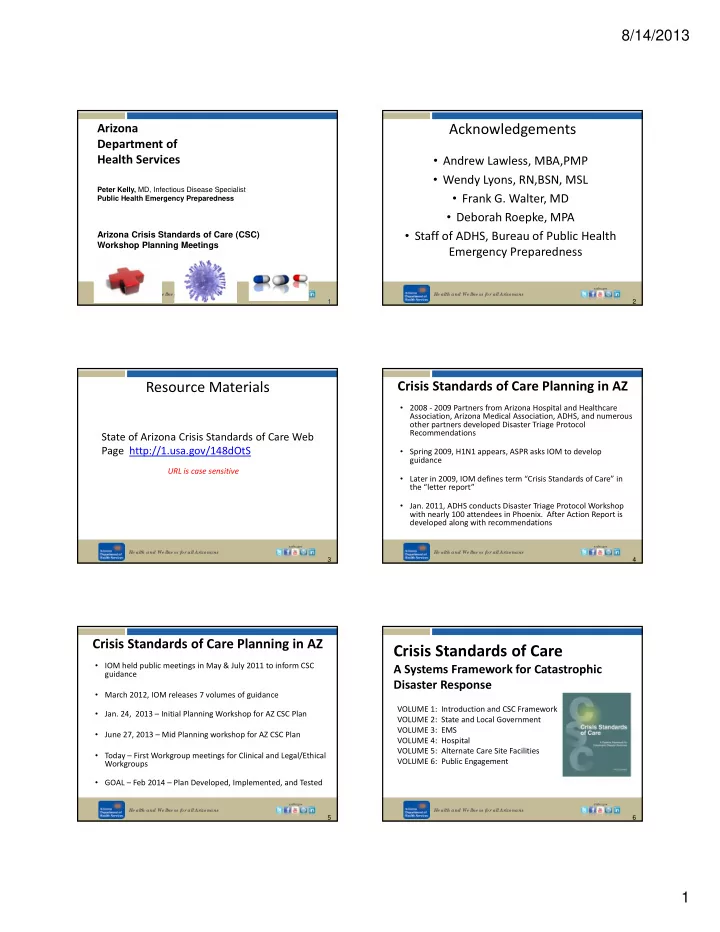
Crisis Standards of Care Planning in AZ

5

  • IOM held public meetings in May & July 2011 to inform CSC

guidance

  • March 2012, IOM releases 7 volumes of guidance
  • Jan. 24, 2013 – Initial Planning Workshop for AZ CSC Plan
  • June 27, 2013 – Mid Planning workshop for AZ CSC Plan
  • Today – First Workgroup meetings for Clinical and Legal/Ethical

Workgroups

  • GOAL – Feb 2014 – Plan Developed, Implemented, and Tested

He alth and We llne ss for all Ar izonans

azdhs.gov

Crisis Standards of Care

A Systems Framework for Catastrophic Disaster Response

6

VOLUME 1: Introduction and CSC Framework VOLUME 2: State and Local Government VOLUME 3: EMS VOLUME 4: Hospital VOLUME 5: Alternate Care Site Facilities VOLUME 6: Public Engagement

slide-2
SLIDE 2

8/14/2013 2

He alth and We llne ss for all Ar izonans

azdhs.gov

What are Crisis Standards of Care?

7

He alth and We llne ss for all Ar izonans

azdhs.gov

Catastrophic Disaster Defined

8

1) Most or all of the community’s infrastructure is impacted. 2) Local officials are unable to perform their usual roles for a period of time extending well beyond the initial aftermath of the incident 3) Most or all routine community functions are immediately and simultaneously disrupted 4) Surrounding communities are similarly affected, and thus there are no regional resources

(IOM, Introduction and CSC Framework 1‐15)

He alth and We llne ss for all Ar izonans

azdhs.gov

CSC Assumptions

for catastrophic disaster response conditions:

9

  • Resources are unavailable or undeliverable to HC facilities
  • Similar strategies being invoked by other healthcare delivery

systems

  • Patient transfer not possible
  • Access to medical countermeasures (vaccine, meds,

antidotes, blood) likely to be limited

  • Available local, regional, state, federal resource caches

(equip, supplies, meds) have been distributed‐ no short term resupply

(IOM, Crisis Standards of Care, 1‐10)

He alth and We llne ss for all Ar izonans

azdhs.gov

Examples

  • 1918 pandemic influenza

– ~500 million infected – 50‐100 million fatalities – 3‐5% of world population

  • Hiroshima and Nagasaki bombings

– 140,000 to 246,000 fatalities – Two cities destroyed

  • In both cases recovery occurred

He alth and We llne ss for all Ar izonans

azdhs.gov

Five Key Elements for all CSC Plans

11

  • A strong ethical grounding… based transparency,

consistency, proportionality, and accountability

  • Integrated and ongoing community and provider

engagement, education, and communication

  • The necessary legal authority and legal environment in

which CSC can be ethically and optimally implemented

  • Clear indicators, triggers, and lines of responsibility
  • Evidence‐based clinical processes and operations

He alth and We llne ss for all Ar izonans

azdhs.gov

Principles of CSC

(Crisis Standards of care, 7‐1,7‐2)

  • Prioritize population health
  • Respect ethical principles
  • Liability protection for health care

practitioners and institutions

  • Triage models for allocation of scarce

resources

  • Formal recognition of catastrophic disaster

enables specific legal authority

slide-3
SLIDE 3

8/14/2013 3

13

He alth and We llne ss for all Ar izonans

azdhs.gov

Community and Health Care Resource Use

prioritize population health rather than individual

  • utcomes

Resources People

Well Outpatient care Usual hospital care Intensive care

He alth and We llne ss for all Ar izonans

azdhs.gov

Goal of Crisis Standard of Care Plans

  • Distribute scarce health care resources across

the whole community in a fair and ethical manner so that we do the most good for the most people.

15

He alth and We llne ss for all Ar izonans

azdhs.gov

Legal Work Group Charter

  • Purpose: Address legal barriers for provision of optimal and

ethical care

  • Goals: Identify legal and regulatory barriers to a health care

provider’s ability to provide care during a catastrophic emergency

  • Identify specific statues and regulations that need a waiver by

the Governor using an emergency proclamation or executive

  • rder
  • State an ethical framework for a paradigm shift from personal

care to community care

He alth and We llne ss for all Ar izonans

azdhs.gov

Emergency Declarations

Applying Arizona Law to Public Health Emergencies; Aubrey Joy Corcoran, AZ Attorney General

  • Declared state of emergency or state of war

emergency with occurrence of imminent threat of illness

  • Arizona Dept. of Health Services coordinates

public health emergency response

  • ARS title 36, Chapter 6, Article 9

He alth and We llne ss for all Ar izonans

azdhs.gov

Emergency Powers

Applying AZ Law to Public Health Emergencies, Aubrey Joy Corcoran, AZ Attorney

  • Governor has complete authority over State agencies

and has the right to exercise all police powers vested in the State

  • Public Health Emergency Governor in consultation

with ADHS Director may:

– Mandate medical examinations of exposed persons – Ration medicines and vaccines – Transport medical support personnel and ill or exposed persons – Provide for procurement of medicine and vaccines

slide-4
SLIDE 4

8/14/2013 4

He alth and We llne ss for all Ar izonans

azdhs.gov

Professional Licensure

Applying AZ Law to Public Health Emergencies; Aubrey Joy Corcoran, AZ Attorney General

  • Person holding a professional license issued by

another state may render professional aid as if the license had been issued in this state. (ARS 26‐310)

  • Pharmacist licensed in another state may

dispense prescription medications during a declared emergency (ARS 32‐1910)

He alth and We llne ss for all Ar izonans

azdhs.gov

Expanded Scope of Practice During a State of Emergency

  • Persons licensed as RN, PA, NP, Pharmacists

could provide professional services beyond current scope of practice

  • Specific services, additional training,

supervision requirement, liability protection?

He alth and We llne ss for all Ar izonans

azdhs.gov

Liability Protections

Applying AZ Law to Public Health Emergencies; Aubrey Joy Corcoran, AZAttorney General

  • Public Health Emergency

– Any person taking an action required by law is immune from civil and criminal liability – Action presumed to be in good faith – State of emergency immunities under ARS 26‐314 also available

  • ARS 26‐402

He alth and We llne ss for all Ar izonans

azdhs.gov

Liability Protections 2

  • State of Emergency

– State and political subdivisions immune from claims based

  • n acts of emergency workers

– Emergency workers responsibilities, immunities and workers compensation benefits as state or subdivision agents and employees performing similar work

  • State and political subdivisions must provide liability

coverage including legal defense of emergency workers

He alth and We llne ss for all Ar izonans

azdhs.gov

Liability Protection 3

Applying AZ Law to Public Health Emergencies; Aubrey Joy Corcoran, AZ Attorney

  • There is no protection for willful misconduct,

gross negligence or bad faith.

  • Absent legislative action health care

institutions cannot be insulated from liability

He alth and We llne ss for all Ar izonans

azdhs.gov

For Discussion

  • Liability for health care institutions
  • Temporary waivers of health care institutions
  • Expanded scope of practice
slide-5
SLIDE 5

8/14/2013 5

He alth and We llne ss for all Ar izonans

azdhs.gov

Ethical Framework of CSC

(Crisis Standards of Care 1‐72)

  • Groups at risk are most vulnerable during a
  • disaster. Sound planning will secure equivalent

resources for at risk‐ groups.

  • When CSC prevail health care providers must

adhere to ethical and professional norms. Conditions may limit autonomous choices but do not permit actions that violate ethical norms

He alth and We llne ss for all Ar izonans

azdhs.gov

Key Features of Ethical Framework

(Crisis Standards of Care 1‐72 to 1‐78)

  • Fairness
  • Duty to care
  • Duty to steward resources
  • Transparency
  • Consistency
  • Proportionality
  • Accountability