Crisis Standards of Care: State of Arizona Clinical Workgroup Agenda - - PDF document

crisis standards of care
SMART_READER_LITE
LIVE PREVIEW

Crisis Standards of Care: State of Arizona Clinical Workgroup Agenda - - PDF document

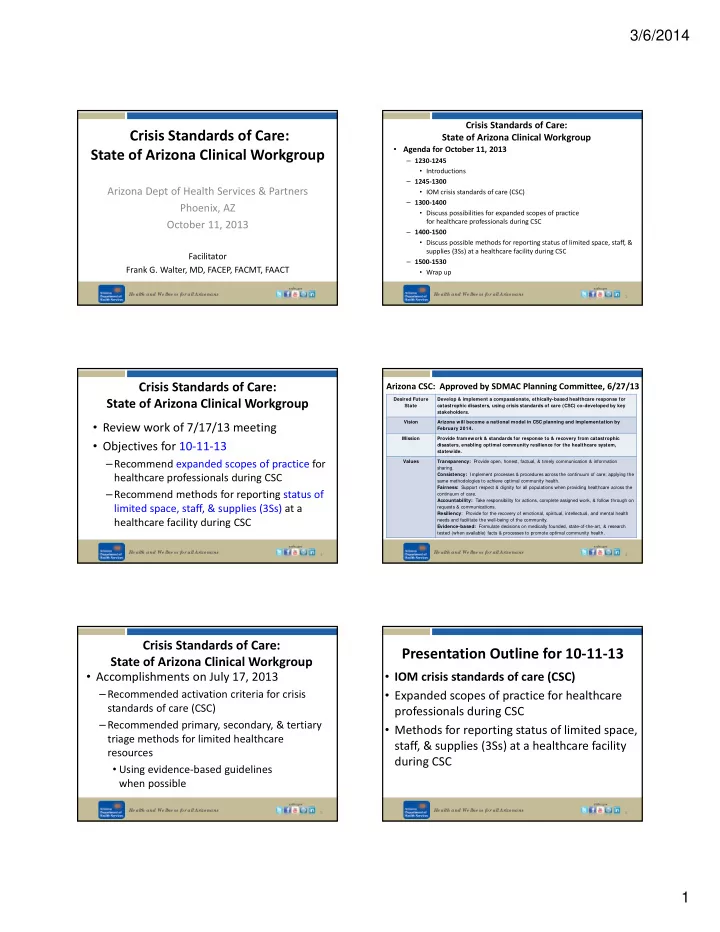
3/6/2014 Crisis Standards of Care: Crisis Standards of Care: State of Arizona Clinical Workgroup Agenda for October 11, 2013 State of Arizona Clinical Workgroup 1230 1245 Introductions 1245 1300 Arizona Dept of Health


slide-1
SLIDE 1

3/6/2014 1

He alth and We llne ss for all Ar izonans

azdhs.gov

Crisis Standards of Care: State of Arizona Clinical Workgroup

Arizona Dept of Health Services & Partners Phoenix, AZ October 11, 2013

Facilitator Frank G. Walter, MD, FACEP, FACMT, FAACT

He alth and We llne ss for all Ar izonans

azdhs.gov

Crisis Standards of Care: State of Arizona Clinical Workgroup

  • Agenda for October 11, 2013

– 1230‐1245

  • Introductions

– 1245‐1300

  • IOM crisis standards of care (CSC)

– 1300‐1400

  • Discuss possibilities for expanded scopes of practice

for healthcare professionals during CSC – 1400‐1500

  • Discuss possible methods for reporting status of limited space, staff, &

supplies (3Ss) at a healthcare facility during CSC – 1500‐1530

  • Wrap up

2 He alth and We llne ss for all Ar izonans

azdhs.gov

Crisis Standards of Care: State of Arizona Clinical Workgroup

  • Review work of 7/17/13 meeting
  • Objectives for 10‐11‐13

– Recommend expanded scopes of practice for healthcare professionals during CSC – Recommend methods for reporting status of limited space, staff, & supplies (3Ss) at a healthcare facility during CSC

3 He alth and We llne ss for all Ar izonans

azdhs.gov

Arizona CSC: Approved by SDMAC Planning Committee, 6/27/13

Desired Future State Develop & implement a compassionate, ethically-based healthcare response for catastrophic disasters, using crisis standards of care (CSC) co-developed by key stakeholders. Vision Arizona will become a national model in CSC planning and implementation by February 2014. Mission Provide framework & standards for response to & recovery from catastrophic disasters, enabling optimal community resilience for the healthcare system, statewide. Values Transparency: Provide open, honest, factual, & timely communication & information sharing. Consistency: Implement processes & procedures across the continuum of care; applying the same methodologies to achieve optimal community health. Fairness: Support respect & dignity for all populations when providing healthcare across the continuum of care. Accountability: Take responsibility for actions, complete assigned work, & follow through on requests & communications. Resiliency: Provide for the recovery of emotional, spiritual, intellectual, and mental health needs and facilitate the well-being of the community. Evidence-based: Formulate decisions on medically founded, state-of-the-art, & research tested (when available) facts & processes to promote optimal community health. 4 He alth and We llne ss for all Ar izonans

azdhs.gov

Crisis Standards of Care: State of Arizona Clinical Workgroup

  • Accomplishments on July 17, 2013

– Recommended activation criteria for crisis standards of care (CSC) – Recommended primary, secondary, & tertiary triage methods for limited healthcare resources

  • Using evidence‐based guidelines

when possible

5 He alth and We llne ss for all Ar izonans

azdhs.gov

Presentation Outline for 10‐11‐13

  • IOM crisis standards of care (CSC)
  • Expanded scopes of practice for healthcare

professionals during CSC

  • Methods for reporting status of limited space,

staff, & supplies (3Ss) at a healthcare facility during CSC

6

slide-2
SLIDE 2

3/6/2014 2

He alth and We llne ss for all Ar izonans

azdhs.gov

IOM Crisis Standards of Care

  • Seek community & provider engagement

preparing for & during CSC

  • Adhere to ethical norms during CSC
  • Provide necessary legal protections for healthcare

providers & institutions using CSC

  • Ensure intrastate & interstate consistency during

CSC

– Clear indicators, triggers, & lines of responsibility – Evidence‐based clinical processes & operations

7 He alth and We llne ss for all Ar izonans

azdhs.gov

IOM Crisis Standards of Care

  • Substantial change in usual healthcare operations & level of

care

  • Justified by specific circumstances
  • Formally declared by state government

– Scope

  • > Statewide

– May authorize

  • Alternate care sites
  • Alternate staffing levels
  • Expanded scopes of practice
  • Long‐term crisis

8 He alth and We llne ss for all Ar izonans

azdhs.gov

Allocation of Specific Resources along the Care Capacity Continuum

Incident demand/resource imbalance increases Risk of morbidity/mortality to patients increases Recovery Normal Operations Extreme Operations Source: IOM, Crisis Standards of Care, 1‐41

CSC Triggers Conventional Contingency Crisis Space Space fully used Patient care areas repurposed Non‐patient care areas used for patient care Facility may be damaged or unsafe Staff Usual staff called in & working Expanded staff responsibilities Elective procedures & admissions deferred Trained staff unavailable or unable to care for volume of patients Stuff Cached & usual supplies used Conservation, adaptation, & substitution with safe re‐ use of select items Critical items lacking Possible re‐allocation of life‐sustaining resources Standard of Care Unchanged Functionally equivalent care Best possible care in difficult circumstances with limited resources: Requires state empowerment for SDMAC activation, Clinical guidance & protection for triage decisions, & Authorization for alternate care sites He alth and We llne ss for all Ar izonans

azdhs.gov

IOM CSC: 3 Cs

  • Conventional care

– Space, staff, & supplies (stuff) [3Ss] in daily practice

  • Contingency care

– 3Ss not used in daily practice

  • Functionally equivalent patient care

– Patient care areas repurposed – Elective procedures & admissions deferred – Expanded staff responsibilities – Conserve, adapt, & substitute supplies – Safely re‐use select supplies

  • Crisis care

– Adaptive 3Ss not used in daily practice – Best possible care in difficult circumstances with limited resources

10 He alth and We llne ss for all Ar izonans

azdhs.gov

Presentation Outline for 10‐11‐13

  • IOM crisis standards of care (CSC)
  • Expanded scopes of practice for healthcare

professionals during CSC

  • Methods for reporting status of limited space,

staff, & supplies (3Ss) at a healthcare facility during CSC

11 He alth and We llne ss for all Ar izonans

azdhs.gov

Scope of Practice

  • Definition

– Extent of licensed healthcare professional’s ability to provide services consistent with their

  • Competence
  • License
  • Certification
  • Privileges

Source: IOM, Crisis Standards of Care, 1-41 & 7-4

slide-3
SLIDE 3

3/6/2014 3

He alth and We llne ss for all Ar izonans

azdhs.gov

Scopes of Practice

  • EMTs
  • Nurses

– NA, LPN, RN – APN, CNS, NP – RNFA, Nurse Anesthetist

  • Pharmacists
  • Physicians
  • Physician’s Assistants
  • Psychologists

He alth and We llne ss for all Ar izonans

azdhs.gov

Scopes of Practice

  • Healthcare providers should practice in

interprofessional teams, practicing to the top

  • f their licenses.

– Thomas R. Frieden, MD, MPH – Head of the U.S. Centers for Disease Control and Prevention (CDC)

He alth and We llne ss for all Ar izonans

azdhs.gov

Scopes of Practice

  • Possibilities

– Limited licensure reciprocity

  • Recognize out‐of‐state healthcare licenses for the duration of a healthcare crisis

– EMS expanded scopes of practice

  • Altered staffing ratios
  • Alternate destination policies or vehicles
  • Treat & release
  • Hospital evacuation
  • Vaccine administration
  • New tasks with just‐in‐time training

– In addition to prior preparedness training

  • New practice settings or durations

– Clinics – Hospitals, etc.

He alth and We llne ss for all Ar izonans

azdhs.gov

Scopes of Practice

  • Possibilities

– Non‐EMS expanded scopes of practice

  • Relaxed documentation requirements
  • New, external staff
  • New tasks with just‐in‐time training, in addition to

prior preparedness training

– Minimum risks – Maximum population benefits

  • New practice settings or durations

– Clinics – Units, etc.

He alth and We llne ss for all Ar izonans

azdhs.gov

Colorado Legislation: Emergency Medical & Trauma Services Act

  • Allows physicians assistants (PAs) & EMTs to practice

under the supervision of any licensed Colorado physician

  • Allows for out‐of‐state physicians & nurses with

licenses in good standing & Colorado physicians & nurses with inactive, unrestricted Colorado licenses to

– Practice under the supervision of a licensed Colorado physician or nurse

He alth and We llne ss for all Ar izonans

azdhs.gov

Arizona Board of Nursing

  • Governs all nursing practice
  • Nursing practice legislated & reflected in

rules & regulations

  • Advisory opinions issued for extended

practice

slide-4
SLIDE 4

3/6/2014 4

He alth and We llne ss for all Ar izonans

azdhs.gov

Advisory Opinion

  • Adopted by the Arizona Board of Nursing,

interpreting what the law requires.

– While not law, it is more than a recommendation. – Official opinion of Arizona Board of Nursing regarding practice of nursing relating to a specific standard of care. – ARS 32‐1606 (A) (2)

He alth and We llne ss for all Ar izonans

azdhs.gov

Advisory Opinions Issued

  • Analgesia by catheter techniques

– Intrathecal – Perineural – Interpleural

  • Epidural anesthesia
  • Bone aspiration & biopsy
  • Central line insertion
  • Removing mediastinal & pleural chest tubes

He alth and We llne ss for all Ar izonans

azdhs.gov

Presentation Outline for 10‐11‐13

  • IOM crisis standards of care (CSC)
  • Expanded scopes of practice for healthcare

professionals during CSC

  • Methods for reporting status of limited

space, staff, & supplies (3Ss) at a healthcare facility during CSC

21 He alth and We llne ss for all Ar izonans

azdhs.gov

Limited Space, Staff, & Stuff (3Ss) for CSC

  • Space

– Hospitals – Intensive care units (ICUs)

  • Staff

– Healthcare professionals

  • Suggestions?
  • Source

– IOM, Crisis Standards of Care, 7‐15

  • Stuff

– Medical transportation – Medications – Airway & breathing

  • Oxygen & oxygen delivery systems
  • Ventilators
  • Extracorporeal membrane oxygenation (ECMO)

– Cardiovascular

  • Vascular access devices
  • IV fluids
  • Blood products

– Elimination

  • Renal replacement therapy

– Wound/burn care supplies – Surgical equipment

He alth and We llne ss for all Ar izonans

azdhs.gov

Methods for Reporting Status of Limited Space, Staff, & Stuff (3Ss) at Healthcare Facilities

  • Notify County

– Health Department – Emergency Management

  • EMResource

– Proprietary tool used by ADHS – HAvBED (Have Available Bed in Emergencies & Disasters)

  • Federal bed poles & situational assessments, e.g., H1N1
  • ADHS Division of Licensing Services

– Waiver requests

  • Arizona Burn Disaster Network Telemedicine Program
  • Poison Control Centers

– 1‐800‐222‐1222

  • Suggestions?

He alth and We llne ss for all Ar izonans

azdhs.gov

Special Resources for Space, Staff, & Stuff (3Ss) for CSC

  • EMS
  • Trauma Centers
  • Arizona Burn Center
  • Pediatric Hospitals
  • Arizona Infectious Disease Referral Centers
  • Radiation Injury Treatment Network
  • Poison control centers
  • Clinics & mental health agencies
  • Dialysis facilities
  • Long‐term care facilities
  • Home healthcare agencies
  • Hospice
  • Public health departments
  • Suggestions?
slide-5
SLIDE 5

3/6/2014 5

He alth and We llne ss for all Ar izonans

azdhs.gov

Acknowledgements

  • Antonio Hernandez
  • Megan Jehn, PhD, MHS

– Coauthor & co‐presenter

  • Considerations For Prioritizing Medical Care During an Overwhelming

Influenza Pandemic

  • Peter Kelly, MD
  • Andrew Lawless, MBA, PMP
  • Wendy H. Lyons, RN, BSN, MSL
  • Ruth E. Penn, MBA
  • Deborah Roepke, MPA

25 He alth and We llne ss for all Ar izonans

azdhs.gov

Acknowledgements

  • Thank you!

– To all members of the State of Arizona Clinical Workgroup for Crisis Standards of Care, for your

  • Time
  • Dedication
  • Service
  • Expertise
  • Resource Materials

– ADHS BPHEP Crisis Standards of Care (CSC) Project

  • http://1.usa.gov/148dOtS

URL is case sensitive

26 He alth and We llne ss for all Ar izonans

azdhs.gov

Questions & Suggestions

He alth and We llne ss for all Ar izonans

azdhs.gov

Crisis Standards of Care: State of Arizona Clinical Workgroup

Arizona Dept of Health Services & Partners Phoenix, AZ October 11, 2013

Facilitator Frank G. Walter, MD, FACEP, FACMT, FAACT