CREATING OPEN-ENDED Think of an essential topic you will PROJECTS - - PowerPoint PPT Presentation

creating open ended
SMART_READER_LITE
LIVE PREVIEW

CREATING OPEN-ENDED Think of an essential topic you will PROJECTS - - PowerPoint PPT Presentation

Creating Open-Ended Projects in Middle School Mathematics 4/27/2012 Prelude CREATING OPEN-ENDED Think of an essential topic you will PROJECTS IN MIDDLE SCHOOL cover in your classroom next year MATHEMATICS Keep that topic in mind as we


slide-1
SLIDE 1

Creating Open-Ended Projects in Middle School Mathematics 4/27/2012 hcarmody@parktudor.org 1

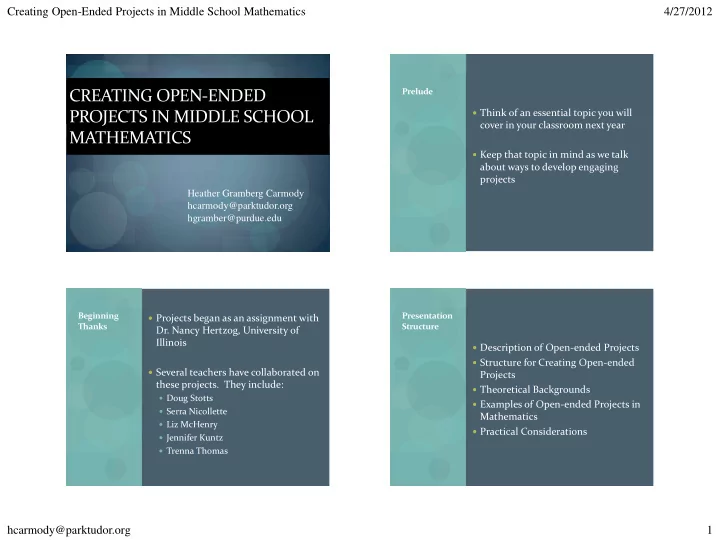
CREATING OPEN-ENDED PROJECTS IN MIDDLE SCHOOL MATHEMATICS

Heather Gramberg Carmody hcarmody@parktudor.org hgramber@purdue.edu

 Think of an essential topic you will

cover in your classroom next year

 Keep that topic in mind as we talk

about ways to develop engaging projects

Prelude  Projects began as an assignment with

  • Dr. Nancy Hertzog, University of

Illinois

 Several teachers have collaborated on

these projects. They include:

 Doug Stotts  Serra Nicollette  Liz McHenry  Jennifer Kuntz  Trenna Thomas

Beginning Thanks  Description of Open-ended Projects  Structure for Creating Open-ended

Projects

 Theoretical Backgrounds  Examples of Open-ended Projects in

Mathematics

 Practical Considerations Presentation Structure

slide-2
SLIDE 2

Creating Open-Ended Projects in Middle School Mathematics 4/27/2012 hcarmody@parktudor.org 2

Reference for Related Article

Carmody, H. G. (2010). Water bottle designs and measures. Mathematics Teaching in the Middle School, 16 (5), 272-277.

What are Open-ended Projects?

 Ill-structured assignments that require creativity

to finish

 A form of learning activities and authentic

assessment

 A way to build differentiation into a general

assignment

What is the purpose of an Open-ended Project?

Application of academic concepts to real life situations

Movement beyond basic skills and to explore meaningful applications

Encourage independence and autonomy

Require students to reflect upon and refine their work

Where have they been used?

 Seventh grade classrooms  Large public schools with ≈30 students per class  Small private school with ≈15 students per class  Wide range of abilities  Culturally and linguistically diverse settings  Other settings (rural, urban and suburban) by

  • ther teachers
slide-3
SLIDE 3

Creating Open-Ended Projects in Middle School Mathematics 4/27/2012 hcarmody@parktudor.org 3

How do they fit with school curriculum?

 Designed to complement daily lessons  Students work in class and at home  Projects typically take 2 to 3 weeks to complete  Seven Design Components

 Content Components  Supportive Instructional Components

 Questions to Develop New OMPs Structure for Creating OMPs

Content Components

1.

Extensive mathematical computation

  • 2. Algebraic notation
  • 3. Written expression
  • 4. Visual or graphic representation

(Carmody, 2010)

Supportive Instructional Components

  • 5. Project proposal
  • 6. Peer collaboration
  • 7. Reflection and self-evaluation

(Carmody, 2010)

slide-4
SLIDE 4

Creating Open-Ended Projects in Middle School Mathematics 4/27/2012 hcarmody@parktudor.org 4

Questions to Create an OMP

 What topic is essential to the curriculum?  What are some meaningful and real world

applications of this topic?

 What applications are appropriate for students of

this age and level of mastery?

 How can I include the different components?

Questions to Create an OMP

 What choices can I offer in terms of content or

product?

 What resources will students need for the project?  What amount of time will students need to produce

quality work? How can I structure a timeline that allows for creativity and rigor?

 Are there adequate opportunities for differentiation to

accommodate various student needs?

 Does this project encourage a deeper understanding of

mathematics than students would otherwise have?

 Recommendations for Students  Recommendations for Classrooms  Recommendations for Teachers  Recommendations for Assessment Justification from Educational Research

Recommendations for Students (gifted and beyond)

 Depth of application (Hirsch and Weinhold, 1999)  Opportunities to reflect upon and refine their

work (Koshy, 2001)

 Opportunity to discuss their thinking with peers

and adults (Hirsch and Weinhold, 1999)

 Differentiation in terms of content, process and

product (VanTassel-Baska, & Stambaugh, 2006)

slide-5
SLIDE 5

Creating Open-Ended Projects in Middle School Mathematics 4/27/2012 hcarmody@parktudor.org 5

Recommendations for the Classroom

 “Challenge students with rich problems that

encourage deep exploration” (Warshauer et al., 2010)

 Provide opportunities to demonstrate giftedness

(Koshy, 2001)

 Move past “unimportant knowledge” (Renzulli,

1982)

Recommendations for Teachers

 Provide time to let ideas develop and form

(Hadamard, 1945)

 Provide the chance for “responsible risk taking”

(Costa, 2001)

 Emphasize independence, and favor flexibility over

structure or chaos (Wheatley, 1999)

 Provide students support to move beyond the familiar

into areas of challenge and creativity (Mann, 2006)

Recommendations for Assessment

 “assessment [should] be an integral part of

teaching” (Zemelman, Daniels and Hyde, 1998, pg. 105)

 Assessment can have “a significant role in the

learning process” (Taylor, 2009)

 Rate and Ratio Project  Water Bottle Project  Project “flops”  A few warnings Examples

slide-6
SLIDE 6

Creating Open-Ended Projects in Middle School Mathematics 4/27/2012 hcarmody@parktudor.org 6

Targeted Concepts  Rates  Unit Rates  Ratios  Proportions  Dimensional Analysis  Researched starting

fact

 Seven equivalencies

with at least two visualizations

 Poster or PowerPoint

Rate and Ratio OMP

Required Components

Rate and Ratio OMP Student Materials

 Project Assignment  Grading Rubric

Rate and Ratio OMP Examples

 Amanda – Gasoline Consumption  Sean – Professional Athlete’s Salary  Caven – Chewing Gum Targeted Concepts  Volume  Surface Area  Solving for Unknown

Quantities

 Relationship between

2-D patterns and 3-D

  • bjects

 Table with three

proposals

 Flat pattern or

prototype of favorite design

 Writing to persuade

  • thers that their design

is best

Water Bottle OMP

Required Components

slide-7
SLIDE 7

Creating Open-Ended Projects in Middle School Mathematics 4/27/2012 hcarmody@parktudor.org 7

Water Bottle OMP Student Material

 Assignment Sheet  Grid for 3 proposals  Grading Rubric

Water Bottle OMP Examples OMPs that Did Not Work

 Story Project  Menu Project took a few years to refine

Small Warnings

 Start small – a goal of 4 Open-ended Projects per

year is very reasonable

 Construct your grading rubric ahead of time  After completing the project, ask for student

  • pinions. My projects are always evolving.
slide-8
SLIDE 8

Creating Open-Ended Projects in Middle School Mathematics 4/27/2012 hcarmody@parktudor.org 8

Through NCTM resources  Bibliography  OMP Components  Questions to Develop

OMP

 Presentation Slides

 OMPs

 Water Bottle  Rate and Ratio  Spreadsheet  Integer Game  Menu  Transformations  Surveys

 Examples of student work

Resources

By email request

Contact Information

Heather Gramberg Carmody hcarmody@parktudor.org Or hgramber@purdue.edu