CREATING A NATIVE VEGETATION INSECTARIUM Putting research into - - PowerPoint PPT Presentation

creating a native vegetation insectarium
SMART_READER_LITE
LIVE PREVIEW

CREATING A NATIVE VEGETATION INSECTARIUM Putting research into - - PowerPoint PPT Presentation

CREATING A NATIVE VEGETATION INSECTARIUM Putting research into practice with an on-farm trial site This project is supported by the PPWCMA, through funding from the Australian Governments National Landcare Programme The multiple benefits of


slide-1
SLIDE 1

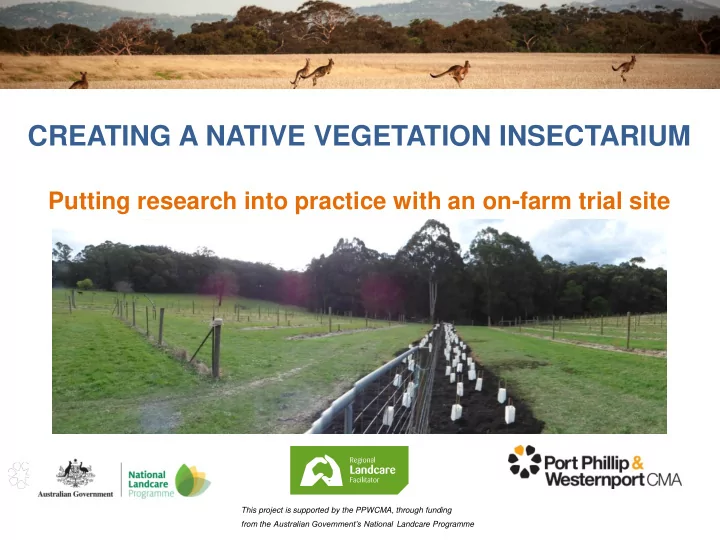
CREATING A NATIVE VEGETATION INSECTARIUM

Putting research into practice with an on-farm trial site

This project is supported by the PPWCMA, through funding from the Australian Government’s National Landcare Programme
slide-2
SLIDE 2
slide-3
SLIDE 3
slide-4
SLIDE 4

The multiple benefits of having native vegetation

  • n your farm
  • Shelterbelt
  • Habitat and food source for insects- (insectariums, beetle

banks, insect corridors)

  • Biodiversity values (consider offsets in planning applications)
  • Meet obligations in Environmental Assurance programs
  • Bush Food production- income diversification
slide-5
SLIDE 5
  • 1. Biodiversity Interactive Map: Look up the relevant Ecological Vegetation Class (EVC)

for your property Weblink: http://mapshare2.dse.vic.gov.au/MapShare2EXT/imf.jsp?site=bim

slide-6
SLIDE 6

Step 2: Zoom in to the area you are looking at. I select a scale of 1:10,000 or 1:20,000 depending on how much information is needed. Step 3: Click on the yellow folder and turn on the 2005 EVC layer. Then refresh the map.

slide-7
SLIDE 7
slide-8
SLIDE 8
slide-9
SLIDE 9

Click on legend to bring up the map key for each EVC

slide-10
SLIDE 10

Click on the pdf icon and fill out the

  • details. Click OK. A hyperlink with
  • pen map will appear. Click on the

link

slide-11
SLIDE 11
slide-12
SLIDE 12

http://www.depi.vic.gov.au/environment-and-wildlife/biodiversity/evc- benchmarks#bioregionname From this web link, you can scroll down past the bioregion map to a table which lists each of these bioregions and hyperlinks to their EVC

  • benchmark. Below is the Highlands-

Southern Fall as Yellingbo is in this bioregion. Open the word or pdf file. Look up the relevant EVC numbers listed in your property EVC Map.

slide-13
SLIDE 13

http://www.mapimage.net/IntraMaps75/ApplicationEngine/Application.aspx?project=Yarr a+Ranges&configId=bf9bd338-12aa-43f2-95aa-a491de0b3a8d Type in an address then click on the Indigenous Vegetation Community List to obtain EVC plant lists specific to that address!

slide-14
SLIDE 14

Look for plants which you have seen featured in the research as appropriate insectarium species Quite a few relevant EVC’s have bush foods, you just need to know what you are looking for Plant a mix of EVC plants depending on the layout

  • f your insectarium

The more plant diversity and layers, the better the habitat for diverse beneficial insects

slide-15
SLIDE 15

CUSTOMISED SITE PLANTING GUIDE Using the EVC list you have for the property, start to highlight plants you know are highly beneficial in an insectarium: Sweet bursaria, wallaby grass, prickly tea-tree are the three HERO plants What else is on your list that matches your planting space/layout and will provide nectar and pollen? Shelterbelt- Upper and Middle story flowering plants Insectary plants- HERO plants and similar ones found in your EVC. Make sure there is diversity in your strata layers and include groundcovers. The customised list for Fieldberberry Farm is available at: http://www.ppwcma.vic.gov.au/news/publications/ NB: this is specific to this farm and is a GUIDE only.

slide-16
SLIDE 16
slide-17
SLIDE 17
  • Upper story (shelterbelt)- E. olida
  • Middle story- (shelterbelt)- Bursaria spinosa, Prostanthera lasianthos
  • Lower story- grevillea, Acacia, correa sp, round leaf mint bush, parrot pea, bush

pea, heath, daisy, honeypots, river mint, lilies, grasses

  • Groundcovers- native violet, running postman, pussytails, muntries etc
slide-18
SLIDE 18
slide-19
SLIDE 19
slide-20
SLIDE 20
slide-21
SLIDE 21
slide-22
SLIDE 22
slide-23
SLIDE 23
slide-24
SLIDE 24
slide-25
SLIDE 25
slide-26
SLIDE 26

Your insectarium layout can be any design you like

  • Grasses under vine or inter-row, end of row strainer posts
  • Surrounding a dam
  • Land class zoned unsuitable for production
  • Garden beds
  • Headlands, buffers and re-vegetated shelterbelts

It’s about insect corridors and connectivity to native vegetation

slide-27
SLIDE 27

Acacia suevolens Heath Mentha australis Kunzea pomifera * Grevillea rosmanifolia Themeda triandra Euc olida (strawberry gum) * Native grasses

Wallaby, Weeping and Spear)

slide-28
SLIDE 28

Is it working?

  • Spring in Victoria hasn’t been kind if you want to monitor insects!

10 sticky traps, one week (7 days) each month Sept-Jan 3 pit fall traps in the main insectary planting, one week each month Sept-Jan Monitoring for increases in abundance and diversity of beneficial insects over next 2 years, longer if my RLF project is re-funded!

slide-29
SLIDE 29

Is it working?

  • Spring in Victoria hasn’t been kind if you want to monitor insects!
  • However, 7 weeks after planting, some native plants were already flowering

and spiders moving in to the insectary

slide-30
SLIDE 30

How much did it cost?

Insectarium Costs- indicative start-up costs for any property EXPENSE ITEM COST CALCULATION COMMENTS native indigenous plants x380 760 based on tubestock prices averaging $2 each 60m row x 2m wide, some indiegnous nurseries are cheaper, commerical nurseries more expensive Eucalypt windbreak (optional) x 10 plants 20 based on tubestock prices averaging $2 each some indiegnous nurseries are cheaper, commerical nurseries more expensive tree guards x 380 342based on .90c/tree guard and stakes bulk buy sticky traps x90 34optional for IPM monitoring IPM monitoring (optional) 1500$30/trap. Optional monitoring Baseline September 1 week x 10 traps. Oct-Jan (4 months). 10 traps over a week x 4 weeks (one analysis/month) = 50 traps total IPM monitoring (optional) 360$30/pitfall trap 3 traps in main insectarium $90 each analysis x 4 months snap lock bags & postage for sticky traps 60approx. post to Melb Uni Mulch 200050m3 variable depending on product used, amount required, transport distance and hire of a spreader TOTAL 5076 without IPM monitoring 3216