SLIDE 1 ALASKA GEOSPA TIAL COUNCIL
February 23, 2018
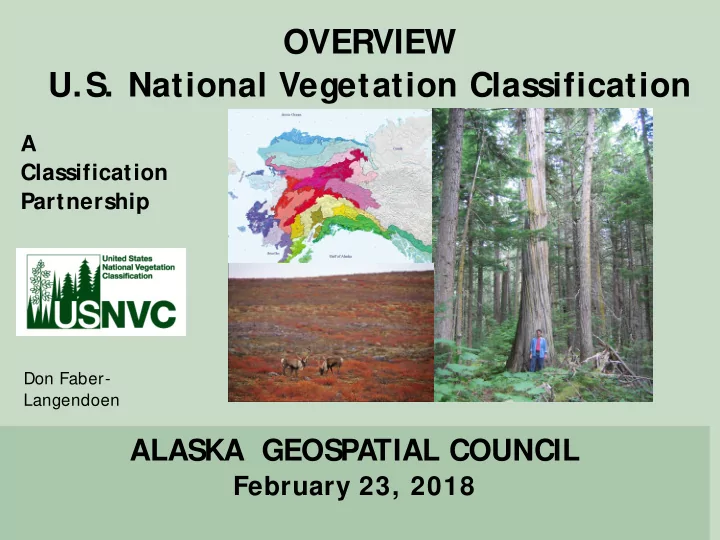
A Classification Partnership
OVERVIEW U.S. National Vegetation Classification
Don Faber- Langendoen
SLIDE 2
Vegetation classification is the process of grouping stands (ecosystem locations) based on shared vegetation and ecological characteristics. As with any taxonomy, vegetation classification is used to simplify the complex patterns of ecosystems in order to communicate and share information.
USNVC: An Ecological Vegetation Classification
SLIDE 3 S
t andards for veget at ion dat a collect ion and analysis
Facilit at e int er-agency collaborat ion and product
consist ency
Est ablish nat ional set of st andards for classifying
exist ing veget at ion
Fost er syst emat ic veget at ion classificat ion for t he U.S
.
Develop minimum met adat a requirement s Collaborat e bet ween st at e, federal and int ernat ional
effort s
SLIDE 4 U.S . Forest S ervice: Lead Agency, Chair
SLIDE 5 CANADIAN NATIONAL VEGETATION CLASSIFICATION A classification for all the natural and semi-natural vegetation in Canada. INTERNATIONAL VEGETATION CLASSIFICATION A classification of global
- vegetation. Best developed
in the Americas and Africa.
SLIDE 6
- A large number of states helped the USNVC
- Many directly use the USNVC as their state classification
- Most have direct access to USNVC information - Natural
Heritage Network / USNVC Classification Database (Biotics 5)
SLIDE 7
USNVC Standard: Guides classification development
SLIDE 8 First Release of USNVC 2.0: February 2016
http://www.esa.org/esa/national-vegetation-classification-press-release/
SLIDE 9 A great need t o syst emat ically invent ory, classify, and
map t he incredible diversit y of ecosyst ems on Eart h in t he face of ever int ensifying land uses and changing landscapes.
The implicat ions for biodiversit y, ecological processes,
and ecosyst em services are profound, as hist oric nat ural syst ems are degraded, or replaced by novel ecosyst ems.
SLIDE 10
SLIDE 11 Cult ural Veget at ion Ruderal and Nat ive Veget at ion
Forest Plantations Natural Forests Orchards and Treed Lawns
Apple orchard (Empire) Douglas fir plantation (40 yr) Beech - maple forest, partially logged
SLIDE 12 NVC Hierarchy – Natural Vegetation
General, Dominant Growth Forms Dominant/ codominant and diagnostic species Multi-layer Diagnostic species and local environmental conditions
http://usnvc.org/data-standard/natural-vegetation-classification/
SLIDE 13
From: Viereck et al. 1992
SLIDE 14
Jorgensen and Meidinger 2015
SLIDE 15
Jorgensen and Meidinger 2015
SLIDE 17
The NVC Standard “presents a process standard to be
used to create a dynamic content standard for all vegetation types in the classification.” (FGDC 2008, p.1).
Ongoing improvement of the USNVC is based on new
information or analyses, assessed through a peer review process maintained by ESA Vegetation Panel.
At all times, there is an authoritative, standard
classification available to users (posted on usnvc.org).
SLIDE 18
- 1. Maintain Dynamic Content
- 2. Submit Proposals:
- Field Data
- Literature
- 3. Review Proposals
- 4. Publish Updates
- 5. Maintain
Supporting Data
USGS NatureServe Ecological Society of America Vegetation ecologists
SLIDE 19 Region Regional Editor
WEST
Warm Desert Este Muldavin Californian Todd Keeler-Wolf Great Basin Marion Reid Vancouverian (Pacific Coastal) Del Meidinger (CA) / Beth Schulz (US) Rocky Mountain Jack Triepke
GREAT PLAINS
Great Plains Bruce Hoagland
EAST
Laurentian-Acadian Don Faber-Langendoen Central Interior-Midwest Shannon Menard Appalachian-Northeast Lesley Sneddon Southeast Coastal Plain Alan Weakley
CARIBBEAN
Caribbean Fito (Humfredo) Marcano
BOREAL
Boreal Alaska TBD (US) / Ken Baldwin (CA)
ARCTIC
Arctic (& alpine) Alaska Scott Guyer (US) / TBD (CA)
POLYNESIA
Hawaii TBD
place
submission t ool ready March 2018
for soft ware development
SLIDE 20 Scope
- Editorial Notes will be relatively short, editorial
improvements to existing type concepts in the US NVC.
- changes typically handled directly by the NVC Review
Board.
- Revision Articles published in US
NVC Proceedings:
- substantially revise existing type concepts or propose new type
- concepts. Articles are similar to j ournal articles.
- Methods, Data, and Best Practices discussions of sampling
methods, data gaps, or best practices when analyzing data).
SLIDE 21
SLIDE 22 Alaska
4 5 8 8 32 702 (46)3 (113)3
2in review 3in development
SLIDE 23
- Federally-funded veget at ion classificat ion proj ect s must
collect , record, and classify dat a and informat ion in a manner t hat allows ot hers t o “ crosswalk” t heir veget at ion classes t o some level of t he US NVC.
- Descript ions from a given proj ect classificat ion should be
relat able t o descriptions wit hin t he US NVC.
- Field dat a collect ed t o support a federal agency proj ect
should meet t he minimum standards for vegetation data
collection set fort h in t he st andard (http:/ / usnvc.org/ wp-
content/ uploads/ 2011/ 02/ NVCS_V2_FINAL_2008-02.pdf;
- Agencies are free t o use as primary classificat ions t hose t hat
best meet t heir needs.
SLIDE 24 24
FIA PLOT DATA
M007 L
Pine Wo o dla nd M014 L a ure ntia n- Ac a dia n Me sic Ha rdwo o d - Co nife r F
SLIDE 25
ESA Panel 2015
SLIDE 26
NVC is working in a fashion t hat is open, t ransparent and compliant wit h FGDC st andards.
- Meet s missions of federal agencies, ES
A Panel, Nat ureS erve, and part ners.
- A dat a management st ruct ure has been designed:
- considerable increases in efficiency and t urnover,
- considerable decreases in personnel expense, and
- improved dat a access for t he user communit y.
- Need t o assure cont inued viabilit y and increased
usabilit y of VegBank plot dat a archive.
SLIDE 27
www.usnvc.org
THANK YOU!