CPSC 213 2.2.3, 2.3, 2.4.1-2.4.3, 2.6 static base types (e.g., - - PowerPoint PPT Presentation

cpsc 213
SMART_READER_LITE
LIVE PREVIEW

CPSC 213 2.2.3, 2.3, 2.4.1-2.4.3, 2.6 static base types (e.g., - - PowerPoint PPT Presentation

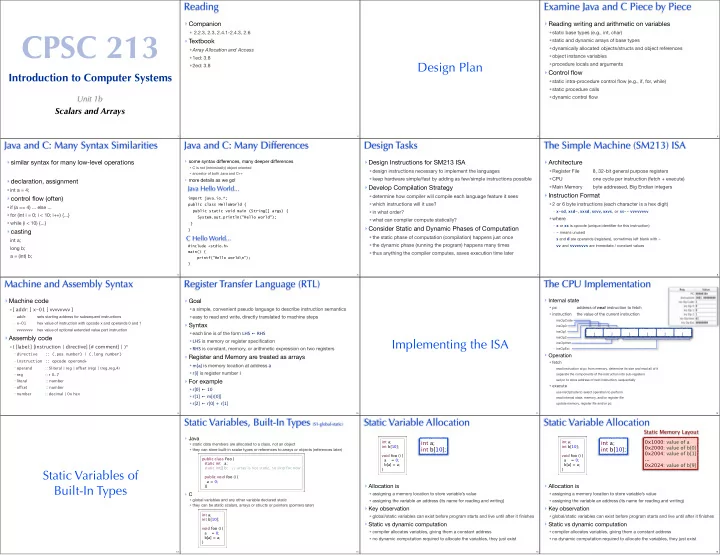
Reading Examine Java and C Piece by Piece Companion Reading writing and arithmetic on variables CPSC 213 2.2.3, 2.3, 2.4.1-2.4.3, 2.6 static base types (e.g., int, char) Textbook static and dynamic arrays of base types


slide-1
SLIDE 1

CPSC 213

Introduction to Computer Systems

Unit 1b

Scalars and Arrays

1

Reading

  • Companion
  • 2.2.3, 2.3, 2.4.1-2.4.3, 2.6
  • Textbook
  • Array Allocation and Access
  • 1ed: 3.8
  • 2ed: 3.8
2

Design Plan

3

Examine Java and C Piece by Piece

  • Reading writing and arithmetic on variables
  • static base types (e.g., int, char)
  • static and dynamic arrays of base types
  • dynamically allocated objects/structs and object references
  • object instance variables
  • procedure locals and arguments
  • Control flow
  • static intra-procedure control flow (e.g., if, for, while)
  • static procedure calls
  • dynamic control flow
4

Java and C: Many Syntax Similarities

  • similar syntax for many low-level operations
  • declaration, assignment
  • int a = 4;
  • control flow (often)
  • if (a == 4) ... else ...
  • for (int i = 0; i < 10; i++) {...}
  • while (i < 10) {...}
  • casting

int a; long b; a = (int) b;

5

Java and C: Many Differences

  • some syntax differences, many deeper differences
  • C is not (intrinsically) object oriented
  • ancestor of both Java and C++
  • more details as we go!

import java.io.*; public class HelloWorld { public static void main (String[] args) { System.out.println("Hello world"); } }

Java Hello World...

#include <stdio.h> main() { printf("Hello world\n"); }

C Hello World...

6

Design Tasks

  • Design Instructions for SM213 ISA
  • design instructions necessary to implement the languages
  • keep hardware simple/fast by adding as few/simple instructions possible
  • Develop Compilation Strategy
  • determine how compiler will compile each language feature it sees
  • which instructions will it use?
  • in what order?
  • what can compiler compute statically?
  • Consider Static and Dynamic Phases of Computation
  • the static phase of computation (compilation) happens just once
  • the dynamic phase (running the program) happens many times
  • thus anything the compiler computes, saves execution time later
7

The Simple Machine (SM213) ISA

  • Architecture
  • Register File

8, 32-bit general purpose registers

  • CPU
  • ne cycle per instruction (fetch + execute)
  • Main Memory

byte addressed, Big Endian integers

  • Instruction Format
  • 2 or 6 byte instructions (each character is a hex digit)
  • x-sd, xsd-, xxsd, xsvv, xxvs, or xs-- vvvvvvvv
  • where
  • x or xx is opcode (unique identifier for this instruction)
  • - means unused
  • s and d are operands (registers), sometimes left blank with -
  • vv and vvvvvvvv are immediate / constant values
8

Machine and Assembly Syntax

  • Machine code
  • [ addr: ] x-01 [ vvvvvvvv ]
  • addr:

sets starting address for subsequent instructions

  • x-01

hex value of instruction with opcode x and operands 0 and 1

  • vvvvvvvv

hex value of optional extended value part instruction

  • Assembly code
  • ( [label:] [instruction | directive] [# comment] | )*
  • directive

:: (.pos number) | (.long number)

  • instruction :: opcode operand+
  • operand

:: $literal | reg | ofgset (reg) | (reg,reg,4)

  • reg

:: r 0..7

  • literal

:: number

  • ofgset

:: number

  • number

:: decimal | 0x hex

9

Register Transfer Language (RTL)

  • Goal
  • a simple, convenient pseudo language to describe instruction semantics
  • easy to read and write, directly translated to machine steps
  • Syntax
  • each line is of the form LHS ← RHS
  • LHS is memory or register specification
  • RHS is constant, memory, or arithmetic expression on two registers
  • Register and Memory are treated as arrays
  • m[a] is memory location at address a
  • r[i] is register number i
  • For example
  • r[0] ← 10
  • r[1] ← m[r[0]]
  • r[2] ← r[0] + r[1]
10

Implementing the ISA

11

The CPU Implementation

  • Internal state
  • pc

address of next instruction to fetch

  • instruction

the value of the current instruction

  • insOpCode
  • insOp0
  • insOp1
  • insOp2
  • insOpImm
  • insOpExt
  • Operation
  • fetch
  • read instruction at pc from memory, determine its size and read all of it
  • separate the components of the instruction into sub-registers
  • set pc to store address of next instruction, sequentially
  • execute
  • use insOpCode to select operation to perform
  • read internal state, memory, and/or register file
  • update memory, register file and/or pc
12

Static Variables of Built-In Types

13

Static Variables, Built-In Types (S1-global-static)

  • Java
  • static data members are allocated to a class, not an object
  • they can store built-in scalar types or references to arrays or objects (references later)
  • C
  • global variables and any other variable declared static
  • they can be static scalars, arrays or structs or pointers (pointers later)

public class Foo { static int a; static int[] b; // array is not static, so skip for now public void foo () { a = 0; }} int a; int b[10]; void foo () { a = 0; b[a] = a; }

14

Static Variable Allocation

  • Allocation is
  • assigning a memory location to store variable’s value
  • assigning the variable an address (its name for reading and writing)
  • Key observation
  • global/static variables can exist before program starts and live until after it finishes
  • Static vs dynamic computation
  • compiler allocates variables, giving them a constant address
  • no dynamic computation required to allocate the variables, they just exist

int a; int b[10];

int a; int b[10]; void foo () { a = 0; b[a] = a; }

15

Static Variable Allocation

  • Allocation is
  • assigning a memory location to store variable’s value
  • assigning the variable an address (its name for reading and writing)
  • Key observation
  • global/static variables can exist before program starts and live until after it finishes
  • Static vs dynamic computation
  • compiler allocates variables, giving them a constant address
  • no dynamic computation required to allocate the variables, they just exist

int a; int b[10]; Static Memory Layout

0x1000: value of a 0x2000: value of b[0] 0x2004: value of b[1] ... 0x2024: value of b[9]

int a; int b[10]; void foo () { a = 0; b[a] = a; }

15
slide-2
SLIDE 2

Static Variable Access (scalars)

  • Key Observation
  • address of a, b[0], b[1], b[2], ... are constants known to the compiler
  • Use RTL to specify instructions needed for a = 0

a = 0; b[a] = a;

int a; int b[10]; void foo () { a = 0; b[a] = a; }

Static Memory Layout 0x1000: value of a 0x2000: value of b[0] 0x2004: value of b[1] ... 0x2024: value of b[9]

16

Static Variable Access (scalars)

  • Key Observation
  • address of a, b[0], b[1], b[2], ... are constants known to the compiler
  • Use RTL to specify instructions needed for a = 0

a = 0; b[a] = a; Generalizing

* What if it's a = a + 2? or a = b? or a = foo ()? * What about reading the value of a?

int a; int b[10]; void foo () { a = 0; b[a] = a; }

Static Memory Layout 0x1000: value of a 0x2000: value of b[0] 0x2004: value of b[1] ... 0x2024: value of b[9]

16

Question (scalars)

  • When is space for a allocated (when is its address determined)?
  • [A] The program locates available space for a when program starts
  • [B] The compiler assigns the address when it compiles the program
  • [C] The compiler calls the memory to allocate a when it compiles the program
  • [D] The compiler generates code to allocate a before the program starts running
  • [E] The program locates available space for a when the program starts running
  • [F] The program locates available space for a just before calling foo()

a = 0; b[a] = a;

int a; int b[10]; void foo () { a = 0; b[a] = a; }

Static Memory Layout 0x1000: value of a 0x2000: value of b[0] 0x2004: value of b[1] ... 0x2024: value of b[9]

17

Static Variable Access (static arrays)

  • Key Observation
  • compiler does not know address of b[a]
  • unless it can knows the value of a statically, which it could here by looking at a=0, but not in general
  • Array access is computed from base and index
  • address of element is base plus offset; offset is index times element size
  • the base address (0x2000) and element size (4) are static, the index is dynamic
  • Use RTL to specify instructions for b[a] = a, not knowing a?

a = 0; b[a] = a;

int a; int b[10]; void foo () { a = 0; b[a] = a; }

Static Memory Layout 0x1000: value of a 0x2000: value of b[0] 0x2004: value of b[1] ... 0x2024: value of b[9]

18

Designing ISA for Static Variables

  • Requirements for scalars
  • load constant into register
  • r[x] ← v
  • store value in register into memory at constant address
  • m[0x1000] ← r[x]
  • load value in memory at constant address into a register
  • r[x] ← m[0x1000]
  • Additional requirements for arrays
  • store value in register into memory at address in register*4 plus constant
  • m[0x2000+r[x]*4] ← r[y]
  • load value in memory at address in register*4 plus constant into register
  • r[y] ← m[0x2000+r[x]*4]
  • Generalizing and simplifying we get
  • r[x] ← constant
  • m[r[x]] ← r[y] and r[y] ← m[r[x]]
  • m[r[x] + r[y]*4] ← r[z] and r[z] ← m[r[x] + r[y]*4]

b[a] = a; a = 0;

19
  • The compiler’s semantic translation
  • it uses these instructions to compile the program snippet
  • ISA Specification for these 5 instructions

int a; int b[10]; void foo () { a = 0; b[a] = a; }

Name Semantics Assembly Machine load immediate

r[d] ← v ld $v, rd 0d-- vvvvvvvv load base+offset r[d] ← m[r[s]] ld ?(rs), rd 1?sd load indexed r[d] ← m[r[s]+4*r[i]] ld (rs,ri,4), rd 2sid store base+offset m[r[d]] ← r[s] st rs, ?(rd) 3s?d store indexed m[r[d]+4*r[i]] ← r[s] st rs, (rd,ri,4) 4sdi r[0] ← 0 r[1] ← 0x1000 m[r[1]] ← r[0] r[2] ← m[r[1]] r[3] ← 0x2000 m[r[3]+r[2]*4] ← r[2]

20
  • The compiler’s assembly translation

int a; int b[10]; void foo () { a = 0; b[a] = a; } ld $0, r0 ld $0x1000, r1 st r0, (r1) ld (r1), r2 ld $0x2000, r3 st r2, (r3,r2,4) int a; int b[10]; void foo () { a = 0; b[a] = a; } r[0] ← 0 r[1] ← 0x1000 m[r[1]] ← r[0] r[2] ← m[r[1]] r[3] ← 0x2000 m[r[3]+r[2]*4] ← r[2]

21
  • If a human wrote this assembly
  • list static allocations, use labels for addresses, add comments

ld $0, r0 # r0 = 0 ld $a_data, r1 # r1 = address of a st r0, (r1) # a = 0 ld (r1), r2 # r2 = a ld $b_data, r3 # r3 = address of b st r2, (r3,r2,4) # b[a] = a .pos 0x1000 a_data: .long 0 # the variable a .pos 0x2000 b_data: .long 0 # the variable b[0] .long 0 # the variable b[1] ... .long 0 # the variable b[9] int a; int b[10]; void foo () { a = 0; b[a] = a; }

22
  • In these instructions
  • We have specified 4 addressing modes for operands
  • immediate

constant value stored in instruction

  • register
  • perand is register number, register stores value
  • base+offset
  • perand in register number

register stores memory address of value

  • indexed

two register-number operands store base memory address and index of value

Addressing Modes

Name Semantics Assembly Machine load immediate

r[d] ← v ld $v, rd 0d-- vvvvvvvv load base+offset r[d] ← m[r[s]] ld ?(rs), rd 1?sd load indexed r[d] ← m[r[s]+4*r[i]] ld (rs,ri,4), rd 2sid store base+offset m[r[d]] ← r[s] st rs, ?(rd) 3s?d store indexed m[r[d]+4*r[i]] ← r[s] st rs, (rd,ri,4) 4sdi

23

ALU: Arithmetic, Shifting, NOP, Halt

  • Arithmetic
  • Shifting NOP and Halt

Name Semantics Assembly Machine register move

r[d] ← r[s] mov rs, rd 60sd add r[d] ← r[d] + r[s] add rs, rd 61sd and r[d] ← r[d] & r[s] and rs, rd 62sd inc r[d] ← r[d] + 1 inc rd 63-d inc address r[d] ← r[d] + 4 inca rd 64-d dec r[d] ← r[d] - 1 dec rd 65-d dec address r[d] ← r[d] - 4 deca rd 66-d not r[d] ← ~ r[d] not rd 67-d

Name Semantics Assembly Machine shift left

r[d] ← r[d] << S = s shl rd, s 7dSS shift right r[d] ← r[d] >> S = -s shr rd, s 7dSS halt halt machine halt f0-- nop do nothing nop fg--

24

Global Dynamic Array

25

Global Dynamic Array

  • Java
  • array variable stores reference to array allocated dynamically with new statement
  • C
  • array variables can store static arrays or

pointers to arrays allocated dynamically with call to malloc library procedure public class Foo { static int a; static int b[] = new int[10]; void foo () { b[a]=a; }} int a; int* b; void foo () { b = (int*) malloc (10*sizeof(int)); b[a] = a; }

26

Global Dynamic Array

  • Java
  • array variable stores reference to array allocated dynamically with new statement
  • C
  • array variables can store static arrays or

pointers to arrays allocated dynamically with call to malloc library procedure public class Foo { static int a; static int b[] = new int[10]; void foo () { b[a]=a; }} int a; int* b; void foo () { b = (int*) malloc (10*sizeof(int)); b[a] = a; } # of bytes to allocate malloc does not assign a type

26

How C Arrays are Different from Java

  • Terminology
  • use the term pointer instead of reference; they mean the same thing
  • stay tuned for more on pointers later
  • Declaration
  • the type is a pointer to the type of its elements, indicated with a *
  • Allocation
  • malloc allocates a block of bytes; no type; no constructor
  • Type Safety
  • any pointer can be type cast to any pointer type
  • Bounds checking
  • C performs no array bounds checking
  • out-of-bounds access manipulates memory that is not part of array
  • this is the major source of virus vulnerabilities in the world today
27

How C Arrays are Different from Java

  • Terminology
  • use the term pointer instead of reference; they mean the same thing
  • stay tuned for more on pointers later
  • Declaration
  • the type is a pointer to the type of its elements, indicated with a *
  • Allocation
  • malloc allocates a block of bytes; no type; no constructor
  • Type Safety
  • any pointer can be type cast to any pointer type
  • Bounds checking
  • C performs no array bounds checking
  • out-of-bounds access manipulates memory that is not part of array
  • this is the major source of virus vulnerabilities in the world today

Question: Can array bounds checking be perform statically?

* what does this say about a tradeofg that Java and C take difgerently?

27

Static vs Dynamic Arrays

  • Declared and allocated differently, but accessed the same
  • Static allocation
  • for static arrays, the compiler allocates the array
  • for dynamic arrays, the compiler allocates a pointer

int a; int* b; void foo () { b = (int*) malloc (10*sizeof(int)); b[a] = a; } int a; int b[10]; void foo () { b[a] = a; }

0x2000: value of b[0] 0x2004: value of b[1] ... 0x2024: value of b[9] 0x2000: value of b

28
slide-3
SLIDE 3
  • Then when the program runs
  • the dynamic array is allocated by a call to malloc, say at address 0x3000
  • the value of variable b is set to the memory address of this array
  • Generating code to access the array
  • for the dynamic array, the compiler generates an additional load for b

0x3000: value of b[0] 0x3004: value of b[1] ... 0x3024: value of b[9]

r[0] ← 0x1000 r[1] ← m[r[0]] r[2] ← 0x2000 r[3] ← m[r[2]] m[r[3]+r[2]*4] ← r[2] r[0] ← 0x1000 r[1] ← m[r[0]] r[2] ← 0x2000 m[r[2]+r[1]*4] ← r[1] load a load b b[a]=a

0x2000: value of b[0] 0x2004: value of b[1] ... 0x2024: value of b[9] 0x2000: 0x3000

29
  • In assembly language
  • Comparing static and dynamic arrays
  • what is the benefit of static arrays?
  • what is the benefit of dynamic arrays?

ld $a_data, r0 # r0 = address of a ld (r0), r1 # r1 = a ld $b_data, r2 # r2 = address of b st r1, (r2,r1,4) # b[a] = a .pos 0x1000 a_data: .long 0 # the variable a .pos 0x2000 b_data: .long 0 # the variable b[0] .long 0 # the variable b[1] ... .long 0 # the variable b[9] ld $a_data, r0 # r0 = address of a ld (r0), r1 # r1 = a ld $b_data, r2 # r2 = address of b ld (r2), r3 # r3 = b st r1, (r3,r1,4) # b[a] = a .pos 0x1000 a_data: .long 0 # the variable a .pos 0x2000 b_data: .long 0 # the b

Static Array Dynamic Array

30

Summary: Scalar and Array Variables

  • Static variables
  • the compiler knows the address (memory location) of variable
  • Static scalars and arrays
  • the compiler knows the address of the scalar value or array
  • Dynamic arrays
  • the compiler does not know the address the array
  • What C does that Java doesn’t
  • static arrays
  • more later... stay tuned!
  • What Java does that C doesn’t
  • typesafe dynamic allocation
  • automatic array-bounds checking
31