CPSC 213 data structure that could be accessed by multiple threads - - PowerPoint PPT Presentation

cpsc 213
SMART_READER_LITE
LIVE PREVIEW

CPSC 213 data structure that could be accessed by multiple threads - - PowerPoint PPT Presentation

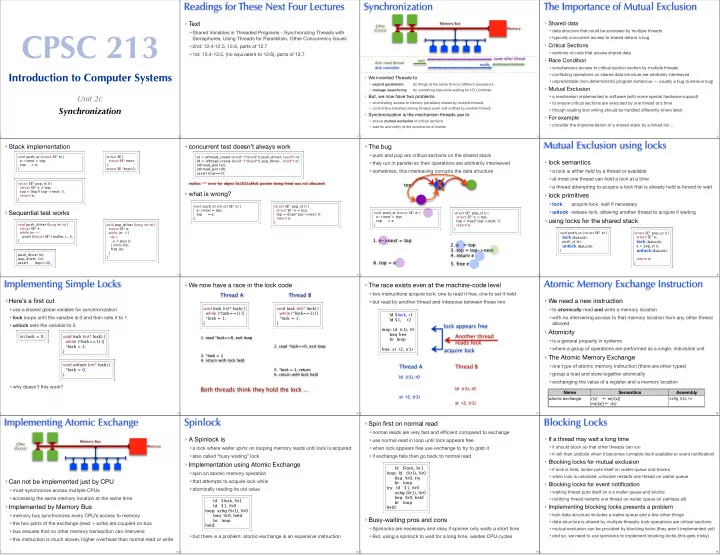
Readings for These Next Four Lectures Synchronization The Importance of Mutual Exclusion Text Shared data Memory Bus CPUs Memory (Cores) CPSC 213 data structure that could be accessed by multiple threads Shared Variables in


slide-1
SLIDE 1

CPSC 213

Introduction to Computer Systems

Unit 2c

Synchronization

1

Readings for These Next Four Lectures

  • Text
  • Shared Variables in Threaded Programs - Synchronizing Threads with

Semaphores, Using Threads for Parallelism, Other Concurrency Issues

  • 2nd: 12.4-12.5, 12.6, parts of 12.7
  • 1st: 13.4-13.5, (no equivalent to 12.6), parts of 13.7
2

Synchronization

  • We invented Threads to
  • exploit parallelism

do things at the same time on different processors

  • manage asynchrony

do something else while waiting for I/O Controller

  • But, we now have two problems
  • coordinating access to memory (variables) shared by multiple threads
  • control flow transfers among threads (wait until notified by another thread)
  • Synchronization is the mechanism threads use to
  • ensure mutual exclusion of critical sections
  • wait for and notify of the occurrence of events

disk-read thread disk controller wait notify CPUs (Cores) Memory Memory Bus some other thread

3

The Importance of Mutual Exclusion

  • Shared data
  • data structure that could be accessed by multiple threads
  • typically concurrent access to shared data is a bug
  • Critical Sections
  • sections of code that access shared data
  • Race Condition
  • simultaneous access to critical section section by multiple threads
  • conflicting operations on shared data structure are arbitrarily interleaved
  • unpredictable (non-deterministic) program behaviour — usually a bug (a serious bug)
  • Mutual Exclusion
  • a mechanism implemented in software (with some special hardware support)
  • to ensure critical sections are executed by one thread at a time
  • though reading and writing should be handled differently (more later)
  • For example
  • consider the implementation of a shared stack by a linked list ...
4
  • Stack implementation
  • Sequential test works

struct SE { struct SE* next; }; struct SE *top=0; void push_driver (long int n) { struct SE* e; while (n--) push ((struct SE*) malloc (...)); } void pop_driver (long int n) { struct SE* e; while (n--) { do { e = pop (); } while (!e); free (e); } } push_driver (n); pop_driver (n); assert (top==0); void push_st (struct SE* e) { e->next = top; top = e; } struct SE* pop_st () { struct SE* e = top; top = (top)? top->next: 0; return e; }

5
  • concurrent test doesn’t always work
  • what is wrong?

et = uthread_create ((void* (*)(void*)) push_driver, (void*) n); dt = uthread_create ((void* (*)(void*)) pop_driver, (void*) n); uthread_join (et); uthread_join (dt); assert (top==0); malloc: *** error for object 0x1022a8fa0: pointer being freed was not allocated void push_st (struct SE* e) { e->next = top; top = e; } struct SE* pop_st () { struct SE* e = top; top = (top)? top->next: 0; return e; }

6

void push_st (struct SE* e) { e->next = top; top = e; }

  • The bug
  • push and pop are critical sections on the shared stack
  • they run in parallel so their operations are arbitrarily interleaved
  • sometimes, this interleaving corrupts the data structure

top

  • 1. e->next = top
  • 2. e = top
  • 3. top = top->next
  • 4. return e

X

  • 5. free e
  • 6. top = e

struct SE* pop_st () { struct SE* e = top; top = (top)? top->next: 0; return e; }

7

Mutual Exclusion using locks

  • lock semantics
  • a lock is either held by a thread or available
  • at most one thread can hold a lock at a time
  • a thread attempting to acquire a lock that is already held is forced to wait
  • lock primitives
  • lock

acquire lock, wait if necessary

  • unlock release lock, allowing another thread to acquire if waiting
  • using locks for the shared stack

void push_cs (struct SE* e) { lock (&aLock); push_st (e); unlock (&aLock); } struct SE* pop_cs () { struct SE* e; lock (&aLock); e = pop_st (); unlock (&aLock); return e; }

8

Implementing Simple Locks

  • Here’s a first cut
  • use a shared global variable for synchronization
  • lock loops until the variable is 0 and then sets it to 1
  • unlock sets the variable to 0
  • why doesn’t this work?

int lock = 0; void unlock (int* lock) { *lock = 0; } void lock (int* lock) { while (*lock==1) {} *lock = 1; }

9
  • We now have a race in the lock code

void lock (int* lock) { while (*lock==1) {} *lock = 1; }

  • 1. read *lock==0, exit loop
  • 2. read *lock==0, exit loop

void lock (int* lock) { while (*lock==1) {} *lock = 1; }

  • 3. *lock = 1
  • 4. return with lock held
  • 5. *lock = 1, return
  • 6. return with lock held

Thread A Thread B Both threads think they hold the lock ...

10
  • The race exists even at the machine-code level
  • two instructions acquire lock: one to read it free, one to set it held
  • but read by another thread and interpose between these two

ld $lock, r1 ld $1, r2 loop: ld (r1), r0 beq free br loop free: st r2, (r1)

lock appears free acquire lock Another thread reads lock

ld (r1), r0 st r2, (r1) ld (r1), r0 st r2, (r1)

Thread A Thread B

11

Atomic Memory Exchange Instruction

  • We need a new instruction
  • to atomically read and write a memory location
  • with no intervening access to that memory location from any other thread

allowed

  • Atomicity
  • is a general property in systems
  • where a group of operations are performed as a single, indivisible unit
  • The Atomic Memory Exchange
  • one type of atomic memory instruction (there are other types)
  • group a load and store together atomically
  • exchanging the value of a register and a memory location

Name Semantics Assembly atomic exchange

r[v] ← m[r[a]] m[r[a]] ← r[v] xchg (ra), rv

12

Implementing Atomic Exchange

  • Can not be implemented just by CPU
  • must synchronize across multiple CPUs
  • accessing the same memory location at the same time
  • Implemented by Memory Bus
  • memory bus synchronizes every CPU’s access to memory
  • the two parts of the exchange (read + write) are coupled on bus
  • bus ensures that no other memory transaction can intervene
  • this instruction is much slower, higher overhead than normal read or write

CPUs (Cores) Memory Memory Bus

13

Spinlock

  • A Spinlock is
  • a lock where waiter spins on looping memory reads until lock is acquired
  • also called “busy waiting” lock
  • Implementation using Atomic Exchange
  • spin on atomic memory operation
  • that attempts to acquire lock while
  • atomically reading its old value
  • but there is a problem: atomic-exchange is an expensive instruction

ld $lock, %r1 ld $1, %r0 loop: xchg (%r1), %r0 beq %r0, held br loop held:

14
  • Spin first on normal read
  • normal reads are very fast and efficient compared to exchange
  • use normal read in loop until lock appears free
  • when lock appears free use exchange to try to grab it
  • if exchange fails then go back to normal read
  • Busy-waiting pros and cons
  • Spinlocks are necessary and okay if spinner only waits a short time
  • But, using a spinlock to wait for a long time, wastes CPU cycles

ld $lock, %r1 loop: ld (%r1), %r0 beq %r0, try br loop try: ld $1, %r0 xchg (%r1), %r0 beq %r0, held br loop held:

15

Blocking Locks

  • If a thread may wait a long time
  • it should block so that other threads can run
  • it will then unblock when it becomes runnable (lock available or event notification)
  • Blocking locks for mutual exclusion
  • if lock is held, locker puts itself on waiter queue and blocks
  • when lock is unlocked, unlocker restarts one thread on waiter queue
  • Blocking locks for event notification
  • waiting thread puts itself on a a waiter queue and blocks
  • notifying thread restarts one thread on waiter queue (or perhaps all)
  • Implementing blocking locks presents a problem
  • lock data structure includes a waiter queue and a few other things
  • data structure is shared by multiple threads; lock operations are critical sections
  • mutual exclusion can be provided by blocking locks (they aren’t implemented yet)
  • and so, we need to use spinlocks to implement blocking locks (this gets tricky)
16
slide-2
SLIDE 2

Implementing a Blocking Lock

  • Lock data structure
  • The lock operation

struct blocking_lock { int spinlock; int held; uthread_queue_t waiter_queue; }; void lock (struct blocking_lock l) { spinlock_lock (&l->spinlock); while (l->held) { enqueue (&waiter_queue, uthread_self ()); spinlock_unlock (&l->spinlock); uthread_switch (ready_queue_dequeue (), TS_BLOCKED); spinlock_lock (&l->spinlock); } l->held = 1; spinlock_unlock (&l->spinlock); }

17
  • The unlock operation

void unlock (struct blocking_lock l) { uthread_t* waiter_thread; spinlock_lock (&l->spinlock); l->held = 0; waiter_thread = dequeue (&l->waiter_queue); spinlock_unlock (&->spinlock); waiter_thread->state = TS_RUNABLE; ready_queue_enqueue (waiter_thread); }

18

Blocking Lock Example Scenario

Thread A Thread B

  • 1. calls lock()
  • 3. grabs spinlock
  • 5. acquires blocking lock
  • 6. releases spinlock
  • 7. returns from lock()
  • 2. calls lock()
  • 4. tries to grab spinlock, but spins
  • 3. grabs spinlock
  • 4. queues itself on watier list
  • 5. releases spinlock
  • 6. blocks

Thread C

  • 8. scheduled
  • 9. calls unlock()
  • 10. grabs spinlock
  • 11. releases lock
  • 12. restarts a Thread B
  • 13. releases spinlock
  • 14. returns from unlock()
  • 16. scheduled
  • 17. grabs spinlock
  • 18. acquires blocking lock
  • 19. releases spinlock
  • 20. returns from lock()
  • 15. yields, blocks or stops

thread running spinlock held blocking lock held

19

Blocking vs Busy Waiting

  • Spinlocks
  • Pros and Cons
  • uncontended locking has low overhead
  • contending for lock has high cost
  • Use when
  • critical section is small
  • contention is expected to be minimal
  • event wait is expected to be very short
  • when implementing Blocking locks
  • Blocking Locks
  • Pros and Cons
  • uncontended locking has higher overhead
  • contending for lock has no cost
  • Use when
  • lock may be head for some time
  • when contention is high
  • when event wait may be long
20
  • Introduced by Tony Hoare and Per Brinch Hansen circ. 1974
  • adds wait-signal synchronization to mutual exclusion
  • basis for synchronization primitives in Java etc.
  • Monitor
  • is a mutual-exclusion lock
  • primitives are enter (lock) and exit (unlock)
  • access for reading vs access for writing?
  • Condition Variable
  • can only be accessed from inside of a monitor (i.e, with monitor lock held)
  • wait

blocks until a subsequent signal operation on the variable

  • notify

unblocks waiter, but continues to hold monitor (Hansen) signal unblocks waiter and atomically transfer monitor to waiter (Hoare)

  • notify_all unblocks all waiters and continues to hold monitor (broadcast)
  • names signal and notify used interchangeably; Hansen semantics universal

Monitors and Condition Variables

21

Waiting and Signalling Basics

  • Basic formulation
  • one thread enters monitor and may wait for a condition to be established
  • another thread enters monitor, establishes condition and signals waiter
  • Waiting exits the monitor
  • before waiter blocks, it exits monitor to allow other threads to enter
  • when wait unblocks, it re-enters monitor, waiting/blocking to enter if necessary
  • note: other threads may have been in monitor between wait call and return

monitor { while (!x) wait (); } monitor { x = true; signal (); }

22

Drinking Beer Example

  • Beer pitcher is shared data structure with these operations
  • pour
  • refill
  • Implementation goal
  • synchronize access to the shared pitcher
  • pouring from an empty pitcher requires waiting for it to be filled
  • filling pitcher releases waiters

void pour () { monitor { if (glasses==0) wait; glasses--; }} void refill (int n) { monitor { for (int i=0; i<n; i++) { glasses++; signal; }}}

23
  • On closer inspection, what are we assuming about signal?
  • Consider this potential execution. Is it legal? Is it problematic?

Thread A Thread B Thread C

  • 1. call pour ()
  • 2. enter monitor
  • 3. glasses == 0
  • 4. wait, exiting monitor
  • 1. call refill (1)
  • 2. enter monitor
  • 3. glasses = 1
  • 4. signal A
  • 5. exit monitor
  • 1. call pour()
  • 2. wait to enter monitor
  • 3. enter monitor
  • 4. glasses--
  • 7. exit monitor
  • 5. awoken
  • 6. wait to enter monitor
  • 7. enter monitor
  • 8. glasses--
  • 9. exit monitor

What is the value of glasses?

void pour () { monitor { if (glasses==0) wait; glasses--; }} void refill (int n) { monitor { for (int i=0; i<n; i++) { glasses++; signal; }}}

What is needed to fix this problem?

24
  • Tony Hoare proposed that signal block and pass monitor to waiter

Blocking Signal — Hoare Semantics

Thread A Thread B Thread C

  • 1. call pour ()
  • 2. enter monitor
  • 3. glasses == 0
  • 4. wait, exiting monitor
  • 1. call refill (1)
  • 2. enter monitor
  • 3. glasses = 1
  • 4. signal A, exiting monitor
  • 5. wait to enter monitor
  • 1. call pour()
  • 2. wait to enter monitor
  • 3. enter monitor
  • 4. glasses==0
  • 7. wait, exiting monitor
  • 5. awoken inside of monitor
  • 8. glasses--
  • 9. exit monitor
  • 6. enter monitor
  • 7. exit monitor

void pour () { monitor { if (glasses==0) wait; glasses--; }} void refill (int n) { monitor { for (int i=0; i<n; i++) { glasses++; signal; }}}

25
  • But, implementing Hoare Semantics has high overhead
  • each blocking/unblocking (scheduling) of a thread is costly
  • blocking in signal leads to significant scheduling overhead
  • what if refill(10) is called with 10 thirsty waiters?

void refill (int n) { monitor { for (int i=0; i<n; i++) { glasses++; signal; }}}

  • 3. glasses++
  • 4. signal exiting monitor
  • 5. wait to enter monitor
  • 6. enter monitor
  • 7. glasses++
  • 8. signal exiting monitor
  • 9. wait to enter monitor
  • 5. awoken inside of monitor
  • 8. glasses--
  • 9. exit monitor
  • 5. awoken inside of monitor
  • 6. glasses--

9 . exit monitor * give up monitor * block until waiter finishes * then reenter monitor * repeat ... refiller blocks/unblocks 10 times

26
  • Per Brinch Hansen propose that signal not block
  • the non-blocking signal is normally called notify
  • lower overhead; fewer block/unblock; this is what everyone does
  • but, this requires changing the waiter code
  • can not assume that wait condition holds after wait returns
  • may have to wait again, if another thread consumed the refill
  • or notify_all to awaken all threads
  • may wakeup too many
  • but, threads re-check glasses==0, so it’s okay

Non-Blocking Notify – Hansen Semantics

void pour () { monitor { while (glasses==0) wait; glasses--; }} void refill (int n) { monitor { for (int i=0; i<n; i++) { glasses++; notify; }}} void refill (int n) { monitor { glasses += n; notify_all; }}}

27

The Monitor and Condition Variables

  • Programs can have multiple independent monitors
  • so a monitor implemented as a “variable” (a struct really)
  • Monitors may have multiple independent conditions
  • so a condition is also a variable, connected to its monitor

uthread_monitor_t* beer = uthread_monitor_create (); uthread_cv_t* not_empty = uthread_cv_create (beer); uthread_cv_t* warm = uthread_cv_create (beer); void pour (int isEnglish) { uthread_monitor_enter (beer); while (glasses==0 || (isEnglish && temp<15)) { if (glasses==0) uthread_cv_wait (not_empty); if (isEnglish && temp < 15) uthread_cv_wait (warm); } glasses--; uthread_monitor_exit (beer); }

28
  • Blocking read
  • call async read as before
  • but now block on condition variable that is given to completion routine
  • Read completion
  • called by disk ISR as before
  • but now notify the condition variable, restarting the blocked read cal

Using Condition Variables for Disk Read

void read (char* buf, int bufSize, int blockNo) { uthread_monitor_t* mon = uthread_monitor_create (); uthread_cv_t* cv = uthread_cv_create (mon); uthread_monitor_enter (mon); asyncRead (buf, bufSize, readComplete, mon, cv); uthread_cv_wait (cv); uthread_monitor_exit (mon); } void readComplete (uthread_monitor_t* mon, uthread_cv_t* cv) { uthread_monitor_enter (mon); uthread_cv_notify (cv); uthread_monitor_exit (mon); }

29

Shared Queue Example

  • Unsynchronized Code

void enqueue (uthread_queue_t* queue, uthread_t* thread) { thread->next = 0; if (queue->tail) queue->tail->next = thread; queue->tail = thread; if (queue->head==0) queue->head = queue->tail; } uthread_t* dequeue (uthread_queue_t* queue) { uthread_t* thread; if (queue->head) { thread = queue->head; queue->head = queue->head->next; if (queue->head==0) queue->tail=0; } else thread=0; return thread; }

30
  • Adding Mutual Exclusion

void enqueue (uthread_queue_t* queue, uthread_t* thread) { uthread_monitor_enter (&queue->monitor); thread->next = 0; if (queue->tail) queue->tail->next = thread; queue->tail = thread; if (queue->head==0) queue->head = queue->tail; uthread_monitor_exit (&queue->monitor); } uthread_t* dequeue (uthread_queue_t* queue) { uthread_t* thread; uthread_monitor_enter (&queue->monitor); if (queue->head) { thread = queue->head; queue->head = queue->head->next; if (queue->head==0) queue->tail=0; } else thread=0; uthread_monitor_exit (&queue->monitor); return thread; }

31
  • Now have dequeue wait for item if queue is empty
  • classical producer-consumer model with each in different thread
  • e.g., producer enqueues video frames consumer thread dequeues them for display

void enqueue (uthread_queue_t* queue, uthread_t* thread) { uthread_monitor_enter (&queue->monitor); thread->next = 0; if (queue->tail) queue->tail->next = thread; queue->tail = thread; if (queue->head==0) queue->head = queue->tail; uthread_cv_notify (&queue->not_empty); uthread_monitor_exit (&queue->monitor); } uthread_t* dequeue (uthread_queue_t* queue) { uthread_t* thread; uthread_monitor_enter (&queue->monitor); while (queue->head==0) uthread_cv_wait (&queue->not_empty); thread = queue->head; queue->head = queue->head->next; if (queue->head==0) queue->tail=0; uthread_monitor_exit (&queue->monitor); return thread; }

32
slide-3
SLIDE 3
  • Why does dequeue have a while loop to check for non-empty?
  • Why must condition variable be associated with specific monitor?
  • Why can’t we use condition variable outside of monitor?
  • this is called a naked use of the condition variable
  • this is actually required sometimes ... can you think where (BONUS)?
  • Experience with Processes and Monitors with Mesa, Lampson and Redell, 1980

Some Questions About Example

uthread_t* dequeue (uthread_queue_t* queue) { uthread_t* thread; uthread_monitor_enter (&queue->monitor); while (queue->head==0) uthread_cv_wait (&queue->not_empty); thread = queue->head; queue->head = queue->head->next; if (queue->head==0) queue->tail=0; uthread_monitor_exit (&queue->monitor); return thread; }

33

Implementing Condition Variables

  • Some key observations
  • wait, notify and notify_all are called while monitor is held
  • the monitor must be held when they return
  • wait must release monitor before locking and re-acquire before returning
  • Implementation
  • in the lab
  • look carefully at the implementations of monitor enter and exit
  • understand how these are similar to wait and notify
  • use this code as a guide
  • you also have the code for semaphores, which you might also find helpful
34

Reader-Writer Monitors

  • If we classify critical sections as
  • reader if only reads the shared data
  • writer

if updates the shared data

  • Then we can weaken the mutual exclusion constraint
  • writers require exclusive access to the monitor
  • but, a group of readers can access monitor concurrently
  • Reader-Writer Monitors
  • monitor state is one of
  • free, held-for-reading, or held
  • monitor_enter ()
  • waits for monitor to be free then sets its state to held
  • monitor_enter_read_only ()
  • waits for monitor to be free or held-for-reading, then sets is state to head-for-reading
  • increment reader count
  • monitor_exit ()
  • if held, then set state to free
  • if held-for-reading, then decrement reader count and set state to free if reader count is 0

Monitor

35
  • Policy question
  • monitor state is head-for-reading
  • thread A calls monitor_enter() and blocks waiting for monitor to be free
  • thread B calls monitor_enter_read_only(); what do we do?
  • Disallowing new readers while writer is waiting
  • is the fair thing to do
  • thread A has been waiting longer than B, shouldn’t it get the monitor first?
  • Allowing new readers while writer is waiting
  • may lead to faster programs by increasing concurrency
  • if readers must WAIT for old readers and writer to finish, less work is done
  • What should we do
  • normally either provide a fair implementation
  • or allow programmer to choose (that’s what Java does)
36

Semaphores

  • Introduced by Edsger Dijkstra for the THE System circa 1968
  • recall that he also introduced the “process” (aka “thread”) for this system
  • was fearful of asynchrony, Semaphores synchronize interrupts
  • synchronization primitive provide by UNIX to applications
  • A Semaphore is
  • an atomic counter that can never be less than 0
  • attempting to make counter negative blocks calling thread
  • P (s)
  • try to decrement s (prolaag for probeer te varlagen in Dutch)
  • atomically blocks until s >0 then decrement s
  • V (s)
  • increment s (verhogen in Dutch)
  • atomically increase s unblocking threads waiting in P as appropriate
37

Using Semaphores to Drink Beer

  • Use semaphore to store glasses head by pitcher
  • set initial value of empty when creating it
  • Pouring and refilling don’t require a monitor
  • Getting the beer warm, however doesn’t fit quite as nicely
  • need to keep track of the number of threads waiting for the warm beer
  • then call V that number of times
  • this is actually quite tricky

uthread_semaphore_t* glasses = uthread_create_semaphore (0); void pour () { uthread_P (glasses); } void refill (int n) { for (int i=0; i<n; i++) uthread_V (glasses); }

38

Other ways to use Semaphores

  • Asynchronous Operations
  • create outstanding_request semaphore
  • async_read:

P (outstanding_request)

  • completion interrupt: V (outstanding_request)
  • Rendezvous
  • two threads wait for each other before continuing
  • create a semaphore for each thread initialized to 0

void thread_a () { uthread_V (a); uthread_P (b); } void thread_b () { uthread_V (b); uthread_P (a); } What if you reversed order of V and P?

39
  • Barrier (local)
  • In a system of 1 parent thread and N children threads
  • All threads must arrive at barrier before any can continue
  • Barrier (global)
  • In a system of N threads with no parent
  • All threads must arrive, before any can continue ... and should work repeatedly

uthread_semaphore_t* barrier = uthread_semaphore_create (0); struct arg_tuple a0 = {1,2,0,barrier}; struct arg_tuple a1 = {3,4,0,barrier}; uthread_init (1); uthread_create (add, &a0); uthread_create (add, &a1); uthread_P (barrier); uthread_P (barrier); printf ("%d %d\n", a0.result, a1.result); void* add (void* arg) { struct arg_tuple* tuple = (struct arg_tuple*) arg; tuple->result = tuple->arg0 + tuple->arg1; uthread_V (tuple->barrier); return 0; }

40
  • Implementing Monitors
  • initial value of semaphore is 1
  • lock is P()
  • unlock is V()
  • Implementing Condition Variables
  • this is the warm beer problem
  • it took until 2003 before we actually got this right
  • for further reading
  • Andrew D. Birrell. “Implementing Condition Variables with Semaphores”, 2003.
  • Google “semaphores condition variables birrell”
41
  • Data structure
  • V(s)

Implementing Semaphores

void uthread_V (uthead_semaphore_t* sem) { uthread_t* waiter_thread; spinlock_lock (&sem->spinlock); sem->counter += 1; waiter_thread = dequeue (&sem->waiter_queue); if (waiter_thread) uthread_start (waiter_thread); spinlock_unlock (&sem->spinlock); } struct uthread_semaphore { int count; spinlock_t spinlock; uthread_queue_t waiter_queue; };

42
  • P(s)

void uthread_P (uthread_semaphore_t* sem) { uthread_t* waiter_thread; spinlock_lock (&sem->spinlock); while (sem->count < 1) { enqueue (&sem->waiter_queue, uthread_self ()); spinlock_unlock (&sem->spinlock); uthread_stop (TS_BLOCKED); spinlock_lock (&sem->spinlock); } sem->count -= 1; spinlock_unlock (&sem->spinlock); }

43

Problems with Concurrency

  • Race Condition
  • competing, unsynchronized access to shared variable
  • from multiple threads
  • at least one of the threads is attempting to update the variable
  • solved with synchronization
  • guaranteeing mutual exclusion for competing accesses
  • but the language does not help you see what data might be shared --- can be very hard
  • Deadlock
  • multiple competing actions wait for each other preventing any to complete
  • what can cause deadlock?
  • MONITORS
  • CONDITION VARIABLES
  • SEMAPHORES
44

The Dining Philosophers Problem

  • Formulated by Edsger Dijkstra to explain deadlock (circa 1965)
  • 5 computers competed for access to 5 shared tape drives
  • Re-told by Tony Hoare
  • 5 philosophers sit at a round table with fork placed in between each
  • fork to left and right of each philosopher and each can use only these 2 forks
  • they are either eating or thinking
  • while eating they are not thinking and while thinking they are not eating
  • they never speak to each other
  • large bowl of spaghetti at centre of table requires 2 forks to serve
  • dig in ...
  • deadlock
  • every philosopher holds fork to left waiting for fork to right (or vice versa)
  • how might you solve this problem?
  • starvation
  • even if some philosophers eat, some could go hungry if never get both forks
  • livelock
  • deadlock avoided, but all philosophers still starve due to timing problem, special case of starvation
45

Avoiding Deadlock

  • Don’t use multiple threads
  • you’ll have many idle CPU cores and write asynchronous code
  • Don’t use shared variables
  • if threads don’t access shared data, no need for synchronization
  • Use only one lock at a time
  • deadlock is not possible, unless thread forgets to unlock
  • Organize locks into precedence hierarchy
  • each lock is assigned a unique precedence number
  • before thread X acquires a lock i, it must hold all higher precedence locks
  • ensures that any thread holding i can not be waiting for X
  • Detect and destroy
  • if you can’t avoid deadlock, detect when it has occurred
  • break deadlock by terminating threads (e.g., sending them an exception)
46

Synchronization in Java (5)

  • Monitors using the Lock interface
  • a few variants allow interruptibility, just trying lock, ...
  • multiple-reader single writer locks

Lock l = ...; l.lock (); try { ... } finally { l.unlock (); } Lock l = ...; try { l.lockInterruptibly (); try { ... } finally { l.unlock (); } } catch (InterruptedException ie) {} ReadWriteLock l = ...; Lock rl = l.readLock (); Lock wl = l.writeLock ();

47
  • Condition variables
  • await is wait (replaces Object wait)
  • signal or signalAll is Hansen “notify” (replaces Object notify, notifyAll)

class Beer { Lock l = ...; Condition notEmpty = l.newCondition (); int glasses = 0; void pour () throws InterruptedException { l.lock (); try { while (glasses==0) notEmpty.await (); glasses--; } finaly { l.unlock (); } } void refill (int n) throws InterruptedException { l.lock (); try { glasses += n; notEmpty.signalAll (); } finaly { l.unlock (); }}}

48
slide-4
SLIDE 4
  • Semaphore class
  • acquire () or acquire (n) is P() or P(n)
  • release () or release (n) is V() or V(n)
  • Lock-free Atomic Variables
  • AtomicX where X in {Boolean, Integer, IntegerArray, Reference, ...}
  • atomic operations such as getAndAdd(), compareAndSet(), ...
  • e.g., x.compareAndSet (y,z) atomically sets x=z iff x==y and returns true iff set occurred

class Beer { Semaphore glasses = new Semaphore (0); void pour () throws InterruptedException { glasses.acquire (); } void refill (int n) throws InterruptedException { glasses.release (n); } }

49
  • Recall the problem with concurrent stack
  • a pop could intervene between two steps of push, corrupting linked list
  • we solved this problem using locks to ensure mutual exclusion
  • now ... solve without locks, using atomic compare-and-set of top

Lock-Free Atomic Stack in Java

void push_st (struct SE* e) { e->next = top; top = e; } struct SE* pop_st () { struct SE* e = top; top = (top)? top->next: 0; return e; }

top

X

50

class Element { Element* next; } class Stack { AtomcReference<Element> top; Stack () { top.set (NULL); } void push () { Element t; Element e = new Element (); do { t = top.get (); e.next = t; } while (!top.compareAndSet (t, e)); } }

top

X

X

51
  • Spinlock
  • one acquirer at a time, busy-wait until acquired
  • need atomic read-write memory operation, implemented in hardware
  • use for locks held for short periods (or when minimal lock contention)
  • Monitors and Condition Variables
  • blocking locks, stop thread while it is waiting
  • monitor guarantees mutual exclusion
  • condition variables wait/notify provides control transfer among threads
  • Semaphores
  • blocking atomic counter, stop thread if counter would go negative
  • introduced to coordinate asynchronous resource use
  • use to implement barriers or monitors
  • use to implement something like condition variables, but not quite
  • Problems, problems, problems
  • race conditions to be avoided using synchronization
  • deadlock/livelock to be avoided using synchronization carefully

Synchronization Summary

52