COVID-19 Construction Update: Claims and Related Coverage Issues - - PowerPoint PPT Presentation

covid 19 construction update
SMART_READER_LITE
LIVE PREVIEW

COVID-19 Construction Update: Claims and Related Coverage Issues - - PowerPoint PPT Presentation

COVID-19 Construction Update: Claims and Related Coverage Issues Mark A. Snyder Jeffrey J. Vita Gregory H. Chertoff Associate Founding Partner NY Co-Managing Partner Saxe Doernberger & Vita, P.C. Peckar & Abramson, P.C. Peckar


slide-1
SLIDE 1

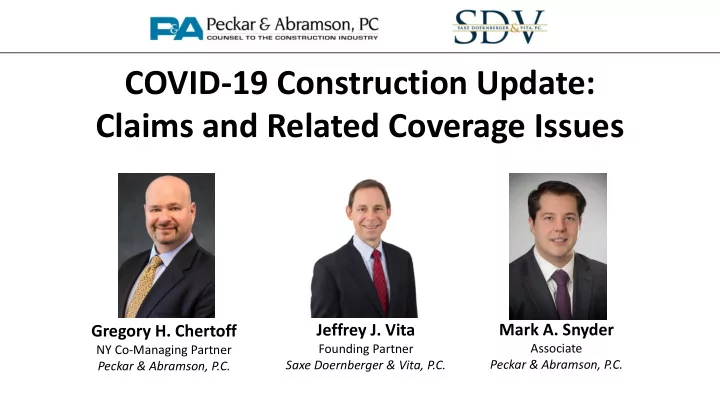
COVID-19 Construction Update: Claims and Related Coverage Issues

Gregory H. Chertoff

NY Co-Managing Partner Peckar & Abramson, P.C.

Mark A. Snyder

Associate Peckar & Abramson, P.C.

Jeffrey J. Vita

Founding Partner Saxe Doernberger & Vita, P.C.

slide-2
SLIDE 2

Mark A. Snyder

Associate Peckar & Abramson, P.C.

slide-3
SLIDE 3

Recognize This is an Unprecedented Time and Know Your Rights

  • Carefully consider the impacts
  • Identify the causes
  • Analyze your contract - identify all notice/documentation requirements
  • There are a wide range of contract clauses that may be implicated – and,

potentially, unusual applications of those clauses

  • Correlate your project specific causes and impacts to your specific contract

clauses

  • Notice - be mindful of tone
slide-4
SLIDE 4

Examples of Impacts and Causes

  • Complete or partial suspension of work
  • Demobilization - Remobilization
  • Standby Mode Costs
  • Price Escalation Upon Restart of Project
  • Labor Productivity Impacts
  • Incomplete Crews/Increased Absenteeism
  • Governmental Guidelines for Safety Practices
  • Social Distancing
  • Governmental Restrictions
  • Owner Restrictions
  • Illness
  • Quarantine
  • Medical Testing Requirements
  • Lack of Inspections
  • Owner directive
  • Government regulation
  • Additional work or newly imposed

requirements

  • Material and Equipment Supply Disruption
  • Late, Partial or Cancelled Delivery of Materials

and/or Equipment

  • Supplier Default/Bankruptcy
  • Added costs
  • Delays
  • Disruptions
slide-5
SLIDE 5

Identify the Clause

  • Cause and effect determines

relief

  • Be expansive
  • Notice, notice, notice!
slide-6
SLIDE 6

Primary Clauses to Review

  • Force Majeure/Extension of Time/Delay Clauses
  • Emergency Clauses
  • Suspension of Work
  • Changes and Extra Work
  • Change in Law
  • Differing Site Conditions
slide-7
SLIDE 7

Force Majeure

  • Unforeseeable at the time of contracting
  • Epidemics, pandemics, and government orders may be covered
  • Review your clause for specific inclusions/exclusions
  • Must mitigate losses
  • May or may not discuss compensation – know which contract

provision discusses entitlement to damages

  • Most likely: Extension of time and delay clauses
  • Compensable delays vs non-compensable
  • Notice!
slide-8
SLIDE 8

Emergency Clause

  • Requires contractor to take action in time of emergency
  • Usually refers back to changes provision
  • Historically viewed to apply to jobsite emergencies (accidents)
  • Depending on language of your clause, it may be read to apply to

national emergencies

  • Notice!
slide-9
SLIDE 9

Suspension of Work

  • Owner’s right to suspend the work
  • Usually provide right for recovery
  • Some clauses limit recovery to schedule relief, some also provide for

compensation – your discrete clause controls

  • Notice!
slide-10
SLIDE 10

Changes and Extra Work

  • Provide compensation and time where the contractor performs

changed or extra work directed by the owner

  • Previously mentioned clauses likely refer back to these
  • Notice and documentation requirements
  • CDC/OSHA/EEOC requirements – extra work?
  • Owner directive to comply with laws, regulations, guidelines – extra

work?

  • To take full advantage, request direction from the owner
slide-11
SLIDE 11

Change in Law

  • Often covers changes that went into effect after contract formation
  • Shelter in place, social distancing, other governmental mandated

guidelines for safety

  • Notice!
slide-12
SLIDE 12

Differing Site Conditions

  • Provides compensation and time when conditions differ from:
  • 1. conditions represented in the contract documents, or
  • 2. conditions that reasonably could have been anticipated
  • COVID-19 differing/concealed/unknown condition?
  • Likely only applies to pre-existing but unknown conditions
slide-13
SLIDE 13

Non-Contractual Remedies

  • Contract may not contemplate COVID impacts
  • Non-contractual arguments, if your contract does not contain an

avenue of relief

  • Impossibility of performance
  • Frustration of purpose
  • Mutual mistake
  • Covenant of good faith and fair dealing
  • Quantum meruit
  • Notice!
slide-14
SLIDE 14

Key Takeaways

  • Not all contract provisions are the same, so you must review the

language carefully to know your rights

  • Not all jobs will be impacted the same way, so you must review

discrete impacts

  • Correlate your impacts to your contract clauses
  • To take full advantage of your rights, give notice as soon as possible

and often as necessary

slide-15
SLIDE 15

Gregory H. Chertoff

NY Co-Managing Partner Peckar & Abramson, P.C.

slide-16
SLIDE 16

Proving Your COVID-19 Damages

  • Understand what you need to prove:
  • What costs and schedule impacts you incurred
  • How those costs and impacts are tied exclusively to Covid crisis issues
  • That the costs and impacts were reasonably incurred
  • That you made reasonable efforts to mitigate
  • Understand your many potential audiences
  • Understand the importance of “real-time” evidence
slide-17
SLIDE 17

Develop a Project-Specific Strategy – Now

  • Segregate & Document – Key themes
  • Separate Covid costs from other job costs
  • Track in as many discrete buckets as possible
  • Different costs may face different entitlement challenges
  • Separate tracking affords flexibility for presentation and proof
  • Gather detailed documentation, with short narrative explanations
  • Photo and video records, with narratives
  • The situation is fluid – make sure your strategy is also
  • Keep re-visiting and updating your strategy as new impacts occur or existing
  • nes evolve
slide-18
SLIDE 18

Mitigation – Show You Thought About It

  • Universal burden to mitigate damages
  • Must use reasonable efforts “under the circumstances”
  • Avoid hindsight myopia – it’s not always 20/20
  • Document the things you considered and rejected and why
  • Document the things you tried, even if not successful
  • Trying reasonably and yet failing to actually reduce costs is ok
slide-19
SLIDE 19

Schedule & Inefficiency Impacts

  • Validate your current schedule and update regularly
  • Resist the urge to set things in stone before you can predict them
  • Review your contract’s schedule spec (if there is one), understand its

requirements, and comply or document why compliance is not possible

  • Be mindful of how you document impacts in the schedule
  • Record facts and effects of delays and also the why and what caused them
  • Don’t just show impacts in the schedule; provide explanatory narratives to

give important context.

slide-20
SLIDE 20

Schedule & Inefficiency Impacts (con’t)

  • Don’t let effects look like causes (e.g. unexplained pacing)
  • Don’t blend schedule recovery into impact – keep it separate
  • Productivity impacts – likely to be many kinds in play
  • Look for measured mile opportunities
  • Consider engaging with owners and subs up front to agree upon methodology
  • Schedule-related costs – GCs, acceleration/mitigation costs, increased

staff, extended staff, off-site staff

slide-21
SLIDE 21

Key Takeaways

  • No one-size-fits-all checklist possible
  • Every project is different
  • Contract/legal rights differ
  • Causes and nature of impacts differ
  • Must understand both to develop effective claims and damages tracking

strategy

  • Don’t miss your only “real-time” opportunity to make a compelling

record

slide-22
SLIDE 22

Jeffrey J. Vita

Founding Partner Saxe Doernberger & Vita, P.C.

slide-23
SLIDE 23

COVID-19-Related Property and Builder’s Risk Insurance

  • Builder’s Risk policies cover

“direct physical loss of or damage to” buildings and structures while under construction as well as materials, supplies and equipment onsite, in transit or temporarily at other locations Is the presence of COVID-19 “direct physical loss of or damage to property”?

  • Property policies cover “direct

physical loss of or damage to” Covered Property caused by or resulting from any Covered Cause

  • f Loss
slide-24
SLIDE 24

COVID-19-Related Property and Builder’s Risk Insurance

  • Choice of law: Will likely depend on

where you file suit and facts (a battle

  • f experts – must prove COVID-19 on

property constitutes “physical loss or damage.”

  • CDC: COVID-19 propensity to attach to

surfaces for prolonged time Is the presence of COVID-19 “direct physical loss of or damage to property”?

  • U.S. Courts split on the issue facing

similar situations (odors, fumes, smoke, etc.)

  • Example: Louisiana: Widder v.

Louisiana Citizens Property Insurance Corporation, 82 So.3d 294 (La. App. Ct. 2011), (intrusion of a contaminant rendering a home unusable and/or uninhabitable constituted “direct physical loss” to property.)

slide-25
SLIDE 25

Some courts BROADLY (pro-insured) interpret “physical loss of or damage,” finding coverage to be triggered with the loss of use or habitability of insured property. Examples include:

  • New Jersey: Gregory Packaging, Inc. v. Travelers Prop. Cas. Co. of Am., 2014 WL 6675934, at *3

(D.N.J. Nov. 25, 2014) (ammonia contamination causing facility to shut down is physical loss even if no structural change to property because facility was temporarily unfit for occupancy)

  • Massachusetts: Matzner v. Seaco Ins. Co., No. 96-0498-B, 1998 WL 566658, *3 (Mass. Super. Aug.

12, 1998) (carbon monoxide contamination constitutes direct physical loss even though it did not produce tangible damage to the structure of the insured property)

  • Minnesota: Sentinel Mgmt. Co. v. New Hampshire Ins. Co., 563 N.W.2d 296 (Minn. Ct. App. 1997)

(loss of functionality of building because of asbestos contamination is direct, physical loss)

Court’s Broad or narrow interpretation of “physical loss” will be key

COVID-19 & “Physical loss of or damage”

slide-26
SLIDE 26

COVID-19 & “Physical loss”

HOWEVER, many courts narrowly (pro-insurer) interpret it to require apparent and discernable damage to the property. Examples include:

  • New York: Roundabout Theatre Co., Inc. v. Cont'l Cas. Co., 751 N.Y.S.2d 4, 5

(App. Div. 2002) (“direct physical loss or damage” language in insurance policy “clearly and unambiguously provides coverage only where the insured's property suffers direct physical damage”);

  • 2nd Cir.: United Airlines, Inc. v. Ins. Co. of State of Pa., 385 F.Supp.2d 343,

349 (S.D.N.Y.2005), aff'd *332 439 F.3d 128 (2d Cir.2006) (damage is required for business interruption coverage flowing from national aviation shutdown in wake of terrorist attacks)

Court’s Broad or Narrow interpretation of “physical loss” will be key

slide-27
SLIDE 27

Other examples of narrow pro-insurer interpretation include:

  • Michigan: Universal Image Prods. v. Chubb Corp., 703 F. Supp. 2d 705

(E.D. Mich. 2010) (stench caused by mold did not render the entire property uninhabitable, even where one employee was infected by bacterial pneumonia)

  • Florida: Mama Jo’s, Inc. v. Sparta Ins. Co., 17-CV-23362-KMM, 2018

WL 3412974, at *9 (S.D. Fla. June 11, 2018) (no physical loss when construction debris and dust from road work required insured to clean floors, walls, tables, chairs, and countertops)

Court’s Broad or narrow interpretation of “physical loss” will be key

COVID-19 & “Physical loss”

slide-28
SLIDE 28

COVID-19-Related Property and Builder’s Risk Insurance - EXCLUSIONS

ISO Exclusion Of Loss Due to Virus Or Bacteria in Commercial Property Policies CP 01 40 07 06: “We will not pay for loss or damage caused by or resulting from any virus, bacterium or

  • ther microorganism that induces or is

capable of inducing physical distress, illness

  • r disease.”
  • Absence of virus exclusion doesn’t

necessarily create coverage

  • Inclusion of virus exclusion doesn’t

necessarily void coverage

Next Hurdle: Virus/Contamination/Pollution Exclusions

“Contamination/Pollution” exclusion: “Actual, alleged or threatened release, discharge, escape or dispersal of CONTAMINANTS OR POLLUTANTS, all whether direct or indirect, proximate or remote or in whole or in part caused by, contributed to or aggravated by any physical loss or damage insured by this Policy”

  • Definition of “Contaminants or Pollutants”

is key as it may or may not include “virus”
slide-29
SLIDE 29

COVID-19-Related Business Interruption Coverage

Commercial Property and BR policies typically contain Loss of Profits coverages resulting from, among others: (1) Damage to the policyholder’s own property (“business interruption”) (2) Damage to the property of a customer or supplier (or a supplier’s supplier) (“contingent business interruption”) – definition of “supplier” key (3) Government action such as quarantine orders/gathering restrictions (“order of civil authority”) – may not require direct physical loss/damage condition (4) Lack of “ingress and egress” to/from insured premises (Physical loss or damage caused by covered peril to third-party property preventing ingress to or egress from the insured's business)

slide-30
SLIDE 30

Coverage Takeaways/Recommendations

  • Control the narrative and submit any non-frivolous claims
  • Keep the notice letter simple, while you have more time to estimate losses
  • Describe the facts, and specifically describe any Civil Authority orders that impact

your business

  • Track and quantify all costs incurred re: virus including remediation, mitigation, loss
  • f business income, crisis management, etc.
  • Keep brokers engaged and in the loop
  • Don’t be discouraged by an initial denial letter – COVID-19 insurance coverage is a

new issue for the courts

  • Read exclusionary language carefully and prepare a rebuttal if necessary
slide-31
SLIDE 31

Legislative Bills – would mandate business interruption coverage

State Proposed Bill Scope: Insureds that employ

Louisiana House Bill No. 858 Less than 100 full-time employees Massachusetts Draft Bill SD.2888 150 or fewer full-time employees New Jersey N.J. Draft Bill A-3844 Less than 100 full-time employees New York Draft Assembly Bill A10226 Less than 100 full-time employees Ohio Draft Bill HB 589 100 or fewer full-time employees Pennsylvania House Bill No. 2372 Less than 100 full-time employees South Carolina Senate Bill 1188 50 or fewer full-time employees

slide-32
SLIDE 32

Legislative Bills – Key Provisions

If enacted, the proposed bills would:

  • Mandate a policy interpretation in favor of coverage for business

interruption losses arising from loss of use and occupancy due to the COVID-19 pandemic

  • Prohibit insurers from denying coverage on the basis of lack of direct

physical loss or damage to property

  • Eliminate the impact of virus exclusions
  • Apply retroactively from dates when declarations of state of emergency

were issued

slide-33
SLIDE 33

Pandemic Risk Insurance Act of 2020 (“PRIA”)

  • If enacted, it would establish a Federal Pandemic Risk Reinsurance Fund

and Program – mirrors Terrorism Insurance Act “TRIA”

  • Mandating participating insurers to provide coverage for any business

interruption loss resulting from an outbreak of infectious disease or pandemic that is declared an emergency or major disaster by the President and certified by the Secretary of Treasury

  • Trigger would be after $250 million dollars in losses, and include an

annual aggregate limit capped at $500 billion dollars

  • Unclear so far if it would apply retroactive and when it would be

enforced

slide-34
SLIDE 34

Questions?

Gregory H. Chertoff Peckar & Abramson, P.C. 212.382.0909 gchertoff@pecklaw.com Mark A. Snyder Peckar & Abramson, P.C. 212.382.0909 msnyder@pecklaw.com Jeffrey J. Vita Saxe Doernberger & Vita, P.C. 203.287.2103 jjv@sdvlaw.com

Thank you!