SDV to Deploy SST (14 th April 2016) Subsea Deployment Systems Ltd. - - PowerPoint PPT Presentation

sdv to deploy sst 14 th april 2016 subsea deployment
SMART_READER_LITE
LIVE PREVIEW

SDV to Deploy SST (14 th April 2016) Subsea Deployment Systems Ltd. - - PowerPoint PPT Presentation

SDV to Deploy SST (14 th April 2016) Subsea Deployment Systems Ltd. Subsea Deployment Systems Ltd. INTRODUCTION An installation method that overcomes the needs for a heavy lift vessel Low risk / low tech / low cost installation method


slide-1
SLIDE 1

Subsea Deployment Systems Ltd.

SDV to Deploy SST

(14th April 2016)

slide-2
SLIDE 2

Subsea Deployment Systems Ltd.

2

INTRODUCTION

  • An installation method that overcomes the needs for a heavy lift vessel
  • Low risk / low tech / low cost installation method
  • Reduced weather sensitivity
slide-3
SLIDE 3

Subsea Deployment Systems Ltd.

3

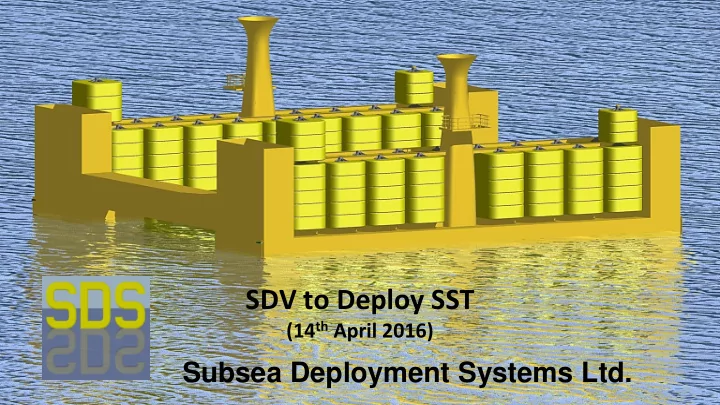
SUBSEA DEPLOYMENT VESSEL (SDV) & SST

Control chain Control tower Tow chain clump weight Castle Subsea Storage Tank (SST) Buoyancy modules Floodable hull Interface frame c/w ballast locker

slide-4
SLIDE 4

Subsea Deployment Systems Ltd.

4

INSTALLATION SCENARIOS

Base Case

  • SST filled with fresh water giving a net weight of 1500t

Optional Case

  • SST filled with oil giving a net weight of 200t

In both cases the installation method will be similar but a smaller SDV would be used for the optional case.

slide-5
SLIDE 5

Subsea Deployment Systems Ltd.

5

SDV MAIN PARTICULARS

  • Length

35.2m

  • Width

29.2m

  • Depth

5.0m

  • Overall height

13.0m (Est. 21.5m incl. interface frame)

  • 408 no. 3x3x1m buoyancy modules
  • Steel

525t

  • Scrap chain 1800t
  • Displacement 3400t
slide-6
SLIDE 6

Subsea Deployment Systems Ltd.

6

OUTLINE INSTALLATION METHOD

Load out

  • Dock on interface frame
  • Flood and lower the SST

below the surface

  • Float SDV over and

connect to SST

  • Flood and lower the

SST until fully supported by the SDV

  • Disconnect inshore HLV
slide-7
SLIDE 7

Subsea Deployment Systems Ltd.

7

OUTLINE INSTALLATION METHOD

Tow

  • Shallow water tow
  • Flood of all tanks and piping
  • Surface tow with nominal buoyancy
  • Deploy tow chain and fully submerge the assembly
slide-8
SLIDE 8

Subsea Deployment Systems Ltd.

8

OUTLINE INSTALLATION METHOD

Approach

  • Adjust tow wire

and tow speed to slow down upon approach to site

  • Lower tow chain

clump weight on to temporary target with SST in range of final target

slide-9
SLIDE 9

Subsea Deployment Systems Ltd.

9

OUTLINE INSTALLATION METHOD

Landing

  • Lower control chains into control towers
  • Pay-out until the system is neutral and lower the assembly on to target
  • When landed lower control chains into control towers and temporarily disconnect
  • Install ballast equivalent to SST weight
  • Disconnect SST from interface frame
  • Reconnect to control chains
  • Raise SDV clear of SST by raising

control chains

  • Pull control chains clear of SDV
slide-10
SLIDE 10

Subsea Deployment Systems Ltd.

10

OUTLINE RECOVERY METHOD

Recover SDV

  • Tow chain clump weight anchors the SDV
  • Recover wire to bring the chain clear of the seabed and slowly move forward
  • Increase tow speed and adjust tow wire until SDV at suitable depth
slide-11
SLIDE 11

Subsea Deployment Systems Ltd.

11

CONTROL CHAIN TOWERS - DYNAMICS

Control chain / towers

  • Vertical control
  • Lateral control
  • Rotational control
  • On-bottom weight

Dynamics

  • Natural period > 120s
  • Response amplitude < 20%
  • f surface vessel
  • Soft-soft landing
slide-12
SLIDE 12

Subsea Deployment Systems Ltd.

12

+

VS

SAFETY AND ENVIRONMENT

Considering like for like operation

  • Small number of people directly involved in operation (typ. 1:10)
  • Environmental impact considerably less
slide-13
SLIDE 13

Subsea Deployment Systems Ltd.

13

INHERENT SAFETY

General

  • Total loss minimised –

“close to neutral”

  • Insensitive to weather
  • No point of ‘no return’

Rigging failure

  • No catastrophic loss

Tow wire failure (10x)

slide-14
SLIDE 14

Subsea Deployment Systems Ltd.

14

VESSELS

  • Currently 10 AHTs on the spot market with WROV fitted
  • Some with offshore crane (crane not strictly required)
  • All with DP II capability and BP > 220t
  • Other 30+ AHTs on the North Sea spot market
slide-15
SLIDE 15

Subsea Deployment Systems Ltd.

15

SEASTATE STATISTICS

slide-16
SLIDE 16

Subsea Deployment Systems Ltd.

16

SUMMARY

  • Largely failsafe and very low tech
  • Larger weather window (wave & ice)
  • Potentially greater availability compared to HLVs
  • Potential for phased installation when not relying on HLV
  • Technology is considered “disruptive” by major contractors
  • SDS is looking for an opportunity to develop the concept into a working solution