course structure Artificial Intelligence traditional model - - PDF document

course structure artificial intelligence
SMART_READER_LITE
LIVE PREVIEW

course structure Artificial Intelligence traditional model - - PDF document

course structure Artificial Intelligence traditional model material to be covered http://www.hcibook.com/alan/teaching/ai355/ uniform coverage Alan Dix (coordinator) plus special topics: Geoff Coulson, Paul Rayson, Gerd Kortoum,


slide-1
SLIDE 1

1

Artificial Intelligence

http://www.hcibook.com/alan/teaching/ai355/ Alan Dix (coordinator)

plus special topics: Geoff Coulson, Paul Rayson, Gerd Kortoum, Manolis Sifalakis, Keith Cheverst, Hans Gellerson

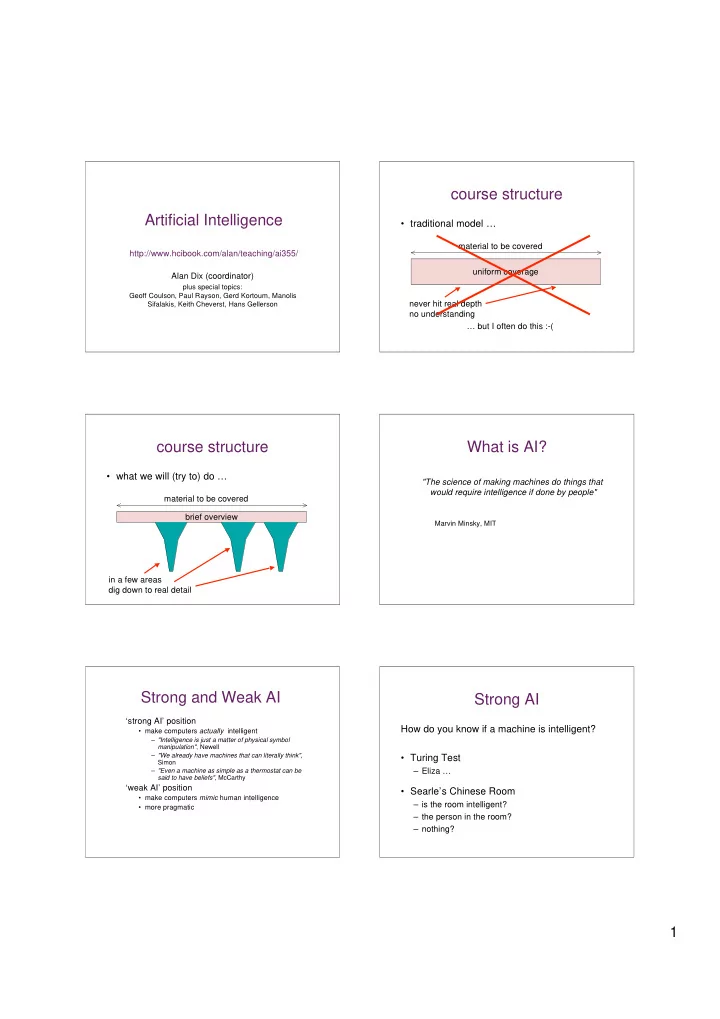
course structure

  • traditional model …

material to be covered uniform coverage … but I often do this :-( never hit real depth no understanding

course structure

  • what we will (try to) do …

material to be covered brief overview in a few areas dig down to real detail

What is AI?

"The science of making machines do things that would require intelligence if done by people"

Marvin Minsky, MIT

Strong and Weak AI

‘strong AI’ position

  • make computers actually intelligent

– "Intelligence is just a matter of physical symbol manipulation", Newell – "We already have machines that can literally think", Simon – "Even a machine as simple as a thermostat can be said to have beliefs", McCarthy

‘weak AI’ position

  • make computers mimic human intelligence
  • more pragmatic

Strong AI

How do you know if a machine is intelligent?

  • Turing Test

– Eliza …

  • Searle’s Chinese Room

– is the room intelligent? – the person in the room? – nothing?

slide-2
SLIDE 2

2

Weaker AI … Alien Intelligence

not as we know it … Chess programs

– can be very good – but NOT like a person – Computer: very broad ‘lookahead’ scanning thousands of possible move paths – Human: small number of ‘sensible’ moves intuition heuristics

the great divide

  • symbolic (traditional) AI

– based on high-level cognitive reasoning – small richer representations – well-defined formal representations, rules

  • sub-symbolic AI

– based on low-level neurological concepts

  • r other ‘natural computation’

– large simple representations – simple attributes, weights neural nets genetic algorithms emergent behaviour logic, search expert systems deduction

Natural computation inspirations

  • Neural networks / Connectionist

– neuron firing in the brain

  • Genetic Algorithms

– natural selection / selective breeding

  • Artificial life & emergent behaviour

– colony behaviour, ants,

  • Simulated annealing (not strictly ‘AI’)

– crystal formation

broad areas of AI (traditional)

  • knowledge representation
  • reasoning
  • search
  • planning
  • game playing
  • machine learning
  • language and speech
  • vision

now separate communities

(some) application areas

  • expert systems (in many domains)
  • theorem proving
  • games
  • robotics and control
  • interfaces and ambient intelligence
  • network routing
  • text and data mining (inc. security)
  • semantic web

recent directions

  • Embodiment

– Intelligence includes interactions with the world

  • Emotion

– intelligence includes feeling

  • Emergence

– intelligence arises in communities

slide-3
SLIDE 3

3

Representation matters

How many moves for knight to get to square X? … draw state space …

X

start state goal state

1 2 3

Knowledge Representation facts (examples)

  • Predicate logic

is_person(Jane) meeting(Jane,10am,tax_office)

  • Frames (a bit like objects)

Meeting { who:Jane, when:10am, where: tax_office)

  • Semantic Web - triples/RDF

id#15 class Person, id#15 name ‘Jane’, id#37 class Meeting, id#37 time ‘10am’, id#37 who id#15

  • may have probabilities, weights …

meeting(Jane,time,tax_office), time=10am 75%, time=11am 25%

named ‘slots’ in RDF URIs

Representing rules and actions

  • Logical inference

– smaller(X,Y) smaller(Y,Z) smaller(X,Z)

  • Production rules (like IF, but always ‘active’)

– WHENEVER see(target) AND not moving DO point_towards(target), start_moving

  • Scripts

– Shopping: get trolley, fill trolley, go to checkout

Reasoning

  • Forward vs. backward chaining

– forward:

  • from start state towards goal
  • known facts infer knew ones

– backward:

  • from goal towards start
  • from query towards facts

Forward vs. backward chaining

forward:

– from start state towards goal – from known facts infer new ones

  • eg. if we know Dolly is a sheep and all sheep have wool

infer new fact Dolly has wool

backward:

– from goal towards start – from query towards known facts

slide-4
SLIDE 4

4

backward reasoning

example: Horn clauses used in Prolog

Known facts:

father(Henry VII,Henry VIII). father(Henry VIII,Elizabeth). r1. ancestor(X,Y) :- father(X,Y). {read father => ancestor} r2. ancestor(X,Y) :- ancestor(X,Z), father(Z,Y).

Query: ancestor(Henry VII, Elizabeth).

Try r1: father(Henry VII, Elizabeth). – FAIL Try r2: ancestor(Henry VII,Z), father(Z,Elizabeth). Try r1. father(Henry VII,Z), father(Z,Elizabeth). succeeds with Z = Henry VIII

search

  • traditional AI algorithms with Geoff Coulson
  • lots of things can be seen as search:

– reasoning – find the pattern of rules that lead from premise to conclusion – learning – find the rules that explain the facts – game playing – find the move that is best no matter what my opponent does – route finding – directions and movements to destination – puzzle solving … examples …

knight’s moves

  • find the shortest path

from start state to end state

  • state space
  • goal
  • start
  • evaluation function

(number of moves)

towers of Hanoi

  • get rings from first tower

to the second tower small on top of large

  • state space – which ring on which tower

N.B. size constraint

  • goal – all the rings on second tower
  • start – all the rings
  • evaluation function – boolean succeed/fail
  • r shortest path

lots more!

plan …

week lecturer topic 11 Alan Dix Intro and my bits … 12 Geoff Coulson Scheme Programming and Search Algorithms 13 Geoff Coulson 14 Paul Rayson Natural Language Processing 15 Gerd Kortuem Reasoning, including Distributed Reasoning (plus maybe temporal reasoning) 16 Manolis Sifalakis Emergent AI, Ant models, natural comp., … 17 Manolis Sifalakis Applications to Networking Keith Cheverst Decision Trees for Ambient Intelligence 18 Hans Gellerson Machine Learning and N. Nets for AmbientI 19 Hans Gellerson Computer Vision and Ubicomp 20 Alan Dix (& GC) Group presentations Alan Dix Wrap up (maybe bit of semantic web)