Course Objectives Research Methods Understand the nature and - - PDF document

course objectives
SMART_READER_LITE
LIVE PREVIEW

Course Objectives Research Methods Understand the nature and - - PDF document

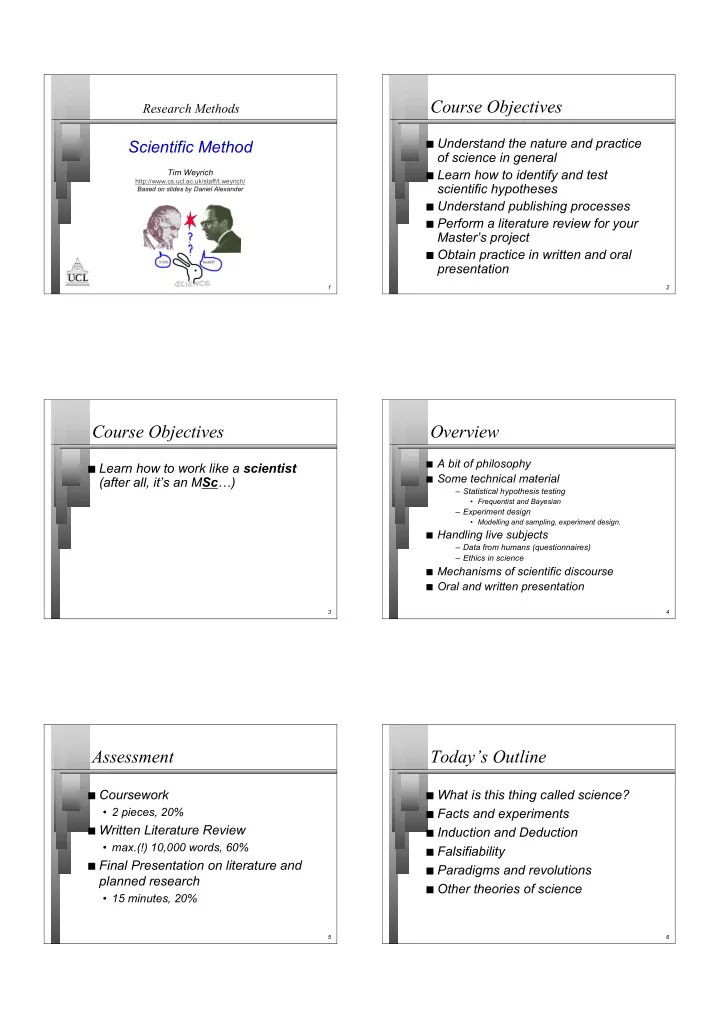
Course Objectives Research Methods Understand the nature and practice Scientific Method of science in general Tim Weyrich Learn how to identify and test http://www.cs.ucl.ac.uk/staff/t.weyrich/ scientific hypotheses Based on slides by


slide-1
SLIDE 1

1

Scientific Method

Tim Weyrich

http://www.cs.ucl.ac.uk/staff/t.weyrich/ Based on slides by Daniel Alexander

Research Methods

2

Course Objectives

■ Understand the nature and practice

  • f science in general

■ Learn how to identify and test

scientific hypotheses

■ Understand publishing processes ■ Perform a literature review for your

Master’s project

■ Obtain practice in written and oral

presentation

3

Course Objectives

■ Learn how to work like a scientist

(after all, it’s an MSc…)

4

Overview

■ A bit of philosophy ■ Some technical material – Statistical hypothesis testing

  • Frequentist and Bayesian

– Experiment design

  • Modelling and sampling, experiment design.

■ Handling live subjects – Data from humans (questionnaires) – Ethics in science ■ Mechanisms of scientific discourse ■ Oral and written presentation

5

Assessment

■ Coursework

  • 2 pieces, 20%

■ Written Literature Review

  • max.(!) 10,000 words, 60%

■ Final Presentation on literature and

planned research

  • 15 minutes, 20%

6

Today’s Outline

■ What is this thing called science? ■ Facts and experiments ■ Induction and Deduction ■ Falsifiability ■ Paradigms and revolutions ■ Other theories of science

slide-2
SLIDE 2

7

What is this thing called science? ?

8

What is this thing called science?

■ Knowledge derived from facts!

9

Facts and experiments

■ What are the facts

10

Facts and experiments

■ What are the facts

11

Facts and experiments

■ What are the facts ■ What people observe depends highly

  • n their experience
  • Botanist
  • Radiologist

■ Observations of facts are fallible

12

Facts and experiments

■ What are the facts ■ What experiments do you do? ■ Influence of theory on:

  • What experiments
  • Experimental setup
slide-3
SLIDE 3

13

Deduction and induction

■ How do we derive knowledge from

facts

■ Deductive logic: Move from given

premises (by definition true) to conclusions

■ Inductive logic: Move from particular

facts to general theory

14

Deduction and induction

Deductive logic is truth preserving

  • 1. All lectures on philosophy are boring
  • 2. This lecture is on philosophy
  • 3. Therefore, this lecture is boring
  • 1. All humans have 2 noses
  • 2. I am human
  • 3. Therefore, I have 2 noses

15

Deduction and induction

Inductive logic

  • Metal x1 expanded when heated at t1
  • Metal x2 expanded when heated at t2
  • Metal x3 expanded when heated at t3
  • Therefore, all metals expand when heated

Inductive logic as applied by the Christmas turkey (Bertrand Russel)

16

Deduction and induction

When can we apply inductive logic

  • N is large
  • N is varied
  • The theory does not contradict any

existing evidence

17

Deduction and induction

When can we apply inductive logic

  • N is large
  • N is varied
  • The theory does not contradict any

existing evidence

Problematic!!

  • When is N large enough
  • What should we vary
  • There are always exceptions

18

Deduction and induction

Further problems with inductionism

  • How can the existence of unobservable

concepts (DNA, atoms) be derived from

  • bservable facts
  • How can the correctness of inductionism

be induced?

slide-4
SLIDE 4

19

Deduction and induction

Facts acquired New predictions Theories

  • Rainbow example

20

Falsifiability

Karl Popper (1902 – 1994)

Worried about all kinds of ‘scientific theories” which were backed up by facts (Marxism, Freud)

These theories can be made to fit any data

But do they rule out anything?

21

Falsifiability

Eddington’s test of general relativity in 1919

22

Falsifiability

Science makes definite predictions

Science is therefore falsifiable

Observations are guided by and presuppose theories

Theories are tentative constructions created by scientists to overcome problems existing with previous theories

23

Falsifiability

A hypothesis is falsifiable if there exists a logically possible observation statement that is inconsistent with it

Example of falsification

  • Theory: All swans are white
  • Discovery of Australia
  • Observation of black swans
  • Theory is falsified

24

Falsifiability

Falsifiable statements

1.

It never rains on Wednesdays

2.

Either it is raining or it is not raining

3.

All points on a Euclidean circle are equidistant from the centre

4.

All metals expand when heated

5.

Heavenly objects fall in straight lines towards the earth

slide-5
SLIDE 5

25

Falsifiability

Falsifiable statements

1.

Luck is possible in speculation in sports

2.

When a ray of light is reflected from a plane mirror, the angle of incidence is equal to the angle of reflection

26

Falsifiability

Is string theory a valid scientific theory?

"For more than a generation, physicists have been chasing a willo-the-wisp called string theory. The beginning of this chase marked the end of what had been three-quarters of a century of

  • progress. Dozens of string-theory conferences have been held,

hundreds of new Ph.D.s have been minted, and thousands of papers have been written. Yet, for all this activity, not a single new testable prediction has been made, not a single theoretical puzzle has been solved. In fact, there is no theory so far—just a set of hunches and calculations suggesting that a theory might

  • exist. And, even if it does, this theory will come in such a

bewildering number of versions that it will be of no practical use: a Theory of Nothing.

http://www.newyorker.com/archive/2006/10/02/061002crat_atlarge 27

Falsifiability

A caricature of Adler’s psychology

  • All behaviour is guided by feelings of

inferiority of some kind

  • Situation: Man is standing next to a

treacherous river and suddenly a child falls in.

  • What does he do?

28

Falsifiability

Degrees of falsifiability

a) Mars moves in an ellipse around the sun b) All planets move in ellipses around the sun

The set of potential falsifiers for a) is a subset of the set of potential falsifiers for b).

29

Falsifiability

The enterprise of science involves the proposal of highly falsifiable hypotheses, followed by deliberate and tenacious attempts to falsify them.

Science is trial and error.

Falsification is the major growth path

30

Falsifiability

Inductionism Only theories that are true are scientific Falsificationism Any theory (speculative or not) which is falsifiable is useful for the advancement of our knowledge The more precise a theory is the more falsifiable it is and thus the better

slide-6
SLIDE 6

31

Falsifiability

Progress of science

Set of problems

Set of hypotheses to deal with them

Falsification of many of these hypotheses

Further testing of the remaining successful hypotheses

New problems arise

Etc…

33

Falsifiability

Sophisticated falsification

Competing theories

New theory is accepted above previous ones if:

  • It is more falsifiable than the previous
  • ne
  • It predicts a new phenomenon not taken

into account in previous theories

35

Falsifiability

The discovery of Neptune

  • The orbit of Uranus did not fit with

Newtonian mechanics

  • A new planet was proposed which

disturbed Uranus’s orbit

  • A range of possible orbits for the new

planet was derived

  • The new planet (Neptune) was observed

in the range of predicted orbits!

36

Falsifiability

The proposal of highly risky new theories is not always a good thing

Progress is especially made if:

1.

A bold conjecture is confirmed.

2.

A cautious conjecture is falsified

Confirmation does have a role in the (intial) acceptance of theories

37

Limitations of falsifiability

Fact is inconsistent with theory

  • Experimentalist: “Theory is wrong”
  • Theorist: “Measurement is wrong”

Observations are theory-driven and

  • fallible. So if O is observed, which

falsifies T, then this will only mean that O|T is false

The observation of O is supplemented by auxiliary theory (measurement apparatus)

38

Limitations of falsifiability

Example: Tycho Brahé’s refutation of Copernicus

If the earth orbits the sun, the position

  • f the stars should differ during the

course of a year.

He did not observe this because he underestimated the distance to these

  • ther stars
slide-7
SLIDE 7

40

Limitations of falsifiability

■ Can we back up falsifiability by

historical examples

■ From Copernicus to Newton…

41

Paradigms and revolutions

Thomas Kuhn (1922 – 1996)

“The structure of scientific revolutions” pre-science – normal science – crisis – revolution (paradigm shift) – normal science – crisis - …

42

Paradigms and revolutions

■ Kuhn’s definition of a scientific

paradigm:

  • what is to be observed and scrutinised
  • the kind of questions that relate to the

subject

  • how these questions are to be

structured

  • how the results of scientific

investigations should be interpreted

43

Paradigms and revolutions

Scientists normally work within a paradigm.

Paradigm:

  • Sets the standard for legitimate work
  • Coordinates ‘puzzle-solving’
  • Distinguishes science from non-science
  • Has explicitly stated fundamental laws

and theoretical assumptions

44

Paradigms and revolutions

Paradigm:

  • Has standard ways to of applying these

laws

  • E.g.: Apply Newton’s law to predict

motion of planets, pendulums and billiard balls

  • Has also something to say about the

instruments of experimentation.

46

Paradigms and revolutions

Normal scientists don’t spend much time worrying about the paradigm

Anomalies do not falsify the paradigm but are new puzzles to be solved within the paradigm

Scientists are taught within the paradigm:

  • Solving standard problems
  • Perform a piece of research under

supervision (PhD)

slide-8
SLIDE 8

47

Paradigms and revolutions

Crisis and revolution

Existence of increasing number of anomalies which are

  • Fundamental
  • Long-standing

Occurrence of rival paradigms

New paradigm

1. is a new description of the world with new concepts 2. Asks new questions 3. Lives in a ‘different world’

48

Paradigms and revolutions

Function of normal science:

Enables direction of energy towards broadening the scope of the current paradigm.

Paradigms are interpreted differently by different research groups => Diversification of strategies within the paradigm.

49

Paradigms and revolutions

Limitations of Kuhn’s theory:

Not clear how different paradigms can be compared and how the best one can be chosen

Is Kuhn a relativist?

He didn’t think so…

Description of scientific practice instead of theory?

50

Paradigms and revolutions

Moving away from the exact sciences:

Psychology

  • Mentalism
  • Behaviourism
  • Cognitive Neuroscience

51

Other theories of science

Paul Feyerabend (1924 – 1994)

Against Method: Outline of an Anarchistic Theory of Knowledge

No distinction between science and non-science

“Anything goes” as scientific method

Science does not deserve its privileged status in Western society

52

Other theories of science

Bayesianism

New experimentalism

Constructive empericism

slide-9
SLIDE 9

53

Summary

■ The norms of scientific method

  • Hypothesis generation
  • Data gathering
  • Hypothesis non-rejection/rejection

■ An ‘ideology’ – a set of rules that are supposed to

be followed

■ In practice this happens only at a very small scale –

data that threatens the paradigm is usually suppressed in some way

■ But adherence to norms of scientific method

constitutes an idea to follow in practice

■ (If not, your papers won’t be published anyway!) ■ ‘Scientific truth’ is a social convention.