Core Claim Formal Methods in Software Development Computer - - PowerPoint PPT Presentation

core claim formal methods in software development
SMART_READER_LITE
LIVE PREVIEW

Core Claim Formal Methods in Software Development Computer - - PowerPoint PPT Presentation

Core Claim Formal Methods in Software Development Computer programs/systems are subject to exact reasoning. Computer programming is an exact science in that all the properties Wolfgang Schreiner of a program and all the consequences of


slide-1
SLIDE 1

Formal Methods in Software Development

Wolfgang Schreiner

Wolfgang.Schreiner@risc.jku.at

Research Institute for Symbolic Computation (RISC) Johannes Kepler University, Linz, Austria http://www.risc.jku.at

Wolfgang Schreiner http://www.risc.jku.at 1/19

Core Claim

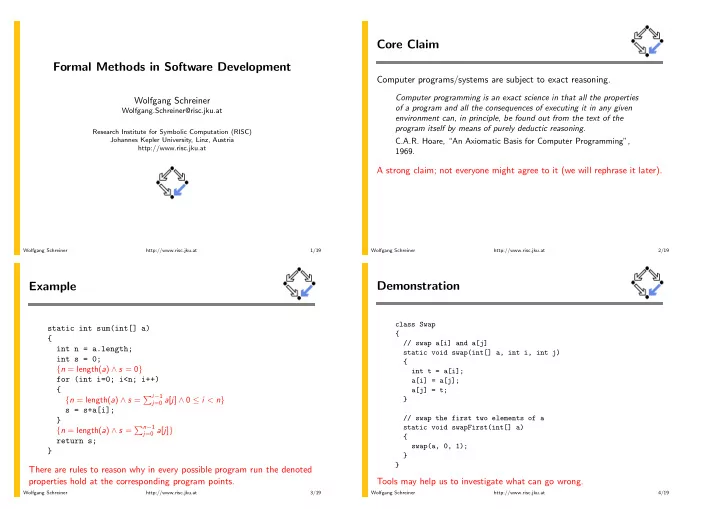
Computer programs/systems are subject to exact reasoning.

Computer programming is an exact science in that all the properties

  • f a program and all the consequences of executing it in any given

environment can, in principle, be found out from the text of the program itself by means of purely deductic reasoning. C.A.R. Hoare, “An Axiomatic Basis for Computer Programming”, 1969.

A strong claim; not everyone might agree to it (we will rephrase it later).

Wolfgang Schreiner http://www.risc.jku.at 2/19

Example

static int sum(int[] a) { int n = a.length; int s = 0; {n = length(a) ∧ s = 0} for (int i=0; i<n; i++) { {n = length(a) ∧ s = i−1

j=0 a[j] ∧ 0 ≤ i < n}

s = s+a[i]; } {n = length(a) ∧ s = n−1

j=0 a[j]}

return s; }

There are rules to reason why in every possible program run the denoted properties hold at the corresponding program points.

Wolfgang Schreiner http://www.risc.jku.at 3/19

Demonstration

class Swap { // swap a[i] and a[j] static void swap(int[] a, int i, int j) { int t = a[i]; a[i] = a[j]; a[j] = t; } // swap the first two elements of a static void swapFirst(int[] a) { swap(a, 0, 1); } }

Tools may help us to investigate what can go wrong.

Wolfgang Schreiner http://www.risc.jku.at 4/19

slide-2
SLIDE 2

Demonstration (Contd)

class Main { public static void main(String[] args) { int n = parseInt(args[0]); int[] a = new int[n]; init(a, n); print(a, n); Swap.swapFirst(a); print(a, n); } static int parseInt(String s) { return Integer.parseInt(s); } static void init(int[] a, int n) { for (int i=0; i<n; i++) a[i] = i; } static void print(int[] a, int n) { for (int i=0; i<n; i++) { System.out.print(a[i]); System.out.print(’ ’); } System.out.println(""); } }

Methods need to be specified (and correspondingly corrected).

Wolfgang Schreiner http://www.risc.jku.at 5/19

Aspects

This reasoning has various aspects:

  • Specification. State the properties that a program shall have.
  • Verification. Argue why a particular program satisfies a given

specification (in every execution).

  • Falsification. Detect that a program violates a specification (in some

execution).

  • Transformation. Transform a program such that it preserves its

behavior (but e.g. improves its execution time).

  • Derivation. Construct a program in such a way that it is guaranteed

to satisfy a given specification. This course deals with specification and verification/falsification.

Wolfgang Schreiner http://www.risc.jku.at 6/19

Properties of Reasoning

Principal advantage: clarity and generality.

The subjects of discussion are well defined. There are clear rules for the correctness of the arguments. The arguments may apply to infinitely many situations. Example: {x ≥ 0}x = x+1{x > 0} (for all x, to show that x is greater than zero after the execution of the assignment statement, it suffices to show that x is greater than or equal to zero before).

Principal disadvantage: abstraction.

We reason about models of the real world. Questionable whether the model adequately describes the real world. Example: the machine code generated by the compiler for x = x+1 may be wrong, or the processor may have an error in the implementation of the + operation, or . . .

All reasoning is relative to the assumptions of the model.

Wolfgang Schreiner http://www.risc.jku.at 7/19

Alternatives to Reasoning

  • Inspection. Let multiple people look at program and discuss it.

Actually, this is reasoning (but without a formal basis). Advantages: reduces programmer’s “system blindness”. Disadvantage: without a formal basis, it is unclear what rules guide the discussion.

  • Testing. Run the program with sample inputs and observe the

external effects (see what happens).

Advantage: the program is shown to work in certain situations. Disadvantage: you never know what happens with other inputs. In concurrent programs, you even do not now whether the same behavior is always exhibited with the same input.

Simulation/Visualization. Similar to testing, but also observe the internal behavior of the program.

Advantage: consideration not limited to external effects. Disadvantages: same as for testing.

Wolfgang Schreiner http://www.risc.jku.at 8/19

slide-3
SLIDE 3

The Power and Limits of Reasoning

Assume a correct proof that program P satisfies specification S. We have shown

that every model execution of P satisfies S, which is also true for all real executions of P if the model is adequate.

We have not shown

that any real execution of P satisfies S, Beware of bugs in the above code; I have only proved it correct, not tried it. Donald E. Knuth, 1977. that S captures your expectation of a real world behavior.

On the other hand, with a successful test run

we demonstrate that some real execution of P satisfies an expectation, we cannot show that this is true for all real executions of P. Program testing can be used to show the presence of bugs, but never to show their absence! E.W.Dijkstra, 1972.

Reasoning and testing have both their place.

Wolfgang Schreiner http://www.risc.jku.at 9/19

Core Claim Rephrased

True interpretation of Hoare’s statement:

Computer programming is an exact science in that all the properties

  • f a model program and all the consequences of executing it in any

given model environment can, in principle, be found out from the text

  • f the program itself by means of purely deductic reasoning.

Still a strong claim, but now everyone should be able to agree to it.

Wolfgang Schreiner http://www.risc.jku.at 10/19

The Role of Reasoning

Often: Post Factum

System Real Model System Specification Modeling Reasoning

Better: Pre Factum

System Real Model System Specification Implementing Reasoning

Write a specification, design a model system, reason about its correctness, then implement the design, then test the implementation.

Wolfgang Schreiner http://www.risc.jku.at 11/19

The Role of Reasoning

So the main role of reasoning is on program/system designs:

Design a principal solution to a given problem. Argue about the correctness of the design. Thus find design errors; repeat process until you are satisfied.

The main role of testing is on program/system implementations:

Map the design to real computers using real programming languages. Run the implementation on sample inputs and check its behavior. Thus find implementation errors; repeat process until you are satisfied.

This is a big difference from “proving that a program is correct”.

Wolfgang Schreiner http://www.risc.jku.at 12/19

slide-4
SLIDE 4

The Role of Reasoning

Apparently, there are various approaches/tools that seem to apply reasoning to real systems . . . Typical goal: prevent runtime errors.

Division by zero, array index out of bounds, null pointer dereferences, memory corruptions (buffer overflows). Tool that takes program as input and detects program errors.

Actually: operate on automatically constructed models.

Focus is on falsification (finding errors). Investigate whether “bad” states might occur in model. Detected/assumed error in model may imply error in real system.

Application to mission-critical/important pieces of software.

Airplane control software. MS Windows device driver.

We always reason about models.

Wolfgang Schreiner http://www.risc.jku.at 13/19

The Origins: Sequential Programs

A personal selection. Robert W. Floyd, 1967: Assigning Meaning to Programs. C.A.R. Hoare, 1969: An Axiomatic Basis for Computer Programming. C.A.R. Hoare, 1972: Proof of Correctness of Data Representations. Edsger W. Dijkstra, 1975: Guarded Commands, Nondeterminacy and Formal Derivation of Programs. Edsger W. Dijkstra, 1976: A Discipline of Programming. Luckham et al, 1979: Stanford PASCAL Verifier - User Manual. David Gries, 1981: The Science of Programming. Axiomatic program semantics, program verification.

Wolfgang Schreiner http://www.risc.jku.at 14/19

The Origins: Concurrent Programs

A personal selection. Dijkstra, 1968: Cooperating Sequential Processes. Ashcorft and Manna, 1971: Formalization of Properties of Parallel Programs. Owicki, Gries, 1976: An Axiomatic Proof Technique for Parallel Programs. C.A.R. Hoare, 1978: Communicating Sequential Processes. Armin Pnueli, 1979: The Temporal Logic of Programs. Leslie Lamport, 1980: The “Hoare Logic” of Concurrent Programs. Robin Milner, 1982: A Calculus of Communicating Systems. Axiomatic semantics, process calculus/algebra, temporal logic.

Wolfgang Schreiner http://www.risc.jku.at 15/19

Later History

In the 1980s, program verification was considered “dead” by many.

Little automation, much manual effort by programmer. Handling of toy programs only.

In the 1990s, model checkers became successful.

Fully automatically check (finite state) models. Verification of hardware and of communication protocols. Systems with state spaces of size 10100 and beyond.

Since the late 1990s, interest in software verification revived.

Model checking/proving of critical pieces of software. Focus often more on falsification than on verification.

New applications such as proof-carrying-code (PCC).

Ship machine code together with proof that code satisfies certain safety/security properties.

New issues such as security considered. Formal methods are a hot topic today (also in industry).

Wolfgang Schreiner http://www.risc.jku.at 16/19

slide-5
SLIDE 5

Languages and Systems

Specification Languages

General: VDM (Vienna Development Method), Z, ASM (Abstract State Machines), OCL (Object Constraint Language for UML), . . . Bound to programming language: SPARK (SPADE Ada Kernel), Larch/C++, JML (Java Modeling Language), Spec#, . . . Algebraic/axiomatic: OBJ, ACT One, Larch, CASL, . . . Concurrent: Unity, Estelle, Lotos, TLA, . . . Mobile: pi-Calculus, . . .

Model Checkers

Spin, SMV, BLAST, Bandera, SLAM, VeriSoft, . . .

Proving Assistants

PVS, HOL, Isabelle, Coq, Theorema, . . .

Verification Environments

Edinburgh Concurrency Workbench, STeP (Stanford Temporal Prover), KIV (Karlsruhe Interactive Verifier), JIVE (Java Interactive Verification Environment), LOOP, Krakatoa/Why, KeY, Mobius, . . .

Wolfgang Schreiner http://www.risc.jku.at 17/19

Course Outline

Specifying and verifying sequential programs.

Hoare calculus and predicate transformers. Computer-supported program verification (RISC ProofNavigator).

Specifying and verifying Java programs.

Java modeling language (JML toolset). Extended static checking of Java programs (ESC/Java2). Verifying Java programs (KeY).

Specifying and verifying concurrent systems.

State graphs for synchronous and asynchronous systems. Specifying properties of concurrent systems in temporal logic. Verifying and model-checking concurrent systems (Spin).

Guest lecture (Janos Sztrik, University of Debrecen).

Queueing theory and its application to the performance analysis of computer systems. Mandatory for KV4 students (also recommended for KV3 students).

14 lectures, 3 of them mandatory for KV4 (optional for KV3).

Wolfgang Schreiner http://www.risc.jku.at 18/19

Grading System

Combined lecture (KV3 for software engineering, KV4 for computer mathematics): exercises and final exam. 10 exercises (KV4: at least one from guest lecture).

KV3: best 7 are used for grading (350 points needed). KV4: best 9 are used for grading (450 points needed).

Final exam.

KV3: 4 questions. KV4: 5 questions (1 from guest lecture).

Each part must be positive; each accounts for 50% of the overall grade.

Wolfgang Schreiner http://www.risc.jku.at 19/19