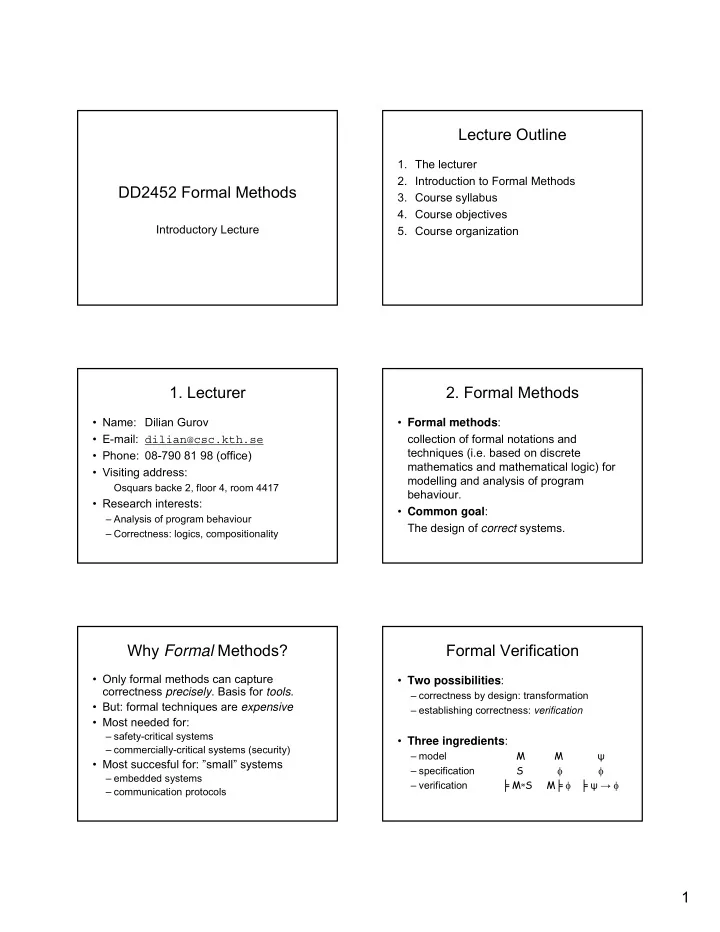
Lecture Outline 1. The lecturer 2. Introduction to Formal Methods - - PDF document

lecture outline
SMART_READER_LITE
LIVE PREVIEW

Lecture Outline 1. The lecturer 2. Introduction to Formal Methods - - PDF document

Lecture Outline 1. The lecturer 2. Introduction to Formal Methods DD2452 Formal Methods 3. Course syllabus 4. Course objectives Introductory Lecture 5. Course organization 1. Lecturer 2. Formal Methods Name: Dilian Gurov Formal


slide-1
SLIDE 1

1

DD2452 Formal Methods

Introductory Lecture

Lecture Outline

  • 1. The lecturer
  • 2. Introduction to Formal Methods
  • 3. Course syllabus
  • 4. Course objectives
  • 5. Course organization
  • 1. Lecturer
  • Name: Dilian Gurov
  • E-mail: dilian@csc.kth.se
  • Phone: 08-790 81 98 (office)
  • Visiting address:

Osquars backe 2, floor 4, room 4417

  • Research interests:

– Analysis of program behaviour – Correctness: logics, compositionality

  • 2. Formal Methods
  • Formal methods:

collection of formal notations and techniques (i.e. based on discrete mathematics and mathematical logic) for modelling and analysis of program behaviour.

  • Common goal:

The design of correct systems.

Why Formal Methods?

  • Only formal methods can capture

correctness precisely. Basis for tools.

  • But: formal techniques are expensive
  • Most needed for:

– safety-critical systems – commercially-critical systems (security)

  • Most succesful for: ”small” systems

– embedded systems – communication protocols

Formal Verification

  • Two possibilities:

– correctness by design: transformation – establishing correctness: verification

  • Three ingredients:

– model M M ψ – specification S φ φ – verification ╞ M≈S M╞ φ ╞ ψ → φ

slide-2
SLIDE 2

2

Main Challenge

  • Real systems are large and complex
  • Only restricted problems are decidable,

i.e. algorithmically solvable

  • Scalablity requires efficient solutions,

i.e. tractability What do we do?

Abstraction

  • Key technique for handling complexity!

separation of concerns; buidling models

  • Key questions:

– What are the important properties? – What is the ”right” abstraction level? – How does the abstract model relate to the concrete system? (”modelling gap”) – How to interpret the results of the analysis?

Main Schools

  • Hoare Logic
  • Process Algebra
  • Model Checking
  • Theorem Proving

We will focus on the first and the third of these approaches.

  • 3. Course Syllabus

Part I. Hoare Logic and Program Verification Goal: Correctness of data manipulation Models: Source code (Java) Specs: Hoare Logic (JML) Method: Proof tableaux; VCG + ATP Tool: ESC/Java2

Course Syllabus

Part II. Temporal Logic and Model Checking Goal: Correctness of state sequences Models: Promela Specs: Temporal logic formulas (LTL) Method: Model checking Tool: SPIN

  • 4. Course Objectives
  • Aim: provide working familiarity with main

methods and tools, in theory and in practice.

  • Grading: to pass the course, a student has to

demonstrate the ability to apply the methods discussed in the course; for the highest grade he/she has also to be proficient in the theoretical foundations of these methods.

slide-3
SLIDE 3

3

Course Objectives

After the course, you should be able to:

  • 1. Independently select a suitable modelling

approach for a given problem;

  • 2. Argue informally and formally for the soundness

and limitations of the chosen approach;

  • 3. Identify, specify and verify important system

properties using suitable automated tools;

  • 4. Correctly interpret and evaluate the results of

the analysis.

  • 5. Course Organization
  • 17 one-hour lectures/tutorials:

mixed

  • 2 lab sessions:

for reporting only!

  • 1 written exam:

5 hours, open-book

  • Course web page:

www.csc.kth.se/DD2452/form09/

  • Course board: sv. ”kursnämnd”

volunteers?

Course Literature

  • Course book:

”Logic in Computer Science” by Huth and Ryan (see Kårbokhandeln)

  • Additional material: on the web page

don’t print without need!

Labs

  • ESC/Java2 lab:

correctness of an ADT implementation

  • SPIN lab:

correctness of a communication protocol

Tools

  • ESC/Java2:

module add escjava escjava2

  • SPIN lab:

module add spin xspin