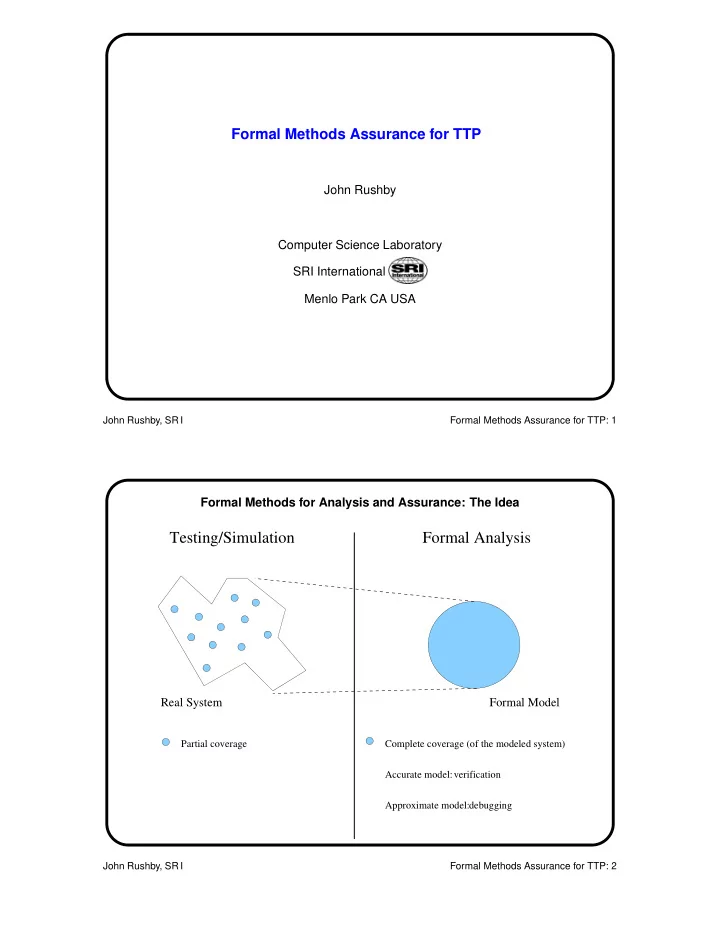
Testing/Simulation Formal Analysis Real System Formal Model - - PDF document

testing simulation formal analysis
SMART_READER_LITE
LIVE PREVIEW

Testing/Simulation Formal Analysis Real System Formal Model - - PDF document

Formal Methods Assurance for TTP John Rushby Computer Science Laboratory SRI International Menlo Park CA USA John Rushby, SR I Formal Methods Assurance for TTP: 1 Formal Methods for Analysis and Assurance: The Idea Testing/Simulation Formal

slide-1
SLIDE 1

Formal Methods Assurance for TTP

John Rushby Computer Science Laboratory SRI International Menlo Park CA USA

John Rushby, SR I Formal Methods Assurance for TTP: 1

Formal Methods for Analysis and Assurance: The Idea Real System

Partial coverage

Testing/Simulation Formal Analysis

Formal Model

Complete coverage (of the modeled system) Accurate model: Approximate model: verification debugging John Rushby, SR I Formal Methods Assurance for TTP: 2

slide-2
SLIDE 2

Formal Methods

  • Build a mathematical model of the system or algorithm of interest
  • And of its environment

If it’s a fault-tolerant system, the environment includes the fault model

  • Examine all possible behaviors of the system in interaction with its environment

Model checking: by brute force enumeration (finite model) Theorem proving: using symbolic representations

  • cf. 5*5-3*3 = (5-3)(5+3) and
✂ ✄✆☎✞✝✟✄✡✠☞☛ ✂ ☎✞✝✍✌✎☛ ✂✑✏ ✝✍✌
  • Model checking is largely automatic; it’s good for debugging

Must often approximate to get finite model, but experience is that you find more bugs by exploring all the behaviors of an approximation than just some of the behaviors of the real thing (then called formal refutation)

  • Theorem proving is automated but requires skilled human guidance;

it’s good for assurance (then called formal verification)

John Rushby, SR I Formal Methods Assurance for TTP: 3

Formal Methods Assurance and TTP

  • TTP/C is already highly assured by traditional means

Testing; fault injection; field experience

  • But formal methods provide complementary assurance

Complete exploration of model vs. partial exploration of implementation

  • Valuable for highly critical applications with strong certification requirements

Allowed or encouraged for some (DO-178B and DO-180 for aircraft)

Required by others (UK DEF-STAN 00-55)

  • Provides insight and design tools for developers of advanced TTP concepts
  • Provides precise, accurate formal specification of system and its

assumptions, properties, interfaces

Including exact characterization of worst case fault model

  • Provides foundation for formal assurance of applications that use TTP

John Rushby, SR I Formal Methods Assurance for TTP: 4

slide-3
SLIDE 3

Context For Our Work

  • NASA project to develop and apply formal methods assurance for advanced FADEC

being developed by GE/Honeywell

  • Architecture uses a novel TTP configuration
  • Formal assurance being performed by SRI, with collaboration from University of Ulm

(Holger Pfeifer in the group of Prof. Friedrich von Henke)

  • Uses various model checkers and SRI’s theorem proving system PVS
  • Initial focus on clock synchronization and group membership

John Rushby, SR I Formal Methods Assurance for TTP: 5

Status and Near-Term Plans

  • Have formally verified a simplified version of the membership algorithm using PVS

Required development of new formal verification method

Developing formal verification of the full algorithm

  • Also have a formal specification suitable for model checking

Will use to help evaluate FADEC architecture

  • Have formally verified clock synchronization algorithm using PVS

Rather complex, strong fault model

Developing new treatment, hybrid fault model

  • Developing formal model of the interaction of synchronization and group

membership (each depends on the other)

  • Completion: end of 2001

John Rushby, SR I Formal Methods Assurance for TTP: 6

slide-4
SLIDE 4

Effort for Formal Refutation and Verification

Knowledge

refutation verification

Effort about system

John Rushby, SR I Formal Methods Assurance for TTP: 7

Longer Term Plans

  • Near-term focus is on the algorithms of TTP itself (internal concerns)
  • Longer-term addresses systems built on TTP (external concerns)

Sponsored by DARPA and by NASA

Formal assurance from control model (e.g., in Matlab)

Down to fault-tolerant implementation

That uses the services of TTP (and its tool chain)

  • Already formally verified a model of time-triggered computation
  • One goal is to make “lite” formal methods “disappear” into the standard engineering

process; for example

Strong static checking for Stateflow (all cases covered etc.)

Formal test-case generation

  • Deployment: 2003

John Rushby, SR I Formal Methods Assurance for TTP: 8

slide-5
SLIDE 5

Disappearing Formal Methods

refutation verification

automated abstraction invisible fm

Knowledge Effort about system

John Rushby, SR I Formal Methods Assurance for TTP: 9

Summary and Prospects

  • Formal assurance for the internal mechanisms of TTP provides added value

to all users at no cost

An additional discriminator in some markets

  • Integrated formal assurance path from external application to TTP implementation

will be valuable in highly critical systems

Could also provide formal verification for TTP implementation (

✒ arch and ✒ code) ✁

We previously verified a complete avionics processor at this level (Collins AAMP)

  • And “disappearing” formal methods could reduce development time and costs

for all systems

  • Formal methods tools are under continuous development and rapidly becoming

more powerful and usable

We’ve been building them for 25 years

New version of PVS, and new systems SAL and ICS will be released in 2001

John Rushby, SR I Formal Methods Assurance for TTP: 10

slide-6
SLIDE 6

To Learn More

  • Check out papers and technical reports at

http://www.csl.sri.com/fm.html, in particular

Verification Diagrams Revisited: Disjunctive Invariants for Easy Verification

http://www.csl.sri.com/˜rushby/cav00.html

Formal Verification of the TTP Group Membership Algorithm http://www.

informatik.uni-ulm.de/ki/PVS/membership.html

Formal Verification for Time-Triggered Clock Synchronization

http://www.informatik.uni-ulm.de/ki/PVS/ tta-clocksync-dcca7.html

Systematic Formal Verification for Fault-Tolerant Time-Triggered Algorithms

http://www.csl.sri.com/reports/html/tse99.html

  • Information about our verification system, PVS, and the system itself are available

from http://pvs.csl.sri.com

Freely available under license to SRI

Built in Allegro Lisp for Solaris, or Linux

John Rushby, SR I Formal Methods Assurance for TTP: 11