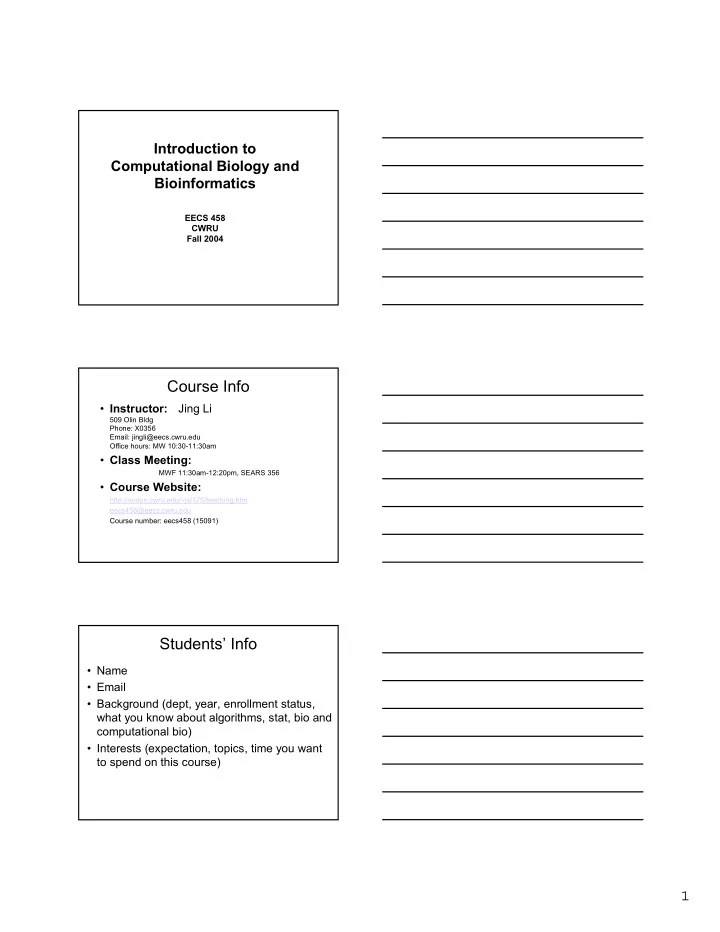
Course Info Instructor: Jing Li 509 Olin Bldg Phone: X0356 - - PDF document

course info
SMART_READER_LITE
LIVE PREVIEW

Course Info Instructor: Jing Li 509 Olin Bldg Phone: X0356 - - PDF document

Introduction to Computational Biology and Bioinformatics EECS 458 CWRU Fall 2004 Course Info Instructor: Jing Li 509 Olin Bldg Phone: X0356 Email: jingli@eecs.cwru.edu Office hours: MW 10:30-11:30am Class Meeting: MWF


slide-1
SLIDE 1

1

Introduction to Computational Biology and Bioinformatics

EECS 458 CWRU Fall 2004

Course Info

  • Instructor:

Jing Li

509 Olin Bldg Phone: X0356 Email: jingli@eecs.cwru.edu Office hours: MW 10:30-11:30am

  • Class Meeting:

MWF 11:30am-12:20pm, SEARS 356

  • Course Website:

http://vorlon.cwru.edu/~jxl175/teaching.htm eecs458@eecs.cwru.edu Course number: eecs458 (15091)

Students’ Info

  • Name
  • Email
  • Background (dept, year, enrollment status,

what you know about algorithms, stat, bio and computational bio)

  • Interests (expectation, topics, time you want

to spend on this course)

slide-2
SLIDE 2

2

Areas in computational biology

  • Sequencing: to determine the sequence
  • f DNA and Proteins
  • Sequence analysis:

– Sequence comparison – Gene recognition – Pattern discovery

  • Statistical genetics/polymorphisms:

– Gene mapping – Linkage and association study

Areas in computational biology

  • Comparative genomics: phylogenetics,

evolution

  • Functional genomics: gene expression

array

  • System biology

– Pathways – Regulatory networks – Protein interaction networks

Areas in computational biology

  • Proteomics:

– Sequencing, folding/structure, functions

  • Drug discovery in the post-genomic era

– Biomarkers – High throughput screen – Docking

slide-3
SLIDE 3

3

Course Overview

  • Intro to molecular bio

– Cell, DNA, RNA, Proteins – Central dogma – Human genome – DNA sequencing

  • Intro to probability, hidden Markov

models, and applications

Course Overview

  • Genomics (sequence analysis)

– Sequence alignments (dynamic programming, hmm) – Gene prediction (hmm) – Motif/Pattern identification (suffix tree, statistical methods)

  • Genomic variations

– Gene mapping – Haplotype inference – Population genetics

Course Overview

  • Evolution

– Phylogeny reconstruction

  • Functional genomics

– Microarray data analysis (mining and learning)

  • Proteomics

– Sequencing – Structure/function prediction

  • System bio

– Pathways – Protein interaction networks

slide-4
SLIDE 4

4

Main Purposes

  • Basic concepts/techniques in molecular

bio/genetics

  • Current topics in comp bio
  • Mathematical methods:

– DP, Graph, String algorithms – Learning algorithms (HMM, Clustering/ Classification) – Statistical methods

  • Research experience

Course Format / Grade

  • HW: 4 assignments, 40%

– Mainly design/analysis of algorithms

  • Project/presentation: 60%

– Team of 2-3 – Topics will be provided or selected by your own. – Examples: proposal of new methods, improvement on previous results, applying methods on new formulations. – Presentation in class. – Term paper.

What you will not learn here:

  • How to use existing software/databases
  • How to collect data experimentally
  • Molecular biology
  • Genetics/ Epidemiology
  • Statistics
slide-5
SLIDE 5

5

Relevant Courses

  • EECS 433: Database Systems
  • EECS 435: Data Mining
  • EECS 454: Analysis of Algorithms
  • EPBI 452: Statistical Methods in Human Genetics
  • EPBI 457: Genetic Linkage Analysis
  • EPBI 471: Statistical Aspects of Data Mining
  • EPBI 491: Epidemiology: Application of Theory and Methods
  • EPBI 492: Epidemiology: Statistical Methods and Modeling
  • GENE 508: Bioinformatics and Computational Genomics
  • GENE 509: Complex Genetic Traits
  • STAT 445/446: Theoretical Statistics I/II
  • BIOC 618: Biology and Mathematics of Microarray Studies

Reference books

0262161974 0521585198

Reference books

0412993910 0521629713

slide-6
SLIDE 6

6

Reference books

026202506 0805346333

Reference books

0131439812

http://www.ncbi.nlm.nih.gov/books/

Acknowledgements

  • Professor Tao Jiang
  • Professor Stefano Lonardi