Course Content Web Technologies and Applications Introduction - - PowerPoint PPT Presentation

course content web technologies and applications
SMART_READER_LITE
LIVE PREVIEW

Course Content Web Technologies and Applications Introduction - - PowerPoint PPT Presentation

Course Content Web Technologies and Applications Introduction Databases & WWW Internet and WWW SGML / XML Winter 2001 Protocols Managing servers HTML and beyond Search Engines CMPUT 499: DBMS and WWW


slide-1
SLIDE 1

Web Technologies and Applications University of Alberta

 Dr. Osmar R. Zaïane, 2001

1

Web Technologies and Applications

  • Dr. Osmar R. Zaïane

University of Alberta

Winter 2001

CMPUT 499: DBMS and WWW

Web Technologies and Applications University of Alberta

 Dr. Osmar R. Zaïane, 2001

2

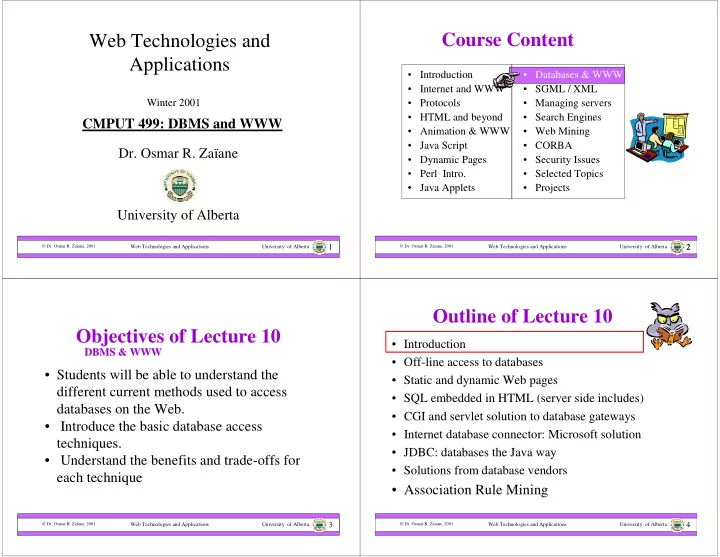
  • Databases & WWW
  • SGML / XML
  • Managing servers
  • Search Engines
  • Web Mining
  • CORBA
  • Security Issues
  • Selected Topics
  • Projects

2

Course Content

  • Introduction
  • Internet and WWW
  • Protocols
  • HTML and beyond
  • Animation & WWW
  • Java Script
  • Dynamic Pages
  • Perl Intro.
  • Java Applets

Web Technologies and Applications University of Alberta

 Dr. Osmar R. Zaïane, 2001

3

Objectives of Lecture 10

DBMS & WWW DBMS & WWW

  • Students will be able to understand the

different current methods used to access databases on the Web.

  • Introduce the basic database access

techniques.

  • Understand the benefits and trade-offs for

each technique

Web Technologies and Applications University of Alberta

 Dr. Osmar R. Zaïane, 2001

4

Outline of Lecture 10

  • Introduction
  • Off-line access to databases
  • Static and dynamic Web pages
  • SQL embedded in HTML (server side includes)
  • CGI and servlet solution to database gateways
  • Internet database connector: Microsoft solution
  • JDBC: databases the Java way
  • Solutions from database vendors
  • Association Rule Mining
slide-2
SLIDE 2

Web Technologies and Applications University of Alberta

 Dr. Osmar R. Zaïane, 2001

5

Introduction

  • WWW
  • user friendly
  • popular
  • accessible
  • cost effective
  • Databases
  • structured and organized
  • secure/ reliable
  • most up-to-date information
  • scalable
  • high availability
  • automatic recovery
  • data integrity

Motivation

Web Technologies and Applications University of Alberta

 Dr. Osmar R. Zaïane, 2001

6

HTTP Client-Server Architecture

Client Server Request Answer H T M L

Web Technologies and Applications University of Alberta

 Dr. Osmar R. Zaïane, 2001

7

HTTP Client-Server Architecture

Client Server Request Answer H T M L H H HTTP Response header Authentication

Stateless Session

Web Technologies and Applications University of Alberta

 Dr. Osmar R. Zaïane, 2001

8

Database Client-Server Architecture

User Status Server Client

Requests Answers Open connection Close connection

Database User status is “remembered” during a session.

slide-3
SLIDE 3

Web Technologies and Applications University of Alberta

 Dr. Osmar R. Zaïane, 2001

9

Simulation of status in stateless session

Client Server Request Answer H T M L H H State information State information

(cookies or hidden variables)

Web Technologies and Applications University of Alberta

 Dr. Osmar R. Zaïane, 2001

10

Outline of Lecture 10

  • Introduction
  • Off-line access to databases
  • Static and dynamic Web pages
  • SQL embedded in HTML (server side includes)
  • CGI and servlet solution to database gateways
  • Internet database connector: Microsoft solution
  • JDBC: databases the Java way
  • Solutions from database vendors
  • Association Rule Mining

Web Technologies and Applications University of Alberta

 Dr. Osmar R. Zaïane, 2001

11

Off-line access to databases

  • Periodically extract data from database and

generate static pages based on common usage and requests

  • Navigation between pages is done through

static links generated in the HTML pages

Web Technologies and Applications University of Alberta

 Dr. Osmar R. Zaïane, 2001

12

Off-line access to databases

Database Client Server 1 2 3 4

Generate Request Access Answer HTML

slide-4
SLIDE 4

Web Technologies and Applications University of Alberta

 Dr. Osmar R. Zaïane, 2001

13

Off-line access to databases

  • Can be indexed by search engines
  • Easy to implement
  • Can be cached by client and accessed off-line
  • Limited navigation
  • Can not access data unless page has been

generated

  • Data not up-to-date

Web Technologies and Applications University of Alberta

 Dr. Osmar R. Zaïane, 2001

14

Outline of Lecture 10

  • Introduction
  • Off-line access to databases
  • Static and dynamic Web pages
  • SQL embedded in HTML (server side includes)
  • CGI and servlet solution to database gateways
  • Internet database connector: Microsoft solution
  • JDBC: databases the Java way
  • Solutions from database vendors
  • Association Rule Mining

Web Technologies and Applications University of Alberta

 Dr. Osmar R. Zaïane, 2001

15

Static vs. Dynamic

Client Server

Request Answer

HTML

Fetch

Client Server

Request Answer

HTML

Fetch Generate

An HTML document stored in a file is a static Web page. Unless the file is edited, its content does not change. A dynamic Web page is generated or partially generated each time it is accessed.

Web Technologies and Applications University of Alberta

 Dr. Osmar R. Zaïane, 2001

16

Outline of Lecture 10

  • Introduction
  • Off-line access to databases
  • Static and dynamic Web pages
  • SQL embedded in HTML (server side includes)
  • CGI and servlet solution to database gateways
  • Internet database connector: Microsoft solution
  • JDBC: databases the Java way
  • Solutions from database vendors
  • Association Rule Mining
slide-5
SLIDE 5

Web Technologies and Applications University of Alberta

 Dr. Osmar R. Zaïane, 2001

17

Server Side Includes

A server side include is a simple HTML-like tag. The Web server parses HTML files and replaces the included tags with their value or output in the HTML file.

<HTML> <HEAD> <TITLE> My Page</TITLE> </HEAD> <BODY> <H1>My Home Page</H1> <P> <!--# include file=“top_menu”--> <p> </BODY></HTML>

<!--#INCLUDE FILE=“file”--> <!--#EXEC CMD=“todo.exe”--> <!--#ECHO VAR=“DATE_LOCAL”>

Web Technologies and Applications University of Alberta

 Dr. Osmar R. Zaïane, 2001

18

Server Side Includes

  • Results generated on the fly
  • Pages easy to maintain
  • Personalized pages for each user
  • All files need to be parsed
  • Slow

Web Technologies and Applications University of Alberta

 Dr. Osmar R. Zaïane, 2001

19

SQL database connectivity using server side includes

  • W3-msql (Hughes Technologies)
  • <! msql connect www.cs.sfu.ca>
  • <! msql database students>
  • <! msql query “select studid, name, firstname from students” q1>
  • <! msql print “Student:@q1.0 Name: @q1.2 @q1.1<br>“>
  • <! msql fetch q1>
  • <! msql free q1>
  • CompuServe Internet Office Webserver
  • <!--#SQL SQL=“select studid, firstname, name from students” format=“Student:

%s Name: %s %s”-->

  • Connectivity to miniSQL, Sybase, Oracle, Informix and any ODBC compliant

Web Technologies and Applications University of Alberta

 Dr. Osmar R. Zaïane, 2001

20

Outline of Lecture 10

  • Introduction
  • Off-line access to databases
  • Static and dynamic Web pages
  • SQL embedded in HTML (server side includes)
  • CGI and servlet solution to database gateways
  • Internet database connector: Microsoft solution
  • JDBC: databases the Java way
  • Solutions from database vendors
  • Association Rule Mining
slide-6
SLIDE 6

Web Technologies and Applications University of Alberta

 Dr. Osmar R. Zaïane, 2001

21

Common Gateway Interface

  • Filling out an HTML form
  • Clicking on a link in an HTML page

CGI is a set of specification for passing information between a client Web browser, a Web server and an application (CGI application). Client Web Server

Request + Data Answer

H T M L

CGI Application

Data

H T M L

processes data & generates HTML

Web Technologies and Applications University of Alberta

 Dr. Osmar R. Zaïane, 2001

22

Common Gateway Interface

  • Client sends request (GET or POST)
  • Server receives request (name of CGI + data)
  • Server launches CGI application and passes

request to it by means of environment variables

  • CGI application returns data to server (STDOUT).

First line contains the MIME content-type

  • Server adds standard HTTP header and returns

data to client.

Web Technologies and Applications University of Alberta

 Dr. Osmar R. Zaïane, 2001

23

Common Gateway Interface

Client Web Server

Request + Data Answer

H T M L

CGI Application

Data

H T M L

processes data & generates HTML

Database

  • Embed SQL in CGI application to access database
  • Use hidden state information and user supplied data to build

database queries

  • Generate HTML based on query results

Web Technologies and Applications University of Alberta

 Dr. Osmar R. Zaïane, 2001

24

Common Gateway Interface

  • Executed on the server
  • Implemented in any programming or scripting

language

  • Started by server upon client request
  • Generated HTML are not indexed by search engines
  • New application process for each request
  • Does not scale well because of the overhead of

spawning new application process for each request

slide-7
SLIDE 7

Web Technologies and Applications University of Alberta

 Dr. Osmar R. Zaïane, 2001

25

Multi-tier

Database Application Middleware

  • Modularity:

specialized layers

  • Scalability:

replicated layers

  • Flexibility:

interchange layers

  • Can be slow,

excessive overhead

  • Appropriate for

standard interfaces

  • Fault-tolerant

Web Technologies and Applications University of Alberta

 Dr. Osmar R. Zaïane, 2001

26

Open DataBase Connectivity

O D B C ODBC calls Application

SQL server driver Sybase driver Oracle driver Other drivers SQL server Sybase Oracle Other DBMSs

Web Technologies and Applications University of Alberta

 Dr. Osmar R. Zaïane, 2001

27

Outline of Lecture 10

  • Introduction
  • Off-line access to databases
  • Static and dynamic Web pages
  • SQL embedded in HTML (server side includes)
  • CGI and servlet solution to database gateways
  • Internet database connector: Microsoft solution
  • JDBC: databases the Java way
  • Solutions from database vendors
  • Association Rule Mining

Web Technologies and Applications University of Alberta

 Dr. Osmar R. Zaïane, 2001

28

Microsoft Internet Information Server

  • Used to create applications activated by Web users
  • ISAPI used to create applications that run as DLLs on Web

server

  • Better performance than CGI because DLLs are loaded into

memory at server run-time

  • Less overhead because each request does not start a separate

process

  • Unstable: if ISAPI DLL application has bugs, it may crash the

entire server

  • Proprietary API

Internet Server API

slide-8
SLIDE 8

Web Technologies and Applications University of Alberta

 Dr. Osmar R. Zaïane, 2001

29

Internet Server API

Client Web browser Web Server

Request Answer

ISAPI Application Server Client Web browser Web Server

Request Answer

ISAPI Filter Server

Allows pre- processing of requests and post-processing

  • f responses

ISAPI DLL application becomes part of the Web server

Web Technologies and Applications University of Alberta

 Dr. Osmar R. Zaïane, 2001

30

Internet Database Connector

Access to databases is accomplished through a component of the Internet information server called the Internet Database Connector (IDC). The IDC is an ISAPI DLL (httpodbc.dll) that uses ODBC to gain access to databases.

Client Web browser Web Server

Request Answer

httpodbc.dll Server

O D B C driver

Database Server

Web Technologies and Applications University of Alberta

 Dr. Osmar R. Zaïane, 2001

31

Internet Database Connector

Client Web browser Web Server IIS

HTTP request HTML doc

httpodbc.dll Server

O D B C DBMS driver

Database Server IDC file HTX file

1 2 3 SQL request 4 5 SQL result data 6 7 8

1- HTTP request 2- ISAPI call to IDC 3- Use idc file query description 4- SQL request 5- SQL result data 6- merge result with template 7- MIME wrapping 8- Return HTML document

Web Technologies and Applications University of Alberta

 Dr. Osmar R. Zaïane, 2001

32

Internet Database Connector

IDC file contains:

– data source name – link to template htx file – SQL statement

HTX file contains:

– HTML document – additional tags to format data returned IDC merges the data being returned with the HTML extension template

slide-9
SLIDE 9

Web Technologies and Applications University of Alberta

 Dr. Osmar R. Zaïane, 2001

33

Outline of Lecture 10

  • Introduction
  • Off-line access to databases
  • Static and dynamic Web pages
  • SQL embedded in HTML (server side includes)
  • CGI and servlet solution to database gateways
  • Internet database connector: Microsoft solution
  • JDBC: databases the Java way
  • Solutions from database vendors
  • Association Rule Mining

Web Technologies and Applications University of Alberta

 Dr. Osmar R. Zaïane, 2001

34

Databases the Java Way

Client Web Browser Java Applet Web Server CGI or Java Application

HTTP TCP/IP Java TCP/IP

  • HTTP TCP/IP connection is stateless
  • Java connection can have an application session and store

state information

  • Java applets run on client side and can bypass Web

browser-Web server connection

  • Java is multi-threaded (multi-threaded socket server)

Web Technologies and Applications University of Alberta

 Dr. Osmar R. Zaïane, 2001

35

Java DataBase Connectivity

Client Web Browser Java Applet Web Server CGI or Java Application

Java Application JDBC Driver Manager

JDBC driver JDBC driver

DBMS2 DBMS1

Web Technologies and Applications University of Alberta

 Dr. Osmar R. Zaïane, 2001

36

JDBC - ODBC Bridge

  • A sophisticated JDBC driver
  • Allows developers to use

existing ODBC drivers when DBMS vendors only provide ODBC driver and no JDBC driver

  • Once JDBC driver is

provided, changes in Java code are minimal

Java Application JDBC Driver Manager

ODBC driver ODBC driver

ODBC Driver Manager JDBC-ODBC bridge JDBC calls ODBC calls

DBMS1 DBMS2

slide-10
SLIDE 10

Web Technologies and Applications University of Alberta

 Dr. Osmar R. Zaïane, 2001

37

Outline of Lecture 10

  • Introduction
  • Off-line access to databases
  • Static and dynamic Web pages
  • SQL embedded in HTML (server side includes)
  • CGI and servlet solution to database gateways
  • Internet database connector: Microsoft solution
  • JDBC: databases the Java way
  • Solutions from database vendors
  • Association Rule Mining

Web Technologies and Applications University of Alberta

 Dr. Osmar R. Zaïane, 2001

38

Sybase NetImpact Dynamo

  • Proprietary server has built in interpreter for carrying out embedded

instructions (SQL, javascript, Perl)

  • in-line scripting
  • web.sql
  • SQL Remote replicates static and dynamic HTML documents as well

as data for disconnected mobile users

<HTML> <HEAD> <TITLE> My Page</TITLE> </HEAD> <BODY> <H1>My Home Page</H1> <P> <SYB type=SQL> ... </SYB> </BODY></HTML>

Client Web browser Web Server

Request Answer

Inter- preter Server

Database Gateway

HTML

Data

Web Technologies and Applications University of Alberta

 Dr. Osmar R. Zaïane, 2001

39

Oracle Web Application Server

Client Web browser

Oracle HTTP Server Httpd Server

Microsoft

IIS

Netscape

Server

Web Request Broker

HTML

Data

Template

Server

  • WBR dispatches and balances the load
  • Open API for WRB
  • Scalable
  • Distributed

SQL cartridge LiveHTML cartridge Java cartridge ODBC cartridge Perl cartridge

Inter-cartridge exchange

Web Technologies and Applications University of Alberta

 Dr. Osmar R. Zaïane, 2001

40

Lotus Notes Domino Server

Database

Client Web Browser Domino Server

HTML

Request

HTML document

Lotus Notes Server

Notes document

Views Fields Forms

Notes Client

Request

slide-11
SLIDE 11

Web Technologies and Applications University of Alberta

 Dr. Osmar R. Zaïane, 2001

41

Recapitulation

  • Stateless HTTP client-server architecture
  • Off-line access to databases becomes stale
  • Dynamic Web pages can access up-to-date data

– SQL embedded in HTML (server side includes) – CGI application (database gateways)

  • Windows NT/IIS = idc file with SQL + htx template
  • Java DBC client side connection to databases
  • Sybase, Oracle and others (middleware + templates)

Web Technologies and Applications University of Alberta

 Dr. Osmar R. Zaïane, 2001

42

Outline of Lecture 10

  • Introduction
  • Off-line access to databases
  • Static and dynamic Web pages
  • SQL embedded in HTML (server side includes)
  • CGI and servlet solution to database gateways
  • Internet database connector: Microsoft solution
  • JDBC: databases the Java way
  • Solutions from database vendors
  • Association Rule Mining

Web Technologies and Applications University of Alberta

 Dr. Osmar R. Zaïane, 2001

43

What Is Association Mining?

  • Association rule mining searches for

relationships between items in a dataset:

– Finding association, correlation, or causal structures

among sets of items or objects in transaction databases, relational databases, and other information repositories.

– Rule form: “Body →

→ Ηead [support, confidence]”.

  • Examples:

– buys(x, “bread”) → buys(x, “milk”) [0.6%, 65%] – major(x, “CS”) ^ takes(x, “DB”) → grade(x, “A”) [1%, 75%]

Web Technologies and Applications University of Alberta

 Dr. Osmar R. Zaïane, 2001

44

Basic Concepts

A transaction is a set of items: T={ia, ib,…it} T ⊂ I, where I is the set of all possible items {i1, i2,…in} D, the task relevant data, is a set of transactions. An association rule is of the form: P Q, where P ⊂ I, Q ⊂ I, and P∩Q =∅

slide-12
SLIDE 12

Web Technologies and Applications University of Alberta

 Dr. Osmar R. Zaïane, 2001

45

Basic Concepts (con’t)

PQ holds in D with support s and PQ has a confidence c in the transaction set D. Support(PQ) = Probability(P∪Q) Confidence(PQ)=Probability(Q/P)

Web Technologies and Applications University of Alberta

 Dr. Osmar R. Zaïane, 2001

46

Itemsets

A set of items is referred to as itemset. An itemset containing k items is called k-itemset. An items set can also be seen as a conjunction of items (or a predicate)

Web Technologies and Applications University of Alberta

 Dr. Osmar R. Zaïane, 2001

47

  • Support of P = P1 ∧ P2 ∧ ... ∧ Pn in D
  • σ(P/D) is the percentage of transactions T

in D satisfying P. (number of T by cardinality of D).

  • Confidence of a rule P → Q
  • ϕ(P → Q/ D) ratio σ((P ∧ Q)/ D) by σ(P/ D)
  • Thresholds:

– minimum support σ’ – minimum confidence ϕ’

Support and Confidence

Web Technologies and Applications University of Alberta

 Dr. Osmar R. Zaïane, 2001

48

  • Frequent (or large) predicate P in set D

– support of P larger than minimum support,

  • Rule P → Q (c%) is strong

– predicate (P ∧ Q) is frequent (or large), – c is larger than minimum confidence.

Strong Rules

slide-13
SLIDE 13

Web Technologies and Applications University of Alberta

 Dr. Osmar R. Zaïane, 2001

49

How do we Mine Association Rules?

  • Input

– A database of transactions – Each transaction is a list of items (Ex. purchased by a customer in a visit)

  • Find all rules that associate the presence of one set of

items with that of another set of items. – Example: 98% of people who purchase tires and auto accessories also get automotive services done – There are no restrictions on the number of items in the head or body of the rule.

Web Technologies and Applications University of Alberta

 Dr. Osmar R. Zaïane, 2001

50

Rule Measures: Support and Confidence

Find all the rules X & Y Z with minimum confidence and support – support, s, probability that a transaction contains {X, Y, Z} – confidence, c, conditional probability that a transaction having {X, Y} also contains Z. Let minimum support 50%, and minimum confidence 50%, we have – A C (50%, 66.6%) – C A (50%, 100%)

Customer buys bread Customer buys both Customer buys milk

Transaction ID Items Bought 2000 A,B,C 1000 A,C 4000 A,D 5000 B,E,F

Web Technologies and Applications University of Alberta

 Dr. Osmar R. Zaïane, 2001

51

Mining Association Rules

For rule A C:

support = support({A, C}) = 50% confidence = support({A, C})/support({A}) = 66.6%

The Apriori principle:

Any subset of a frequent itemset must be frequent.

Frequent Item set Support {A} 75% {B} 50% {C} 50% {A,C} 50%

  • Min. support 50%
  • Min. confidence 50%

Transaction ID Items Bought 2000 A,B,C 1000 A,C 4000 A,D 5000 B,E,F

Web Technologies and Applications University of Alberta

 Dr. Osmar R. Zaïane, 2001

52

Mining Frequent Itemsets: the Key Step

➀ Find the frequent itemsets: the sets of items that have minimum support

◆ A subset of a frequent itemset must also be a frequent itemset, i.e., if {AB} is a frequent itemset, both {A} and {B} should be frequent itemsets ◆ Iteratively find frequent itemsets with cardinality from 1 to k (k-itemsets)

➁ Use the frequent itemsets to generate association rules.

slide-14
SLIDE 14

Web Technologies and Applications University of Alberta

 Dr. Osmar R. Zaïane, 2001

53

The Apriori Algorithm

Ck: Candidate itemset of size k Lk : frequent itemset of size k L1 = {frequent items}; for (k = 1; Lk !=∅; k++) do begin Ck+1 = candidates generated from Lk; for each transaction t in database do increment the count of all candidates in Ck+1 that are contained in t Lk+1 = candidates in Ck+1 with min_support end return ∪k Lk;

Web Technologies and Applications University of Alberta

 Dr. Osmar R. Zaïane, 2001

54

The Apriori Algorithm -- Example

T ID Item s 100 1 3 4 200 2 3 5 300 1 2 3 5 400 2 5

Database D

item set sup. {1} 2 {2} 3 {3} 3 {4} 1 {5} 3

Scan D C1

item set sup {1 2} 1 {1 3} 2 {1 5} 1 {2 3} 2 {2 5} 3 {3 5} 2

C2 Scan D

item set {1 2} {1 3} {1 5} {2 3} {2 5} {3 5}

C2 L3 Scan D

item set sup {2 3 5} 2

C3 item set

{2 3 5} item set sup. {1} 2 {2} 3 {3} 3 {5} 3

L1

item set sup {1 3} 2 {2 3} 2 {2 5} 3 {3 5} 2

L2

Note: {1,2,3}{1,2,5} and {1,3,5} not in C3

Web Technologies and Applications University of Alberta

 Dr. Osmar R. Zaïane, 2001

55

Generating Association Rules from Frequent Itemsets

  • Only strong association rules are generated.
  • Frequent itemsets satisfy minimum support threshold.
  • Strong AR satisfy minimum confidence threshold.
  • Confidence(AB) = Prob(B/A) = Support(A∪B)

Support(A) For each frequent itemset, f, generate all non-empty subsets of f. For every non-empty subset s of f do

  • utput rule s(f-s) if support(f)/support(s) ≥ min_confidence

end

Web Technologies and Applications University of Alberta

 Dr. Osmar R. Zaïane, 2001

56

Recommender with Association Rules

  • There exist recommender systems using

statistical correlations, neural networks etc.

  • Assocition rule based recommenders need to

be trained. training set updated often

  • Based on transactions useribought <i1, i2,…>
  • If Userx buys ia and <ia, ib> is frequent itemset

and user x never bought ib then suggest ib