Countering Poaching of Russias Amur Tigers Objectives Increase - - PowerPoint PPT Presentation
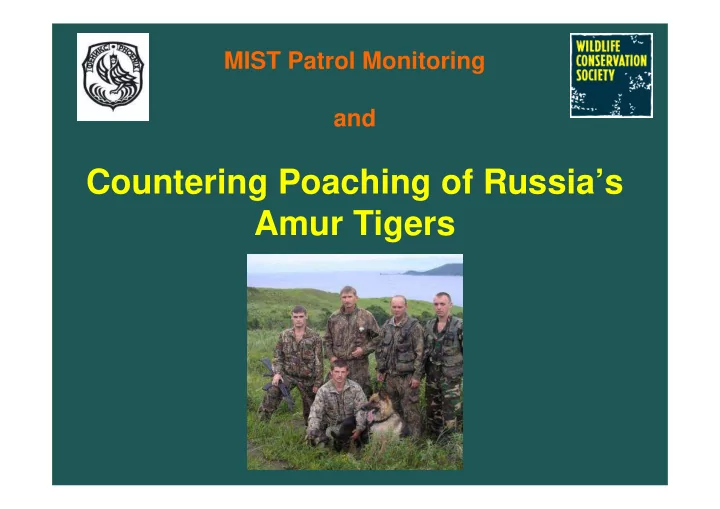
MIST Patrol Monitoring and Countering Poaching of Russias Amur Tigers Objectives Increase effectiveness of anti-poaching efforts to protect tigers in 4 protected areas in Primorski Krai Increase tiger numbers both inside and outside
Objectives
Increase effectiveness of anti-poaching efforts to protect tigers in 4 protected areas in Primorski Krai Increase tiger numbers both inside and outside these protected areas
PROGRAM COMPONENTS
- 1. Improving Protection in 4 protected areas
- 2. Organise Tiger and Prey Population
Monitoring at these 4 sites
Project Sites in Russia
- Sites 1 & 2 MIST Patrol Monitoring launched December 2010.
- Sites 3 & 4 MIST Patrol Monitoring launched August 2011.
93 49 7870 Total 40 30 4014 Sikhote Alin Nature Reserve 8 4 831 Zov Tigra National Park 18 8 1220 lazovsky Nature Reserve 27 7 1805 Kedrovaya Pad - Leopardoviy potential tiger population present tiger population area size (km2) Site
Size of the sites, present and potential tiger populations
PROGRAM COMPONENTS
Introduction of the MIST patrol monitoring system
- Introduction of a system of “adaptive patrol management”.
- Introduction of a performance linked bonus scheme for inspectors based on
quality of patrol work ($1500 per month per PA)
- Provision of financial/operational support for the implementation of regular
patrols ($1050) and patrol data storage ($150 per month).
- Provision of ongoing technical support (helpdesk patrol data entry, data
analyses, producing patrol reports, training inspectors in data collection and patrol skills)
- 1. Improving Protection in
4 protected areas
IMPROVING PROTECTION - STEPS
Agreement with the 4 protected areas
about the introduction of MIST patrol monitoring, inspector bonus system and patrol support.
- Design of MIST monitoring systems for
each of the 4 protected areas.
- Training of inspectors in patrol data collection.
Training of protected area staff in data storage.
- Provision of MIST equipment (GPS units, batteries, battery chargers,
a laptop computer for each protected area for data storage).
- MIST monitoring test-period.
- Official launch of MIST (with bonus payments and patrol support).
- Start of adaptive patrol management aimed at continuously improving
patrol quality (data analysis, feedback meetings, setting new patrol targets, etc).
- Monitoring changes in tiger and prey population size in the protected areas.
What is MIST patrol monitoring?
- A system for monitoring anti-poaching patrols
developed in 1997 for protected areas in Uganda.
- Based on G.I.S. technology.
- Enables adaptive patrol management (patrol data
collection - analysis - feedback - patrol planning).
- Today, MIST is used in many countries and
conservation programs, but this is the first time it is used in Russia.
- MIST has been fully adapted by WCS and Phoenix
for use in Russia.
MIST
Thailand Campuchea Laos Burma Russia and China Sumatra
MIST use in tiger sites in Asia
Advantages of MIST:
- User-friendly, no need for GIS expert.
- Easy to produce reports on anti-poaching efforts and results with
highly visual graphs, tables and maps.
MIST data collection enables monitoring of:
- Habitat
- Wildlife
- Threats to wildlife and habitat
- Anti-poaching patrol activities
- Anti-poaching results
PATROL DATA COLLECTION: MAIN FORM
PATROL DATA COLLECTION: VIOLATION FORM
PATROL DATA COLLECTION: LEOPARD AND TIGER FORM
MIST Patrol Management Process
Field patrols & data collection with GPS units and data forms Data entry & processing Analysis & reporting Feedback strategy meetings Adaptive Management
Management Review & Feedback Loop
- We process patrol data into 2-month
patrol reports for each of the 4 protected areas.
- We organise feedback meetings with the
management and inspectors of protected areas.
- The patrol efforts and results of each
team are discussed at these meetings.
- New patrol targets are set at the meetings
for each team in order to continuously improve patrol quality.
Inspector Incentive Scheme
($1500 per month per protected area)
- Provides financial incentive for inspectors to improve
performance
- Tactical mechanism to direct patrol efforts
- Creates healthy competition between patrol teams
(better performance)
- Improves team work, team spirit & morale
- May reduce staff turnover
Patrol reports – example 1
November 2011
Time spent on patrols (hours)
December 2011
40 80 120 160 200 240 280
team 1 team 2 team 3 team 4 пешком засада машина мотоцикл снегоход квадрацикл
40 80 120 160 200 240 280
team 1 team 2 team 3 team 4 foot patrols road blocks vehicle motor bike snow mobile all terrain vehicle
Patrol reports – example 2
Patrol reports – example 3
Anti-poaching effort
- no. of patrols
- no. patrol days
- patrol distance
- patrol start times
- no. hours patrolled
- patrol coverage
(Anti-)poaching indicators:-
Anti-poaching results
- uncovered violations
- arrests and citations
- fines and convictions
- confiscations
(weapons, snares, game) Results per unit effort
- per patrol
- per km patrolled
- per hour patrolled
- per inspector or team
- per $1 spent
PROGRAM COMPONENTS
Assess monitoring protocols at the 4 protected areas Design and introduce modern techniques for estimating tiger and prey abundance Conduct annual winter surveys
- 2. Organise Tiger and Prey Population