Application of LLNs sensors to deter Elephant poaching in Kenya 1 - - PowerPoint PPT Presentation

application of lln s sensors to deter elephant poaching
SMART_READER_LITE
LIVE PREVIEW

Application of LLNs sensors to deter Elephant poaching in Kenya 1 - - PowerPoint PPT Presentation

Application of LLNs sensors to deter Elephant poaching in Kenya 1 Photo credit: Matt and Kim Rudge http://www.flickr.com/photos/mattandkim/94501077/sizes/z/in/photostream/ AGENDA * COUNTRYS FAST FACT . * POACHING IN KENYA * CRISIS IN


slide-1
SLIDE 1

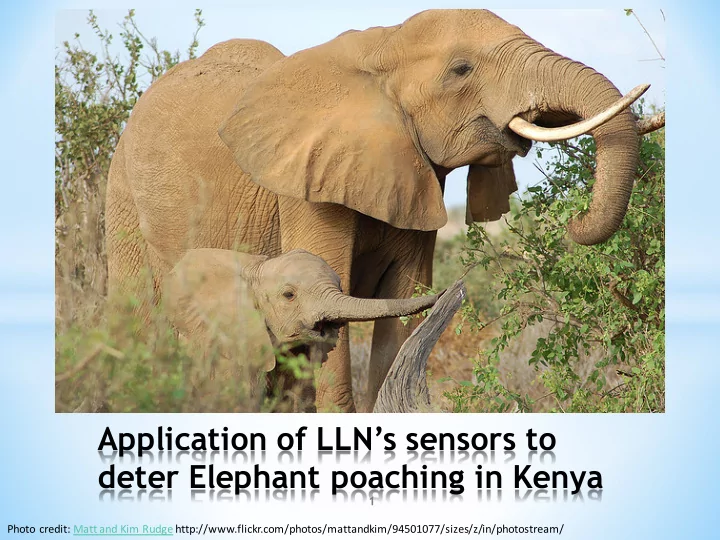
Application of LLN’s sensors to deter Elephant poaching in Kenya

Photo credit: Matt and Kim Rudge http://www.flickr.com/photos/mattandkim/94501077/sizes/z/in/photostream/ 1
slide-2
SLIDE 2

AGENDA

*COUNTRY’S FAST FACT

.

*POACHING IN KENYA *CRISIS IN POACHING *CONSERVATION EFFORTS *GLOBAL EFFECTS *WHAT'S IS BEEN DONE *LLN’S OVER GPS USE *PROPOSED SOLUTION BASED ON LLN’S SENSORS *CHALLENGES

2

slide-3
SLIDE 3

Size 582,650km² Economic growth 5.4% (2015) GDP/capita ~US $ 1,588 Literacy 87% Doctors 0.13/1000 Life Expectancy 63 Population ~ 44 million Physical Location East Africa Foreign Ex. Tourism is 3rd after Coffee and Tea

https://www.gfmag.com/global-data/country-data/kenya-g dp-c ountry-report+&cd=1&hl=en&c t=clnk&gl=it

  • Last Updated Thursday, March 17, 2016

http://www.cnbcafrica.com /news/east-africa/2014/09/09/kenya-leads-internet/

  • Last Updated: Tue, 09 Sep 2014 14:01:39 GMT

http://www.bloomberg .com/news/articles/2015-03-05/world-bank -raises-kenya-s-economic-growth-forecast-to-6-percent

  • Last Updated 5th March 2015

3

slide-4
SLIDE 4
  • Threat to endangered

and exceptional wildlife Populations.

  • Elephants and black

rhinos most common targets.

  • Threat to the Kenyan

Economy.

  • National Security

Implications.

http://www.kenyalogy.com/eng /parques/parques.html

**Illegal hunting or trapping of wildlife for food or profit

slide-5
SLIDE 5

Kenya’s and East Africa’s Persistent Problem

5

slide-6
SLIDE 6

"Our research which records the births and deaths of all elephants is a particularly sensitive barometer and alerted the world to what is happening with poaching. We reached a tipping point in 2009 where deaths outnumbered births.”

By Dr. Iain Douglas- Hamilton

http://kron4.com/2014/08/18/poachers-kill-100k-elephants-in-africa/ http://wildnet.org/wildlife-programs/elephant

6

slide-7
SLIDE 7

http://www.itv.com/news/2016-03-14/the-decline-in-rhino-num bers/

7

slide-8
SLIDE 8

GLOBAL EFFECTS

*Developing countries

demand for authority to sell ivory.

*Boycott trade in ivory. *The global community

must provide infrastructure to deter poaching.

*Providing an alternative

by creating economic

  • pportunities.

8

slide-9
SLIDE 9

*Demand for illegal ivory still

very high.

*Implement modern RTM of

elephants

*Decisive political will *Strenthening of communities

and KWS

*Enforce 1989 Ivory Trade Ban *Refrain from purchasing any

items that may contain ivory.

Kenyan President Uhuru Kenyatta boosts the international fight against poaching on Tuesday 3rd March 2015 – World wildlife day https://www.youtube.com/watch?v=J84nWN2lUGU

9

slide-10
SLIDE 10

Social Responses

*Education! Wildlife = Tourism

= Income!

*Social marketing to change

demand Environmental Responses

*NGOs (eg. WWF) and global

  • rganizations like CITES

working on conservation.

*GPS tracking devices on

animals Political Responses

*Taking action from the highest

  • ffice [1]

*Stricter conservation policies and

implementation

*Stricter laws and enforcement

Economic Responses

*Trade boycotts *Increased fines for poachers *More government spending on

conservation and enforcement

[1] Kenyan President Uhuru Kenyatta boosts the international fight against poaching on Tuesday 3rd March 2015 – World wildlife day https://www.youtube.com/watch?v=J84nWN2lUGU

10

slide-11
SLIDE 11

WHAT IS HAS BEING DONE?

KWS and IFAW (International Fund for Animal Welfare ) using GPS collars to track the movement

  • f elephants to protect them from poaching and learning about their migration patterns. The

Tsavo East National Park region via the internet.

http://www.justgpstracking.com/blog/2011/03/gps-collars-prevent-elephant-poaching-in-kenya/#sthash.hLGcW6IC.dpuf Last Updated 24 March 2011

11

slide-12
SLIDE 12

KWS and Amboseli Trust for Elephants (ATE) have continuously monitored the Amboseli elephant population. In 2002, researchers used the GPS points, satellite imagery, and Esri software to perform GIS analysis. ~35,000 Elephants

http://www.esri.com/esri-news/arcnews/summer15articles/mapping-a-future-for-kenyas-amboseli-elephants Last Updated 24 March 2011

12

WHAT IS HAS BEING DONE?

slide-13
SLIDE 13

This GPS collar sends an elephant's location information via satellite to security managers and park rangers. Save the Elephants (STE) specializes in elephant tracking through GPS

http://africa.clintonfoundation.org/elephants/#!/

Last Updated 17 March 2015

13

WHAT IS HAS BEING DONE?

slide-14
SLIDE 14

WHAT IS HAS BEING DONE? - Video

Lewa wildlife conservancy rangers used the GPS points, satellite imagery , and mobile radios to keep track of the Elephants where bouts.

https://www.youtube.com/watch?v=pSAkG27WM4E&feature=youtu.be Last Updated 24 March 2011

14

slide-15
SLIDE 15

The use of LLN’s can be more favourable than GPS in that they are:

* Require less power than GPS * Sensors are much smaller in physical size * More accurate in measurements .e.g on

acceleration and temperature measurements.

* Use IPv6 routing with inherent security. * Research to exploit open the possibility of ICN

standards (Pursiut and NDN) or DTN especially for game reserves [community based]

slide-16
SLIDE 16

PROPOSED SOLUTION BASED ON LLN’S SENSORS

The cloud storage service e.g. ubidots forwards the message to the mobile phone ranger in the field or command center READ A border router is configured to forward data from the mote to the cloud storage service. Elephant in the park is fitted with a mote sensor an configured with an IPv6 address for internet routing Mobile phone receives the triggered message that would require their action to visit the site SEND VISUALIZE

16

slide-17
SLIDE 17

*Real-time monitoring (RTM) system to monitor the

movement behavior of the elephants.

*The tracking data are collected from the elephants and

telemetered to a border router.

*The sensor implements algorithms to measure (acceleration

and temperature).

*If an alert condition is detected, both an SMS message and

e-mail are generated and issued to the border router.

*The message is forwarded to the cloud storage e.g ubidots

and is visualized by the mobile client of the rangers or at the command center.

PROPOSED SOLUTION BASED ON LLN’S SENSORS

17

slide-18
SLIDE 18

*Limited computational power requires discreet

use of cryptography.

*Limited data rate requires careful co-

  • rdination

*Dynamic environment requires robustness to

packet loss

*Sensor design for the rugged wildlife terrain. *Sensor nodes may be inaccessible *Firmware needs to be updated for feature

expansion or “bug fix”

slide-19
SLIDE 19

Website: http://www.nacosti.go.ke Contact: +254 733 997 189 and cyrus.kamau@nacosti.go.ke