
SLIDE 1
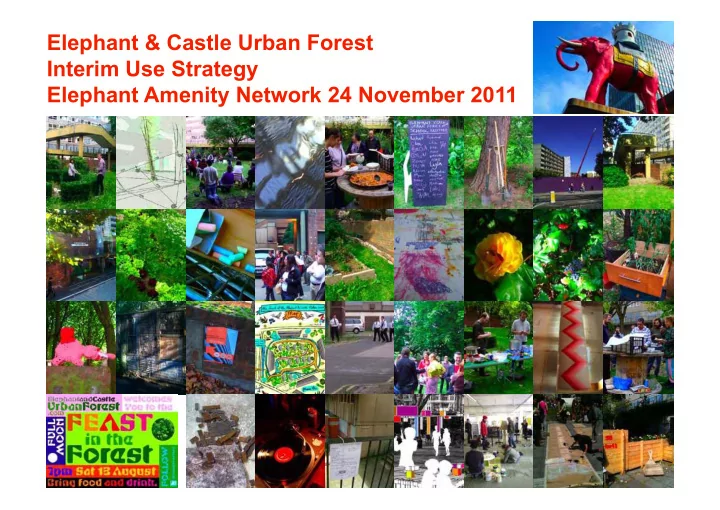
Elephant & Castle Urban Forest Interim Use Strategy Elephant - - PowerPoint PPT Presentation
Elephant & Castle Urban Forest Interim Use Strategy Elephant Amenity Network 24 November 2011 Contributors Authorship of Images Adrian Glasspool Email applications for use of images and text should Ali Kaviani be addressed to
Contributors Adrian Glasspool Ali Kaviani Ceilia Cronin Christina Ttofa Ed Fyfe Katherine McNeil Liliana Dmitrovic Luke Miller Patrick Blunt Paul McGann Peter Stevenson Richard Lee Richard Reynolds Local residents and businesses of the Elephant & Castle Organisations Biz Extra dialogue Elephant Amenity Network Elephant & Castle Urban Forest Heygate Residents Association involuntarymovement Lend Lease London Borough of Southwark Mobile Gardeners People’s Republic of Southwark Soundings Southwark Chamber of Commerce Walworth Society Potential Partner Organisations Connexions Goldsmiths College Kings College Health Partners London College of Communications Morley College Pullens Residents Associations South Bank University Southwark College Space Syntax Walworth Garden Farm Vision Trust Potential Third Sector Partners Architecture for Humanity London BTCV Habitat for Humanity Report collated by Katherine McNeil for the Elephant Amenity Network elephantamenity.wordpress.com
Authorship of Images Email applications for use of images and text should be addressed to elephantamenity@gmail.com Images on cover obtained from the Elephant & Castle Urban Foresters Facebook log, KM image library, Architecture for Humanity, London
1: Introduction page 1
5.0 Logistics & Way Forward 5.1 Introduction 5.2 ‘Canopy’ Orgnaisation 5.3 Programme and Co Ordination 5.4 Legislative Context 5.5 Management of Interim Use Spaces 5.6 Existing Building Considerations 5.7 Land Ownership, Site Access, Handovers 5.8 Public Ownership 5.9 Effjcient Decision Making Processes 5.10 Construction Access Route 5.11 Security and Safety 5.12 Next Stage and Way Forward Appendix
Gardening Site” Elephant Amenity Network, 2nd April 2011
Executive Summary 1.0 Introduction 1.1 Purpose of the Report 1.2 Context of People and Place 1.3 Current Status on Interim Use 1.4 Vision 1.5 Benefjts of Interim Use 1.6 Open Access 2.0 Assets 2.1 Existing Site Assets 3.0 Locations for Interim Use 3.1 Locations for Interim Use 3.2 Breaking Down Barriers 3.3 The New Park 4.0 Opportunities for Interim Use 4.1 Growing and Gardening 4.2 Interim Accommodation 4.3 Health & Wellbeing 4.4 Learning & Training 4.5 Livliehood 4.6 Reuse & Making 4.7 Gathering
1: Introduction page 2
1: Introduction page 3
Interim Use, is widely recognised as best practice to facilitate transformation through the process of change within major regeneration. It allows ideas to be explored and tested, a proto type for the future. The seeds of activity within The Heygate Estate at the Elephant and Castle, over the last year, are evidence
time between old and new, is enabling a natural recalibration drawing in new ideas, activities and initiatives. An evolution. With this new space emerging, interim uses such as gardening, waste recycling, arts projects and events are talking place, a fjrst glimpse of people-led regeneration. The community welcomes the committment shown by the developer, Lend Lease, in Interim Use Initiatives. This shared interest will provide long term benefjts for the quality of life and success of the new regeneration. The intrinsic key to unlock the potential is open accessibility, a window to the new neighbourhood. Imagined by Annie Lennox and Paul McGann
1: Introduction page 4
Words which sum up attendees current image of the Elephant & Castle Area Elephant Amenity Network Visioning Report June 2011
1: Introduction page 5
1.1 Purpose of the Report This Strategy Report is a gathering of ideas and observations made by local people on Interim Use within the Heygate Estate and collects thoughts from a broad range of perspectives. The Report builds from the interactive Community Workshop in June, attended by over 100 people. It recognises that a broader outreach programme needs to be set in place and recommends that the Southwark / Lend Lease Regenration Team give this appropriate consideration. The Strategy is aimed at a wide audience and, on this basis, includes a signifjcant amount of information. Please do makes reference to the Contents page to assist navigation. 1.2 The Context of People and Place The Elephant Castle is home for over 51,000 people, a rich and diverse patterns of communities, cultures and
The area has seen two signifjcant changes in the last century. Firstly signifjcant bomb damage in the Second World War, followed in the 1960s by new development of housing Estates and a divisive road network. Our current times see a further signifjcant wave of change through proposals for new developments and large scale regeneration. The Heygate Estate is home to 5 of the original 1200 households and has, over the last 2 years, seen a different kind of use emerging within this unique Urban Forest environment. People intuitively recognise and are drawn to places which have positive qualities. The natural habitat of the site remains as a legacy of original housing plan. With the main residential community now moved on, the quiet
residents and people who walk through the site have built a positive energy of interest through campaigning to raise awareness of the unique qualities of the open spaces, routes and walkways generated by the trees themselves. The proposals for Interim Use are now at a stage where activities and ways forward have been identifjed and form the body of this report. The activity and events have, so far, been made possible with limited funding. Activities have received support from Hollywood fjlm fees which were reinvested within Forest Feasts and have been fortunate to receive a donation this month, from the General Electric donation of over 8000 plants from the living plant picture in Trafalgar Square. Imagine what can be achieved with the full support of London Borough
Those involved appreciate that this is a long-term journey and are keen to ensure that the momentum, built up
1.3 Current Status on Interim Use A number of activites and endeavours have been taking place within the site over the last year. These include gardening, nursery planting, walks, talks and social events. These can be described as intrinsic elements of community and a rebirth of this unique place. As an overview, the current uses and occupancies within the space include: Housing A key aspect, the Heygate is home to the existing residents represented by the Heygate Residents Association Social Endeavours Through the work of Crossway Church and organisations in the Rodney Place Club Building Education Active gardening for local school children from Victory Park A study space for students at Goldsmiths, London College of Communications and Schools of Architecture Forest School talks Health & Wellbeing Food production, gardening, parkour, walking, running, amenity Livliehood Through rental of space for fjlm crews Networking through connections at events and activities Community Events and Gatherings Films, festivities, guided walks Making and Arts Projects Artists’ projects, Drawathons, Imaginative waste reuse Discussions and Reports on Interim Use have been as follows:
Included in full in the Appendix of this report
The Interim Use extracts are included in this Report. Website link to the whole report is elephantamenity.wordpress.com/2011/06/24/visioning-workshop-report/
An initial consultation meeting where Lend Lease made a short presentation Details will be made available on the Developers website at www.elephantandcastle.org.uk/pages/consultation_dialogue/75/liason_groups.html
A workshop was held at Crossway Church. Website link to the Notes will be made available on the Elephant Amenity Network website The outcome of this workshop is this Strategy Report. This will be posted on the Elephant Amenity Network website
A meeting where 3 presentations from Southwark College, Creative Spaces and Mobile Gardeners were made. Details will be made available on the Developers website
1: Introduction page 6
Imagined by Annie Lennox and Paul McGann
1: Introduction page 7
1.4 Vision Together, We are Building the Future The June Visioning Day Event was set up by the Elephant Amenity Network (EAN). “The EAN has been in existence since March 2009, when a new ‘Elephant & Castle Regeneration Charter for Community Inclusion and a Better Quality of Life for All’ was launched by local people and businesses.” The section relating to Interim Use is included on the following pages. The full report can be downloaded from the Elephant Amenity Network website Over the last 6 months, a number of discussions and consultations have been taking place, through the consultation process. The recent Community Workshop, held on Saturday 12th November, identifjed some key aspects of the vision:
1: Introduction page 8
1: Introduction page 9
Illustration by rebecca.davies.blogspot.com
1: Introduction page 10
1.5 Benefj ts of Interim Use Interim Use is recognised as best practice for long term regeneration. In essence, utilising existing re- sources, harnassing energies of the community and unlocking the real potential of neighbourhoods. Benefj ts include:
generation and neighbourhood sustainability “How do we move from a public service model that focuses on providing for peoples’ needs to one that embraces their strengths and liberates their skills, ideas, energy and drive? A key step is to move from single function public services to places for integrated neighbourhood delivery.” The Bromley by Bow Centre A Platform for Neighborhood Well-Being Case Study in the Compendium for the Civic Economy The examples included on this page provide a set of references for investigation to build an appropriate and contextually connected plan for the Elephant & Castle Regeneration. Deptford Project, Cathedral Developments www.thedeptfordproject.com Compendium for Civic Economy Publication Partners: NESTA, CABE, 00:/ www.nesta.org.uk/assets/features/ compendium_for_the_civic_economy Groundwork www.groundwork.org.uk Igloo Sustainable Property Investment www.igloo.uk.net Meanwhile Manual
www.meanwhile.org.uk/news/meanwhile-intermedi- ary-handbook
Future Communities www.futurecommunities.net
1: Introduction page 11
Early Interim Use in Action The Allottments Inspiration: The High Line, New York www.thehighline.org/ A redundant space comes alive and regenerates a neighbourhood 1.6 Open Access Interim Use and Open Access to regeneration sites go hand in hand. All parties are invited to share the vision and work together to fj nd solutions tailored to the local context: community, landowner, developer and new partners. An opportunity to lead the way with a new inspired approach. An outline process for maintaining open and pulic access includes:
setting high aspirations for all parties
use can happen
and partnering with organisations who have achieved this on similar sites
within the site to encourage a new movement through and buld upon the activities currently happening
forum to fj nd solutions The Interim use is a real opportunity to develop a sustainable and inclusive regenration and set an international benchmark for development. Initial discussions have taken place with the London Borough of Southwark Regeneration Team and were positively received. Opportunities for pocket funding from innovative investors exist. These may be start up projects and ‘tasters’ for manufacturers to prototype and test ideas. Potential locations for interim use are described in the following sections of this report, with a close relationship with the masterplan principles, an inspiration for the new emerging community.
The Heygate Virtuous Circle image: Luke Miller Consideration of pedestrian and cycle links during demolition can open up the area for interim use and bring early benefj ts image: Luke Miller
1: Introduction page 12
Poetry Reading Forest Feast Forest Visitors Interim Use: Step by Step Autumn Maintenance 2011 Decks Maintenance Team 2011 Artist Installation on the Heygate
1: Introduction page 13
Potential: Music from Camberwell Potential: New Markets Forest Visitor Reuse Drawer: Growing Potential Site Access Routes and Proposals to be safeguarded during the demolition process image: Luke Miller Preliminary Access Study image: Richard Reynolds
1: Introduction page 14
Section 2 of the Interim Use Strategy Elephant Amenity Network 24th November 2011
2: Assets Page 1
2.1 Existing Site Assets The site has a number of valuable assets which have yet to be scheduled and made publically available. These include: Trees Planted spaces Open spaces Residential Properties 1200 dwellings Playspaces Community and Tenant Spaces Elevated walkways Open hard surfaced roads Garage Spaces This list does not constitute a defjniative schedule. The Elephant Amenity Network has requested that a fully detailed schadule is drawn up and made available for independent valuation. Other spacts which are considered as assets which should be factored into the valuation include:
Trees of the Urban Forest Valued at £18 million, People’s Tree Caveat Open Green Planted Spaces Crossway Garden Walkways A Unique Urban Feature Childrens’ Playspaces
2: Assets Page 2
The Club Room Currently occupied and in use by tenants Housing Offjce, Content Street Crossway Church Land Smaller Buildings and Structures Garages and Roads Dwellings: Slab Blocks Dwellings: Maisonettes
2: Assets Page 3
Section 3 of the Interim Use Strategy Elephant Amenity Network 24th November 2011
3: Locations for Interim Use Page 1
Crossway Church, New Kent Road The Club Building, Rodney Road Community Garden Space, Wansey Street
3.1 Places and Locations for Interim Use The community Workshop on 11th November identifjed a number of possible locations for Interim Use. These recognise the potential of the existing assets and connect with the proposed public spaces within the
approach, is key to the success of the transformation of the site and surrounding neighbourhood.
Currently in use as a community building with a high uptake of regular, often oversubscription for local community groups, including 7 Congregations and the Southwark Asylum Seekers Advice Centre. Crossway is a prime example of how a number of organisations can share space. We recommend that a study on the work which stems from Crossway Church is undertaken.
The site is currently overgrown with a number of mature trees. Gardeners within the Heygate have requested that the existing trees remain. It is likely that heavy machinery will be required to clear the site and prepare soil for cultivation.
A number of the units on this level are currently occupied and include a Karate School, Food Project, Church and Southwark-supported new business Creative Innovation. The building may be an appropriate location for
and Interim Use space proposed along along Victory Place.
Currently a central route through the heart of the site and the new park within the new masterplan proposals.
A now vacant site adjacent to the Newington Library and Museum, which offers possibilities for connections with these existing facilities. A detailed report on initial concept proposals is included in Section 4 of this report.
Opportunity to establish a presence and activity on the new square . The site is currently hoarded off and part
A prime site, highly visible along the busy New Kent Road, regularly used by both pedestrians and public transport routes. Presents signifjcant opportunities for advertising the new activities. The wide pedestrian pavement invites possibilities for activities to spill out onto the street and test appropriate uses. A further area for exploration of box park accommodation
Opening up this perimeter will encourage access from Victory Park and providing a pavement for pedestrian access along the western edge. The residential street suggests that artists studios may be appropriate.
The existing walkways are a unique feature of the site, with a number elevated within the Forest canopy. The width of many is suffjcient to allow mobile gardening and exhibitions to take place
New gardens. An opportunity to open up the path edge for cultivation and enjoyment of the trees
New construction training facility within the site Garage Site, Walworth Road
2: Locations for Interim Use Page 2
Dwellings: Slab Blocks Open Play Space Dwellings: Maisonettes New Park and Square location from Elephant Road Housing Offjce, Content Street New Kent Road Victory Place Tree Perimeter Rodney Place Rodney Road, Victory Place, Balfour Street Site
3: Locations for Interim Use Page 3
community growing spaces buildings for interim use artists studios interim accommodation social community spaces
3: Locations for Interim Use page 4
approx location of new park community growing spaces buildings for interim use artists studios interim accommodation social community spaces
construction training
3: Locations for Interim Use page 5
New Kent Road: Wall and garages a barrier Image: Katherine McNeil Closed: Breathe Life In 3.2 Breaking Down Barriers Perceptions of the Heygate Estate often decribe it as impenetrable to those who do not live locally. The tall perimeter blocks visible from New Kent Road, Rodney Place and Walworth Road conceal the delights of the Urban Forest within. Visibility of place is key to the success of cities. The perimeter garages and walkways at street level are the blank lifeless frontages which people experience walking past the neighborhood. The Oakmayne site adjacent to the railway has created a new barrier to the life of Elephant Road and New Kent Road. We think this is a lost
Opening up the perimeter to the street will create exciting opportunities for:
Early demolition of the existing walls and garages will release the broad forecourts at the base of the existing building which can house interim use activities, generating interest in the site. This opportunity was discussed at the November Walworth Community Council Meeting and identifjed by Councillors as a positive area of discussion and exploration. We recommend that this is developed through the Elephant Amenity Network, London Borough of Southwark and Lend Lease and Community Partners as a Pilot Positive Project. Contact: Elephant Amenity Network New Kent Road: Potential Opening Up Image: Ed Fyfe Life and Vibrancy
3: Locations for Interim Use page 6
3.3 The New Park Interim Use will optimise the opportunities for long term success is closely aligned with the masterplan and, in particular the new park. A number of activities for the new park were identifjed in the EAN Visioning Report:
www.gardeningleave.org/
3: Locations for Interim Use page 7
Section 4 of the Interim Use Strategy Elephant Amenity Network 24th November 2011 Image: Architecture for Humanity, London london.architectureforhumanity.org
Crossway Garden Nursery for fruit trees Victory Park School in the news & Raised beds Victory Park School Growing in Planters
The Community workshop identifjed a range ofopportunities for Interim Use. These encompass a range of activites and presence: Growing & Gardening Accommodation Health & Wellbeing Learning & Training Livliehood Making Gathering Many are developed projects and new ones emerging. Given the scale and nature of Forest activities, these projects are a snapshot of those found to date. The Elephant Amenity Network welcomes news of other projects and activities. 4.1 Growing & Gardening Project 1 Nursery Planting: a Current Activity A Current Activity: fruit trees are being planted in Crossway Garden nursery in partnership with the children of Victory Park School. Raised planter boxes have been constructed and placed within the northern terrace, home to the oldest tree in the Forest, the Great Silver Maple. Victory School currently has limited space for gardeing, considered as an essential component of education and a connections with the educational curriculum. London Borough of Southwark have been consulted on planting and locations of the nursery and raised planters. The project will be developed through community gardening and extend activities for the potential to grow and nurture plants and trees for the new gardens within the site – trees which belong to place, and are part of the long-term story of transformation. This is a low-carbon, cost effective method of providing trees for the furture of the site. The links with the school and sustainable approach is an innovative model for positive regeneration. Locations: Crossway Garden and existing green spaces Project 2 Allottment Gardening Traditional food growing allottments are in place through the site, primarily located in maisonette gardens. There are around 12 allottment holders growing vegetables and fmowers. Reuse of discarded materials from within the site form the edges of raised beds. Locations: existing green spaces and the new park Project 3 Mobile Gardening A new Community Interest Company, the Mobile Gardeners, has developed from the existing gardening
neighbourhood, through the inclusion of small portable gardens. This initiative is an effective tool to spark the change in perception of the Elephant & Castle from an urban traffjc island to a place full of positive energy and innovation. Mobile Gardening enages people and inspires. The images on the far right show our Brighton University student on a walk around the neighbourhood streets, capturing imaginations. Locations: site wide and beyond Allottments
4: Opportunities Page 2
Proposed Community Garden Space, Wansey Street Mobile Gardners Mobile Garden on Elephant Road Image & garden: Christiana Ttofa Inspiration; Dalston Eastern Curve
Prinzessinnengarten garden, Berlin Prinzessinnengarten: raised beds Location Plan: Wansey Street Community Garden Dalston Curve
Mobile Gardening on the Walworth Road Image & Garden: Christiana Ttofa
4: Opportunities Page 3
4: Opportunities Page 4
4.2 Interim Accommodation Project 1: Short life Housing The maisonettes offer opportunities for short life Housing within the neighbourhood. Initial investigations with local charities have confjrmed the need. The advantage which housing offers are enormous. Firstly, the benefjts of providing a home to those in need, the fjrst step towards independent living. Other types of housing such as live/work are proposed a way of securing new start up businesses. A presence on the site offering benefjts for the security and safety of the site and those passing through. Interim housing provides a managed stepping stone for those in need within Southwark, into permanent housing
connect housing with the activities in the Forest and the potential for livliehood. For example, Connexions and the “Vision Trust- supported housing” are seeking short-life accomodatiion (with a 3 -5 year lease) for young people leaving care and a nearby offjce/workspace where they can provide fmoating support on life skills and employment advice. Locations: existing maisonettes within the site Project 2: Spaces for Community Groups Long Term Established Groups: Local community groups will benefjt from provision of suitable meeting spaces within the Estate. Existing groups include those associated with Crossway Church, New Kent Road and The Club Building on Rodney Place. The key to these spaces is “multi-use” inspired by the example set by Crossway Church. Crossway Church has outlined the activities within the building here: There are currently seven congregations using Crossway, including ... “ Seventh Day Adventist - Ghanaian majority Temple of Praise - Ghanaian majority pentecostal Glory Church - Majority African Assemblies of God Because Jesus Lives - Majority Ivory Coast charismatic Ebenezer - Ghanaian majority presbyterian Peace International - Majority African fellowship and ourselves.. Multiethnic and multicultural protestant free church We also have GB, a youth group, occasional bible studies, Robes night shelter in previous years, Southwark Day Centres for Asylum seekers, a Latin American language School (currently not meeting), a complimentary therapy clinic is about to start, occasional community meetings and fjlm crew facilities.” Crossway Church is also a base for the weekly Thursday drop in sessions for the Southwark Day Centre for Asylum Seekers, who have been providing this service for over 10 years. The Elephant & Castle is well known as a place of arrival for many asylum seekers. The voluntary and community sector have need for offjce space as well as meeting space. Organisations include Connexions and The Vision Trust. Within the wider regeneration, there are a number of Voluntary and Community Sector (VCS) groups within Hannibal House, located in the building above the shopping centre, and Community Action Southwark/Cambridge House, which should also be considered. Local knowledge understands that these groups have carried out audits for offjce and meeting space. Artists Studio Workspaces Crossway Church www.crosswaychurch.org.uk Short Life Housing Image: Architecture for Humanity, London Community Meeting Spaces
4: Opportunities Page 5
4.2 Interim Accommodation continued The People’s Republic of Southwark have identifjed uses as follows:
& fun – we hope to start this up again, as these were always greatly appreciated by everyone who attended) (this kind of further explains why the ‘multi-use’ is essential, as ‘operations’ could be just offjce space; information/drop-in centre may be ‘gathering’, arts/crafts is both arts & informal learning etc) www.peoplesrepublicofsouthwark.co.uk/ A number of existing organisations within the Rodney Place Club Building, Brandon Street include:
Other units are occupied. With intermittent opening times and some unsigned, we recommend that outreach with the parade is undertaken. Consideration of accommodation for these established groups, many of whom have been in existence for
continued their work and operations through the decant phase is testement to their value to the community. The next few months are critical to ensure that these important community assets are given appropriate support through a further period of change. We recommend that a full Outreach Programme is undertaken by the Regeneration Team to include:
represent these groups through duration of the regeneration process. We recommend that the Champion is drawn from an individual or team with specialist experience and knowledge in community initiatives. More Recent and Growing Groups: New groups and organisations have become established in the last year. These include the Elephant Amenity Network, Mobile Gardners and The Walworth Society. These new groups will benefjt from meeting space. For example, the Elephant Amenity Network requires a base for planning activities and future involvement in Neighbourhood Planning. We recommend that these groups are contacted to establish spatial requirements. Consultation on briefs for multi use spaces is essential to ensure that requirements are incorporated. For example, external space may be required for some organisations. Possible locations: The Club Buildings, Rodney Place and Housing Offjces on Content Street
4: Opportunities Page 6
Help My People Event Some of the Organisations on the Parade of Existing Shops at The Club The Parade of Units, The Club Building on Rodney Place
4.3 Health and Wellbeing Project 1: Health Partnerships Activities within open green space in the city are widely recognised by medical experts as bringing health benefjts through connections with growing, walking and social interaction, The Chairman of King’s College recently spoke at the November Walworth Community Council Meeting. He noted that GPs and Helath practiotioners will be reaching out to communities to take the initiative for generating new networks of activities to promote healthy living and eating. Food growing and sport are ideal activities to take place within the Forest and engage the community in outside activities. Locations: Site Wide Project 2: Sports Activities The Forest sees people walking through on a daily basis as part of a quiet diversion from the noise and traffjc of the city streets. Dog walkers and runners are regularly seen on the walkways within the tree canopies. Elephant Park, prior to hoarding being erected for the Oakmayne site, was used on a weeklay basis for football, games and community gatherings - a spontaneous inhabitation of space. Over the last few months Parkour is practised within the Forest. The link noted opposite shows a video of Parkour movement within the Heygate. Parkour is recognised by Westminster City Council as a popular sport, with the imminet opening of the LEAP Parkour Park, described as “London’s First and the World’s largest purpose build Parkour Park” www.parkourgenerations.com/category/news-vocabulary/parkour-park The open space within the heart of the Forest, located within the zone of the new public park, is an ideal location to reinstate football and other sporting activities and make local groups and teams aware of its
Possible location: the central park space Project 3: Engaging the Elephant’s Youth The Community Interim Use Workshop and Consultation Liasion Groups have noted the necessity to engage Youth Groups. Sport is one route to engagement, outreach and involvement. Connexions is “a service providing advice, guidance, support and personal development for all 13 - 19 year
We recommend a full school’s outreach programme is undertaken to establish an appropriate engagement strategy for young people. This should include asking young people their views on sport, activities, education and training. Possible Locations: review with the young people through outreach Health & Wellbeing Running on the Walkways image: Paul McGann Green Growing Environment image: Paul McGann Saturday Morning at The Coronet Parkour in the Forest parkour.com
4: Opportunities Page 7
4: Opportunities Page 8
Form Studies Ed Fyfye, Goldsmiths College Construction Training Analysis & Stepping Stones Ed Fyfe, Goldsmiths College New Tools, New Skills
4.4 Learning and Training Project 1: School Projects Victory School have regular gardening activities within the Forest. The body of knowledge gained can be collected and published as a Borough-wide active learning initiative. Further outreach to local schools can spread the words and knowledge share. Project 2: Construction Training Facility The Developer, Lend Lease have undertaken to include Construction Training throughut the construction period. LL are looking to partner with Southwark College, which is due to merge with another Southwark College in the near future. Construction skills can be directly applied to building interim use projects and contributing to maintenance ‘on the ground’ localised training. Note: A report on this aspect was included at the Interim Use Meeting on 24th November by Southwark College Links with Housing Associations (many of whom run employability projects) and education and training providers in the voluntary sector can positively contribute to the Construction Training Facilitity. We recommed that this is included in the outreach programme. See list provided by Southwark Works Unit 239, Elephant & Castle Shopping Centre, London SE1 6TE Project 3: Further and Higher Education Student Projects A number of Higher Education Students have used the Heygate site as an area of study. Examples of Goldsmiths student, Ed Fyfe are included here, as part of an on-going fjnal year Degree Project. Further information can be found on the Blog at http://www.edfyfe.co.cc/ Students from London College of Communications have been visiting the Heygate for photographic and creative projects. The potential for engagement with Higher Education Institutions is high with Camberwell College of Art, London Colllege of Communications and South bank University all in close proximity. Partnership projects through these institutions and their international contacts will lead to research and fjnance opportunities in the long term. Project 4: Informal Learning Initiatives include the Urban Forest School organised talks and walks. A schedule of activities is included here. A highlight was the Bat Conservation Trust Talk which was followed by bat detecting . Details of the talks can be found on the Elephant & Castle Urban Forest website. This type of informal learning can be expanded through to include activities run by the Elephant Amenity Newtork and Peoples Republic of Southwark and other local organisations. 4.5 Livliehood Project 1: Boxtainer Incubation: Sustainable Job Creation An outline proposal follows on the following pages: Possible sites include
Business Extra, who have made the proposal, will work closely with local residents, Lend Lease and Southwark to develop the ideas. An inclusive consultation and engagement is promoted to ensure that Wansey Street Residents are fully consulted, appropriate information made available and their views fully taken into account. A successful and positive example of this type of accommodation is Container City at Tower Hamlets www.containercity.com Project 2: Natural Garden Centre The gardening activities have the potential to generate plants and products for sale or exchange. This could be located within a site on the New Kent Road perimeter, as an information draw into the Community Garden. Partnerships with the Pullens Garden Shop, Farehsraes, and local health food business, Baldwins can be established.
4: Opportunities Page 9
4: Opportunities Page 10
4: Opportunities Page 11
4: Opportunities Page 12
4: Opportunities Page 13
4.6 Reuse and Making Project 1: Waste Upcycling / Reuse Recycling and inventive reuse of materials is currently happening within the Forest. Recycling and upcycling on an appropriate scale is a live topic and a number of London Boroughs involved in setting up projects. An example of this is The Brixton Remakery in partnership with London Borough of Lambeth and consultation and design by Architecture for Humanity London. “The project is a centre for enterprise, training and community initiatives based on the reuse of materials. BRC will bring new life to 200 tonnes of waste materials each year, including furniture, bikes, wood, tools, musical instruments, computers, textiles and more. The project will provide training and volunteering, opportunities and green jobs, equipping local people with skills for a low carbon economy” http://remakery.posterous.com/ http://openarchitecturenetwork.org/projects/brixton_re-use_centre A proposal by the Peoples Republic of Southwark is included here:
They say that one man’s rubbish is another one’s gold. In many ways, what we use and what we throw away is
Back in 2007, People’s Republic of Southwark held the fjrst and only Freecycle event in Southwark, and continued to hold monthly eco-events for just over a year at different free venues around the borough. The events included a Free shop, information stalls, arts and crafts activities, vegan food etc. We propose to set up a Reuse centre for the area, to raise awareness of the waste and recycling issues and encourage local residents and businesses to develop more environmentally-friendly practices. The centre would comprise a Free Shop, composting area, workshop spaces for re-making of donated and collected waste etc and would in many ways integrate other proposed and potential uses on the development (including Box Park, the construction training facility, artists’ workshops, the mobile gardeners and others) The benefjts of the initiative include Ò reduction of the carbon footprint of the development Ò developing a sense of community through donation of things we don’t need any more to others who may Ò informal learning – from learning about current problems and existing alternatives to learning new hands-
formal training or employment Ò individual residents and businesses would not only save money through reuse of existing ‘waste’, but the re-made waste could generate income for community projects Ò help engage wider community, from tenants associations to schools, colleges etc There is little which cannot be remade – a man had built a self-sustainable fmoating island from empty coke bottles and salvaged wood, handbags knitted out of plastic bags are growing in popularity etc. The Brixton remakery, referred to in the report, is just one good example of how it can be done. info@peoplesrepublicofsouthwark.co.uk
The Brixton Remakery Materials Streams Image: Brixton Remakery The Brixton Remakery Architecture for Humanity London Proposals london.architectureforhumanity.org Recycled Noticeboard in the Heygate The Oikos Project under construction www.oikosproject.com/ Image: Ed Fyfe
4.6 Making Project 2: Arts Projects Ther are currently a number of arts projects happening spontaneously across the site. The buildings have become a three dimensional “canvas” for creativity. The workshop identifjed a local gallery at Crucifjx Lane in the Borough, as well as locally based artist Annie Cattrell and the artists/makers in Iffme yard. This spontanaity is strong evidence of a creative transformation occuring, a positive to be nurtured. This is not something which can be ‘manufactured’ and the engagement of artists with place recognised as a signifjcant change in perception of the neighbourhood. Note: An update on possibilies and links with a new CIC Company was presented at the Interim Use Meeting on 24th November Project 3: Artists Co-Operative The workshop identifjed an idea for an artists co-operative and a proposal is attached opposite. Inspiration: Great Western Road Studios, London The Brixton Remakery Materials Streams Exhibition Space The Brixton Remakery Architecture for Humanity London Proposals london.architectureforhumanity.org Weaving in the Forest www.shanewaltener.com http://weeklyweavers.blogspot.com
4: Opportunities Page 14
4: Opportunities Page 15
4.7 Gathering and Social Activities Project 1: Ongoing Elephant & Castle Urban Forest Events Many events and social activities have been organised by the inspirational Elephant & Castle Urban Forest, an
Forest Asset and shaping redevelopment. “The objects of the company are to carry on activities which benefjt the community and in particular to champion arboreal assets within the area of Southwark London defjned as the Elephant & Castle Urban Forest, particularly that defjned as the Heart of the Elephant and Castle Urban Forest by commissioning, supporting and hosting and marketing entertainment and educative events and activities for the community and visitors.” www.elephant andcastleurbanforest.com/ The Urban Foresters work in Partnership with the Elephant Amenity Network, and have growing followings on Facebook and Twitter. The Foresters have organised regular guided walks around the Heygate through the summer, educational talks and events, attended by people of all ages. Photographs and a video of the Forest were exhibited at The Garden Museum exhibition “From Garden City to Green City’. A highlight of the series was the Bat Talk on the snapshot diary of events is included on the following page. Inspiration: the South Bank in the Heygate? Crossway Maintenance Southwark Interim Use: Management Meeting Interim Use Community Workshop Notes at Crossway Church View of the Forest from Draper House image: Thomas Kronig
4: Opportunities Page 16
Feast in the Forest Plants from the Trafalgar Square Wall Beegate at the Heygate www.www.london-se1.co.uk/news/view/5685 Inspirational publication: The Canopy Talk: Richard Wentworth & Poetry Urban Forest School
4: Opportunities Page 17
Supernatural Urban Forest – 23 September 2011
Eighty of us gathered outside Crossways Church as Hollywood gathered inside the forest. Access was restricted as zombies and explosions rocked the urban idyl but we found a dark secluded glade off Heygate Street for Nigel
told by Vanessa Woolf, a modern version of the shiver-making classic ‘The Old Nurses Tale’ set on the Heygate in 2010 during the time everyone was being moved out.
Creative Forest – 22 September 2011
Creative Forest with London Environmental Forum Ideas and activities to celebrate the year of Forests in
Harvest Feast – 18 September 2011
Harvest feast in the Crossways Forest Garden. More BBQ paella, allotment grub, puddings from the congregation of Crossways Church, bread baked from an earth oven and two stoves making chutney from green
Grass Roots Change – 14 September 2011
An evening of talk and discussion from three fantastic grassroots campaigners.
Feast In The Forest: Paella Festival – 3 September 2011
On a beautiful September evening two giant paellas were cooked on BBQs and enjoyed by eighty or so of us.
Forest Screen Two: Juliet and The Herbs – 21 August 2011
The second Forest Screen was the documentary of Juliette de Bairacli Levy, herbalist, author, traveller and pioneer of holistic veterinary medicine, (in other words veggy dog food). A policevan of tourch bearing offjcers turned up but didn’t stay around for more than a few minutes (not their kind of fjlm I think).
Urban Forest School: Bat Conservation Trust – 18 August 2011
Xavier Hamon of the Bat Conservation Trust came to help us detect bats in the forest and we found several Pipistrelles and at least one Noctule, the largest of the native bats.
Feast in The Forest – 13 August 2011
As dusk fell on the full moon lit forest guests emerged from the trees carrying their offering. Tupperware popped
harvest fresh salad leaves and nasturtium fmowers. About sixty of us at peak feast time kicked back on the grassy banks in the centre of ‘Allotment Phase 3 until the early hours with a musical backdrop of LPs that took us to the swinging 1930s via Stevie Wonder’s Innervisions and concluded with the inappropriately timed soundtrack to Sunburn
Harvest Dance – 6 August 2011
What was planned as a party to celebrate the completion of the London Guerrilla Gardening lavender harvest bloomed into something far bigger. The harvest was actually cancelled due to drizzle but the party went ahead and we had two bands, three DJs, a massive sound system and a great crowd dancing into the early hours in peace while London starting rioting outside.
Urban Forest School: London Orchard Project – 4 August 2011
David Blair of the London Orchard Project came to share his work with Londonders spotting, mapping and harvesting fruit trees. If you’d like to help spot, map and harvest fruit trees in the Elephant and Castle Urban Forest (check the maps section to see the expanse of the forest frontier) then get in touch with richard@elephant andcastleurbanforest.com
4: Opportunities Page 18
4: Opportunities Page 19
Section 5 of the Interim Use Strategy Elephant Amenity Network 24th November 2011
5: Logistics Page 1
5: Logistics Page 2
5: Logistics Page 3
5.1 Introduction With suggestions for Interim Use proposals for interim use now in place, a number of items have been identifjed which will require clarifjcation from the landowner, developer, landowner and other external parties.These are
The contributors of this report recognise that resolution of logistics will be part of an ongoing process of
An opportunity to set a benchmark for future regeneration projects. 5.2 ‘Canopy’ Organisation for Interim Use The historic fragmentation of local community within the area is recognised as a opportunity for the regeneration
recognise the value and importance of communities and their people. Solution: Interim use is managed by a ‘canopy’ organisation run be local people. This body will be a community enterprise which will be the custodian of the Interim Use programme of activity well represented by local people,
This is a long-term initiative and will evolve over the period of the regeneration. At present there are a number of seed projects under discussion. Custodianship, under an independent canopy organisation, will assist in co-ordination of interim use activities to identify clear patterns of use and communication. Recommendations: Set a strategy and process in place to facilitate a central liaison organisation 5.3 Programme Co Ordination Interim use and the demolition and construction programmes require close co-ordination Solution:
5.4 Legislative context Consultations for the Supplementary Planning Document and Regeneration Masterplan are running in parallel from November 2011. As the two are strongly inter-related, this means that the SPD has the potential to impact
Interim Use is dependant on access and demolition/construction sequences Solutions:
period
5: Logistics Page 4
5.5 Management of Interim Spaces Management of Interim Use spaces requires expertise and a clear strategy put in place. Solution:
Reference: Compendium for the Civic Economy www.civiceconomy.net 5.6 Existing Building Considerations: Asbestos is present within the existing buildings. Specialist asbestos removal will be required in advance of demolition, both of which are currently within LBB Southwark’s scope. Precedents and Examples:
within the site
the asbestos is safe, providing that it is not disturbed
Solutions:
5.7 Land Ownership, Site Access, Handovers London Borough of Southwark currently owns the land. Following demolition, the site will pass into Lend Lease
benefjt and success of the regeneration. Solutions:
interim use
to enable and facilitate interim use proposals
5: Logistics Page 5
5.8 Public Ownership Public ownership of land is recognised as a way of connecting people with place encouraging a sense of real engagement, interest and custodianship. Current proposals are unclear about leasing arrangements and how the public areas will be managed. One workshop attendee has note “The community land trust could be an excellent way forward as it is a way of retaining community ownership in a development. It enables land value to be separated from asset value and there helps local people to access affordable housing in their own community. They have been very successful in many parts of the country. It also dovetails with community planning which is now available to all communities from 1st April 2012 under the new Localism Act 2011.” This can be applied to public spaces and the new park within the masterplan. There may be mechanisms to prototype this within the Interim Uses. Solution:
Reference: Urban Community Land Trust www.communitylandtrusts.org/case-studies/urban-clts
5.9 Effjcient Decision Making Processes The Community Workshop identifjed the challenge of obtaining sign off on decisions. Solution:
5.10 Construction Access Route A construction access route is currently proposed through the site for Oakmayne construction lorries to dispose
regularity of traffjc movements is understood to be on an intermittent basis Solution:
times for traffjc movements. This is a typical issue, successfully managed within inner city development. Southwark Council have agreed, in principle, that this can be accommodated 5.11 Security and Safety Safety and security within the site are recognised as important considerations which need to be balanced with interim use activities, the demolition programme and long-term goal of changing the perception of the Heygate. The Workshop recognised that a holistic and co-ordinated approach involving a range of parties is required. Solution:
for open access
5: Logistics Page 6
5.12 Next Stage and Way Forward This Interim Use Strategy is an initial gathering of information and activities developed by Community Members. This report builds from the Visioning Workshop and recommends that reference to this initial Community inspired initiative is made through the process. We view this Strategy as a further step towards a co-ordinated and visible Plan for Interim Use. We recognise that there are many challenges and recommend that a comprehensive programme of activity is developed. This will require input from the Community, London Borough of Southwark and Lend Lease. Establishing a process and working methodology for this to happen is considered essential. Suggested stages to set up the Interim Use Plan as a long-term initiative are:
basis through the regeneration
Key to long-term success is an inclusive approach with a focus on the local community. The Elephant Amenity Network welcomes engaged dialogue with the London Borough of Southwark and Lend Lease in developing an
agenda.
5: Logistics Page 7
Appendix Page 1
3 The principles of portable community gardening The principle of the interim use for community gardening is that any equipment installed, or plants planted, can be moved and reused elsewhere when the development phasing requires the use of the current site. As development on this scale is done in phases, gardening activities can follow this phasing to maximise community benefits from the redevelopment itself. This portability can be achieved through use of techniques such as raised beds (which can be dismantled and re-assembled) and container gardening (using containers such as skips or other portable containers.) The developers at Kings Cross railway lands (Argent) have been successfully engaging with the local community over the last few years through the educational and recreational activities fostered by their hoop and skip gardening projects3. Interim community gardening on the Heygate We have identified two sites that, over the redevelopment period, could be used one after the other, or in stages, as the development progresses. There areas are the garden south of Crossways church, and the former Pritchard House site between Wansey St and Brandon St. These are shown in Figure 2. These sites benefit from the substantial natural attributes of the Heygate site (with 2.7ha of green space, 450+ mature trees including a range of mature fruit and nut species.) Other sites may also be identified. Figure 2: Potential community gardening sites on the Heygate Estate Site 1: existing garden area by Crossways church Site 2: between Wansey St and Brandon St We currently propose site 1 for initial use, as this requires little preparatory work, followed by site 2 which is likely to need a greater amount of
3http://www.kingscrosscentral.com/hoop_garden, http://www.kingscrosscentral.com/skip_garden
2 Figure 1: The Heygate Virtuous Circle What is Interim Use? Further to positive discussions with local stakeholders and Lend Lease (Southwark Council’s development partner for the Heygate Estate), the Elephant Amenity Network1 proposes use of two small parts of the Heygate Estate site for community gardening activities. This activity would make use
to fifteen years) over which the Heygate Estate is to be demolished and replaced with new development. Interim use (also called “meanwhile use”) of development sites is now widely accepted by developers, following a government initiative in 20092, who recognise that it can bring benefits to the themselves (through PR, strengthening their community links and security) as well as the benefits to the wider community and to the natural environment.
1The Elephant Amenity Network has been in existence since March 2009 when a new “Elephant &
Castle Regeneration Charter for Community Inclusion and a Better Quality of Life for All” was launchedbylocalpeopleandbusinesses.Sincethattimewehavebeenorganisingacoalitionoflocal groupsandpeoplethatincludesCounciltenants,leaseholders,shopkeepersormarkettradersor amenitygroups(whowishtopreservelocalopenspacesandparks).Wehopetopresentamoreunited voicefromthelocalcommunityaboutwhatwethinkanddesirefromregenerationattheElephantand Castle.TheElephantAmenityChartercanbesummarisedinthreeprinciples:Principle1:Open Masterplanning,Principle2:BenefitsforAll,Principle3:HousingthatreallyisAffordable
2The previous Government’s Department of Communities and Local Government community finance
proposalsonmakinglandavailableforcommunitygrowing
Appendix Page 2
4 What are the benefits to the community? Bringing people together The Elephant & Castle is characterised by a wide religious, economic, linguistic and ethnic diversity. This brings a wealth of knowledge and experience to the area, but also presents real challenges in bringing groups together and finding common channels of communication. Gardening and food growing are activities that have wide appeal and form a core part of most cultures. In this way, community food growing presents an almost unique opportunity to bridge divisions and encourage communication and learning. Education Gardening activities are a fundamental part of environmental education, both for schools and for adults. Growing and nurturing plants is accessible to a wide range of people with differing experience and abilities. It also fosters a range of transferable skills and experience – including personal skills such as team working, communication, self dependency and leadership as well as technical skills in horticulture and biology and maths. The sites lie within 1km of six schools. Health benefits It is now widely recognised (see publications by Capital Growth4 and Sustain5) that outdoor food growing has health benefits. In particular, in terms of physical health, it is a positive attraction for people who live in urban areas to be outside and take exercise (gardening can be a strenuous activity), providing a reason to be outside. In terms of mental health, it provides opportunities for socialising, which can decrease isolation and lead to improved self esteem and transferable skills. Many health centres, hospitals and charities now see the health benefits of urban agriculture in preventing illness and triggering healing responses and use food growing related activities to treat patients suffering from both physical and mental illness. Food growing and production Food growing contributes towards a healthy and balanced diet, and allows an alternative to supermarkets for sourcing of some foods. Furthermore, growing food from seed, if planted wisely, can be a low cost way of providing fresh produce. There is locally an extreme shortage of places where food can be grown. Recent programmes from the GLA, Sustain, Edible Estates and others, including initiatives on the Rockingham and Aylesbury Estates, have shown great latent interest in using underused spaces for food growing. However,
4http://www.capitalgrowth.org/ 5http://www.sustainweb.org/cityharvest/health/
5 given the widespread lack of private gardens and allotments6, there is still a massive deficit in available land. Using raised beds and containers, as is needed for interim uses, ensures that the quality of the soil is of a high standard. Maintaining the vibrancy of the Elephant and Castle During a regeneration programme that will stretch over fifteen years from 2011 (estimate by Lend Lease, Southwark Council’s regeneration partner) there is a real danger that having an empty hoarded site this big will destroy the vitality and character of the Elephant and Castle. The Heygate Estate is equivalent in size to the area between Charing Cross, Leicester Square and Piccadilly Circus. Instead of letting this resource go to waste for such a long period, we believe that there is a huge range of positive meanwhile uses that will attract people and make the site vibrant and active during this long period. Attracting investment to the area Interim use is now established in Southwark, particularly north of Elephant & Castle. A recent example, the Union Street Urban Orchard, attracted (in 2010) sponsorship from Bankside Urban Forest, Lake Estates Ltd, Carillion, Arts Council of England amongst others, facilitating a range of activities and investment that would not otherwise have been made. Leaving a legacy The concept of interim use, whilst about using temporary sites, is also by its nature about ensuring that investment is portable and can thus be recycled
Urban Orchard, for example, the fruit trees, having been carefully looked after and nurtured over a year, were planted out into carefully chosen sites throughout the surrounding Bankside Community Council area. What are the benefits to business? The examples of Union Street Orchard and Kings Cross railway lands show,
them with tangible benefits. Security of active occupation Security is a key concern in the Heygate Estate. It is not yet known what arrangements are being planned for the main site (“Phase 2”), but it is clear that ensuring that a site the Heygate is secure will need to involve more than hoardings and site staff. As an indication of the scale, hoarding the
6Ourresearchindicatesthatofasampleoflocalallotmentsmostareeitherclosedtonewentrantsor
expectwaitingtimetobeseveralyears,andSouthwarkCouncilisunabletomeetdemand
FieldingStallotmentwaitinglistis73long,estimated4-10yearswaitingtime
StuartRdwaitinglistisat100people,withthelistclosed
BermondseyandRotherhitheisestimatedat2to3yearswaitingtime
OneTreeHillstillhas27peoplewaitingforallotmentswhilstwaitinglisthasbeenclosedfor 3yearsandaregettingatleast4to5enquiriesaweek
Appendix Page 3
7 These proposals effectively bring forward in time some of the main community benefits of the regeneration. There are a number of small physical measures also identified which will have costs associated with them, but as all of these are going to be needed at some point in the regeneration programme there should be no change to the overall costs of regeneration. What actions are needed Who needs to be involved No one organisation is able to ensure that interim uses are implemented on the Heygate Estate. However our initial discussions with Lend Lease and with Groundwork Southwark7, as well as Living Streets Southwark8 indicate that the potential of the Heygate Estate for interim uses is widely supported in principle. A key stakeholder is Southwark Council, who own the land, and further discussions need to take place with them about practicalities, timing and responsibilities. Similarly, the Elephant Amenity Network is working to identify additional stakeholders and potential users of the community gardening facility. This includes a range of local T&RAs, amenity groups, faith groups and other local residents. What is the timescale? Lend Lease believe that Southwark Council are aiming to finalise the terms
substantial progress can be made during this period in agreeing locations and phasing, as well as generating external sponsorship and support. We have therefore set a tentative target for spring 2012 for the start of gardening activities on the first site. What are the next steps? The next steps during the remainder of 2011 include: 1. Agreeing the site area(s) for the community gardening activity 2. Agreeing principles of access and security with Southwark Council and Lend Lease (see Annex 1 to this note) 3. Developing detailed programme for facilitation works 4. Developing more detailed costs for installation and maintenance of required equipment
7A publically funded organisation whose vision is “Weworktowardsavision–ofasocietyof
sustainablecommunitieswhicharevibrant,healthyandsafe,whichrespectthelocalandglobal environmentandwhereindividualsandenterpriseprosper.” The organisation is currently working with thenearbyBrowningEstate(http://www.london.groundwork.org.uk/what-we-do/case- studies/2010/browning-estate-art-project.aspx)andtheCharlesDickensSchoolGarden http://www.london.groundwork.org.uk/what-we-do/case-studies/2010/placemakers-community-fund,- so/charles-dickens-school-garden.aspx
8http://southwarklivingstreets.org.uk/
8 5. Identifying sources of matched funding that meet the overall funding requirement 6. Developing and implementing a stakeholder action plan agreeing terms of engagement and assigning responsibilities where appropriate 7 These proposals effectively bring forward in time some of the main community benefits of the regeneration. There are a number of small physical measures also identified which will have costs associated with them, but as all of these are going to be needed at some point in the regeneration programme there should be no change to the overall costs of regeneration. What actions are needed Who needs to be involved No one organisation is able to ensure that interim uses are implemented on the Heygate Estate. However our initial discussions with Lend Lease and with Groundwork Southwark7, as well as Living Streets Southwark8 indicate that the potential of the Heygate Estate for interim uses is widely supported in principle. A key stakeholder is Southwark Council, who own the land, and further discussions need to take place with them about practicalities, timing and responsibilities. Similarly, the Elephant Amenity Network is working to identify additional stakeholders and potential users of the community gardening facility. This includes a range of local T&RAs, amenity groups, faith groups and other local residents. What is the timescale? Lend Lease believe that Southwark Council are aiming to finalise the terms
substantial progress can be made during this period in agreeing locations and phasing, as well as generating external sponsorship and support. We have therefore set a tentative target for spring 2012 for the start of gardening activities on the first site. What are the next steps? The next steps during the remainder of 2011 include: 1. Agreeing the site area(s) for the community gardening activity 2. Agreeing principles of access and security with Southwark Council and Lend Lease (see Annex 1 to this note) 3. Developing detailed programme for facilitation works 4. Developing more detailed costs for installation and maintenance of required equipment
7A publically funded organisation whose vision is “Weworktowardsavision–ofasocietyof
sustainablecommunitieswhicharevibrant,healthyandsafe,whichrespectthelocalandglobal environmentandwhereindividualsandenterpriseprosper.” The organisation is currently working with thenearbyBrowningEstate(http://www.london.groundwork.org.uk/what-we-do/case- studies/2010/browning-estate-art-project.aspx)andtheCharlesDickensSchoolGarden http://www.london.groundwork.org.uk/what-we-do/case-studies/2010/placemakers-community-fund,- so/charles-dickens-school-garden.aspx
8http://southwarklivingstreets.org.uk/
6 entire perimeter of Phase 2, whilst maintaining access to Heygate St, would involve 2km of hoardings. It is clear that blocking access to the entire site for an unknown period is inconceivable in terms of the damage that it would do to the image of the area – part of which fronts one of the busiest roads in London (New Kent Road). Security can also be generated by public footfall. Currently, access to the site is complex to the non-resident as the walkways can be hard to follow. The future masterplan will have as an objective to increase the permeability
the site, with access routes based on those planned for the final development, and varying these over the redevelopment project, a combination of passing pedestrian traffic and active uses of part of the site will provide activity and thus discourage antisocial behaviour and crime. We outline proposals for both sites in an Annex to this note – some of which will require limited works. As demolition progresses, this access issue will be increasingly reduced and the community gardening uses will continue to provide a focus for activity and thus reduce risks. Employment A development of this scale and over the length of time envisaged here will require a substantial ongoing workforce for the site works. The interim use activities provide a means for the developer to develop links with local school children which, as they get to employable age, allows them to present themselves as an attractive local employer, which in turn helps to generate local employment for the community. Land and property values The Elephant and Castle suffers from a poor image in London, part of which is related to the dominance of the main roads in the area, but part is due to a reputation for crime. Recent use of the Heygate Estate by a number of film producers appears to be entrenching this view, and this in turn is providing a headache for the developer who would like the area to be seen as an attractive place to work and live – as this will allow them to generate more income. Interim uses provide a positive way of ensuring that part of the site remains vibrant and active during this long period which ultimately brings significant financial benefits to the developer by improving the image of the development. Access and security Provision of active use of parts of the Heygate Estate site will provide constant and passive monitoring by passers-by and thus contribute to the security of the site whilst also providing early real community benefits in terms of improved and safer through routes. To permit this, a range of access proposals, and timescales, have been identified (see Annex 1). Appendix Page 4
9 Annex 1: Access and Security Introduction Discussions between the Elephant Amenity Network and Lend Lease/ Southwark Council have shown that security is understandably an area of
use can bring, but set out some specific issues and proposals in this annex. It should be noted that a detailed plan for the securing of the Heygate Estate site is not available to the public, and it is not know whether detailed proposals yet exist. These proposals and issues are therefore based
Access routes Both sites are accessible without demolition. They have different characteristics, however. a) Site 1 near Crossways Church. This site requires very little preparation work to make it usable for community gardening. However current access from the south is from Heygate St (no pavement) whilst ground level access from the north/New Kent Road is blocked by small brick walls either side of Crossways Church. b) Site 2 at Wansey St/Brandon St. This site has been enclosed by hoardings for over a decade, and some debris from the demolition of Pritchard House remains, together with some hard standing. This will require more work to clear, but in terms of access the site is accessible now from both Brandon St and Wansey St, and would also provide a welcome pedestrian route connecting these two streets, blocked for many years. Relatively minor interim works would improve access to both sites. At Site 1, a small length of pavement on Heygate St between the garage entrance and Rodney Place would allow access from the south, and removal of one or both brick walls either side of Crossways Church would allow access from the north. These proposals are set out in Figure 3 overleaf. 10 Figure 3: Potential site access routes and proposals to be safeguarded / provided during the demolition process Security The discussion of security impacts requires some knowledge of the philosophy that Southwark Council and Lend Lease will apply to the regeneration as they develop their security plan. In the absence of statements on this topic, we believe that in fact these two sites are well located to support the security measures needed to secure the Heygate Estate site during the demolition and construction period. Site 1 Site 1 is within the interior of the Heygate, alongside maisonettes and behind the Crossways Church. Crossways Church is an important focal point for the estate. The security of the existing church will be paramount and it will be incumbent on Southwark council and Lend Lease to ensure that the security
and cost of hoarding off and patrolling the entire site, and the danger that this will provide for antisocial behaviour to continue to the rear of the building, passive monitoring will improve security on both sides. The proposal to use the former garden area south of the church as a community garden would achieve this by providing a focal point for Appendix Page 5
11 community use – and thus generate footfall as it would be accessible from north and south with limited works. In the short term removal of one or both of the low brick walls at each side
Heygate St end would allow safe access. In the longer term a wider access could also be achieved by removal of the walkway steps and higher wall west of Crossways Church. This would provide a wide access route through the site, usable by both pedestrians and cyclists, providing a direct route from Brandon Street through to New Kent Road and Elephant and Castle/ Falmouth St. This would allow good views through the length of the access route and estate and the high number of users on the London Cycle Route (LCN) 23 which currently has to detour from Brandon St across the dangerous junction
further improving security. In both these scenarios, there are a range of proposals which could improve access incrementally as demolition and funding permits, including: Short term Removal of the low brick walls either side of Crossways Church to allow access to site 1 from New Kent Road Short term Provide pavement on the north side of Heygate St between Rodney Place and the garage entrance Medium term Removal of the wall and walkway steps west of Crossways Church to allow a wider access and better sightlines Longer term Removal of the walkway crossing over between the garage entrance north of Heygate St and the garden site Longer term Removal of the thin brick wall at the northern end of Brandon St and provision of a toucan crossing of Heygate St at this location. Site 2 We believe use of this site for community gardening would actually improve security of the surrounding areas considerably. At present both Wansey St and Brandon St are dead-ends, blocked off by the site. This presents a serious security hazard and there is a high level of crime already in this location, requiring frequent police patrols. Integral to the proposal to bring community gardening to the Pritchard House site would also to provide a through route between Wansey and Brandon Streets to be restored at minimal expense – this is believed to be planned anyway within the wider regeneration proposals, but would be an easy early win for the developer and council. 12 Our proposal envisages a through route to the north of the garden site – but it could be to the south of it to keep a straight route along Wansey St – and to use the remainder of the site for community gardening. The actions required will be as follows: Short term Move hoardings to allow through route (at least 3m wide) between Brandon and Wansey streets Medium term Improve lighting in the area east and west A summary of the access proposals for both sites is shown in Figure 4, following the strategic desire lines identified by MAKE, also indicating how the new routes connect with public transport (bus stops, London Cycle Hire points and the tube/national rail) and the London Cycling Network. Figure 4: How considering the new pedestrian and cycle links during demolition can open up the area for interim use and bring early benefits Appendix Page 6