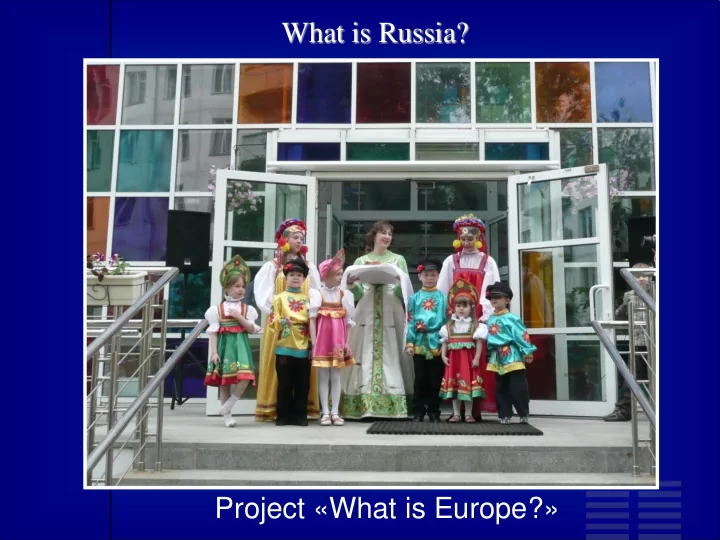
SLIDE 1
What is Russia? Project «What is Europe?»
SLIDE 2
We live in Russia. Russia is a huge country. It takes more than a week to cross the country from West to East in a train
SLIDE 3 The National Banner and Anthem of Russia in
The Kremlin and the Red Square are the symbols of Russia
SLIDE 4 Not only ethnic Russians live in Russia, but also people
- f other nationalities: Bashkir people,
Tatar people, Osetin people, Yakut people and many other peoples. That's why our country is called the Russian Federation
SLIDE 5 In the North winter may last 6-7 months in a year. Hard frosts, heavy snowfall may
- happen. The cold pole is in Siberia
(Oymyakon). Temperature falls almost below 70 degrees there. In Moscow there can be a lot of snow, too. Many inhabitants of the country enjoy skiing, skating, and riding sleighs.
SLIDE 6
Russia is surrounded by many seas. People in Russia like to go the warm Black Sea on vacation In the southern part of Russia climate is mild. Winter is warm and summer is hot In 2014 the Winter Olympic Games will take place in the town of Sochi in southern Russia
Symbols of Olympic Games 2014
SLIDE 7
Russian nature is diverse. In the North it is cold, there lies the Arctic and the tundra Indigenous people live in Siberia and in the North of Russia
SLIDE 8
There are a lot of forests in Russia. Coniferous forests of spruce, pines and larch are called the taiga Many people like to go hiking with all their family
SLIDE 9 Spruce trees, pines, maples, lindens,
and other trees grow in our forests The birch appears in many folk songs, poems and fairy tales The larch is considered the national tree, while the most popular tree is the birch
SLIDE 10 In summer and especially in autumn a lot
- f people go outdoors to gather mushrooms.
This time is even sometimes called «Mushroom Hunt». Gathered mushrooms are dried, fried, pickled or put into a soup
SLIDE 11 In spring many plants flower in the steppe, like tulips and irises. The main plant in the steppe is feather grass. Now steppes are left
SLIDE 12 In the extreme south of the country sandy and clayed deserts and semi-deserts are
severe environment, many animals inhabit these areas
SLIDE 13
There are high mountains in Russia: the Caucasian mountains, the Ural mountains, the Altai mountains, Kamchatka volcanous
SLIDE 14
The main Russian river is called the Volga The largest lake in Russia is the Baikal There is a lot of fresh water in it Many Russians like fishing Small river in central Russia
SLIDE 15 In Russia many people have small summer cottages in the vicinity
- f their town, made of wood or bricks. They are called dachas.
Dacha is not just a cottage, it is a lifestyle Russians go there to have a rest and to grow fruits, flowers and vegetables
SLIDE 16
Russians celebrate the New year on the 1st of January. Christmas is celebrated on January 7th “Ded Moroz” (the Russian analogue of Santa Claus) and his granddaughter “Snegurochka” bring children presents A snowman In kindergarten a fir tree is decorated; children and adults dance around it.
SLIDE 17
In February people celebrate the Carnival (Maslenitsa festival). They burn a straw woman, play, ride horses, make pancakes and eat them — people say farewell to winter! In our kindergarten we celebrate all the holidays
SLIDE 18
In older samovars like this were used to make tea Iron pots were used for cooking gruel and cabbage soup. Traditionally Russians greet their guests with bread and salt Milk was kept in clay jugs
SLIDE 19
The national Russian costume is the kokoshnik (wonan's headdress) and sarafan (wide-brim dress) for women and kartuz (peaked cap), loose shirt and sharovary (wide trousers) for men Ancient bast shoes “lapti”
SLIDE 20 Many Russian toys were made
SLIDE 21 This is how wooden spoons were made This is how matryoshka doll was made This doll was put on top
to keep them hot Russian souvenirs The “bears” toy
SLIDE 22
In our kindergarten we learn Russian folk dances and songs The «stream» game The Russian dance A musical instrument: wooden spoons The “pulling the rope” game
SLIDE 23 Popular characters from Russian fairy tales Koshchey The Immortal – a “scary” character and Prince Ivan Bear is a frequent character in fairy tales Baba Yaga flies
- n a broomstick
- r in a deep mortar
SLIDE 24
The first fairy tales for babies The Tawny Chicken (that laid a golden egg) The Turnip (which they couldn't pull out of the ground) Kolobok (“Round-sided”, baked from flower by granny)
SLIDE 25
The presentation has been prepared by prof. Natalia Ryzhova (scientific supervisor) and Moscow kindergarten #2452
Photos from kindergartens #2452 and #2721 (Moscow) were used, and the photos from Natalia Ryzhova's personal archive, including photos of kindergartens #1505, 1599, 2374, 2452, 2721, 2507 (Moscow), “Olympia” (Volgograd), #49 (Volzhskiy), #85, “Punochka” (Yakutia), #5 (Sterlitamak), #60 (Vladikavkaz), and photos by Lidia Cherezova (Volgograd)
Welcome to Russia!
Contacts: ryzhovoi@gmail.com 2452@bk.ru http://crrds2452.mskobr.ru, www.ecochildren.org