
SLIDE 1
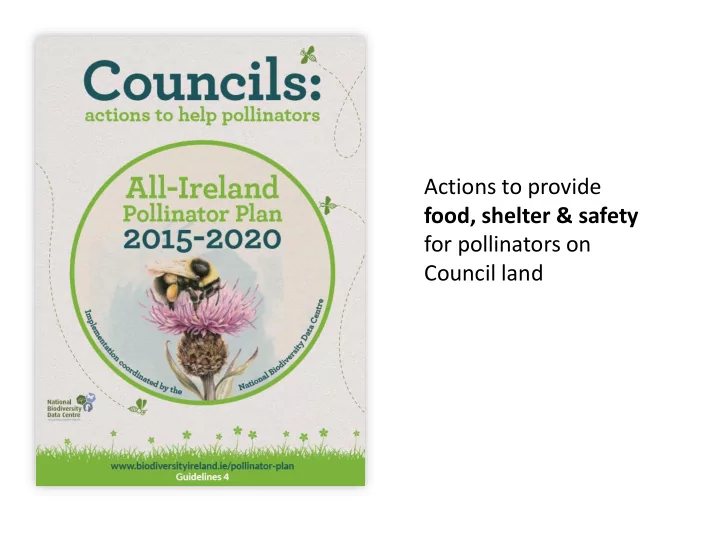
Council land COUNCILS: actions to help pollinators A. Identify and - - PowerPoint PPT Presentation
Actions to provide food, shelter & safety for pollinators on Council land COUNCILS: actions to help pollinators A. Identify and protect existing areas that are good for pollinators Waterford Action 1 : Promote the management and
Action 1: Promote the management and restoration of semi-natural habitats and their native plants on council land
Waterford Waterford Waterford
that are good for pollinators
that are good for pollinators
Action 2: Identify and protect existing sources of food and shelter for pollinators on general council land
Waterford Waterford Waterford
✓ Flowering hedgerows (food) ✓ Patches of wildflowers on waste ground (food) ✓ Small wild areas with bramble/ivy (food) ✓ Existing earth banks (shelter) ✓ Dry stone walls (shelter) DON’T REPLACE SOMETHING GOOD WITH SOMETHING THAT IS ONLY OK…
Action 3: At least 10 locations mown under a pollinator friendly regime (5 cut & lifts per year)
to allow more native plants to flower
to allow more native plants to flower
Action 4: At least 5 meadows (one cut and lift per year)
Waterford
Action 5: 10 flagship roadside verges that are managed to be pollinator friendly (one cut and lift per year) Action 6: Introduce a layered mowing approach to other roadside verges
to allow more native plants to flower
Cut once a year – food and shelter Cut on a 6-weekly rotation from mid April - food Cut regularly
Liam Scott
Waterford Waterford
Action 7: Plant a native wildflower meadow. Source native seed from Ireland and ensure that you plant pollinator-friendly species. This is difficult and can be costly
FOOD
Bees will be just as happy with natural regeneration
Action 8: Plant a native flowering hedgerow FOOD
Traditional management of hedgerows
in flower in April-May, they are not good for pollinators and other wildlife.
FOOD Action 9: Replace grass with a dense clover sward
Action 10: For future ornamental tree planting select from pollinator- friendly species
Tom Cuffe
List of ‘Street trees’ and ‘Open Space’ trees in appendix in Council guidelines. Examples: Open Space: Willow Lime Rowan Wild Cherry Bird Cherry Apple Horse chestnut Juneberry Indian Bean Tree Foxglove Tree Japanese flowering cherry Street Trees: Juneberry Upright Hawthorn Pillar Crab Callery Pear Rowan Lime
FOOD
FOOD Action 11: For new works ensure 75% of ornamental planting is pollinator friendly NOT GOOD FOR POLLINATORS Very gaudy annuals like Geranium, Begonia, Busy Lizzy, Primula, Daffodil, Tulip, Salvia splendens don’t provide food
Peter Cuthbert
Action 13: Make some urban planters pollinator friendly Action 12: In future
planting, select pollinator- friendly species
This might look good to us, but provides no food for pollinators
FOOD
Action 14: Pollinator-friendly roundabouts. Some roundabouts planted in a pollinator-friendly way with bulbs or pollinator-friendly perennials
FOOD
Peter Cuthbert Peter Cuthbert
Action 15: Manage hedgerows for pollinators Action 16: Bare earth/sand banks for wild pollinator nesting
*62 mining solitary bee species in Ireland
Action 17: Holes in wood or concrete for wild pollinator nesting Action 18: Bee hotels for wild pollinators
*Bee hotels can be useful and are a good awareness raising tool, but actions 16 and 17 are preferable ways to create nest sites.
*15 cavity- nesting solitary bee species in Ireland A number of small hotels is better than
terms of minimising the risks of disease and predators killing the bees.
✓ Aim to eliminate in some locations ✓ Turf - spray only sports pitches, bowling greens, cricket squares ✓ Adopt a policy of not spraying paths until the 15th April ✓ Have spraying buffer zones around important pollinator habitat ✓ Adopt the Pesticide Best Practice Code
Action 19: Reduce or eliminate the use of pesticides Action 20: Ensure best practice the use of pesticides cannot be avoided
Waterford
Action 21: Build actions on pollinators into existing frameworks and initiatives Action 22: Fund pollinator projects on council land to demonstrate best practice to other sectors Action 23: Put up signage to identify pollinator-friendly habitats on council land
Award Scheme (parks)
Action 24: Print & distribute pollinator-friendly guidelines to other sectors Action 25: Promote & distribute the Junior Pollinator Plan to local schools
Action 26: Facilitate or deliver training on pollinators and how to take action to protect them
Action 28: Promote and get involved in other pollinator related initiatives Action 27: Fund pollinator award in the Tidy Towns or Ulster in Bloom competition
Kildare County Council & Wicklow County Council supported animation
Action 29: Log your ‘Actions for Pollinators’ on the mapping system to ensure your efforts are recognised
Action 30: Take part in the Bumblebee Monitoring Scheme
Zoe Devlin Tom Cuffe
polinators@biodiversityireland.ie
Many thanks to all those who have donated images to the All-Ireland Pollinator Plan.