
SLIDE 1
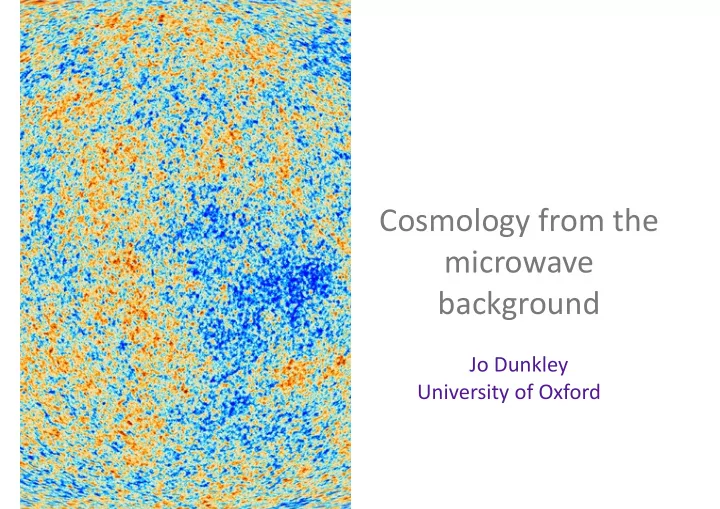
Cosmology(from(the( microwave( background( Jo(Dunkley( - - PowerPoint PPT Presentation
Cosmology(from(the( microwave( background( Jo(Dunkley( University(of(Oxford( Jo Dunkley History of early universe Inflation? T 10 15 GeV t 10 -35 s CDM decoupling? T 10 GeV? t 10 -8 s Neutrino decoupling T 1 MeV t
Inflation? T ∼ 1015 GeV t ∼ 10-35 s CDM decoupling? T ∼ 10 GeV? t ∼ 10-8 s Neutrino decoupling T ∼ 1 MeV t ∼ 1s Big Bang Nucleosynthesis T ∼ 100 keV t ∼ 10 min Matter-Radiation Equality T ∼ 0.8 eV t ∼ 60,000 yr Recombination T ∼ 0.3 eV t ∼ 380,000 yr Later: Neutrinos become ‘cold’ < t~100,000,000 yr
1. Inflation (?) imprints quantum fluctuations. 2. Space expands, regions enter into causal contact and start to evolve. 3. Coupled baryons and photons produce oscillations in plasma. After 380,000 years the fluctuations have evolved, and we see a snapshot
Linearity means we can use the anisotropies to infer the initial fluctuations and the contents of the Universe.
Planck(Collaboration(2015
Plus(6(other(wavelengths
cmb
cmb
largest(scales(removed
Planck(Collaboration(2015
ACTPol maps, scale 15 uK, 10 degrees, Naess et al 2014
Planck(Collaboration(2015
2 10 30 101 102 103 104
D`[µK2]
90 18 1000 2000 3000 4000
Multipole moment, `
Planck ACT SPT 1 0.2 0.1 0.07 0.05
Angular scale
Planck(Collaboration(2015
6Rparameter(LCDM(fits(extremely(well:(constraints(on(baryon,(CDM(and(Lambda(fractions,(and(size(
CMB(temperature
20 40 60 80 100
`
Planck(Collaboration(2015
Greatly(limits(vast(zoo(of(alternatives(to(LCDM,(e.g.(
CMB(polarization((ERmode)
2000 30 500 1000 1500 2000
16
1 10 100 1000 10000 mχ[GeV] 10−27 10−26 10−25 10−24 10−23 feff σv [cm3 s−1]
Thermal relic Planck TT,TE,EE+lowP WMAP9 CVL Possible interpretations for: AMS-02/Fermi/Pamela Fermi GC
dE dtdV (z) = 2 g ρ2
critc2Ω2 c(1 + z)6pann(z),
(81) where pann is defined as pann(z) ⌘ f(z)hσ3i mχ , (82) the critical density of the Universe today, m is the mass of
Dark(Matter( annihilation
50 100 150 200 250 300 350 400 0.0 0.4 0.8 1.2 1.6 [( + 1)]2 C
/2 [×107]
T only T + P 2 ]
Planck(Collaboration(2015
Lensing(limits(curvature(to(2%,(and(neutrino(mass(sum(to(0.7(eV.
CMB(lensing
(1) Number(of(species:( (2) Neutrino(mass
Neff = 3.13 ± 0.32 Planck TT N 3 15 0 23 Planck TT
Planck(Collaboration(2015
X mν < 0.68 eV More species: longer radiation domination, suppress acoustic oscillations, anisotropic stress shifts peaks More mass: neutrinos switch from being relativistic (hot) to non-relativistic (cold) earlier. Hot neutrinos free-stream, reducing matter clustering and damping of photon-baryon oscillations compared to CDM.
0.018 0.020 0.022 0.024 0.026 ωb 1 2 3 4 5 6 7 8 Neff A v e r e t a l . ( 2 1 3 ) C
e e t a l . ( 2 1 4 ) Planck TT+lowP Planck TT+lowP+BAO Planck TT,TE,EE+lowP
X mν < 0.23 eV
2
Planck TT Planck TT Planck TT Planck TT
+(BAO
Forecasted(errors:( 2015(((Planck(((+(BOSS(((((100(meV( 2017(((ACTPol((+(BOSS((((((60( 2019(((AdvACT(+(BOSS((((((40( 2021(((AdvACT(+(DESI(((((((20( 2020s(CMBRS4(+(DESI(((((((16
Aberzajian(et(al(2014
From(oscillation(expt,(minimum( mass(sum(=(60(meV.(
Planck Collaboration: Cosmological
100 500 1000 2000
500 1000 1500
ns = 0.96 ns = 1.00
Planck(Collaboration(2014,(2015(
n<1 Universe(is(flat(to(0.5%,(fluctuations(are(super5horizon,(Gaussian(and(adiabatic
From(K(Story
˙ ˙ h
k + 2 ˙
a a ˙ h
k − k 2hk = 0
T
From(K(Story
˙ ˙ h
k + 2 ˙
a a ˙ h
k − k 2hk = 0
T
φ2
0.95 0.96 0.97 0.98 0.99 1.00
ns
0.00 0.05 0.10 0.15 0.20 0.25
r0.002
N = 5 N = 6 Convex Concave
φ
Planck TT+lowP Planck TT+lowP+BKP +lensing+ext
50 100 150 200 250 300 −0.01 0.01 0.02 0.03 0.04 0.05 Multipole BKxBK (BKxBK−αBKxP)/(1−α)
Planck(Collaboration(2015 Planck/BICEP2(Collaborations(2015
BRmode(power
10 30 100 300 1000
Frequency (GHz)
10
10 10
1
10
2
RMS brightness temperature (µK)
CMB Thermal dust Synchrotron 30 44 70 100 143 217 353 Sum fg
Planck(Collaboration(2015 (level(over(70R90%(of(sky)
Until(Planck,(dust(level( uncertain(to(order%of% magnitude%
AP d
20 200 µKRJ @ 353 GHz
Next:(CMBRS4(campaign(from(~2020R25( Now:(’StageR3’(CMB:(Spider,(PolarBear,(BICEP3,(Keck,(CLASS,(SPTR3G,(GroundBird( My(project((led(in(Princeton):(AdvACT(( Targeting(r=0.01(with(five(wavelengths(2016R18.