SLIDE 1
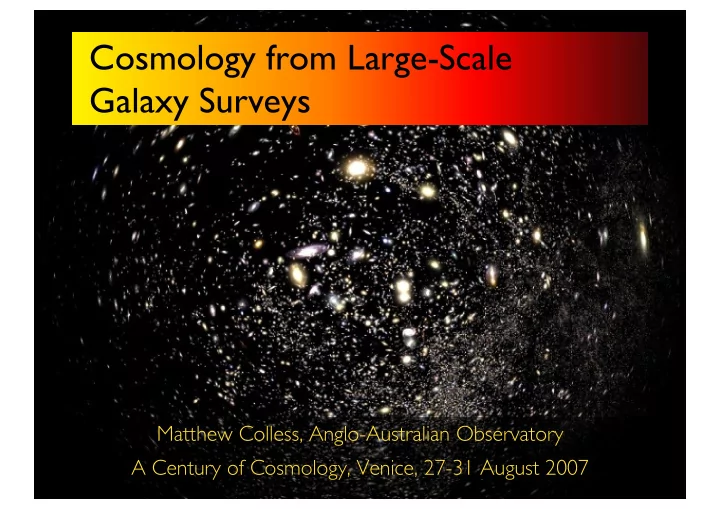
Cosmology from Large-Scale Galaxy Surveys
Matthew Colless, Anglo-Australian Observatory A Century of Cosmology, Venice, 27-31 August 2007
SLIDE 2
A brief history of galaxy surveys
Before 1980: Pre-history - first galaxy redshift surveys
Hubble, the expanding universe, and all that
1985-1995: Age of Discovery - large-scale structures
The CfA redshift survey and the iconic stick-figure The development of multi-object spectrographs Large (104) z-surveys - LDSS, Autofib, PSCz, LCRS…
1995-2005: Industrial Revolution - ‘precision cosmology’
Massive (105) z-surveys - 2dFGRS, SDSS, 6dFGS, 2MRS… Deep z-surveys - DEEP, VVDS, zCOSMOS…
Present & future: Post-Modernism - death or glory?
Dark energy - holy grail? much ado about nothing? BAO (106) surveys - WiggleZ, FASTsound, WFMOS… Galaxy surveys with ELTs - baryon tomography…
AAO
FOC FOCAP LDSS LDSS Autofib utofib 2d 2dF 6d 6dF AA WFM FMOS OS
SLIDE 3
Las Campanas Redshift Survey ~25000 z’s
State of the art ~1997
CfA fA Survey ~15000 z z’s
SLIDE 4
Evolution of Redshift Surveys
2dFGRS SDSS
SLIDE 5
UK Schmidt Telescope (1.2m) Anglo-Australian Telescope (3.9m)
Surveys with the AAT & UKST
SLIDE 6 The 2-degree Field Spectrograph
Multi-ob ulti-object ject fi fibre re sp spectrog ectrogra raph w h with ith rob robotic
Sp Spectra ectra for 400 for 400 gala laxies ov xies over 2º er 2º 2d 2dF ena F enabled led a a massiv ssive e z-surv urvey ey
SLIDE 7
The 2dFGRS map of 221000 galaxies
SLIDE 8 The large-scale structure of the galaxy distribution, on scales from millions to billions of light-years, depends on… the amounts of the various constituents of the universe (baryonic matter, dark matter, dark energy etc.) the recipe for how galaxies are formed (when, where, and with what bias relative to the dark matter) The rich structure of the galaxy distribution encodes much physics and many parameters
100 million light-years
Large-Scale Structure in Model Universes
SLIDE 9
Surveys versus simulations
Comparis ison of slic lices fr from CfA fA2, 2dFGRS and SDSS surveys on diffe ifferent scale les, all ll compared to equiv ivale lent slic lices, sele lected fo for their ir sim imila ilarit ity, fr from the Mille illenniu ium Sim imula latio ion (Sprin
pringe gel, Fre renk k & W White ite 2 2006)
SLIDE 10
2dFGRS structure & cosmology results
SLIDE 11
The large-scale structure of the galaxy distribution is reliable and precisely determined on size scales from 1 Mpc to 200 Mpc The properties of the galaxy distribution confirm that the large-scale structure grows by gravitational instability… consistent with quantum fluctuations emerging from Big Bang being amplified by gravity into galaxies/clusters/superclusters The total density of all types of matter in the universe is M = 0.23 there is only 23% of critical density needed for a flat universe The total density in ordinary matter is B = 0.04 baryons are 19% and CDM is 81% of all matter in the universe Neutrinos make up less than 13% of all the matter in the universe the total mass of the 3 neutrino species is less than 0.7 eV First detection of baryon acoustic oscillations (simultaneous with SDSS)
2dFGRS structure & cosmology results
SLIDE 12
Composition of the cosmos
19% 19% 77% 77%
SNe CMB Baryons
SLIDE 13 The 6dF Galaxy Survey
A redshift & peculiar velocity survey
- f galaxies in the local universe
Covers southern sky with |b|>10º Primary galaxy sample selected from 2MASS with Ktot<12.75 Also H<13.0, J<13.75 (2MASS) and r<15.6, b<16.75 (SuperCosmos) 11 other samples: radio, X-ray, IRAS Peculiar velocity survey uses FP for 15,000 bright early-type galaxies Observations obtained May 2001 to Jan 2006 using 6dF spectrograph on the UK Schmidt Telescope Database:137k spectra, 124k galaxy redshifts over 80% of southern sky Final data release Aug 2007
SLIDE 14 Sky coverage & redshift completeness
Obse bserve rved 1 d 1464/1 /1598 fi fields; 9 lds; 92% o
the so south thern rn sky sky w with ith |b|> |b|>10° Mean an re redsh dshif ift c t comple plete teness ss for th r the K-ban K-band prim d primary ary sam sample ple is 8 is 88%
SLIDE 15
Comparison with other z-surveys
Comparing the 6dFGS to the 2dFGRS and SDSS…
6dFGS galaxy sample is NIR selected rather than optically-selected 6dFGS surveys <z>=0.05 local universe (cf. 2dFGRS/SDSS <z>=0.1) 6dFGS volume is comparable to the 2dFGRS, but 3x smaller than SDSS Large fibres, so aperture effects are less for 6dFGS than 2dFGRS/SDSS
SLIDE 16
6dFGS redshift space maps
z < 0.1
SLIDE 17
The 6dFGS view of the local universe
SLIDE 18 z-only ly z z + v 1 conto tours rs
pairs of param paramete ters rs
6dFGS power spectra and constraints
Galaxy power spectrum Velocity power spectrum
SLIDE 19 2MASS Redshift Survey
All-sky z-survey to Ks=11.25 (limit is 1.5 mag brighter than 6dFGS) 93% complete with z’s from Arecibo, Green Bank and FLWO 1.5m in North and 6dFGS and CTIO in South 2MRS contains 23,000 galaxies and is densest all-sky z-survey to date
cz=6000 km/s
Erdogdu et al., ., 2006, , MNRAS, , 368, , 151
SLIDE 20 Local density field reconstruction
2MRS de density sity fi field re ld reconstru structio tion by by F Fourie rier-Be r-Besse ssel de l decompo positio sition an and W d Wie iener fi r filte lterin ring
Erdogdu et al., ., 2006, , MNRAS, , 373, , 45
SLIDE 21 Predicted local velocity field
The linea The linear v r velocity field elocity field in the in the Sup uperg ergala lactic ctic Pla lane a ne as p s pred redicted icted from from the reconstructed the reconstructed 2M 2MRS d RS density field ensity field (a (assum ssuming ing =0.5) 0.5)
Erdogdu et al., ., 2006, , MNRAS, , 373, , 45
SLIDE 22 Dark energy from geometry
The g The geom eometry of the univ etry of the universe erse ca can b n be m e mea easured sured a at v t very ea ery early rly tim times from es from C CMB, a , and nd a at la t later ter tim times b es by a y a v variety of m riety of method ethods: s: ‘Sta tand ndard rd ca cand ndle le’ prov rovid ided ed by sup y supernov ernovae ‘Sta tand ndard rd sca scale le’ from from gra ravita itationa tional l lensing ensing Grow Growth of d th of density ensity perturb erturbations in clusters tions in clusters ‘Sta tand ndard rd ruler ruler’ of b
ryon acoustic oscilla coustic oscillations (B tions (BAO) O) in the g in the gala laxy d xy distrib istribution ution
The geometry of f the univ iverse is is governed by the equatio ion of f state, knowle ledge of whic ich reveals ls the nature of f the dark energy
SLIDE 23 The WiggleZ BAO survey
Science goals…
Primary: first z-survey measure of BAO scale at z~1; aim for ~2% precision to constrain w to ~10% and test for evolution Secondary: study properties of star-forming galaxies at z~1
Observing plan…
Targets: 400,000 b~1 galaxies (200,000 with z>0.5) over 1000 deg2 Sample: from GALEX + SDSS/RCS; FUV-NUV colour selects Lyman break at z>0.7; NUV-r selects emission line galaxies Observations: using AAOmega spectrograph with 2dF on AAT Status: ~80,000 redshifts to date; aim to complete in 2009
WiggleZ team…
Australia: Drinkwater, Jurek, Pimbblet (UQ); Blake, Couch, Forbes, Glazebrook, Brough, Jones, Barnes (Swinburne); Woods (UNSW); Croom (Sydney); Pracy (ANU); Colless, Sharp (AAO); USA: Forster, Madore, Martin, Small (GALEX); Canada: Gilbank, Gladders, Yee (RCS2)
Glazebrook et al. , astro-ph/0701876
SLIDE 24 Sim Simula ulations of tions of Wig iggleZ leZ BAO m O mea easurem surement com ent compared red to m to mod
el pow
er spectrum ectrum exp expect ~2% p ect ~2% precision on sta recision on stand ndard rd ruler sca ruler scale le Mea easure sure H(z (z) and nd DA(z) at t z~0.7, us 0.7, use p priors on riors on M and nd H0 (CMB giv ives es Mh2), reconstruct d , reconstruct density field ensity field 2.7% on .7% on H, 1.8% on 1.8% on DA Eq Equa uation of sta tion of state p te precision recision 10% on 0% on w0 (sim (simila ilar to r to SNe e surv urveys b eys but ut com complem lementa entary in ha ry in having ing a a d different m ifferent method ethod & d & different ifferent deg egenera eneracies cies)
Monte Carlo average data — Model power spectrum
BAO precision and constraints on w
SLIDE 25 WiggleZ fields and target selection
Total su tal surve rvey are area o a of ~1000deg2, m made ade u up
7 e equ quato atorial fi rial fields, lds, eac ach o
100-2
deg2 (> (>9º o º on a side a side, > , >2-3
BA BAO sc scale ale at z> at z>0.5 .5) Targe argets se ts sele lecte ted u d usin sing combin binatio ation o
UV (G (GALEX) an ) and o d optic ptical al (S (SDSS/R /RCS2) ) colo lours rs Sele lectio tion c crite riteria pic ria pick emissio ission-lin
galaxie ies at at z~0.7 .7 (> (>200 o
the ~400 targe targets pe ts per de r deg2) Allo llocate ated 2 d 220 n nigh ights ts
AAT o
ver 2 r 2006-9
SLIDE 26 UV-optical selection criteria
Galax alaxie ies w s with ith NUV < < 2 22.8 .8 an and 20.0 .0 < < r < r < 2 22.5 .5 FUV-N
>1 o
no F FUV de dete tectio tion z > 0 0.5 .5 NUV-r
2 blu blue star-f star-form rmin ing galax galaxie ies, s, stro trong emissio ission lin lines g-r/r-i c g-r/r-i colo lour r cut re redu duces n s numbe ber
.5 galax galaxie ies GALEX-S
ban ands ds matc atch no F FUV x ELGs
Model colours 0<z<1.5 .5 LBG SB Im Scd Sbc E/S0
Emissio ission-lin
galaxie ies m s margin arginally ally pre preferre rred to d to lu lumin inous re s red galax d galaxie ies: bias f s: bias fac acto tor sm smalle aller bu r but e t easie asier to r to re redsh dshif ift (sh t (shorte rter e r expo posu sure res, s, more re ro robu bust in st in po poor c r conditio ditions) s)
SLIDE 27 Status of WiggleZ survey
2dFGRS // SDSS SDSS LRGs 2SLAQ LRGs
Wiggle iggleZ surve rvey
Fin inal l expected numbers…
~350,000 sp ~350,000 spectra ectra ~210 ~210,000 000 red edshifts shifts ~160,000 g ~160,000 gala laxies xies at z>0.5 t z>0.5
Redshift ift success rate 60% Tunin ing sele lectio ion crit iteria ia, fractio ion at z>0.5 75% Fractio ion of f sample le at z>0.5 45% Reaches z~1 in in 1–hour exp. (cf. z~0.1 fo for 2dFGRS) due to ELG sele lectio ion & effi fficie iency of AAOmega spectrograph
SLIDE 28 Small-scale clustering
Prelim relimina inary clustering ry clustering m mea easurem surement strong ent stronger tha er than a n assum ssumed ed… Prop roposa
l was 400 red s 400 redshifts/d shifts/deg eg2 at z>0.5 for sa t z>0.5 for sample w le with ith b=1 =1.0 Clustering lustering leng length now th now m mea easured sured to b to be 6 e 6 Mpc/h c/h b=1 =1.4 Eq Equiv uivalent surv lent survey for ey for b=1 =1.4 is 200 red 4 is 200 redshifts/d shifts/deg eg2 at z>0.5 t z>0.5 Thus the rev Thus the revised ised ta targ rget is a et is a surv survey of ey of 200,000 z>0.5 g 00,000 z>0.5 gala laxies xies Hig Higher b her bia ias therefore la s therefore larg rgely com ely compensa ensates for low tes for lower efficiency er efficiency
SLIDE 29 FastSound survey
Proposed z>1 BAO survey using FMOS/Subaru NIR spectroscopy…
FMOS: 400-fibre J+H OH-suppressed NIR spect., commissioning in Feb 08 ~600,000 H galaxies in ‘redshift desert’ at z~1.0–1.7 over ~300 deg2 (~1 Gpc3) O(100) nights on Subaru Unique redshift range for BAO survey, good precision, lots of ancillary science Japan/UK/Australia team of 40+ people
Totani et al., 2006, in Co Cosmology with wide-fi field photometric and spectroscopic galaxy surveys
(w (with ith A AP te P test) st)
SLIDE 30 WFMOS survey
Wide-Field Multi-Object Spectrograph for an 8-m telescope (Subaru/Gemini)
1.5 degree field 4000 optical fibres 5 years to build
Survey of >1,000,000 z~1 galaxies to measure BAO
Survey takes ~3 years Combined with CMB / SNe / lensing methods, could achieve precision of w0~few% & w1~10% Also possible z~3 survey
Colless (2005) & Glazebrook (2005), , both in Probin ing the Dark Univ iverse wit ith Subaru and Gemin ini, http:/ ://www.noao.edu/meetings/subaru
SLIDE 31
Once and future galaxy surveys
Wide-field spectroscopy and redshift surveys will continue to be powerful tools for large-scale structure and cosmology The combined 6dF redshift + velocity survey will better constrain fundamental parameters (such as and rg) and so provide new insights on the relative distributions of luminous and dark matter Current (WiggleZ) and future (FASTsound, WFMOS) redshift surveys will trace the evolution of galaxies & large-scale structure, measuring precisely the evolving geometry of the universe Combined with CMB, SNe and weak lensing, BAO surveys will determine the evolution of the equation of state with few-% precision and strongly constrain the nature of the dark energy Future ELT surveys will map the 3D distribution of baryons down to galaxy scales out to the epoch of formation of the first galaxies