Correction: W2V vs. V2W Recorrection: Perspective Derivation - - PowerPoint PPT Presentation

correction w2v vs v2w recorrection perspective derivation
SMART_READER_LITE
LIVE PREVIEW

Correction: W2V vs. V2W Recorrection: Perspective Derivation - - PowerPoint PPT Presentation

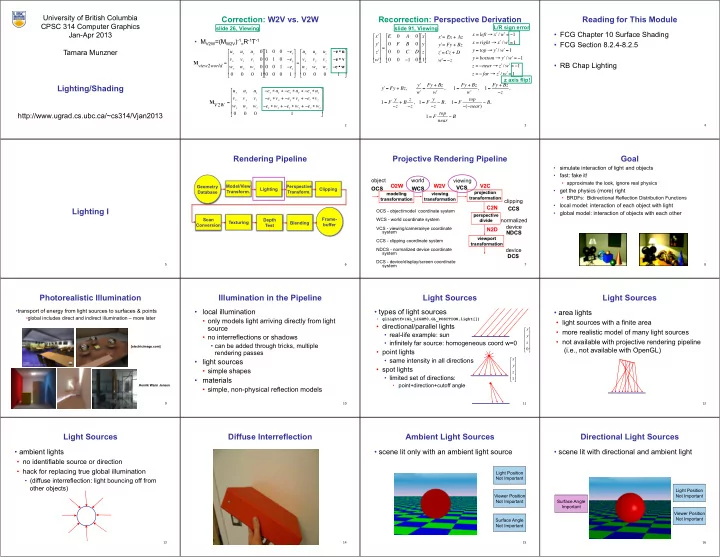
University of British Columbia Correction: W2V vs. V2W Recorrection: Perspective Derivation Reading for This Module CPSC 314 Computer Graphics L/R sign error slide 26, Viewing slide 91, Viewing FCG Chapter 10 Surface Shading Jan-Apr 2013


slide-1
SLIDE 1

http://www.ugrad.cs.ubc.ca/~cs314/Vjan2013

Lighting/Shading

University of British Columbia CPSC 314 Computer Graphics Jan-Apr 2013 Tamara Munzner

2

Correction: W2V vs. V2W

  • MV2W=(MW2V)-1

=R-1T-1

Mview2world = ux uy uz vx vy vz wx wy wz 1

  • 1

ex 1 ey 1 ez 1

  • =

ux uy uz e•u vx vy vz e• v wx wy wz e• w 1

  • MV2W =

ux uy uz ex ux + ey uy + ez uz vx vy vz ex vx + ey vy + ez vz wx wy wz ex wx + ey wy + ez wz 1

  • slide 26, Viewing

3

Recorrection: Perspective Derivation

x' y' z' w'

  • =

E A F B C D 1

  • x

y z 1

  • y'= Fy + Bz, y'

w' = Fy + Bz w' , 1= Fy + Bz w' , 1= Fy + Bz z , 1= F y z + B z z , 1= F y z B, 1= F top (near) B, x'= Ex + Az y'= Fy + Bz z'= Cz + D w'= z x = left x /

  • w = 1

x = right x /

  • w =1

y = top y /

  • w =1

y = bottom y /

  • w = 1

z = near z /

  • w = 1

z = far z /

  • w =1

1= F top near B z axis flip! L/R sign error slide 91, Viewing

4

Reading for This Module

  • FCG Chapter 10 Surface Shading
  • FCG Section 8.2.4-8.2.5
  • RB Chap Lighting

5

Lighting I

6

Rendering Pipeline

Geometry Database Model/View Transform. Lighting Perspective Transform. Clipping Scan Conversion Depth Test Texturing Blending Frame- buffer

7

Projective Rendering Pipeline

OCS - object/model coordinate system WCS - world coordinate system VCS - viewing/camera/eye coordinate system CCS - clipping coordinate system NDCS - normalized device coordinate system DCS - device/display/screen coordinate system

OCS O2W VCS CCS NDCS DCS

modeling transformation viewing transformation projection transformation viewport transformation perspective divide

  • bject

world viewing device normalized device clipping W2V V2C N2D C2N WCS

8

Goal

  • simulate interaction of light and objects
  • fast: fake it!
  • approximate the look, ignore real physics
  • get the physics (more) right
  • BRDFs: Bidirectional Reflection Distribution Functions
  • local model: interaction of each object with light
  • global model: interaction of objects with each other

9

Photorealistic Illumination

[electricimage.com]

  • transport of energy from light sources to surfaces & points
  • global includes direct and indirect illumination – more later

Henrik Wann Jensen 10

Illumination in the Pipeline

  • local illumination
  • only models light arriving directly from light

source

  • no interreflections or shadows
  • can be added through tricks, multiple

rendering passes

  • light sources
  • simple shapes
  • materials
  • simple, non-physical reflection models

11

Light Sources

  • types of light sources
  • glLightfv(GL_LIGHT0,GL_POSITION,light[])
  • directional/parallel lights
  • real-life example: sun
  • infinitely far source: homogeneous coord w=0
  • point lights
  • same intensity in all directions
  • spot lights
  • limited set of directions:
  • point+direction+cutoff angle
  • z

y x

  • 1

z y x

12

Light Sources

  • area lights
  • light sources with a finite area
  • more realistic model of many light sources
  • not available with projective rendering pipeline

(i.e., not available with OpenGL)

13

Light Sources

  • ambient lights
  • no identifiable source or direction
  • hack for replacing true global illumination
  • (diffuse interreflection: light bouncing off from
  • ther objects)

14

Diffuse Interreflection

15

Ambient Light Sources

  • scene lit only with an ambient light source

Light Position Not Important Viewer Position Not Important Surface Angle Not Important

16

Directional Light Sources

  • scene lit with directional and ambient light

Light Position Not Important Viewer Position Not Important Surface Angle Important

slide-2
SLIDE 2

17

Point Light Sources

  • scene lit with ambient and point light source

Light Position Important Viewer Position Important Surface Angle Important

18

Light Sources

  • geometry: positions and directions
  • standard: world coordinate system
  • effect: lights fixed wrt world geometry
  • demo:

http://www.xmission.com/~nate/tutors.html

  • alternative: camera coordinate system
  • effect: lights attached to camera (car headlights)
  • points and directions undergo normal model/

view transformation

  • illumination calculations: camera coords

19

Types of Reflection

  • specular (a.k.a. mirror or regular) reflection causes

light to propagate without scattering.

  • diffuse reflection sends light in all directions with

equal energy.

  • mixed reflection is a weighted

combination of specular and diffuse.

20

Specular Highlights

21

Types of Reflection

  • retro-reflection occurs when incident energy

reflects in directions close to the incident direction, for a wide range of incident directions.

  • gloss is the property of a material surface

that involves mixed reflection and is responsible for the mirror like appearance of rough surfaces.

22

Reflectance Distribution Model

  • most surfaces exhibit complex reflectances
  • vary with incident and reflected directions.
  • model with combination

+ + = specular + glossy + diffuse = reflectance distribution

23

Surface Roughness

  • at a microscopic scale, all

real surfaces are rough

  • cast shadows on

themselves

  • “mask” reflected light:

shadow shadow Masked Light

24

Surface Roughness

  • notice another effect of roughness:
  • each “microfacet” is treated as a perfect mirror.
  • incident light reflected in different directions by

different facets.

  • end result is mixed reflectance.
  • smoother surfaces are more specular or glossy.
  • random distribution of facet normals results in diffuse

reflectance.

25

Physics of Diffuse Reflection

  • ideal diffuse reflection
  • very rough surface at the microscopic level
  • real-world example: chalk
  • microscopic variations mean incoming ray of

light equally likely to be reflected in any direction over the hemisphere

  • what does the reflected intensity depend on?

26

Lambert’s Cosine Law

  • ideal diffuse surface reflection

the energy reflected by a small portion of a surface from a light source

in a given direction is proportional to the cosine of the angle between that direction and the surface normal

  • reflected intensity
  • independent of viewing direction
  • depends on surface orientation wrt light
  • often called Lambertian surfaces

27

Lambert’s Law

intuitively: cross-sectional area of the “beam” intersecting an element

  • f surface area is smaller for greater

angles with the normal.

28

Computing Diffuse Reflection

  • depends on angle of incidence: angle between surface

normal and incoming light

  • Idiffuse = kd Ilight cos θ
  • in practice use vector arithmetic
  • Idiffuse = kd Ilight (n • l)
  • always normalize vectors used in lighting!!!
  • n, l should be unit vectors
  • scalar (B/W intensity) or 3-tuple or 4-tuple (color)
  • kd: diffuse coefficient, surface color
  • Ilight: incoming light intensity
  • Idiffuse: outgoing light intensity (for diffuse reflection)

n l θ

29

Diffuse Lighting Examples

  • Lambertian sphere from several lighting

angles:

  • need only consider angles from 0° to 90°
  • why?
  • demo: Brown exploratory on reflection
  • http://www.cs.brown.edu/exploratories/freeSoftware/repository/edu/brown/cs/

exploratories/applets/reflection2D/reflection_2d_java_browser.html

30

Specular Highlights

Michiel van de Panne

31

Physics of Specular Reflection

  • at the microscopic level a specular reflecting

surface is very smooth

  • thus rays of light are likely to bounce off the

microgeometry in a mirror-like fashion

  • the smoother the surface, the closer it

becomes to a perfect mirror

32

Optics of Reflection

  • reflection follows Snell’s Law:
  • incoming ray and reflected ray lie in a plane

with the surface normal

  • angle the reflected ray forms with surface

normal equals angle formed by incoming ray and surface normal θ(l)ight = θ(r)eflection

slide-3
SLIDE 3

33

Non-Ideal Specular Reflectance

  • Snell’s law applies to perfect mirror-like surfaces,

but aside from mirrors (and chrome) few surfaces exhibit perfect specularity

  • how can we capture the “softer” reflections of

surface that are glossy, not mirror-like?

  • one option: model the microgeometry of the

surface and explicitly bounce rays off of it

  • or…

34

Empirical Approximation

  • we expect most reflected light to travel in

direction predicted by Snell’s Law

  • but because of microscopic surface

variations, some light may be reflected in a direction slightly off the ideal reflected ray

  • as angle from ideal reflected ray increases,

we expect less light to be reflected

35

Empirical Approximation

  • angular falloff
  • how might we model this falloff?

36

  • nshiny : purely empirical

constant, varies rate of falloff

  • ks: specular coefficient,

highlight color

  • no physical basis, works
  • k in practice

v

Ispecular = ksIlight(cos)nshiny Phong Lighting

  • most common lighting model in computer

graphics

  • (Phong Bui-Tuong, 1975)

37

Phong Lighting: The nshiny Term

  • Phong reflectance term drops off with divergence of viewing angle from

ideal reflected ray

  • what does this term control, visually?

Viewing angle – reflected angle

38

Phong Examples

varying l varying nshiny

39

Calculating Phong Lighting

  • compute cosine term of Phong lighting with vectors
  • v: unit vector towards viewer/eye
  • r: ideal reflectance direction (unit vector)
  • ks: specular component
  • highlight color
  • Ilight: incoming light intensity
  • how to efficiently calculate r ?

v

Ispecular = ksIlight(v•r)nshiny

40

Calculating R Vector

P = N cos θ |L| |N| projection of L onto N P = N cos θ L, N are unit length P = N ( N · L )

L P N

θ

41

Calculating R Vector

P = N cos θ |L| |N| projection of L onto N P = N cos θ L, N are unit length P = N ( N · L ) 2 P = R + L 2 P – L = R 2 (N ( N · L )) - L = R

L P P R L N

θ

42

Phong Lighting Model

  • combine ambient, diffuse, specular components
  • commonly called Phong lighting
  • once per light
  • once per color component
  • reminder: normalize your vectors when calculating!
  • normalize all vectors: n,l,r,v

Itotal = kaIambient + Ii(

i=1 #lights

  • kd(n•li) + ks(v•ri)nshiny )

43

Phong Lighting: Intensity Plots

44

Blinn-Phong Model

  • variation with better physical interpretation
  • Jim Blinn, 1977
  • h: halfway vector
  • h must also be explicitly normalized: h / |h|
  • highlight occurs when h near n

l n v h Iout(x) = Iin(x)(ks(h•n)nshiny );with h = (l + v)/2

45

Light Source Falloff

  • quadratic falloff
  • brightness of objects depends on power per

unit area that hits the object

  • the power per unit area for a point or spot light

decreases quadratically with distance

Area 4πr2 Area 4π(2r)2

46

Light Source Falloff

  • non-quadratic falloff
  • many systems allow for other falloffs
  • allows for faking effect of area light sources
  • OpenGL / graphics hardware
  • Io: intensity of light source
  • x: object point
  • r: distance of light from x

2

1 ) ( I c br ar Iin

  • +

+ = x

47

Lighting Review

  • lighting models
  • ambient
  • normals don’t matter
  • Lambert/diffuse
  • angle between surface normal and light
  • Phong/specular
  • surface normal, light, and viewpoint

48

Lighting in OpenGL

  • light source: amount of RGB light emitted
  • value represents percentage of full intensity

e.g., (1.0,0.5,0.5)

  • every light source emits ambient, diffuse, and specular

light

  • materials: amount of RGB light reflected
  • value represents percentage reflected

e.g., (0.0,1.0,0.5)

  • interaction: multiply components
  • red light (1,0,0) x green surface (0,1,0) = black (0,0,0)
slide-4
SLIDE 4

49

Lighting in OpenGL

glLightfv(GL_LIGHT0, GL_AMBIENT, amb_light_rgba ); glLightfv(GL_LIGHT0, GL_DIFFUSE, dif_light_rgba ); glLightfv(GL_LIGHT0, GL_SPECULAR, spec_light_rgba ); glLightfv(GL_LIGHT0, GL_POSITION, position); glEnable(GL_LIGHT0); glMaterialfv( GL_FRONT, GL_AMBIENT, ambient_rgba ); glMaterialfv( GL_FRONT, GL_DIFFUSE, diffuse_rgba ); glMaterialfv( GL_FRONT, GL_SPECULAR, specular_rgba ); glMaterialfv( GL_FRONT, GL_SHININESS, n );

  • warning: glMaterial is expensive and tricky
  • use cheap and simple glColor when possible
  • see OpenGL Pitfall #14 from Kilgard’s list

http://www.opengl.org/resources/features/KilgardTechniques/oglpitfall/

50

Shading

51

Lighting vs. Shading

  • lighting
  • process of computing the luminous intensity

(i.e., outgoing light) at a particular 3-D point, usually on a surface

  • shading
  • the process of assigning colors to pixels
  • (why the distinction?)

52

Applying Illumination

  • we now have an illumination model for a point
  • n a surface
  • if surface defined as mesh of polygonal facets,

which points should we use?

  • fairly expensive calculation
  • several possible answers, each with different

implications for visual quality of result

53

Applying Illumination

  • polygonal/triangular models
  • each facet has a constant surface normal
  • if light is directional, diffuse reflectance is

constant across the facet

  • why?

54

Flat Shading

  • simplest approach calculates illumination at a

single point for each polygon

  • obviously inaccurate for smooth surfaces

55

Flat Shading Approximations

  • if an object really is faceted, is this

accurate?

  • no!
  • for point sources, the direction to light

varies across the facet

  • for specular reflectance, direction to

eye varies across the facet

56

Improving Flat Shading

  • what if evaluate Phong lighting model at each pixel
  • f the polygon?
  • better, but result still clearly faceted
  • for smoother-looking surfaces

we introduce vertex normals at each vertex

  • usually different from facet normal
  • used only for shading
  • think of as a better approximation of the real surface

that the polygons approximate

57

Vertex Normals

  • vertex normals may be
  • provided with the model
  • computed from first principles
  • approximated by

averaging the normals

  • f the facets that

share the vertex

58

Gouraud Shading

  • most common approach, and what OpenGL does
  • perform Phong lighting at the vertices
  • linearly interpolate the resulting colors over faces
  • along edges
  • along scanlines

C1 C2 C3 edge: mix of c1, c2 edge: mix of c1, c3 interior: mix of c1, c2, c3

does this eliminate the facets?

59

Gouraud Shading Artifacts

  • often appears dull, chalky
  • lacks accurate specular component
  • if included, will be averaged over entire

polygon

C1 C2 C3 this interior shading missed! C1 C2 C3 this vertex shading spread

  • ver too much area

60

Gouraud Shading Artifacts

  • Mach bands
  • eye enhances discontinuity in first derivative
  • very disturbing, especially for highlights

61

Gouraud Shading Artifacts

C1 C2 C3 C4 Discontinuity in rate

  • f color change
  • ccurs here
  • Mach bands

62

Gouraud Shading Artifacts

  • perspective transformations
  • affine combinations only invariant under affine,

not under perspective transformations

  • thus, perspective projection alters the linear

interpolation!

Z – into the scene Image plane

63

Gouraud Shading Artifacts

  • perspective transformation problem
  • colors slightly “swim” on the surface as objects move

relative to the camera

  • usually ignored since often only small difference
  • usually smaller than changes from lighting variations
  • to do it right
  • either shading in object space
  • or correction for perspective foreshortening
  • expensive – thus hardly ever done for colors

64

Phong Shading

  • linearly interpolating surface normal across the facet,

applying Phong lighting model at every pixel

  • same input as Gouraud shading
  • pro: much smoother results
  • con: considerably more expensive
  • not the same as Phong lighting
  • common confusion
  • Phong lighting: empirical model to calculate illumination at

a point on a surface

slide-5
SLIDE 5

65

Phong Shading

  • linearly interpolate the vertex normals
  • compute lighting equations at each pixel
  • can use specular component

N1 N2 N3 N4

Itotal = kaIambient + Ii kd n li

( ) + ks v ri ( )

nshiny

( )

i=1 #lights

  • remember: normals used in

diffuse and specular terms discontinuity in normal’s rate of change harder to detect

66

Phong Shading Difficulties

  • computationally expensive
  • per-pixel vector normalization and lighting

computation!

  • floating point operations required
  • lighting after perspective projection
  • messes up the angles between vectors
  • have to keep eye-space vectors around
  • no direct support in pipeline hardware
  • but can be simulated with texture mapping
  • stay tuned for modern hardware: shaders

67

Gouraud Phong

Shading Artifacts: Silhouettes

  • polygonal silhouettes remain

68

A D C B

Interpolate between AB and AD

i

  • B

A D C

Interpolate between CD and AD

Rotate -90o and color same point

Shading Artifacts: Orientation

  • interpolation dependent on polygon orientation
  • view dependence!

69

B A C vertex B shared by two rectangles

  • n the right, but not by the one on

the left E D F H G first portion of the scanline is interpolated between DE and AC second portion of the scanline is interpolated between BC and GH a large discontinuity could arise

Shading Artifacts: Shared Vertices

70

Shading Models Summary

  • flat shading
  • compute Phong lighting once for entire

polygon

  • Gouraud shading
  • compute Phong lighting at the vertices and

interpolate lighting values across polygon

  • Phong shading
  • compute averaged vertex normals
  • interpolate normals across polygon and

perform Phong lighting across polygon

71

Shutterbug: Flat Shading

72

Shutterbug: Gouraud Shading

73

Shutterbug: Phong Shading

74

Non-Photorealistic Shading

  • cool-to-warm shading

http://www.cs.utah.edu/~gooch/SIG98/paper/drawing.html kw = 1+ n l 2 ,c = kwcw + (1 kw)cc

75

Non-Photorealistic Shading

  • draw silhouettes: if , e=edge-eye vector
  • draw creases: if

(e n0)(e n1) 0 http://www.cs.utah.edu/~gooch/SIG98/paper/drawing.html (n0 n1) threshold

76

Computing Normals

  • per-vertex normals by interpolating per-facet

normals

  • OpenGL supports both
  • computing normal for a polygon

c b a

77

Computing Normals

  • per-vertex normals by interpolating per-facet

normals

  • OpenGL supports both
  • computing normal for a polygon
  • three points form two vectors

c b a c-b a-b

78

Computing Normals

  • per-vertex normals by interpolating per-facet normals
  • OpenGL supports both
  • computing normal for a polygon
  • three points form two vectors
  • cross: normal of plane

gives direction

  • normalize to unit length!
  • which side is up?
  • convention: points in

counterclockwise

  • rder

c b a c-b a-b (a-b) x (c-b)

79

Specifying Normals

  • OpenGL state machine
  • uses last normal specified
  • if no normals specified, assumes all identical
  • per-vertex normals

glNormal3f(1,1,1); glVertex3f(3,4,5); glNormal3f(1,1,0); glVertex3f(10,5,2);

  • per-face normals

glNormal3f(1,1,1); glVertex3f(3,4,5); glVertex3f(10,5,2);