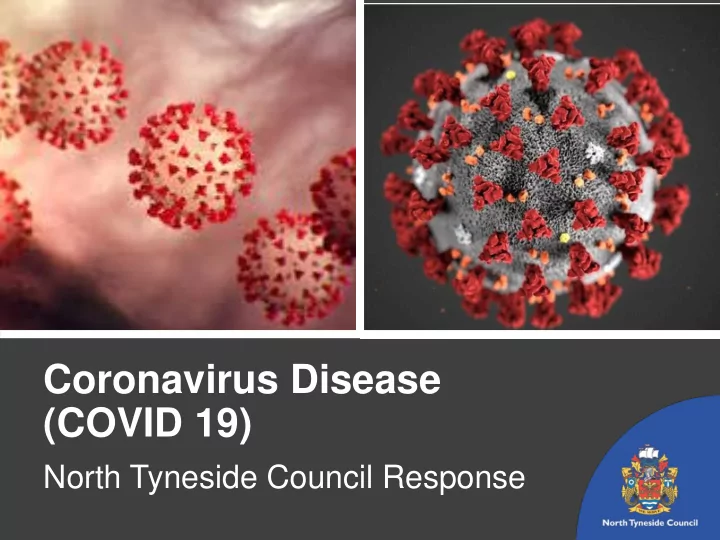
Coronavirus Disease (COVID 19) North Tyneside Council Response - - PowerPoint PPT Presentation
Coronavirus Disease (COVID 19) North Tyneside Council Response What we would like to cover Local, regional and national planning Our strategic objectives The current Public Health picture Planning and Preparedness Issues for
What we would like to cover
- Local, regional and national planning
- Our strategic objectives
- The current Public Health picture
- Planning and Preparedness
- Issues for Members
- Next steps
Local, regional and national planning
- Locally; our Emergency Planning
- Regionally; Local Resilience Forum, 12
Chief Executives
- Nationally; 9 regions, COBR(A)
Our strategic objectives
- Calm and resilient leadership
- Follow national guidance
- Reflect the current context; slow the speed of
infection, flatten the curve
- Protect the vulnerable
- Protect our staff
- Support the Borough by delivering essential services
and working in partnership with businesses and the CVS
The global picture
Global
- WHO declared pandemic on 11th March 2020
- The first 3 major outbreaks outside China were
in South Korea, Iran, Italy
- There is now a major outbreak across Europe
as a whole
- 191,127 confirmed cases and 7807 deaths
reported across 159 countries
The global picture
National
- Risk level for UK was raised by the
Government from moderate to high on 12th March 2020
- Since then the UK Government has moved
from the contain to delay stage
- 56,221 people have been tested,
- 2,626 recorded confirmed cases but this is a
significant underestimate real number is much higher
- 103 deaths to date
What is Covid 19?
- The virus causing Covid 19 is referred to as
SARS-CoV-2
- The associated disease is referred to a
coronavirus disease 19 or COVID-19
- Coronaviruses are common across the world
- This is a new coronavirus that causes
infectious respiratory illness
- The lack of immunity in the population means
it has the potential to spread extensively
How does Covid 19 spread in the population?
- It is thought to be spread from person to person by
cough droplets or sneeze droplets
- Droplets fall on people in the near vicinity and can
infect another person if it makes contact with membranes of the eyes, nose and mouth
- Touching or shaking the hand of an infected person
and then touching the mouth, eyes or nose without first washing hands can spread the infection
- Touching other surfaces contaminated with the
virus and then touching the mouth, eyes or nose without first washing hands can spread the infection
Who is most at risk?
- Individuals of any age can acquire the infection
- Adults of middle age and older are most
commonly affected
- Older age is associated with increased
mortality
- Symptomatic infection in children appears to be
uncommon
- Minimal information about the infection in
pregnancy
- Health care workers and carers are at
increased risk
What are the symptoms of Covid 19?
- Incubation period is within 14 days
- Most cases develop symptoms between 4 to 5
days after exposure
- Symptoms include a fever, cough, shortness of
breath, or flu-like symptoms
- Current evidence suggests that most cases
appear to be mild
- Asymptomatic infections have been reported
What are the symptoms of Covid 19?
- Causes more severe symptoms in:
- Older people
- Those with weakened immune systems
- Those with long term conditions such as diabetes,
cancer and chronic lung disease
- Symptoms that do occur in children reported to be
mild
- Most cases resolve within 7 days of symptoms
starting
What to do if someone has symptoms?
- Stay at home for 7 days if you develop:
- a high temperature
- a new continuous cough
- Use paracetamol not ibuprofen
- If you live with others and you or one of them have
symptoms of coronavirus, all household members must stay at home for 14 days
- The 14-day period starts from the day when the first
person in the house becomes ill
What to do if someone has symptoms?
- Anyone in the household who subsequently displays
symptom stay at home for 7 days from when the symptoms appear, regardless of point they were at in the original 14 day isolation period
- Move vulnerable individuals out of your home or stay
away from them as much as possible
- Those with symptoms can return to work after 7 days if
there is no high temperature, but the cough may persist
Stay at home advice for those with symptoms
If you have symptoms of coronavirus infection (COVID-19), however mild, do not leave your home for 7 days from when your symptoms start:
- Stay at least 2 metres (about 3 steps) away from
- ther people in your home if possible
- Sleep alone, if possible
- Wash your hands regularly for 20 seconds, each
time using soap and water, or use hand sanitiser
- Stay away from vulnerable individuals, such as
the elderly and those with underlying health conditions, as much as possible
What is the UK Government's Strategy?
Planning assumptions Worst case scenario
80% infection attack rate 50% with clinical symptoms, vast majority will be mild
- 30% of those with symptoms will
require some assessment by a health professional
- 4% of those with symptoms will require
hospital care
- 1% of those with symptoms will require
the highest level of critical care
1% infection fatality rate (from 0.01% aged 0-9 years to 8.76% in those 80+)
Two key approaches
- 1. MITIGATION
Slowing the spread of the disease and reducing the peak of the healthcare demand while protecting those at most risk of infection
- Isolating suspected
cases
- Household quarantine
- Social distancing for
vulnerable people
- 2. SUPPRESSION
Reducing the epidemic growth and reducing the number of cases to low levels through social distancing measures across the whole population including the closure of schools and universities. Maintain the situation until a vaccine is available
Two key approaches
Current advice: social distancing
- 70 years or older (regardless of medical
conditions)
- 0-69 years with an underlying health
condition
- Pregnant women
- People at particular risk due to more complex
health problems
Summary of current advice on social distancing
North Tyneside Council strategic planning and preparedness
- Strategic ERLG Covid-19 established
- A Strategic Coordinating Group (SCG) meets daily due to the
dynamic situation. Strategic priorities:
- Calm and resilient leadership
- Follow national guidance
- Reflect the current context: slow the spread of infection, flatten
the curve
- Protect the vulnerable
- Protect our staff
- Support the Borough by delivering essential services and
working in partnership with business and the CVS
Planning assumptions – worst case
21% of the workforce may be absent in the peak weeks. 50% of the workforce may require time off at some stage over the entire period of a pandemic - figure higher if schools were closed. Average duration of absence suggested is 14 days.
200 400 600 800 1000 1200 1400 1600 1800 1 2 3 4 5 6 7 8 9 10 11 12 13 14 15 16 17 18 19 20 21 22
Number of staff Weeks
North Tyneside Staff - Planning Assumptions COVID-19
Absences from work 50% with clinical symptoms 80% infected
Priority services:
- Support to the vulnerable
- Public Health and hygiene
- Revenues, benefits and payment of regular
and new support
- Dignified and respectful bereavement
services
- Communication and local leadership
Decisions to date
Decisions to date
As of today we have closed:
- Battle Hill Library
- Cullercoats Library
- Forest Hall Library
- Howdon Library
- Monkseaton Library
- Shiremoor Library
- Wideopen Library
- (Tynemouth Library closed recently for redevelopment,
but the replacement mobile bus will now be withdrawn as part of the package of measures).
Sport and leisure facilities (and activities) include:
- Waves Leisure Pool
- Tynemouth Pool
- Hadrian Leisure Centre
- The Lakeside Centre
- The Parks Sports Centre
- Whitley Bay Mini Golf Course
- Shiremoor Adventure Playground
- All outdoor sports facilities
- All Active North Tyneside activities
Decisions to date
Events:
- The North Tyneside 10k Road Race has been postponed
- Tynemouth Food Festival has been postponed
- We are reviewing planned activities for the celebration of
VE Day on 8 May and these are likely to be cancelled.
- The visitor centre at St Mary’s Lighthouse will be closed
as will the borough’s museums at Segedunum and Stephenson Steam Railway.
- Public performances at Playhouse, Whitley Bay will be
suspended till further notice
- At this time the Mouth of the Tyne Festival planned for
July 9-July-13 is not postponed at this time.
Decisions to date
Business Continuity Planning
Considering the projections we continue to stress test our business continuity plans against the curve.
200 400 600 800 1000 1200 1400 1600 1800 1 2 3 4 5 6 7 8 9 10 11 12 13 14 15 16 17 18 19 20 21 22
Number of staff Weeks
North Tyneside Staff - Planning Assumptions COVID-19
Absences from work 50% with clinical symptoms 80% infected
Communicating with residents and businesses:
- We have created a
COVID-19 landing page on the website
- A one stop shop for
information with links to more detailed information internally and externally
- Social media updates
residents as guidance changes and Council services are impacted.
- Members get
- ur Situation Reports
Issues for Members during this time
- Elections and by-elections are
suspended
- Face to face likely to change
- Annual Meetings potentially
suspended
- Other meetings potentially
suspended
- Electronic meetings
potentially introduced
- Some functions, different
delegations
- Some functions, longer
deadlines
The role
- f
Members during this time
- The eyes and ears in our
communities identifying vulnerabilities and listening to business
- Set the right example, follow
the guidance
- Look after your own hygiene,
health and loved ones
- Tonight is a great example,
you stayed quorate, protecting those Members who are more vulnerable.
- Please be aware BAU is
about to change
This is an unusual emergency
It will last many months Please look after your colleagues and yourself and our residents
Remember, community leadership is important