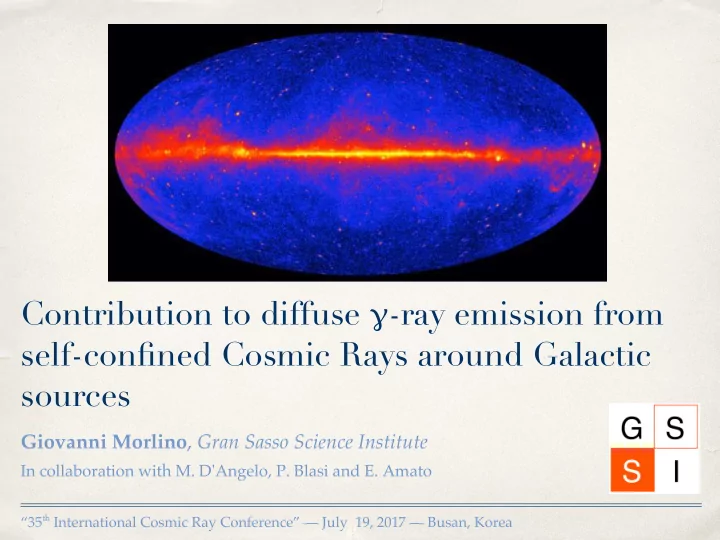
Contribution to diffuse -ray emission from self-confned Cosmic Rays - - PowerPoint PPT Presentation

contribution to diffuse ray emission from self confned
SMART_READER_LITE
LIVE PREVIEW

Contribution to diffuse -ray emission from self-confned Cosmic Rays - - PowerPoint PPT Presentation

Contribution to diffuse -ray emission from self-confned Cosmic Rays around Galactic sources Giovanni Morlino , Gran Sasso Science Institute In collaboration with M. D'Angelo, P. Blasi and E. Amato 35 th International Cosmic Ray


slide-1
SLIDE 1

Contribution to diffuse γ-ray emission from self-confned Cosmic Rays around Galactic sources

“35th International Cosmic Ray Conference” — July 19, 2017 — Busan, Korea

Giovanni Morlino, Gran Sasso Science Institute

In collaboration with M. D'Angelo, P. Blasi and E. Amato

slide-2
SLIDE 2

Recent results from FermiLAT collaboration on the CR distribution in the Galactic plane [Acero et al. 2016, ApJS 223]

  • In the outer region (R > 8kpc) the

CR density at ~20 GeV is flat

(i.e. decreases much slower than the source distribution)

  • In the inner region the CR density

has a peak at ~ 3 kpc

  • The slope @ 20 GeV is not

constant This scenario is difficult to accommodate in a standard diffusion model with homogeneous diffusion coefficient Prediction from GALPROP Prediction from GALPROP s=2.7 Distribution of sources Very flat gradient Pronounced peak

The problem of the cosmic ray gradient in the Galactic plane seen by Fermi-LAT

  • G. Morlino – ICRC 2017
slide-3
SLIDE 3

Possible solutions

Uniform diffusion

Extended halo, H > 4 kpc (Dogiel, Uryson, 1988; Strong et al.,1988; Bloemen, 1993, Ackerman et al., 2011) Flatter distribution of SNR in the outer Galaxy (Ackerman et al., 2011) Enhancement of CO/H2 density ratio (XCO) in the outer Galaxy (Strong et al., 2004) Advection effects due to the Galactic wind (Bloemen, 1993; Breitschwerdt, Dogiel, Voelk, 2002) None of these ideas can simultaneously account for all signatures

  • fatness R > 8 kpc,
  • peak at R~3-4 kpc,
  • variation in the slope

Non uniform diffusion

Diffusion dependence on galactocentric distance (Evoli et al., 2012; Gaggero et al., 2015) Self generated diffusion (Recchia, Blasi & Morlino, 2016) Different parallel and perpendicular diffusion (Vittino's talk, CRD 045)

  • G. Morlino – ICRC 2017

D⊥≪D∥

slide-4
SLIDE 4

Dependence with Galactic latitude

  • G. Morlino – ICRC 2017

Distribution of the power-law photon index of the galactic diffuse γ-ray emission over the galactic longitudes integrated for the interval |b|< 5◦ and 10°<|b|<1 5◦ [from Yang, Aharonian & Evoli 2016]

|b| < 5° 10° < |b| < 15° The slope change toward the Galactic centre disappears at high latitude Supports the idea that the variation

  • ccurs mainly in the Galactic disc.
slide-5
SLIDE 5

During the process of escaping, CR can excite magnetic turbulence (via streaming instability) that keep the CR close to the SNR for a long time, up to ~105 yr [Malkom et al. (2013) Nava et al. (2015)]

Forward Shock Runaway CRs

In this region CRs can excite waves

Effect of self-amplifcation near the CR sources

  • G. Morlino – ICRC 2017
slide-6
SLIDE 6

During the process of escaping, CR can excite magnetic turbulence (via streaming instability) that keep the CR close to the SNR for a long time, up to ~105 yr [Malkom et al. (2013) Nava et al. (2015)] The region where this can happen is at most of the order

  • f the coherence-length of the magnetic field

(after this distance the diffusion becomes 3D and the CR density drops rapidly below the average Galactic value)

Forward Shock Runaway CRs

B

In this region CRs can excite waves

Effect of self-amplifcation near the CR sources

Simulation from Nava & Gabici (2012)

  • G. Morlino – ICRC 2017
slide-7
SLIDE 7

During the process of escaping, CR can excite magnetic turbulence (via streaming instability) that keep the CR close to the SNR for a long time, up to ~105 yr [Malkom et al. (2013) Nava et al. (2015)] The region where this can happen is at most of the order

  • f the coherence-length of the magnetic field

(after this distance the diffusion becomes 3D and the CR density drops rapidly below the average Galactic value) During the time CR spend in the vicinity of sources they can produce diffuse emission via π0 → γ γ A single halo is (in general) too faint to be observed with current telescope BUT the sum of all halos can contribute to the diffuse emission.

Forward Shock Runaway CRs

In this region CRs can excite waves

Effect of self-amplifcation near the CR sources

  • G. Morlino – ICRC 2017

B

Simulation from Nava & Gabici (2012)

slide-8
SLIDE 8

Effect of self-amplifcation near the CR sources: basic equations

CR transport equation in 1-D

Forward Shock Runaway CRs

B

In this region CRs can excite waves

  • G. Morlino – ICRC 2017

The injection of particle is mimicked through a cloud of CR at t = 0

slide-9
SLIDE 9

Effect of self-amplifcation near the CR sources: basic equations

CR transport equation in 1-D Self-generated diffusion coefficient

Forward Shock Runaway CRs

B

In this region CRs can excite waves Turbulence spectrum

  • G. Morlino – ICRC 2017
slide-10
SLIDE 10

Effect of self-amplifcation near the CR sources: basic equations

CR transport equation in 1-D Transport equation for magnetic turbulence Self-generated diffusion coefficient Resonant amplification: Damping Injection

Forward Shock Runaway CRs

B

In this region CRs can excite waves Turbulence spectrum

  • G. Morlino – ICRC 2017
slide-11
SLIDE 11

Effect of self-amplifcation near the CR sources: damping mechanisms

Non-linear Landau damping

(Zhou & Matthaeus, 1990; Ptuskin Zirakashvili, 2004)

Damping due to anisotropic cascade (wave-wave interaction)

(Farmer & Goldreich, 2004)

Damping due to ion-neutral friction

(Kulsrud & Pearce, 1969; Kulsrud & Cesarsky, 1971; Drury et al., 1996)

Unless neutral hydrogen density is very low, the ion neutral damping dominates

  • G. Morlino – ICRC 2017

Coherence scale of the turbulence

slide-12
SLIDE 12

Evolution of CR density close to the source

CR distribution function @ 10 GeV for several ages Distribution function of turbulence Diffusion coeffcient Distance from the source Average Galactic level

  • G. Morlino – ICRC 2017

ECR=0.2 ESN qinj( p)∝ p

−4

slide-13
SLIDE 13

Escaping time

Assuming injected spectrum p-4 CR energy ~ 20% ESN

With neutrals nH/ni ~ 5%-10% tdiff = Lc

2

DGal

Standard escaping time using Galactic diffusion

No neutrals

  • G. Morlino – ICRC 2017
slide-14
SLIDE 14

Distribution of SNR in the galactic plane during the last ~105 yrs using a rate of 1 SN/(30 yr)

SNR population

We assume the SNR distribution according to the model by Green (2015)

  • G. Morlino – ICRC 2017
slide-15
SLIDE 15

5°-15° 85°-95° 175°-185°

Diffuse Galactic emission from Fermi-LAT

FermiLAT diffuse emission

Diffuse Galactic γ-ray flux for three different angular sectors extracted from the Fermi-LAT data [ Yang, Aharonian & Evoli, 2016]

slide-16
SLIDE 16

Contribution of the escaping CRs to the diffuse Galactic emission

ni=0.45 cm

−3 ;

nH=0.0cm

−3

“Real” diffuse contribution assuming AMS spectrum in the whole Galaxy Sum of diffuse emission plus contribution from all the source cocoons

slide-17
SLIDE 17

ni=0.45cm

−3 ;

nH=0.05cm

−3

Contribution of the escaping CRs to the diffuse Galactic emission

ni=0.45 cm

−3 ;

nH=0.0cm

−3

Angular sector Fully ionized nH=0.05 5°-15° 4500 740 85°-95° 350 57 175°-185° 77 13

Number of sources contributing to the emission

slide-18
SLIDE 18

Conclusions

Diffuse gamma-ray emission shows that the CR distribution is not constant across the Galaxy The self-confnement of CRs during the escape from the source can generate a cocoon of -rays around each source if the presence of neutral Hydrogen is negligible. The sum of all cocoons along the line of sight can contribute to the diffuse -ray emission especially toward the inner Galactic region. The self-confnement can also affect the total grammage felt by CRs [see D'Angelo, Blasi, Amato, 2016] Some caveats: We need a better description of particle escape from the source The rate of non-linear magnetic damping is poorly known The presence of molecular clouds close to the SNR may further enhance the gamma-ray emission

  • G. Morlino – ICRC 2017
slide-19
SLIDE 19

Backup slide

  • G. Morlino – ICRC 2017

Gamma-ray spectrum from a single cocoon

slide-20
SLIDE 20

Backup slide

  • G. Morlino – ICRC 2017

Spectra of interstellar emission model components for |b| > 10 and |b| < 10 [Acero et al., 2016]