
SLIDE 1
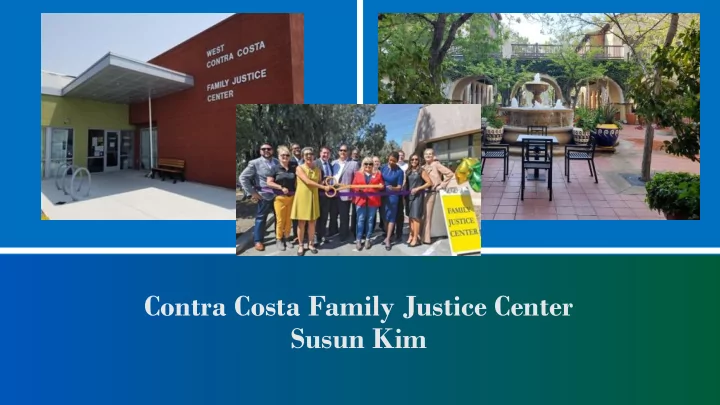
Contra Costa Family Justice Center Susun Kim SOME NUMBERS Domestic - - PowerPoint PPT Presentation
Contra Costa Family Justice Center Susun Kim SOME NUMBERS Domestic Violence 1 in 4 women 1 in 7 men 54% of mass shooting cases involve DV or family violence Sexual Assault 1 out of 6 women: victims of rape or attempted rape
Domestic Violence
violence Sexual Assault
in her lifetime; 1 in 33 men
suicide.
Child abuse
and children when they become men.
Elder abuse
Law Enforcement Assistance
Court Support Safety Planning
Victims of Crime
Compensation
Program Assistance With Emergency Shelter Restraining
Order Assistance Peer Counseling
SB 968 declares Contra Costa County the first Zero Tolerance for Domestic Violence County in California (now Alliance to End Abuse)
2001
Planning efforts for West Family Justice Center began
2009
West Family Justice Center pilot opened in Richmond
2011
Planning efforts for Central Family Justice Center began
2014
Central Family Justice Grand Opening in March
2015
West Family Justice Center moved to permanent site in May
2015
New non-profit’s 13- member board seated in September
2016
Planning for East Family Justice Center
2018
Opened East Family Justice Center.
2019
These are families from the first 6 months in 2020. We anticipate 5,000 by the end of 2020.
Loss of Jobs – economic crisis No safety net for undocumented immigrants DV shelters not accepting new clients APS and CFS reports down 18% increase in number of clients in first 6 months
30 Minutes a Day! Building Safety Through Community
A project of the Family Justice Center
The issue:
been virtually invisible.
foundational to addressing the unmet needs of this underserved community.
disability communities must come together to identify approaches to reaching these victims.
There were four methods identified in the Joint Statement on Crime Victims with Disabilities** to address the needs
services Our Project addresses 3 and 4 by developing a Communication and Outreach Plan. The disability is not the problem. The accessibility is the problem
Mohamed Jemni #TED2013
**National Council on Disability, Association of University Centers on Disabilities and the National Center for Victims of Crime developed a Joint Statement in 2007.
Our process:
Justice Center regarding access to our services
through the Independent Living Resources
representatives of persons with disabilities
practices Th There i is s only nly ONE W E WAY AY t to LOOK OOK a at thi things un unti til SOM OMEON ONE sho hows us us HO HOW W to to look at at them them wit with DIFFERE RENT NT EY EYES ES.
Working with our Disability Advisory Council:
from the surveys to develop a Communication and Outreach Plan that addresses improving access to
practice protocols. “We nee need to to make e e ever ery sing ngle thi thing acc accessible to to ever ery s sing ngle person w
h a disabilit ility.”
Stevie Wonder Musician and Activist