Contents The Knowledge Foundation grant The Information Fusion - - PDF document

contents
SMART_READER_LITE
LIVE PREVIEW

Contents The Knowledge Foundation grant The Information Fusion - - PDF document

Information Fusion from Databases, Sensors and Simulations - a Research Program in Cooperation with Industry Professor Sten F. Andler et al. School of Humanities and Informatics University of Skvde, Sweden www. infofusion .se Information

slide-1
SLIDE 1

www.infofusion.se

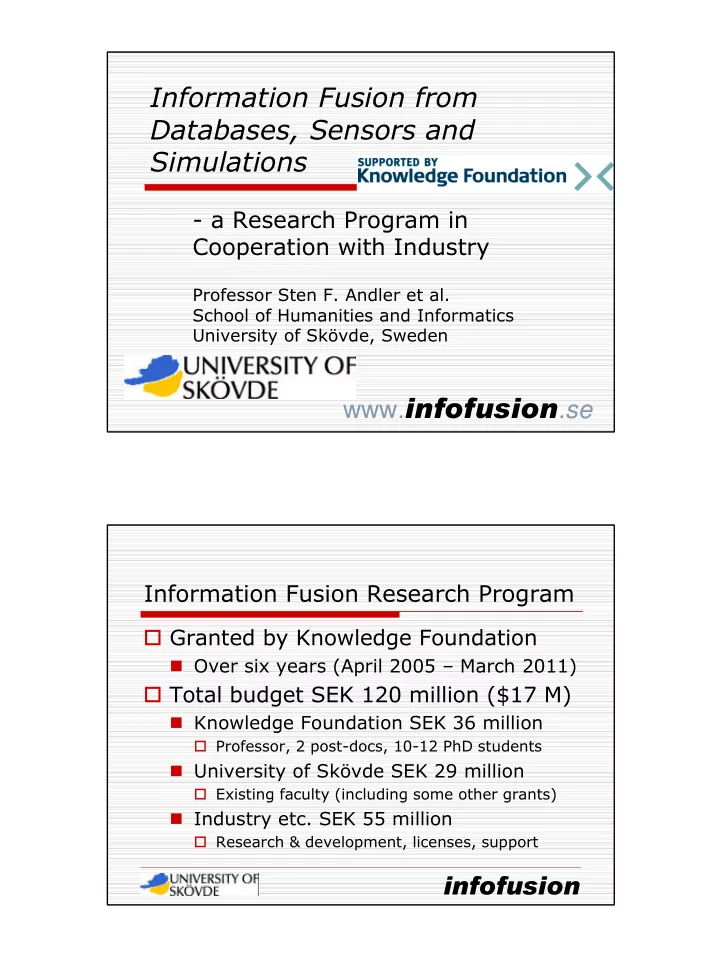
Information Fusion from Databases, Sensors and Simulations

  • a Research Program in

Cooperation with Industry

Professor Sten F. Andler et al. School of Humanities and Informatics University of Skövde, Sweden

infofusion

Information Fusion Research Program

Granted by Knowledge Foundation

Over six years (April 2005 – March 2011)

Total budget SEK 120 million ($17 M)

Knowledge Foundation SEK 36 million

Professor, 2 post-docs, 10-12 PhD students

University of Skövde SEK 29 million

Existing faculty (including some other grants)

Industry etc. SEK 55 million

Research & development, licenses, support

slide-2
SLIDE 2

infofusion

Contents

The Knowledge Foundation grant The Information Fusion process Scenario: Ground situation awareness Vision: Information Fusion Framework Scenarios: Driving the vision

Bioinformatics, manufacturing, precision agriculture, systems development

Organization and build-up phase

infofusion

Past (databases) Past (databases) Present (sensors) Present (sensors) Future (models) Future (models) Information Fusion – for improved decision support Information Fusion – for improved decision support

Information Fusion Process

slide-3
SLIDE 3

infofusion

Observe Observe Act Act Orient Orient Decide Decide

Object Object Situation Situation Threat Threat Signal Signal

Increasing awareness

Increased speed and quality

Manual / Semi-Automatic / Automatic

Information Fusion Context

(with Ericsson Microwave Systems)

infofusion

Object Object Situation Situation Threat Threat

Automatic

I n c r e a s i n g c

  • m

p l e x i t y

Semi-automatic

Semi-automatic Manual Manual Manual

Increasing uncertainty Increasing awareness

Information Fusion Potential

(with Ericsson Microwave Systems)

slide-4
SLIDE 4

Ground Situation Awareness Scenario: Ground Situation Awareness Scenario: Ideal for development of information fusion methods Ideal for development of information fusion methods

For situation awareness and fast decision cycles we need to:

  • Process, fuse and analyze

information from many sources into Common Situation Picture

  • Pass relevant parts of Situation

Picture to everyone with need

  • Adapt resources to situation, in

planning stage and real time

(with Ericsson Microwave Systems, Exensor)

infofusion

  • complex situations
  • very large numbers of detected objects/targets
  • hidden or camouflaged objects
  • dense target scenarios and terrain masks makes

target tracking very hard

  • large amounts of clutter generating false detections
  • target classification/identification very important

The information environment is heterogeneous and must be interpreted at several levels Sensor Data Fusion and Information Fusion will play important roles when combining and analyzing the information!

Ground Situation Awareness Scenario: Ground Situation Awareness Scenario: Some very tough problems to solve Some very tough problems to solve

(with Ericsson Microwave Systems, Exensor)

slide-5
SLIDE 5

infofusion

Network Network-

  • based C

based C2

2 systems also

systems also for civilian crisis management for civilian crisis management

New scenarios emerge – national security

  • A military as well as a civilian responsibility

Controlling terrorism, organized crime, major disasters

  • Often demands joint operations between government agencies

Today: Stovepipe solutions

  • Poor interoperability between government agencies

infofusion

Our Information Fusion Vision

Maintaining a holistic perspective on IF

  • 1. Theoretical framework – nature of IF
  • Terminology, information fragments, effects
  • 2. Algorithms and methods for IF, modeling
  • Building blocks for IF applications
  • 3. Infrastructure for IF systems
  • Domain-specific requirements
  • Toolbox / platform evaluation / demonstrator
slide-6
SLIDE 6

infofusion

Why a Theoretical Framework?

To develop a holistic perspective that encompasses:

  • different types of fusion at different levels,
  • information fusion in the context of its use in the

support of human decision making

To facilitate cooperation between groups

  • e.g. terminology

To exploit synergy between different scenarios/projects

infofusion

Existing Frameworks

Several fusion models exist

e.g. the (revised) JDL data fusion model,

  • riginally developed in the mid 1980:s

but all of these have limitations:

e.g. specific to military applications e.g. not incorporating

requirements of human decision making and support system development issues

slide-7
SLIDE 7

infofusion

Our framework will …

take existing models as a starting point develop a common terminology across projects identify generic elements and processes across different fusion applications and contexts capture the interaction of information fusion

  • with the cognitive processes and requirements of

(individual) human decision making

  • with the flow of information in collective decision

processes in groups and organizations

address system development issues

infofusion

Scenarios: Driving the Vision

Information fusion for rapid and improved decision making in network-based systems (ground situation awareness scenario) Simulation-based information fusion for manufacturing decision support Information fusion for medical informatics and bioinformatics Precision agriculture Information fusion in the systems development process Infrastructures for information fusion

slide-8
SLIDE 8

Production information

  • Past records

from databases

  • Status from

production sensors

  • Projections

from simulation models

Know-how

Computer-based tools for production and flow analysis Infrastructure for information gathering Information needs

Maintenance

Simulation-based Information Fusion for Manufacturing Decision Support (with DELFOI, Electrolux, Euromation and Volvo PowerTrain)

infofusion

Genome

AREXIS

Genetics Drug

(with Arexis, Cellartis, InNetics, LexWare Labs)

Information fusion approach to drug discovery

  • Information fusion from many different levels of data
  • Observation and control of biological experiments
  • Comparison to predicted behavior from models
slide-9
SLIDE 9

infofusion

Modified from Shepherd et al. NEJM 1999

Glucose uptake - type 2 diabetes

infofusion

insulin resistent insulin responsive

Vision - short term

  • Systems biology
  • Software engineering
  • Mathematics, etc.
slide-10
SLIDE 10

infofusion

Genome Phenotype Interactions within and between ‘omes Metabolome Proteome Transcriptome Molecular fluxes through “network” Information fusion in bioinformatics

Protein data Enzyme and network data Sequence data Interaction model Expression data

infofusion

slide-11
SLIDE 11

infofusion

Precision Agriculture Scenario

  • Control the first link of the food production chain
  • ⇒ high/stable quality, minimal impact
  • Research, development and practical application of PA

techniques for

  • Optimizing the application of fertilizer and pesticides

(and watering) within fields

  • Improving yield and quality towards the requirements
  • f customers (while reducing cost)
  • Minimizing environmental impact, e.g. run-off

(conventional/ecological)

  • (with Agrovast foundation, Swedish Farmers' Co-
  • perative, Yara in Sweden and Nordkalk)
  • DGPS
slide-12
SLIDE 12

infofusion

Precision Agriculture, cont.

Soil condition (e.g. clay content)

  • Sparse samples for careful analysis in lab
  • Continuous measurements of soil conductivity
  • ⇒ Interpolation of approximate clay content

Real-time Information Fusion of

  • Databases: soil condition, harvests, rainfall
  • Sensors: current state of crop (nitrogen take-up,

water content)

  • Simulations: Models of fertilizer effect, rainfall

variations, etc.

New sub- system/component Phasing out of sub- system/component Development of new system

Use and further development Development

Vision Vision Phasing

  • ut

Development Requirements info Application domain info Hardware info Design info Implementation info System environment info Runtime info Method info Project info Test info

Information fusion in the software development process

slide-13
SLIDE 13

infofusion

Anne Persson 8 Patient för unders. Patient Tids- bokning Tids- bokning Prel. b e d ö m- ning Prel. bedöm
  • ning
Mott - agning Mott
  • agning
Patient inbokad Vård- upp- följning Vård
  • upp-
följning Be- handlad
  • patient
Patient med symptom Diagnos Vård- planering Vård- planering Under- sökning Under- sökning Planerad be - handling Mål Öka antal diagnoser Öka antal åtgärdade fall Vård- enhet Vård- enhet Patient Stödenhet
  • Röntgen
  • Prov/lab
Stödenhet
  • Röntgen
  • Prov/lab
  • Prel. be
  • dömning
Remiss M å l ? M å l ? Patient Väntetid: 5 min Effektiv tid: 7 min Mätning: Väntetid: 2 dagar Effektiv tid: 2,5 tim Väntetid: 17 min Effektiv tid: 12 min Väntetid: Effektiv tid: Föreslagen åtgärd Priori
  • tering
Kärn- process: Stöd- process: Uppgift Svar B e
  • handling
Be
  • handling
Åter
  • besök
Aktörer Sjuk
  • sköterska
Patient Teknik: System Boknings
  • system
Info.: Bokning Beläggning Aktörer Läkare Teknik System Remiss
  • system
Info: Vård- tillfälle Aktörer
  • Läkare
  • Patient
Teknik utrustning System Info.: Journal Aktörer Läkare Patient Teknik Diktafon Teknik Info.: Vård
  • tillfälle
Beroenden / Gränssnitt: Mål ? Väntetid: Effektiv tid: Be- handling Be
  • handling
Journal - underlag ELECTRUM Library Information System Book cataloging system To maintain all kinds
  • f
information within the library IS Goal 1 To maintain information about book resources IS Goal 2 To maintain information about customer loans and transactions IS Goal 3 To maintain information about requests and customer waiting list IS Goal 4 To maintain information about the most popular and newly published books IS Goal 5 To provide a 24 hours a day library catalogue search IS Req 1 supports Catalogue search engine should be connected to Internet IS FReq 2 supports Catalogue search engine should have a WWW interface IS FReq 3 Library catalogue should be exportable on CD ROM IS FReq 4 supports supports Library IS should use as much existing software as possible IS FReq 5 supports Loan Transaction System Catalogue search system Customers requests system Queue registration system communicates commu- nicates communicates Information System Requirements Technical Components relates_to

Vx Vy taller_than(x,y) -> shorter_than(y,x) taller_than(Anna,Lars)

Begin print X If ….. Then …… End

IS development = decision driven process

Keywords: Lifecycle perspective Information transformation Information fragmentation

Jag är främst intresserad av de delar av beslutsarbetet som genomförs på ett individuellt plan,

  • dvs. till skillnad från t.ex.

förhandlingar vilket av naturliga skäl inkluderar flera personer och ytterligare dimensioner av beslutsarbete tillkommer då såsom

  • lika sociala aspekter. Jag

avgränsar bort egenskaper hos beslutfattare, i bemärkelsen vilken psykologisk typ och vilken beslutsstil de enskilda individerna har. Jag avser att fokusera på de aktiviteter i beslutsprocessen som föregår val av alternativ. Därmed bortser jag från de aktiviteter som inbegriper genomförande och uppföljning av det fattade beslutet (se Figure 5). Eftersom jag har avgränsat bort aktiviteter som inkluderar flera personer faller följaktligen ’bargaining’ och ’authorisation’ bort.

Info about the past: development information from previous life-cycles Info about the present: runtime data, current development information Info about the future: simulations of future system behaviour

infofusion

Improve precision and requirements fulfillment of developed software Decrease lead-time in the development process

increased computer supported co-use (fusion) of development information between the different development phases effective and efficient integration of tool support in the development process with the intention to support synergy between the different phases improved accuracy and timeliness of decision- making in the software development process

The IF vision for the software development process

slide-14
SLIDE 14

infofusion

Organization: Research collaboration

Advisory Board Profile Director International Scientific Committee Research Project

  • Exec. Committee
  • Admin. Support

Research Project

Research Project Research Project Research Group Research Group

Company

Academic and industry representation

infofusion

Build-up Phase

15 Sep 2004 – Kick-off of build-up

Program director, co-director Executive committee

1 Apr 2005 – Profile start

Contract with Knowledge Foundation

Program plan, objectives, budget

Contracts with companies

Extent, responsibilities, IPR

Initial project specifications Advisory Board

slide-15
SLIDE 15

infofusion – Information Fusion Research Program