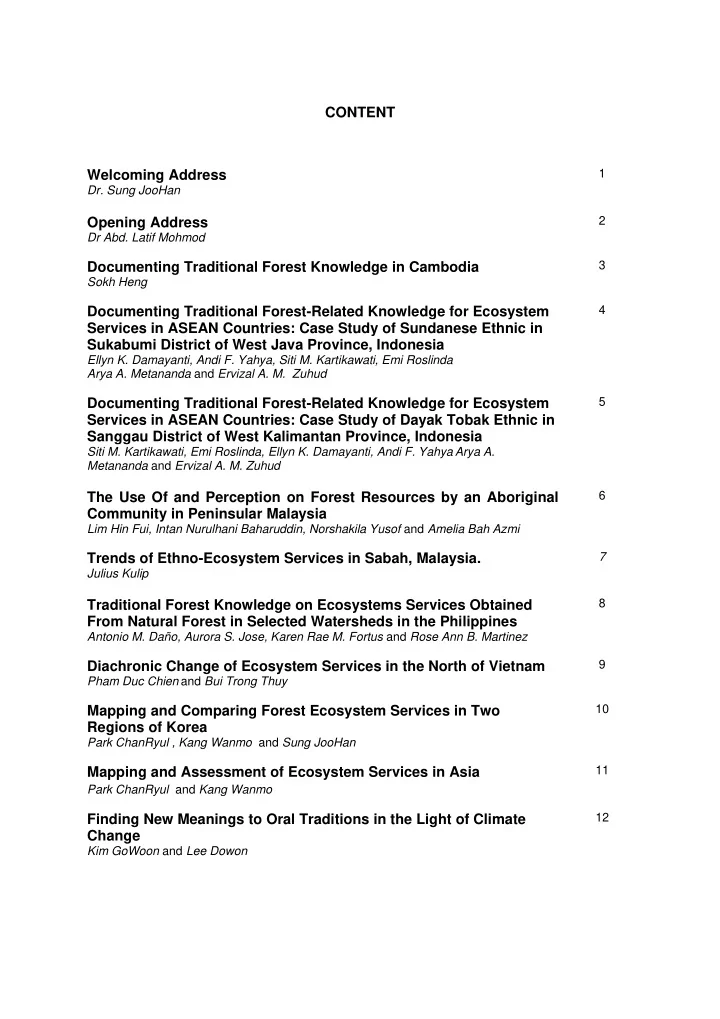
SLIDE 1 CONTENT Welcoming Address
1
Opening Address
Dr Abd. Latif Mohmod 2
Documenting Traditional Forest Knowledge in Cambodia
Sokh Heng 3
Documenting Traditional Forest-Related Knowledge for Ecosystem Services in ASEAN Countries: Case Study of Sundanese Ethnic in Sukabumi District of West Java Province, Indonesia
Ellyn K. Damayanti, Andi F. Yahya, Siti M. Kartikawati, Emi Roslinda Arya A. Metananda and Ervizal A. M. Zuhud 4
Documenting Traditional Forest-Related Knowledge for Ecosystem Services in ASEAN Countries: Case Study of Dayak Tobak Ethnic in Sanggau District of West Kalimantan Province, Indonesia
Siti M. Kartikawati, Emi Roslinda, Ellyn K. Damayanti, Andi F. Yahya Arya A. Metananda and Ervizal A. M. Zuhud 5
The Use Of and Perception on Forest Resources by an Aboriginal Community in Peninsular Malaysia
Lim Hin Fui, Intan Nurulhani Baharuddin, Norshakila Yusof and Amelia Bah Azmi 6
Trends of Ethno-Ecosystem Services in Sabah, Malaysia.
Julius Kulip 7
Traditional Forest Knowledge on Ecosystems Services Obtained From Natural Forest in Selected Watersheds in the Philippines
Antonio M. Daño, Aurora S. Jose, Karen Rae M. Fortus and Rose Ann B. Martinez 8
Diachronic Change of Ecosystem Services in the North of Vietnam
Pham Duc Chien and Bui Trong Thuy 9
Mapping and Comparing Forest Ecosystem Services in Two Regions of Korea
Park ChanRyul , Kang Wanmo and Sung JooHan 10
Mapping and Assessment of Ecosystem Services in Asia
Park ChanRyul and Kang Wanmo 11
Finding New Meanings to Oral Traditions in the Light of Climate Change
Kim GoWoon and Lee Dowon 12
SLIDE 2 1
Welcoming Address
Secretary General of Asian Center for Traditional Forest Knowledge (ACTFOK) Korea Forest Research Institute (KFRI) Korea Email: jhs033@forest.go.kr Ladies and gentlemen, I would like to welcome all of you to Kuala Lumpur, Malaysia. It is a great pleasure that Korea Forest Research Institute, FRIM, and APAFRI co-host a regional workshop on Sharing Traditional Forest Knowledge for Ecosystem Services in ASEAN Countries. Let me extend my gratitude to Dr. Sim Heok Choh, Executive Secretary of APAFRI, and participants for attending this workshop. Also, I would like to thank the moderators, speakers and all the distinguished guests for being here with us today. Currently, half of the world population lives in urban area, so population size continuously decreasing in rural areas. Urban migration caused by rapid economic developments can affect the cultural and social binding of local community which forms and maintains traditional forest knowledge. In this fast changing environment, each community has been confronted with the world-wide common problem of global warming, as well as local level factor of human disturbances. Most of, if not all, the ecosystem services, can be evaluated at local level. This evaluation process can provide a better understanding of the traditional forest-related knowledge, and facilitate establishing sound and long-term sustainable forest management policies and strategies. This workshop had been prepared over one year to share information and data for a better understanding on TFK related to ecosystem services. Countries in the Asia Pacific region, especially in the sub-region of Southeast Asia, have very diverse types of forests, which have been providing various different types of ecosystem services. It is a challenge to understand and properly document the ecosystem services at local, regional and global
- levels. To this end, KFRI established Asian Center for Traditional Forest Knowledge (ACTFOK) as
a hub of oriental forest traditional knowledge in 2012. I would like to seek your support and cooperation. I believe today’s workshop is very significant and timely since it is being held when forest cooperation among Asian countries are highly required. I hope our discussions here will yield fruitful outcomes through your active participation. Once again, I would like to offer my appreciation to all of you for joining us today despite your busy schedule, and I wish APAFRI the best success. Thank you.
SLIDE 3 2
Opening Address
Dr Abd. Latif Mohmod Chairman of Asia Pacific Association of Forestry Research Institutions (APAFRI) and Director General of Forest Research Institute Malaysia (FRIM) Good Morning Ladies and Gentlemen, First and foremost, allow me to express my upmost gratitude on behalf of APAFRI and also FRIM, for the honour to host this workshop here in Kuala Lumpur. I also like to thank Korea Forest Research Institute, for the generous contributions which support this workshop. Ladies and Gentlemen, It was almost a year ago that we met here at this same hotel to discuss the issues of documenting traditional knowledge related to environmental services from countries in Southeast Asia. Many of those present here today were also at that workshop, which prompted the launching of a more systematic study for this region. Since then, APAFRI, with the generous financial support from the Korea Forest Research Institute (KFRI) had initiated a series of surveys in five SEA countries: Cambodia, Indonesia, Malaysia, Philippines and Vietnam. These surveys, conducted by colleagues in these countries, were designed to collect information related to traditional knowledge and practices related to environmental services. The documentation of this information, with appropriate analyses, could contribute to formulating national policies in the protection, conservation, and sustainable utilization of forest resources, in face of increasing threats to the environment at large. The present workshop, which will run for three days starting today, shall allow the colleagues to share and discuss their findings. This region has one of the most diverse ecosystems and also heavily populated by indigenous people, many are still depending on the forests for their livelihoods. I believe this would be just the beginning of many more studies to be carried out in the field of traditional knowledge for this region, which could discover, or re-discover, valuable inputs to assist us in better manage the environmental services. Ladies and Gentlemen, As I am here also representing APAFRI, allow me to briefly introduce this network of forestry research
- institutions. The Asia Pacific Association of Forestry Research Institutions is an NGO with over 60
institution members from over 20 countries in the Asia Pacific region. APAFRI is a non-governmental
- rganization currently hosted by the Forest Research Institute Malaysia. Its objective is to promote
collaborative exchanges among institutions to enhance and increase the forestry research and conservation capacity in the Asia Pacific. Its other role is to act as a catalyst, facilitator, and to become an information hub for dissemination of results on research and other activities relevant to forestry within the Asia Pacific and to the world at large. It was officially launched in 1995, during a meeting of the Heads of Forestry Research in the Asia Pacific in Indonesia. Over the past nearly 20 years APAFRI has organized many events in the form of meetings, workshops, seminars, symposiums and conferences, within the region with the primary objective to enhance collaboration between the members and also for information exchange. These events cover a very wide scope, ranging from general forestry, poverty reduction, traditional knowledge, pest and diseases, conservation and sustainable utilization, to forestry for climate change mitigation and adaptation. The ultimate aim is to contribute to building up the critical mass necessary for the sustainable management of the precious forest resources in the region. APAFRI is continuously exploring
- pportunities to work with the other regional and international organizations on activities and
programmes which will, directly or indirectly, contributing to forestry research and development in greening the Asia Pacific region. The opportunity to participate in forums such as this one here this week would be invaluable for APAFRI, both to promote our efforts in raising the awareness of the vital contributions of forests to human wellbeing, and in the process to further enhance our linkages with
- ther organizations with similar and related objectives.
Thank you very much, and I wish you all a very successful and fruitful deliberation during these three days in Kuala Lumpur.
SLIDE 4 3
Documenting Traditional Forest Knowledge in Cambodia
Sokh Heng Institute of Forest and Wildlife Research and Development Forestry Administration #40 Preah Norodom Blvd, Phnom Penh Cambodia Email: sokhhengpiny@yahoo.com There is abundant traditional forest knowledge among the indigenous people in Cambodia. But unfortunately, there has not been almost studies and documentation of their knowledge. The study was conducted in the two villages: (Salavisay Village and Thnout village) in Kampong Thom province of Cambodia that is dominated by Kuy Indigenous people to look at the traditional knowledge of Kuy communities on the ecosystem services of the forests. The study aims to: (1) know the condition on the forest ecosystem in the two villages dominated by Kuy Indigenous people in Kampong Thom province based on their knowledge; (2) determine the knowledge of the forest ecosystem services among the Kuy communities; and (3) determine the trend of the value of different material goods collected by the Kuy communities. The forests play a vital role to the Kuy community in terms of providing foods, wood and other tangible
- goods. The provisioning services of the forest include fuel (firewood and charcoal), edible plants,
grazing for livestock, bush meats, medicinal plants, honey, resin, fruits, materials for housing, farming tools, handcraft materials. Seldom do the Kuy members collect food for commercial purposes although there are forests products that may have the potential for commercialization such as honey and fruits. Honey is considered a very important commodity among the Kuys. Resin tapping used to be a significant source of income among the Kuys. Recently, collection of wood from the forests has
- declined. Under the current condition of the forests, selling of timber is no longer a significant source
- f income among Kuy communities. The government’s campaign against illegally sourced logs also
limits harvesting of timber. The decline of population of premium timber species, after years of
- verexploitation, resulted to few species left which are now being conserved as seed sources. Most
community members are aware of the role of forests on water and hydrology, its protective role for storm and typhoon. The Kuy communities also showed high awareness on the role of the forests on climate and regulating air pollutants as well as the supporting function of the forest. The knowledge of the Kuys on the protective role of the forests is believed to have been acquired from extension and awareness raising by the NGOs and government workers and mass communications rather than their traditional knowledge. Most of the beliefs of the Kuy people have a strong link to the forests. However, many of the Kuys become assimilated to Khmer culture including religion. But there are still some spirit forests that are kept by the Kuys as burial site. Other practices are already becoming rare as the community adopts Buddhist religion. The result of the study indicates the importance of the forest to the Kuy communities. It is therefore recommended to secure the land rights of the communities through the establishment of Community Forestry in the Kuy areas. Together with the establishment of the CFs, restoration is needed to increase the provisioning services of the community forest. There is also a need to enhance the skills of the Kuy communities on value adding and processing of some NTFPs.
SLIDE 5 4
Documenting Traditional Forest-Related Knowledge for Ecosystem Services in ASEAN Countries: Case Study of Sundanese Ethnic in Sukabumi District of West Java Province, Indonesia
Ellyn K. Damayanti1, Andi F. Yahya2, Siti M. Kartikawati3, Emi Roslinda3 Arya A. Metananda2 and Ervizal A. M. Zuhud2
1 SEAMEO BIOTROP Southeast Asian Regional Centre for Tropical Biology 2 Division of Plant Diversity Conservation, Department of Forest Resources Conservation and
Ecotourism, Faculty of Forestry, Bogor Agricultural University
3 Faculty of Forestry, University of Tanjung Pura
Indonesia Indonesia has been known as a rich country in terms of biodiversity, ecosystems, social, cultural, and
- history. It is inhabited by more than 550 ethnic groups with a total population of 237.6 million in 2010.
The whole population is spread over 78,609 villages, in which 2,902 villages are located in the forest and 15,816 villages directly adjacent to the forest (on the fringe of forest). Although only 18,718 villages which have direct interactions and get certain benefits from the nearby forests, it is also possible for the villages outside the forest/not directly adjacent to the forest to get benefits from the forest ecosystem services. However, along with the pace of development of cities and villages, more people live in the urban areas and do not get the direct benefits of the forest ecosystem services. This condition has been considered to reduce the peoples' insight/awareness of the importance of forest as an ecosystem service provider and lead to the extinction of local/traditional knowledge about the benefits and utilization of forests in sustainable way. Therefore, understanding the changes of the forest ecosystem services experienced by the local communities by assessing/evaluating the forest ecosystem services in a certain period of time can provide valuable insights. With more than 550 ethnic groups, Indonesia certainly has an invaluable wealth of local/traditional knowledge, including the knowledge about the benefits of the forest ecosystem services. Sundanese ethnic group, the second most populous ethnic group native to the western part of Java Island, was purposively selected to document the traditional forest-related knowledge on ecosystem
- services. This ethnic group is well known for their direct interactions with forest, including the use of
forest ecosystem services in their daily lives. Research was conducted in Gunung Walat University Forest (GWUF) in Hegarmanah Village, Cicantayan Sub-district, Sukabumi District of West Java Province, from August to December 2014. Interview data were analyzed to see the changes occurred in and around the utilized forests since Indonesian independence (1945) up to the present (2014). The 20-selected respondents show positive perceptions on the four groups of ecosystem services, namely provisioning, regulating, cultural, and supporting services, even though the degree of perceptions fluctuates over the periods. Sundanese people in Hegarmanah Village have been acknowledging GWUF as a state forest which is managed as university forest based on rules and
- regulations. The communities respect and obey those rules and regulation, and in return, they can
utilize non-timber forest products and other ecosystem services from GWUF. Non-timber forest products collected from GWUF, such as pine and copal resin, firewood from dead and fallen tree branches, grasses for livestock feed, etc. shows the forest ecosystem provisioning services. Various ecosystem regulating services such as maintenance of air quality, climate regulation, water management, flood control, regulation of human diseases, etc. have been acknowledged by the GWUF management. Education, aesthetic, and social relation are among ecosystem cultural services also can be found in GWUF. This research also found that the traditional forest-related knowledge for ecosystem services in both locations could be managed and conserved by eliminating the intervention from outside and for the benefit of outsider. Moreover, the ecosystem services could provide benefits to the communities, because both the knowledge and the ecosystem services were used for subsistence. However, further works by including more number and age of respondents are needed to improve the understanding on traditional forest-related knowledge for ecosystem services throughout generations a certain ethnic group.
SLIDE 6 5
Documenting Traditional Forest-Related Knowledge for Ecosystem Services in ASEAN Countries: Case Study of Dayak Tobak Ethnic in Sanggau District of West Kalimantan Province, Indonesia
Siti M. Kartikawati1, Emi Roslinda1, Ellyn K. Damayanti3, Andi F. Yahya2 Arya A. Metananda2 and Ervizal A. M. Zuhud2
1 Faculty of Forestry, University of Tanjung Pura 2 Division of Plant Diversity Conservation, Department of Forest Resources Conservation and Ecotourism
Faculty of Forestry, Bogor Agricultural University
3 SEAMEO BIOTROP Southeast Asian Regional Centre for Tropical Biology, Indonesia
Email: kartikawt@gmail.com Indonesia has been known as a rich country in terms of biodiversity, ecosystems, social, cultural, and
- history. It is inhabited by more than 550 ethnic groups with a total population of 237.6 million in 2010.
The whole population is spread over 78,609 villages, in which 2,902 villages are located in the forest and 15,816 villages directly adjacent to the forest (on the fringe of forest). Although only 18,718 villages which have direct interactions and get certain benefits from the nearby forests, it is also possible for the villages outside the forest/not directly adjacent to the forest to get benefits from the forest ecosystem services. However, along with the pace of development of cities and villages, more people live in the urban areas and do not get the direct benefits of the forest ecosystem services. This condition has been considered to reduce the peoples' insight/awareness of the importance of forest as an ecosystem service provider and lead to the extinction of local/traditional knowledge about the benefits and utilization of forests in sustainable way. Therefore, understanding the changes of the forest ecosystem services experienced by the local communities by assessing/evaluating the forest ecosystem services in a certain period of time can provide valuable insights. With more than 550 ethnic groups, Indonesia certainly has an invaluable wealth of local/traditional knowledge, including the knowledge about the benefits of the forest ecosystem services. Dayak Tobak ethnic group, part of Dayak ethnic group that native to the western part of Kalimantan Island, was purposively selected to document the traditional forest-related knowledge on ecosystem
- services. This ethnic group is well known for their direct interactions with forest, including the use of
forest ecosystem services in their daily lives. Research was conducted in two locations, namely Ampar and Lancak tembawang in Cempedak Village, Tayan Hilir Sub-district, Sanggau District of West Kalimantan Province, from August to December 2014. Interview data were analyzed to see the changes occurred in and around the utilized forests since Indonesian independence (1945) up to the present (2014). The 20 selected respondents show positive perceptions on the four groups of ecosystem services, namely provisioning, regulating, cultural, and supporting services. Timber for construction material and non-timber forest products, such as various types of plants and wildlife for food, medicine and religious ceremony collected from Ampar and Lancak tembawang show the forest ecosystem provisioning services. Tembawang also provide ecosystem regulating services, such as clean air quality, climate regulation, water management, and preventing forest fires and forest pest and disease
- attacks. Cultural/religious ceremonies and social relation as ecosystem cultural services also can be
found in tembawang. Dayak Tobak people have been keeping their tradition on tembawang and managing tembawang in sustainable way. Tembawang management has lasted hundreds of years, passing some periods, including the period divisions used in this research. The concepts of management, utilization, and size as well as the ecosystem services of tembawang remain unchanged until today. This research also found that the traditional forest-related knowledge for ecosystem services in both locations could be managed and conserved by eliminating the intervention from outside and for the benefit of outsider. Moreover, the ecosystem services could provide benefits to the communities, because both the knowledge and the ecosystem services were used for subsistence. However, further works by including more number and age of respondents are needed to improve the understanding on traditional forest-related knowledge for ecosystem services throughout generations a certain ethnic group.
SLIDE 7 6
The Use Of and Perception on Forest Resources by an Aboriginal Community in Peninsular Malaysia
Lim Hin Fui, Intan Nurulhani Baharuddin, Norshakila Yusof and Amelia Bah Azmi Forest Research Institute Malaysia 52109 Kepong, Selangor Malaysia Email: limhf@frim.gov.my This study concerns the use of and perception on forest resources by 34 Orang Asli Semai village elders (50 years and above) in Kg Ulu Geroh, Peninsular Malaysia over the last for decades (1980- 2014). In terms of provisioning services provided, the findings show that this Orang Asli community continues to make use of various forest resources to meet their daily subsistence needs. The resources harvested and collected include firewood, edible greens, resin, livestock raising ground, forest fruits, medicinal plants, building materials and handicraft materials. The harvesting of these forest resources are mainly for household subsistence needs. Only forest fruits such as durian (Durio zibethinus) and petai (Parkia speciosa) are harvested and sold to generate additional household
- income. However, there is a general decline in the use of forest resources by the village elders over
the years. With income generated from oil palm, there is less need for villagers to collect or gather food resources and firewood. Similarly, with availability of modern medicines, collection of medicinal plants also becomes less important. With the coming of Christianity and Islam to the village, religious and cultural rites have become less important as these formal religions do not encourage or forbid the practice of traditional rites. In terms of regulating services, at least 70% of respondents believed that forests hold and clean rains, block wind and lessen the damage from storm. There was an increase in the proportion of the respondents who think that there is a change in climate over the last four decades. In terms of cultural services provided the forests was regarded /developed as an educational site for the tourists. This form of development was increasingly shared by the respondents in this study. Of the 34 respondents, 64% always, usually and sometimes perceived that the forest reserve has developed into an educational site in the early period of 1980-1990. This percentage on this perception increased to 70% during the second period (1991-2000) and then to 76% in the third period (2001-2014). Consequently, the proportion of respondents agreeing to the perception that there is a rise in the number of tourists coming to Kg Ulu Geroh also increased from 22% (1980-1990) to 56% (2001-2014.) In terms of supporting services, among the respondents, the percentage strongly and agreed to perception that forest provides good soil was 97% and provides good nutrient cycle was 88%. In short, social change outside and within this indigenous community has affected the use of forest resources and their perception on them.
SLIDE 8 7
Trends of Ethno-Ecosystem Services in Sabah, Malaysia.
Julius Kulip Institute for Tropical Biology and Conservation University Malaysia Sabah Kota Kinabalu, Sabah Malaysia Email: julkulip@ums.edu.my Surveys on the ethno-ecosystem services in two villages namely Tudan Village, Tuaran District and Timbou Village, Tambunan District were conducted from 1st October 2014 until 20th December 2014. The objectives were 1) To survey the provisioning services, regulating services, cultural services, and supporting services that exist in Tudan Village, Tuaran District and Timbou Village, Tambunan District, 2) To investigate the trends of ethno-ecosystem services for three periods namely, before Year 1960s, from Year 1961 to Year 2000 and Year 2001 onwards, 3) To compare the differences of trends of both villages. Methods of surveys include interviewed 20 respondents with the age of 40 years and above. Informants were interviewed with both open-ended and semi-structured questionnaires provided by Asian Center for Traditional Forest Knowledge (ACTFOK), which has four criteria and 33 items. Each item was to be surveyed and analyzed according to the three periods: before Year 1960, from Year 1961 to Year 2000, and after Year 2001. The results showed that, In Tudan Village, the general overall trends of provisional services as follow: On the provisioning services, the number of respondents collected resin, fire woods, honey, wild edible green/mushroom and types of trees for making houses were reduced. Types of wildlife animals hunted were increased. No changed in number of edible wild fruits and medicinal plants types collected. On the regulating services, increased in awareness of respondents that trees could hold and clean rains, slow down the flow of rains thus reduced flood and reduced the spread of pests & diseases and increased in awareness of respondents that forests could block the wind and lessen the damage, clean air and regulate climate. On the cultural services, very few respondents practice their culture inside the forest. On the supporting services, habitat for wildlife was most important and generally all decreased. In Timbou Village, the general overall trends are as follow: On the provisioning services, the number of respondents collected resin, fire woods, honey, wild edible green/mushroom and types of trees for making houses were reduced. Types of wildlife animals hunted were reduced. No changed in number
- f edible wild fruits and medicinal plants types collected. On the regulating services, increased in
awareness of respondents that trees could hold and clean rains, slow down the flow of rains thus reduced flood and reduced the spread of pests & diseases increased in awareness of respondents that forests could block the wind and lessen the damage, clean air and regulate climate. On the cultural services, very few respondents practice their culture inside the forest. On the supporting services, good soil, good nutrient cycling and good soil for raising seedlings were the most important and generally slightly increased.
SLIDE 9 8
Traditional Forest Knowledge on Ecosystems Services Obtained From Natural Forest in Selected Watersheds in the Philippines
Antonio M. Daño, Aurora S. Jose, Karen Rae M. Fortus and Rose Ann B. Martinez Ecosystems Research and Development Bureau (ERDB-DENR) College, Laguna Philippines Email: Tonydano93@yahoo.com The multitude benefits that people obtain from the forest ecosystem are collectively known as environmental services. Assessment on how the communities of indigenous people (IPs) perceived the environmental services obtained from the natural forests was conducted in two watersheds in the, Philippines; (1) Bago watershed in Negros Province in Visayas; and (2) Manupali watershed in Bukidnon Province, Mindanao. Respondents were local people with ages 60 years old and above. They were assumed to have accumulated knowledge and experience over the years regarding the value of the forest. Other respondents were key leaders and officials of the tribal communities. An interview schedule patterned from Korean experienced was designed to obtain the necessary
- information. The questionnaire has two parts – background of the area and the survey respondents;
and services obtained from the forest specifically; supporting, provisioning, regulating and cultural
- services. The best value of the forest as perceived by the community leaders was also determined
through focus group discussion. Descriptive analysis was used to interpret the level and extent of traditional forest-related knowledge of the local people on the ecosystem services using the Likert scale with equivalent rating measurements. Majority of the respondents highly valued the ecosystem’s supporting services measured in terms of nutrient cycling, seed dispersal and primary production. Respondents also perceived that the supporting services declined starting 2000 as compared to earlier years. In terms of provisioning services, the respondents have high level of knowledge on the products obtained from the forest particularly on food and water while moderate level of knowledge were noted in terms of minerals, pharmaceutical/biochemical/industrial and energy products. On regulating services of the forest, majority of the respondents have high level of perceptions on the carbon sequestration and climate change role of the forest, waste decomposition, purification of air and water, crop production and on the pest and diseases control function of the forest. As to the cultural services value of the forest, majority of the respondents were found to have high level of appreciation on the cultural services of the forest. Both Bago and Manupali watershed respondents perceived that their culture is strongly tied-up with the forest and forest protection is a key to the preservation of their culture. However, most
- f the Manupali respondents have moderate level of knowledge on the recreation and eco-
educational benefits of their community forest. People’s heightened awareness on the ecosystem services obtained from the forest, can be capitalized in the implementation of programs toward protection and conservation of the natural forest. The study also validated the historical and cultural importance of forest to the indigenous people which are vital in forest conservation and sustainable management of natural resources.
SLIDE 10 9
Diachronic Change of Ecosystem Services in the North of Vietnam
Pham Duc Chien1* and Bui Trong Thuy2
1Research Institute for Forest Ecology and Environment
Duc Thang Ward, North Tu Liem District, Ha Noi, Viet Nam
2Forest Science Centre of North-eastern Vietnam
Phuc Yen Towship, Vinh Phuc Province, Viet Nam
*Email: p.d.chien@vafs.gov.vn
Ecosystem services including provisioning services, regulating services, cultural services and supporting services could be defined as human benefits from nature. Understanding the ecosystem services and their changes overtime, therefore, is very crucial to conserve and develop sustainably ecosystem services and to maintain their benefits to people. This study was conducted to get insight into the diachronic changes of ecosystem services in Chieng Bom Commune, Thuan Chau District, Son La Province, which focus on Thai People, and in Mau Son Commune, Loc Binh District, Lang Son Province, which focus on Dao People. Thai and Dao people both are ethnic minorities among 54 ethnic groups of Vietnam. In each place, village headmen and elderly villagers (over 50 years old) were interviewed with a questionnaire revised and adjusted from the one created by Korean Forestry Research Institute (KFRI). The questionnaire of ecosystem services has four criteria of: provisioning services, regulating services, cultural services and supporting services. In details, the ecosystem services have been categorized into 25 items, including 10 providing, 6 regulating, 4 cultural and 5 supporting items. Each item was diachronically surveyed and analyzed according to the following periods: before 1954, from 1955 to 1986, and after 1986. Each interview was conducted by research team and local people, who understand deeply local culture and activities. Both forests in the two areas have very high provisioning services such as firewood, wild edible greens, livestock raising, and wood for housing and farming tools, but strongly decreased after 1954. Both Thai and Dao people depend strongly on natural resources, meaning that they are very weak at cultivation and marketing. Regarding the regulating services, most respondents in the two places pointed out a decreased trend in all aspects of ecosystem services such as clean the rains and water, block the wind and lessen the damage from storm/typhoon, slow down and reduce the frequency and severity of floods. Cultural services such as village festival for sacred forests and forest spirit was reduced during the period of 1954-1986, and then gradually recovered recently. Supporting services like ecosystem maintenance have been reducing since 1954, particularly for the wildlife habitat. In comparison, the villages in Son La Province use the provisioning services more actively than the villages in Lang Son Province, specially for the marketing purposes. In cultural services, Thai people tend to maintain and recover their traditional rites overtime, while there is a decreasing trend in maintenance of traditional rites for Dao people, even though they have gradually increased after
- 1986. For the supporting services, Dao people have experienced an increasing in tourist visiting to the
landscape, while a slight increase in tourists visiting traditional festival was recorded by Thai People. In conclusion, the ecosystem services of both places have been changing overtime accordingly to the social-economic conditions of the country. Further action is needed to understand and apply the appropriate traditional knowledge of Thai and Dao people to maintain and develop the diverse ecosystem services in the regions.
SLIDE 11 10
Mapping and Comparing Forest Ecosystem Services in Two Regions of Korea
Park ChanRyul 12, Kang Wanmo 1 and Sung JooHan 12
1Forest Ecology Division, Korea Forest Research Institute, Seoul, 130-712, Korea 2Asian Center for Traditional Forest Knowledge, Korea Forest Research Institute, Seoul, 130-712
Korea Emails: park@forest.go.kr, maeulsoop@korea.kr, chandrap@chol.com Korean government had started national forest programme to rehabilitate and restore devastated forests in 1962. Currently, the South Korean case is considered to be a good reforestation model in the world. The shift of fuel resources from timber to fossil fuel had contributed to the success of forest restoration as well as the government’s commitments to the programme. However, this programme had also affected the ecosystem services in mountainous areas due to the change of tree species and fuel use. Therefore, the diachronic change and the regional difference of ecosystem service should be evaluated to implement the management programme for sustainable forests in next generation. Eight published papers relating with forest ecosystem services had been reviewed, and the diachronic changes of ecosystem services between strictly conserved forests (Mt. Gariwangsan, GW forests) and highly utilized ones (GOTJAWAL, Larva forests) in South Korea were compared. Village headmen and elderly villagers (over 50 years old) were interviewed with questionnaire including four criteria and dozens of items. GW forests had highly given provisioning services such as woods and wild edible greens before 1988, which have drastically (p<0.05) decreased in recent years. Local villagers responded that regulating services like clean water and fresh air have been recently weakened (p<0.05), but cultural services like village rituals have been maintained and environmental education and sightseeing activity have
- increased. Supporting services like ecosystem maintenance were recognized as being maintained or
- increasing. The ecosystem services of GW forests have been changing along with socio-economic
changes such as fuel use and livestock raising since 1988. The faster decreasing trend of regulation services in GW forests might be related to selective logging and forest-road construction around this village. GOTJAWAL forests had high provisioning services such as woods, fuels from horse and cow excrement, farming tools and house timbers from 1946 to 1988, which have drastically (p<0.05) decreased in recent years. Local villagers responded that regulating services such as clean water and fresh air have recently weakened, but cultural services like village rituals have been maintained and environmental education and sightseeing activity have increased. Ecosystem services of GOTJAWAL have been changing along with socio-economic changes such as fuel use and livestock raising since 1988. Over all these two regions showed similar patterns in that provisioning and regulating services have been decreasing, while cultural and supporting services have been maintained or increasing. The resilience of these two regions could be linked with forest volumes, number of protestant churches and wood fuel per capita in statistics. The boundary areas of these two regions had been provided for diverse ecosystem services before 1988, but the inner areas have recently utilized as a cultural
- services. Cognition gap of cultural services could be recognized at GOTJAWAL forests where ritual
ceremony has been transcended, and all services at GW forest showed high contribution value to ecosystem services than Jeju did. These results imply that ecosystem services of system itself can be evaluated and understood in the perspective of socio-economic and cultural-ecological viewpoint, and at the hierarchical scale of local, regional and national level. It is important to quantify ecosystem services with the statistics and map diachronic changes of ecosystem services to understand the resilience of regional system.
SLIDE 12
11
Mapping and Assessment of Ecosystem Services in Asia
Park ChanRyul 12 and Kang Wanmo 1
1Forest Ecology Division, Korea Forest Research Institute 2Asian Center for Traditional Forest Knowledge, Korea Forest Research Institute
Hoegi-ro 57, Dongdaemun-gu, Seoul City, 130-712 Korea E-mail address: park@forest.go.kr Ecosystem services (ES) have been emerged as critical crtiteria for natural resources management toward human being wellbeing. However, it is rather challenging to quantify and map the diverse types of ES. Four categories of ES have been suggested, each category has diversity depending on, not only temporal periods and spatial location, but also spatial scale such as local, regional and global levels. To enhance the implementation of suggested disciplines from the analysis of ES, quantified and verified data need to be collected at a hierarchical scale of spatial level. Therefore, this study was conducted to analyze the direction and status of previous study at the viewpoint of quantification of ES, and to suggest analytic methods of collected questionnaire data. A total of 40 published papers had been reviewed, and their keywords analyzed with the package of keyword clouds. Surveyed results could be quantified according to the type of approaches used to map ES and assess ES depending on the data features such as availability of data sources, types of data sources, spatial scale and methods used. A sample data table has been constructed to compare the ES among countries. Traditional knowledge can be mapped and quantified at the local level to identifying ES, however spatial scale in hierarchical way of local, regional and global levels should be considered. Five Likert scales were applied to quantify the cognition of ES by local peoples, but there are still problem in mapping exact identity of items of each category of ES. The data input of each items and the analysis with ordination and R-statistics will be demonstrated.
SLIDE 13 12
Finding New Meanings to Oral Traditions in the Light of Climate Change
Kim GoWoon and Lee Dowon Graduate School of Environmental Studies, Seoul National University Korea Email: agnesgwkim@gmail.com There have been a number of attempts to include oral traditions such as stories, folk beliefs, and proverbs in researching traditional ecological knowledge. However, due to unestablished methodologies and the interdisciplinary characteristics, the application of such approach has been drawn back despite its usefulness in studying traditional resource systems and its functioning. Nevertheless, the annual workshop between APAFRI and KFRI can be a great opportunity for such
- research. In other words, with an effort of a group of experts from diverse cultural and academic
backgrounds, it is possible and useful to investigate oral traditions. In particular, this approach could analyze similarities and differences among cultures with regard to forest management practices of local people as well as traditional ecological knowledge about weather systems. In this regard, based
- n some practical examples conducted in various countries, a research framework could be proposed
for a joint study among Asian nations. Weather related and forest related knowledge within oral traditions can be an interesting subject that could attract international attention as they might disclose local strategies of climate change adaptation or mitigation.