Constantine believed that the Roman Empire had The - - PDF document

constantine believed that the roman empire had the
SMART_READER_LITE
LIVE PREVIEW

Constantine believed that the Roman Empire had The - - PDF document

World Religions and the History of Christianity: Eastern Orthodox Constantine believed that the Roman Empire had The Byzantine Empire (the Eastern Roman Empire) become


slide-1
SLIDE 1

World Religions and the History of Christianity: Eastern Orthodox 125

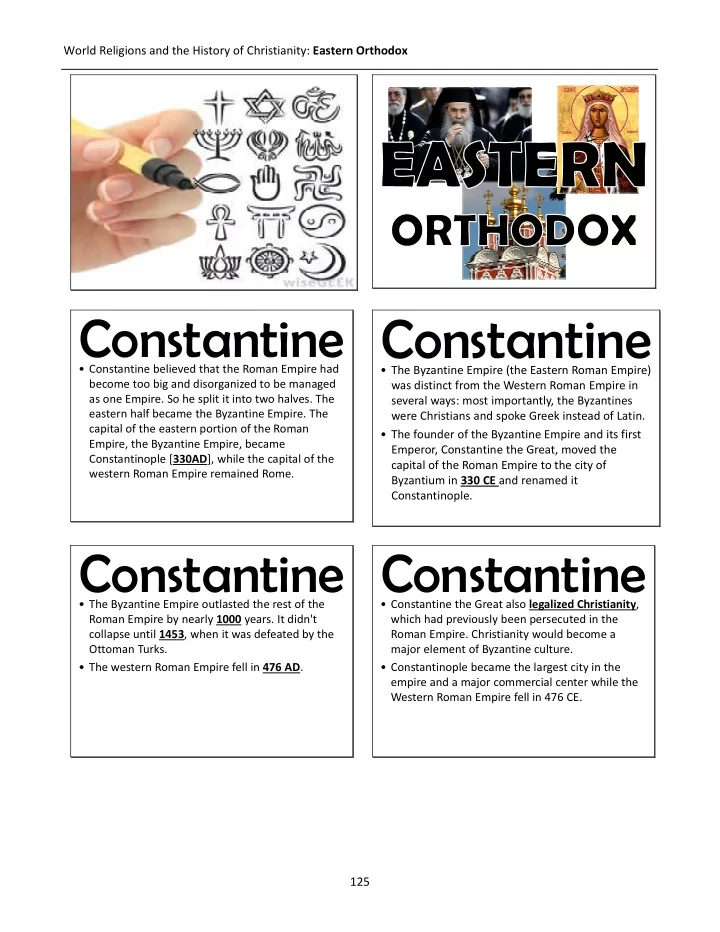
  • Constantine believed that the Roman Empire had

become too big and disorganized to be managed as one Empire. So he split it into two halves. The eastern half became the Byzantine Empire. The capital of the eastern portion of the Roman Empire, the Byzantine Empire, became Constantinople [330AD], while the capital of the western Roman Empire remained Rome.

  • The Byzantine Empire (the Eastern Roman Empire)

was distinct from the Western Roman Empire in several ways: most importantly, the Byzantines were Christians and spoke Greek instead of Latin.

  • The founder of the Byzantine Empire and its first

Emperor, Constantine the Great, moved the capital of the Roman Empire to the city of Byzantium in 330 CE and renamed it Constantinople.

  • The Byzantine Empire outlasted the rest of the

Roman Empire by nearly 1000 years. It didn't collapse until 1453, when it was defeated by the Ottoman Turks.

  • The western Roman Empire fell in 476 AD.
  • Constantine the Great also legalized Christianity,

which had previously been persecuted in the Roman Empire. Christianity would become a major element of Byzantine culture.

  • Constantinople became the largest city in the

empire and a major commercial center while the Western Roman Empire fell in 476 CE.

slide-2
SLIDE 2

World Religions and the History of Christianity: Eastern Orthodox 126

  • At the Battle of Tours near Poitiers, France,

Frankish leader Charles Martel, a Christian, defeats a large army of Spanish Moors, halting the Muslim advance into Western Europe.

  • His grandson Charlemagne carved out a vast

empire that stretched across Europe.

  • Charlemagne (c.742-814), also known as Karl and

Charles the Great, was a medieval emperor who ruled much of Western Europe from 768 to 814.

  • When the people of western Europe awoke on

December 26, 800, they had an emperor again. On Christmas Day, as King Charles of France knelt in prayer before the altar of the church of St. Peter's in Rome, Pope Leo III suddenly placed a golden crown on his head.

slide-3
SLIDE 3

World Religions and the History of Christianity: Eastern Orthodox 127

  • !"#!
slide-4
SLIDE 4

World Religions and the History of Christianity: Eastern Orthodox 128

slide-5
SLIDE 5

World Religions and the History of Christianity: Eastern Orthodox 129

$#

  • Monophysitism is an error concerning

the nature of Christ that asserts Jesus had only one nature and not two as is taught in the correct doctrine of the hypostatic union: Jesus is both God and man in one person. In monophysitism, the single nature was divine and not human.

$%&#

  • Miaphysitism is a Christological formula
  • f the Oriental Orthodox Churches.

Miaphysitism holds that in the one person of Jesus Christ, Divinity and Humanity are united in one nature, the two being united without separation, without confusion, and without alteration.

$'$%&#

  • Historically, Chalcedonian Christians

have considered Miaphysitism in general to be [agreeable] to an

  • rthodox interpretation, but they have

nevertheless perceived the Miaphysitism of the non-Chalcedonians to be a form of Monophysitism.

$'$%&#

  • The Oriental Orthodox Churches

themselves reject this characterization. They prefer the term non- Chalcedonians.

slide-6
SLIDE 6

World Religions and the History of Christianity: Eastern Orthodox 130

(#

Assyrian Church Mia- / Ephesus Oriental Church Mono- / Chalcedon

slide-7
SLIDE 7

World Religions and the History of Christianity: Eastern Orthodox 131

)%

  • “Coptic” means “Egyptian,” and

Christians living in Egypt identify themselves as Coptic Christians. As a denomination they originated in the city

  • f Alexandria, one of the most faithful,

respected, and fruitful cities during the Apostolic Period.

%&

  • The Russian Orthodox Church, part of

the Eastern Orthodox Church.

*+

  • The name Greek Orthodox Church or Greek

Orthodoxy, is a term referring to the body of several Churches within the larger communion of Eastern Orthodox Christianity, whose liturgy is or was traditionally conducted in Koine Greek, the

  • riginal language of the New Testament, and

whose history, traditions, and theology are rooted in the early Church Fathers and the culture of the Byzantine Empire.

$&

  • There are currently 23 sui juris churches that make

up the Catholic Church.

  • 22 of these 23 churches are Eastern churches; only

the Latin church is Western. But the primary reason most people don’t know about all these Eastern churches is that the Latin Catholic church makes up 98% of all Catholics worldwide.

$&

  • Another thing that people often confuse is the

difference between a “rite” and a “church”. The churches above are NOT rites; instead they each practice a rite. A rite is a liturgical patrimony: it is the way in which a church worships. There are primarily six different rites within the Catholic church (with many variations within the different churches).

&

  • The Orthodox Church is not a single church but

rather a family of 13 "autocephalous," or self- governing, churches. They are united in their understanding of the sacraments, doctrine, liturgy, and church government, but each administers its

  • wn affairs.

&

  • The nature of the Eastern Orthodox Church is

conciliar rather than monarchical. That is, the patriarchs all hold equal authority in the Church and there is no centralized headquarters from which jurisdiction is maintained. Because the Ecumenical Patriarch—believed to be the first in honor among Orthodox patriarchs—is the Patriarch of Constantinople, Istanbul may be considered the spiritual center of the Orthodox communities.

slide-8
SLIDE 8

World Religions and the History of Christianity: Eastern Orthodox 132

  • &
  • The Nicene-

Constantinopolitan Creed

  • http://www.antiochian.org/674
slide-9
SLIDE 9

World Religions and the History of Christianity: Eastern Orthodox 133

slide-10
SLIDE 10

World Religions and the History of Christianity: Eastern Orthodox 134