Conservation/Recovery of Colorado Pikeminnow in Grand Canyon - - PowerPoint PPT Presentation

conservation recovery of colorado pikeminnow in grand
SMART_READER_LITE
LIVE PREVIEW

Conservation/Recovery of Colorado Pikeminnow in Grand Canyon - - PowerPoint PPT Presentation

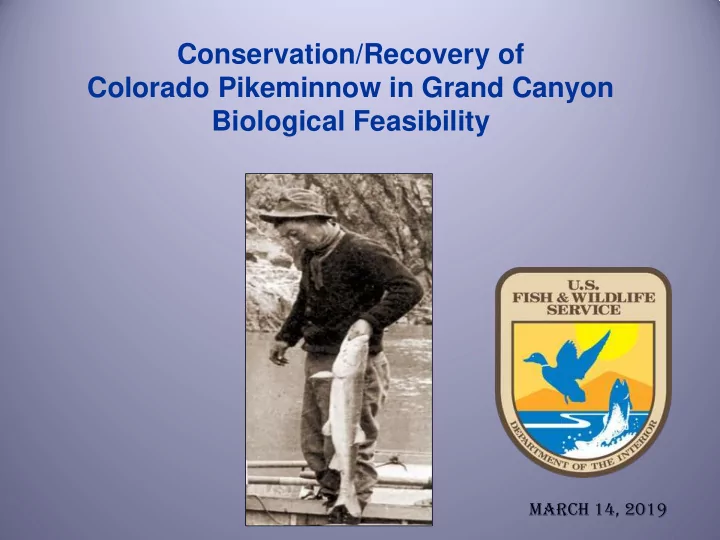
Conservation/Recovery of Colorado Pikeminnow in Grand Canyon Biological Feasibility March 14, 2019 A little background What, How & Why? Stakeholder Involvement Preliminary/Draft; do not cite B a c k g r o u n d

slide-1
SLIDE 1

Conservation/Recovery of Colorado Pikeminnow in Grand Canyon Biological Feasibility

March 14, 2019

slide-2
SLIDE 2

 A little background  What, How & Why?  Stakeholder

Involvement

Preliminary/Draft; do not cite

slide-3
SLIDE 3

B a c k g r

  • u

n d

Preliminary/Draft; do not cite

slide-4
SLIDE 4

Preliminary/Draft; do not cite

Background: Pikeminnow Archeological Records

Stanton’s Cave 4,000 ya LCR - Salt Can. Cave Homolovi Site Catclaw Cave below Hoover

slide-5
SLIDE 5

Preliminary/Draft; do not cite

Background: Pikeminnow Historical Collections*/Reports

Glen Canyon/Paria “Salmon”: Settlers – 1880s Stanton Christmas Meal – 1889 Dynamite Fishing – Loper early 1900s *Museum specimen (UM) - 1934 Shinumo Creek “Salmon”

  • Nevills 1940; 1942
  • Goldwater 1940

Tapeats Creek “Salmon” – Nevills 1948

  • J. Doerr 1948

LCR @ Grand Falls “Salmon” – Miller (via Sykes) – early 1900s Below Lava 14-16 “Salmon” – Kolb 1911 Havasu Creek - *Angler 1972

1 3 2

slide-6
SLIDE 6

Background:

“…These salmon were old friends of ours, being found from one end to

the other of the Colorado, and on all its tributaries. They sometimes weigh twenty-five or thirty pounds, and are common at twenty pounds; being stockily built fish, with large, flat heads. They are not gamey, but afford a lot of meat with a very satisfying flavour.”

Ellsworth L. Kolb 1915. Through the Grand Canyon…

Preliminary/Draft; do not cite

slide-7
SLIDE 7

 What & How?

Phased Conceptual Approach:

 Phase 1 Pikeminnow Viability/Feasibility

Assessment

 Phase 2 - If Viable/Feasible (based on phase 1)

Experimentation to Assess Feasibility.

 Phase 3 - If Viable/Feasible (based on phase 2

experimentation) Plan Development and Implement Recovery Actions (translocation(s) & monitoring etc.).

Preliminary/Draft; do not cite

slide-8
SLIDE 8

 What & How? Phase 1

 Pikeminnow Viability/Feasibility Assessment Paper exercise thru agreement with USGS USGS – science provider Steering Committee to guide process – reps

with management authorities in GC: AZGFD, NG&F, HG&F, NDOW, NPS, FWS, USBR

Expert elicitation (w/field visit) Report (targeted winter 2019/2020) Stakeholder review USGS OFR

Preliminary/Draft; do not cite

slide-9
SLIDE 9

 WHY?

 Additional Conservation and Recovery

Options May be Needed.

Preliminary/Draft; do not cite

slide-10
SLIDE 10

Status - Green River Subbasin

Preliminary/Draft; do not cite

slide-11
SLIDE 11

Status – Col. River Subbasin

Preliminary/Draft; do not cite

slide-12
SLIDE 12

Status – San Juan Subbasin

Preliminary/Draft; do not cite

slide-13
SLIDE 13

Commitment: IF future actions (e.g. Phase proposed – at the table with work together openly and responsibly. 2 or 3) are stakeholders to

Preliminary/Draft; do not cite

slide-14
SLIDE 14

Thank You

slide-15
SLIDE 15

Background

Preliminary/Draft; do not cite

Recovery Criteria:

Self-Sustaining – Green River Subbasin > 2,600 adults Colorado Subbasin >1,000 OR

  • Col. SB > 700 AND >800 in San Juan
slide-16
SLIDE 16

uo Q us at t S ends r T e ur Fut

Green Colorado Preliminary/Draft; do not cite