Conflicts of Interest No Financial Conflicts Biases, favorable - - PDF document

conflicts of interest
SMART_READER_LITE
LIVE PREVIEW

Conflicts of Interest No Financial Conflicts Biases, favorable - - PDF document

2/10/2016 Doc, What Else Can I Do? Learning the Evidence Behind Complementary and Alternative Chronic Pain Management for Chronic Nonspecific Low Back Pain Part 2 Michael Saenger, MD, FACP APA PCSS O; February 1, 2013 Conflicts of Interest


slide-1
SLIDE 1

2/10/2016 1

Doc, What Else Can I Do? Learning the Evidence Behind Complementary and Alternative Chronic Pain Management

for Chronic Nonspecific Low Back Pain Part 2 Michael Saenger, MD, FACP APA PCSS‐O; February 1, 2013

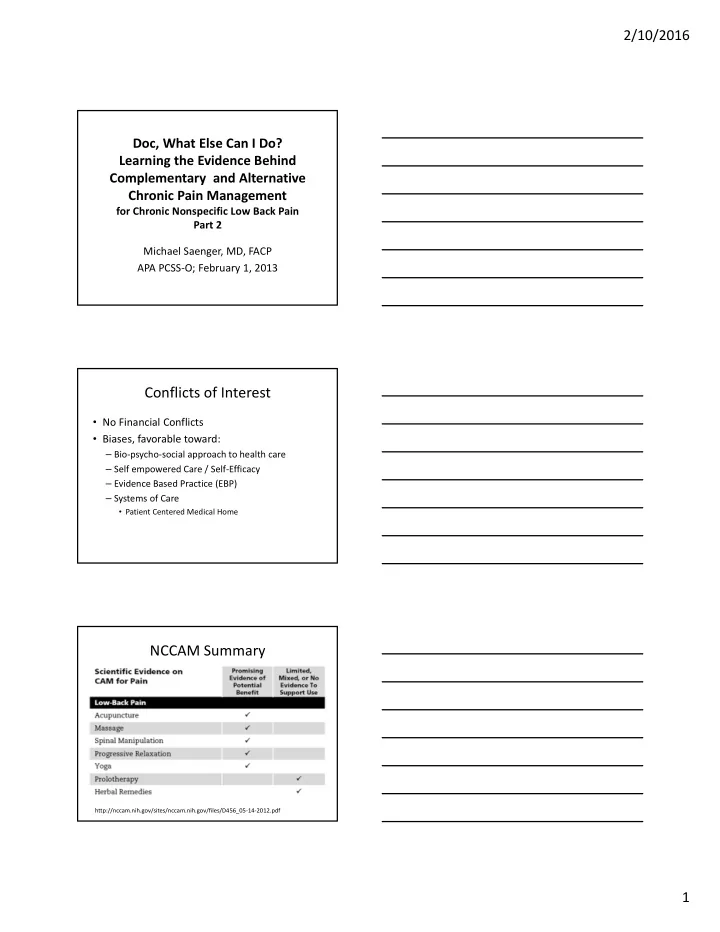
Conflicts of Interest

  • No Financial Conflicts
  • Biases, favorable toward:

– Bio‐psycho‐social approach to health care – Self empowered Care / Self‐Efficacy – Evidence Based Practice (EBP) – Systems of Care

  • Patient Centered Medical Home

NCCAM Summary

http://nccam.nih.gov/sites/nccam.nih.gov/files/D456_05‐14‐2012.pdf

slide-2
SLIDE 2

2/10/2016 2

Sorry, we can’t cover everything

  • Goals: to Learn and Keep Learning
  • Part 2 Today:

– More, How to Not be Fooled by the “Evidence” – A lot more CAM Evidence: – Now what?

  • Part 1 Taped and available through:

– www.pcss‐o.org – www.psychiatry.org\pcssowebinars

CAM Categories:

  • Whole Medical Systems
  • Mind‐Body Medicine
  • Natural, Biologically Based Products
  • Devil’s Claw
  • Glucosamine
  • Manipulation and Body Based Practices
  • Spinal Manipulation, Massage, Acupuncture, Prolotherapy

and Alexander Technique

  • Energy Medicine
  • Reiki

Natural, Biologically Based Products

  • Herbal Medicine (“Botanicals”)
  • Vitamins
  • Minerals
slide-3
SLIDE 3

2/10/2016 3

Other Terms for Biologically Based Tx

  • Phytomedicine
  • Nutriceutical
  • “Functional food”
  • “Natural Product”
  • “Dietary Supplement”

Dietary Supplements and the FDA

  • Dietary Supplement Health and Education Act

(DSHEA) of 1994

  • “This statement has not been evaluated by

the Food and Drug Administration. This product is not intended to diagnose, treat, cure, or prevent any disease.”

  • But, OK to claim improved

“Structure” or “Function”

Devil’s Claw

  • Harpagophytum Procumbens standardized to

50 mg (H50) or 100 mg harpagoside(H100) vs placebo (P); BID

– Acute on chronic LBP; 197 patients enrolled – Randomized, Double Blind; 4 weeks – Outcome = # of patients without pain (last week): 6 (H50), 10 (H100) and 3 (Placebo)

Chrubasik S, Junck H, Breitschwerdt H, Conradt C, Zappe H. Eur J Anaesthesiol. 1999 Feb;16(2):118‐29. Effectiveness of Harpagophytum extract WS 1531 in the treatment of exacerbation of low back pain: a randomized, placebo‐controlled, double‐blind study.

slide-4
SLIDE 4

2/10/2016 4

NNT Devil’s Claw

  • Pain free at 4 weeks, approximately:

– 6 of 61 on H50 (10%) – 3 of 61 on Placebo (5%)

  • NNT = 1 / ARR

1 / (0.10 – 0.05) = 20 But with wide confidence intervals for small sample

  • Similar effect on pain in 2nd pilot study of 88

patients between Doloteffin (Devil’s Claw) and low dose Vioxx (Rofecoxib)

  • S. Chrubasik et al. A randomized double‐blind pilot study comparing Doloteffin and Vioxx in the treatment of low back pain

Rheumatology 2003;42:141–148

Safety of Devil’s Claw

  • Reportedly similar “mild” GI side‐effects as

seen with placebo

  • Beware possible hypoglycemic effect
  • Long term studies not available
  • Caution with Asthma
  • Avoid in pregnancy

Potencies of Devil’s Claw Products

Estimation of the relative antiinflammatory efficacies of six commercial preparations of Harpagophytum procumbens (Devil's Claw) Nassima Abdelouahab Ouitas and Charles Heard Phytother Res 24: 333–338 (2010)

slide-5
SLIDE 5

2/10/2016 5

?? Cost of Devil’s Claw

  • Difficulty of finding similar product
  • Actual ingredients in non‐FDA “supplement”

are unknown

  • USP or NSF label may help

Certification of OTC Supplements

  • USP (United States Pharmacopeial Convention)

– USP is a scientific, nonprofit, standards‐setting

  • rganization that advances public health through

public standards and related programs that help ensure the quality, safety, and benefit of medicines and foods.

  • NSF (initially: the National Sanitation Foundation)

– NSF International was founded from the University of Michigan's School of Public Health as the National Sanitation Foundation to standardize sanitation and food safety requirements

http://www.usp.org http://www.nsf.org/business/about_NSF/

Glucosamine for cLBP

  • Randomized;

double blinded

  • Daily intake of

1500 mg of oral glucosamine

  • 6 months

Wilkins et al. Effect of Glucosamine on Pain‐Related Disability in Patients With Chronic Low Back Pain and Degenerative Lumbar

  • Osteoarthritis. JAMA. 2010;304(1):45‐52
slide-6
SLIDE 6

2/10/2016 6

Infinitely Large NNT for Glucosamine

  • Equal reductions in RDQ Roland Morris

Disability Questionnaire (0‐24 scale) Glucosamine Placebo

– Baseline 9.2 9.7 – 6 month 5 5 – 12 month 4.8 5.5

Wilkins et al. Effect of Glucosamine on Pain‐Related Disability in Patients With Chronic Low Back Pain and Degenerative Lumbar

  • Osteoarthritis. JAMA. 2010;304(1):45‐52

Safety of Glucosamine; N(%)

Wilkins et al. Effect of Glucosamine on Pain‐Related Disability in Patients With Chronic Low Back Pain and Degenerative Lumbar

  • Osteoarthritis. JAMA. 2010;304(1):45‐52

Cost of Glucosamine

  • OTC (often with Chondroitin…)
  • $60 for 6 months

Wilkins et al. Effect of Glucosamine on Pain‐Related Disability in Patients With Chronic Low Back Pain and Degenerative Lumbar

  • Osteoarthritis. JAMA. 2010;304(1):45‐52
slide-7
SLIDE 7

2/10/2016 7

Body Based Practices

  • Spinal Manipulation Therapy (SMT)
  • Massage
  • Acupuncture
  • Prolotherapy
  • Movement Therapies

– Alexander Technique – Pilates

Spinal Manipulation in Chronic LBP

  • “Hands‐on” treatment of the spine, includes:

– Manipulation and – Mobilization

Spinal Manipulation in Chronic LBP

  • Cochrane Review:

– 26 RCTs (total participants = 6070), nine with a low risk of bias – “Sensitivity analyses … suggest that neither the technique nor profession of the therapist had a profound influence on the overall pooled effect”

Rubinstein SM, van Middelkoop M, Assendelft WJJ, de Boer MR, van Tulder MW. Spinal manipulative therapy for chronic low‐back pain. Cochrane Collaboration (2012)

slide-8
SLIDE 8

2/10/2016 8

Spinal Manipulation Chronic LBP Pain ‐ Forest Plot

Rubinstein SM, van Middelkoop M, Assendelft WJJ, de Boer MR, van Tulder MW. Spinal manipulative therapy for chronic low‐back pain. Cochrane Collaboration (2012)

Spinal Manipulation cLBP ‐ Function

Rubinstein SM, van Middelkoop M, Assendelft WJJ, de Boer MR, van Tulder MW. Spinal manipulative therapy for chronic low‐back pain. Cochrane Collaboration (2012) UK Beam Trial Team BMJ, doi:10.1136/bmj.38282.669225.AE (published 29 November 2004)

95% Confidence Intervals “Best Care” included: The Back Book; and encouragement in “active management” SMT < 9 20 minute sessions Exercise < 9 60 minute sessions

slide-9
SLIDE 9

2/10/2016 9

Safety of Spinal Manipulation

  • Infrequent complications
  • Rare herniated discs

Rubinstein SM, van Middelkoop M, Assendelft WJJ, de Boer MR, van Tulder MW. Spinal manipulative therapy for chronic low‐back pain. Cochrane Collaboration (2012)

Cost of Spinal Manipulation $300+

  • Initial evaluation: $55‐200
  • “Adjustments” (follow‐up visits): $50‐150

– http://www.howmuchisit.org/chiropractic‐care‐cost/ accessed Dec 2012

Cherkin et al. Ann Intern Med. 2003;138:898‐906

Massage Therapy in Chronic LBP

  • Many massage therapy techniques:

– Swedish – Structural – Fascial or connective tissue release techniques – Cross fiber friction – Myofascial trigger point techniques

  • Low quality evidence for most of the studies

Brosseau et al. Ottawa Panel – Massage – LBP. J Bodyworks and Movement Tx; 2012.

slide-10
SLIDE 10

2/10/2016 10

Massage – Change in Function

Cherkin, D.C., Sherman, K.J., Kahn, J., Wellman, R., Cook, A.J., Johnson, E., et al., 2011. A comparison of the effects of 2 types of massage and usual care on chronic low back pain: a randomized, controlled trial. Annals of Internal Medicine 155 (1), 1‐9.

95% Confidence Intervals

NNT Massage: Function

  • 3 point RDQ Score (0‐24) decrease

at 26 weeks:

– 60% Massage; 40% UC – NNT = 5

  • But no difference at 52 weeks

Massage – Change in “Bothersomeness”

Cherkin, D.C., Sherman, K.J., Kahn, J., Wellman, R., Cook, A.J., Johnson, E., et al., 2011. A comparison of the effects of 2 types of massage and usual care on chronic low back pain: a randomized, controlled trial. Annals of Internal Medicine 155 (1), 1‐9.

slide-11
SLIDE 11

2/10/2016 11

NNT Massage: Bothersomeness

  • 2 point “Bothersome” (0‐10) decrease

at 10 weeks

– 60% Massage; 30% UC – NNT approximately 3 during treatment

  • But no difference at 26 weeks

Safety of Massage

  • No known side‐effects

Cost of Massage $250+

  • 8 sessions

Cherkin et al. Ann Intern Med. 2003;138:898‐906

slide-12
SLIDE 12

2/10/2016 12

Berman B, Langevin H, Witt C, and Dubner R. Acupuncture for Chronic Low Back Pain. N Engl J Med 2010;363:454‐61.

Acupuncture’s Traditional Meridians for Energy Reservoirs “qi”: GV = Governing Vessel UB = Urinary Bladder GB = Gall Bladder

Meta‐Analysis for Acupuncture Trialists’ Collaboration

Vickers A et al. Acupuncture for Chronic Pain. Arch Int Med (2012) 172(19) 1444‐1453

Acupuncture vs No Acupuncture Pain ‐ Forest Plot

Vickers A et al. Acupuncture for Chronic Pain. Arch Int Med (2012) 172(19) 1444‐1453

slide-13
SLIDE 13

2/10/2016 13

Acupuncture vs Sham Acupuncture Forest Plot

Vickers A et al. Acupuncture for Chronic Pain. Arch Int Med (2012) 172(19) 1444‐1453

NNT: Pain No Tx vs Sham vs Acupuncture

  • Estimated 50% reduction in pain achieved in:

30% no acupuncture group 42.5% sham acupuncture group 50% acupuncture group

  • NNT = 5 for acupuncture vs no acupuncture

‐ while acupuncture was ongoing ?Infinitely large for acupuncture vs sham

Vickers A et al. Acupuncture for Chronic Pain. Arch Int Med (2012) 172(19) 1444‐1453

Acupuncture vs No Acupuncture Function ‐ Forest Plot

Furlan et al. Acupuncture and dry‐needling for low back pain. Cochrane; 2011

slide-14
SLIDE 14

2/10/2016 14

NNT: Function Acupuncture vs No Accupuncture

  • ? NNT

– Larger, higher quality studies are needed

Furlan et al. Acupuncture and dry‐needling for low back pain. Cochrane; 2011

Safety of Acupuncture

  • Infrequent to have complications
  • But see:

– “Acupuncture: Does it alleviate pain and are there serious risks? A review of reviews” – commentary: “Acupuncture’s claims punctured: Not proven effective for pain, not harmless”

Harriet Hall. Acupuncture’s claims punctured: Not proven effective for pain, not harmless. PAIN 152 (2011) 711–712 Ernst E, Lee MS, Choi TY. Acupuncture: Does it alleviate pain and are there serious risks? A review of reviews. PAIN 152 (2011) 755–764

Cost of Acupuncture $250‐750

  • 10 sessions over 7 weeks
  • Cost per session:

– Individual $65‐120; – Supervised student: $40 – “Community Acupuncture”: $15

  • https://www.pocacoop.com/ Accessed Dec 2012
  • No difference in outcomes per level of training

http://www.nytimes.com/2010/05/08/health/08patient.html; accessed Dec 2012 Witt et al. Journal of Pain, Vol 11, No 5 (May), 2010: pp 431‐435

slide-15
SLIDE 15

2/10/2016 15

Comparative Effectiveness of Exercise, Acupuncture, and Spinal Manipulation for Low Back Pain

  • Structured exercise and SMT equally effective
  • Insufficient comparisons acupuncture to SMT
  • Insufficient comparisons for cost‐effectiveness
  • “If no clinical benefit is appreciated after using
  • ne of these approaches for 8 weeks, then the

treatment plan should be reevaluated and consideration should be given to modifying the treatment approach or using alternate forms of

  • care. Strength of recommendation: Weak.”

Standaert et al. Comparative Effectiveness of Exercise, Acupuncture, and Spinal Manipulation for Low Back Pain. SPINE Volume 36, Number 21S, pp S120–S130

Prolotherapy Theory

  • “Prolotherapy treatment is the injection of an

irritant … in the painful area … that creates a short duration of inflammation.

  • Prolotherapy rapidly produces collagen and

cartilage… which stimulates the immune system’s own healing mechanism.

  • The new collagen … strengthens and restores

joints, and supporting soft tissue, reducing or eliminating many different types of pain.”

http://prolotherapyinstitute.com/prolotherapy‐questions.htm accessed Dec 2012

? Infinitely Large NNT Prolotherapy

Dagenais S, Yelland MJ, Del Mar C, Schoene ML. Prolotherapy injections for chronic low‐back pain (Review) (2010) Cochrane Collaboration.

slide-16
SLIDE 16

2/10/2016 16

Safety of Prolotherapy

  • Frequent soreness

– felt by Practitioners to be sign of “healing”

  • 2‐4% headache consistent with spinal HA
  • Infrequent menopausal spotting

– if steroids used for injection

  • Nausea or diarrhea in < 42%

Dagenais S, Yelland MJ, Del Mar C, Schoene ML. Prolotherapy injections for chronic low‐back pain (Review) (2010) Cochrane Collaboration.

Cost of Prolotherapy $1000?

  • ?Four treatments
  • Each treatment may cost $125‐500
  • Insurance does not cover

http://www.answerbag.com/q_view/2100771

Alexander Technique

“individualized approach designed to develop lifelong skills for self care that help people recognize, understand, and avoid poor habits affecting postural tone and neuromuscular coordination.”

Little et al; RCT Alexander Technique, Exercise and Massage; BMJ 2008;337:a884

http://www.youtube.com/watch?v=coVXuDjHrf M&feature=player_embedded#!

slide-17
SLIDE 17

2/10/2016 17

Alexander Technique

  • “The art of learning to overcome

unnecessary muscle tension”

– Accessed Jan 2013 http://www.cafepress.com/dancersoutlet/6260587

  • Stages; you learn:
  • 1. How to recognize habits of tension
  • 2. How to decrease the frequency of those habits
  • 3. Skills for more optimal brain and body coordination

– Accessed Jan 2013 http://alexandertechniqueguide.com/faq/

Alexander Technique

Little et al; RCT Alexander Technique, Exercise and Massage; BMJ 2008;337:a884

Alexander Technique

  • At baseline, over the course of 28 days, each

group had a mean of at least 24 painful days

  • On average they were:

– 45 years old – High school graduates – > 2/3 women

Little et al; RCT Alexander Technique, Exercise and Massage; BMJ 2008;337:a884

slide-18
SLIDE 18

2/10/2016 18

Outcomes Alexander Technique: 1yr

Little et al; RCT Alexander Technique, Exercise and Massage; BMJ 2008;337:a884

Outcomes Alexander Technique: 1yr

RDQ disability # days LBP/28 days Control NS (9.2) NS (23) Massage NS NS 6 Alexander NS ‐13 24 Alexander ‐ 4.1 ‐20 Exercise NS ‐11 Ex + Massage ‐ 2.4 ‐11 Ex + 6 AT ‐ 3 ‐13 Ex + 24 AT ‐ 4.2 ‐20

Little et al; RCT Alexander Technique, Exercise and Massage; BMJ 2008;337:a884

NNT Alexander Technique

  • As the results are presented as improvements

in continuous variables rather than a percentage who meet a certain cut point of improvement, we cannot calculate a NNT

Little et al; RCT Alexander Technique, Exercise and Massage; BMJ 2008;337:a884

slide-19
SLIDE 19

2/10/2016 19

Safety Alexander Technique

  • No adverse events were reported by exercise
  • r Alexander Technique
  • One patient noted worse pain with massage

Little et al; RCT Alexander Technique, Exercise and Massage; BMJ 2008;337:a884

Cost Alexander Technique $600?

  • “similar rate … to private music lessons”

– Accessed Jan 2013 http://en.wikipedia.org/wiki/Alexander_technique

  • Private Lessons

– 10 sessions: $585 – 1 session: $65

– Accessed Jan 2013 http://alexandertechniqueguide.com/faq/

  • Group Classes, ATL Certified Instructor

– 8 sessions: $95 – drop‐in: $15

– Accessed Jan 2013 http://www.robbinlmarcus.com/at‐class‐schedule.html

  • DVDs: $15‐90

Energy Medicine

  • Veritable (measurable)

– Magnetic – Light – Direct‐ or alternating‐ current fields

  • Putative (yet to be measured; “BioField”)

– Qi Gong – Reiki – Healing or Therapeutic Touch

slide-20
SLIDE 20

2/10/2016 20

Reiki

  • The word Reiki is made of two Japanese words

– Rei which means "God's Wisdom or the Higher Power" and – Ki which is "life force energy". – Reiki is actually "spiritually guided life force energy."

http://www.reiki.org/faq/WhatIsReiki.html accessed Dec, 2012

Reiki as per:

http://www.reiki.org/faq/WhatIsReiki.html

  • “A treatment feels like a wonderful glowing

radiance that flows through and around you….

  • Reiki is a simple, natural and safe method of

spiritual healing and self‐improvement that everyone can use. It has been effective in helping virtually every known illness and malady and always creates a beneficial effect. It also works in conjunction with all other medical or therapeutic techniques to relieve side effects and promote recovery.”

Reiki

per “Learn Reiki in 10 minutes” Video

  • “Benevolent love energy”
  • “Permeates universe”
  • If “attuned” to “harmonic vibration” then

cleansed

  • Gratitude is key attitude

– “Cure for” “anger” and “worry” – I.e. Mindfullness add‐on to Reiki

http://www.bing.com/videos/search?q=reiki&mid=0FDD99317F3A3569D1080FDD99317F3A3569D108&view=detail&FORM=VIRE2 Dec 2012

slide-21
SLIDE 21

2/10/2016 21

?? NNT for Reiki

  • “To date, based on the poor quality of studies

and their reporting, it is currently impossible to draw definitive conclusions about the efficacy of Reiki.”

  • Jadad scores = 0‐2 in 11 of 12 studies

Sondra vanderVaart et al. J ALTERNATIVE AND COMPLEMENTARY MEDICINE Volume 15, Number 11, 2009, pp. 1157–1169

Safety of Reiki

  • “exacerbation rates of reported symptoms”

– 2.5% for physical pain – 1.1% for palpitation/dizziness – 0.7% for anxiety/depression

Alternative Therapies in Health and Medicine Suzuki, Kiyoshi yr:2012 vol:18 iss:4 pg:38 ‐50

Cost of Reiki ? $200?

  • Each healing ritual session $25‐100
  • Lasting approximately one hour each

http://www.reiki.org/FAQ/Questions&Answers.html accessed Dec, 2012

slide-22
SLIDE 22

2/10/2016 22

State of EBP for CAM for cLBP

  • Low quality of evidence
  • Short term, modest benefits possible from:

– ? Devil’s Claw – Massage – Spinal manipulation – Acupuncture

  • Long term, modest benefits possible from:

– Alexander Technique – Yoga – ? Mindfullness

Duration of Therapy?

  • SMT, Massage and Acupuncture

– Partially effective during active administration – Should they be continued indefinitely?

  • What would the cost be?
  • Would the small benefit persist?
  • Yoga

– Growing trend of effect – Should treatment continue beyond 8 weeks?

  • What would the cost be?
  • Would the small benefit grow?

Integrated, Evidence Based Practice

Sackett, D L (1999). Evidence‐based medicine: How to practice and teach EBM (2nd ed.). Edinburgh: Churchill Livingstone. http://www.library.auckland.ac.nz/subject‐guides/edu/ebp/ebpsocialwork.htm (accessed Dec 3, 2012)

slide-23
SLIDE 23

2/10/2016 23

Can I Apply this CAM for My Patient?

  • IF reasonably valid and moderately effective,
  • Consider:

– Values, preferences of this patient – Cost of therapies – Local availability of therapies

  • Note some CAM providers give free or reduced fee tx

– Possible side‐effects

Sherman et al. BMC Complementary and Alternative Medicine 2004, 4:9

Hypothesis – Transition of Care

Away from therapies: Dangerous Ineffective Passive High Dose Opioids Benzodiazepines Chronic “Muscle Relaxants” Chronic “Sleep Medications”

slide-24
SLIDE 24

2/10/2016 24

Hypothesis – Transition of Care

Away from therapies: Dangerous Ineffective Passive Towards therapies: Safe Moderately effective Self‐efficacious

Hypothesis – Transition of Care

Away from therapies: Dangerous Ineffective Passive Towards therapies: Safe Moderately effective Self‐efficacious Passive Bridge therapies: Massage Spinal Manipulation Acupuncture

Hypothesis – Transition of Care

Towards therapies: Safe Moderately effective Self‐efficacious Alexander Technique Yoga Progressive Relaxation Deep Breathing

slide-25
SLIDE 25

2/10/2016 25

In Summary, Our Obligation

  • For each specific condition,
  • ffer patients evidence‐based treatment,

including evidence‐based CAM

  • If the patient remains symptomatic,

Re‐evaluate and consider offering

  • ther CAM modalities as may be appropriate.

Questions?

  • Dr. Richard Deyo – “Back Pain Research:

Past History, Pitfalls, and Possibilities” “There has been a history of ineffective treatment “fads” for back pain. Treatment utilization and costs have increased rapidly, but without corresponding declines in reported functional limitations and number of work disability claims related to back pain. It is unclear whether much meaningful progress has been made.”

http://nccam.nih.gov/sites/nccam.nih.gov/files/2009septmin.pdf accessed Jan 2013 National Advisory Committee, Complementary and Alternative Medicine; Minutes of the 37th Meeting: Sept 2009

slide-26
SLIDE 26

2/10/2016 26

  • Dr. Richard Deyo – “Back Pain Research:

Past History, Pitfalls, and Possibilities”

“Pitfalls that have impeded true progress include:

  • 1. Exaggerated reports of treatment success from

“experts” and the popular media;

  • 2. Misleading clinical trial outcomes (apparent

treatment‐related improvements that actually reflect factors such as placebo)

  • 3. Methodological challenges in randomized

clinical trials (RCTs)

– Statistically significant results often are not clinically important

http://nccam.nih.gov/sites/nccam.nih.gov/files/2009septmin.pdf accessed Jan 2013 National Advisory Committee, Complementary and Alternative Medicine; Minutes of the 37th Meeting: Sept 2009

Hypothesis – Transition of Care

Away from therapies: Dangerous Ineffective Passive Towards therapies: Safe Moderately effective Self‐efficacious Passive Bridge therapies: Massage Spinal Manipulation Acupuncture

Hypothesis – Transition of Care

Towards therapies: Safe Moderately effective Self‐efficacious Alexander Technique Yoga Progressive Relaxation Deep Breathing

slide-27
SLIDE 27

2/10/2016 27

Learn and Keep Learning

  • Cochrane Collaboration
  • Trip Database

– http://library.medicine.yale.edu/guides/screencas ts/finditfast/finditfast_9/PubMed Advanced – http://www.ncbi.nlm.nih.gov/pubmed/advanced

NCCAM References/Resources

  • Subscribing to CAM newsletter

https://nccam.nih.gov/tools/subscribe?digest=1 Summary Table http://nccam.nih.gov/health/providers/digest /pain‐science/chart

For Patient Reference

  • 6 Tips for patients considering CAM

http://nccam.nih.gov/health/tips/pain

  • NCCAM Clinical Digest

http://nccam.nih.gov/health/providers/digest/c hronicpain.htmMedlinePlus http://www.nlm.nih.gov/medlineplus/medlinepl us.html

slide-28
SLIDE 28

2/10/2016 28

Other References

  • What is Complementary and Alternative

http://medicine/?http://nccam.nih.gov/health/whatiscam#types accessed December, 2012

  • Jacobs B, Gundling K The ACP Evidence‐Based Guide to Complementary

and Alternative Medicine 2009 ACP Press

  • A Systematic Review and Meta‐Analysis of Efficacy, Cost‐Effectiveness,

and Safety of Selected Complementary and Alternative Medicine for Neck and Low‐Back Pain Andrea D. Furlan, Fatemeh Yazdi, Alexander Tsertsvadze, Anita Gross,Maurits Van Tulder, Lina Santaguida, Joel Gagnier, Carlo Ammendolia, Trish Dryden, Steve Doucette, Becky Skidmore, Raymond Daniel, Thomas Ostermann, and Sophia Tsouros Clinical Epidemiology Methods Centre, Ottawa Hospital Research Institute, University of Ottawa Evidence‐Based Practice Center, Box 208, Ottawa, ON, Canada K1H 8L6 Correspondence should be addressed to Alexander Tsertsvadze, atsertsvadze@ohri.ca Received 1 February 2011; Accepted 14 May 2011

EBP References

  • Users' Guides to the Medical Literature:

A Manual for Evidence‐Based Clinical Practice, 2nd Edition

Gordon Guyatt, Drummond Rennie, Maureen O. Meade, and Deborah J. Cook

  • http://www.certs.hhs.gov/centers/centers.ht

m

  • http://www.ahrq.gov/clinic/epcix.htm