CONDENSED MATTER: The Chemical Bond PCES 16.1 Quantum Mechanics - - PowerPoint PPT Presentation

condensed matter the chemical bond
SMART_READER_LITE
LIVE PREVIEW

CONDENSED MATTER: The Chemical Bond PCES 16.1 Quantum Mechanics - - PowerPoint PPT Presentation

CONDENSED MATTER: The Chemical Bond PCES 16.1 Quantum Mechanics explains chemical bonding. As we saw, in QM we can form states which are superpositions (ie., sums) of different states- allowing them to spread in space, which lowers their


slide-1
SLIDE 1

CONDENSED MATTER: The Chemical Bond

Quantum Mechanics explains chemical

  • bonding. As we saw, in QM we can form

states which are superpositions (ie., sums)

  • f different states- allowing them to spread

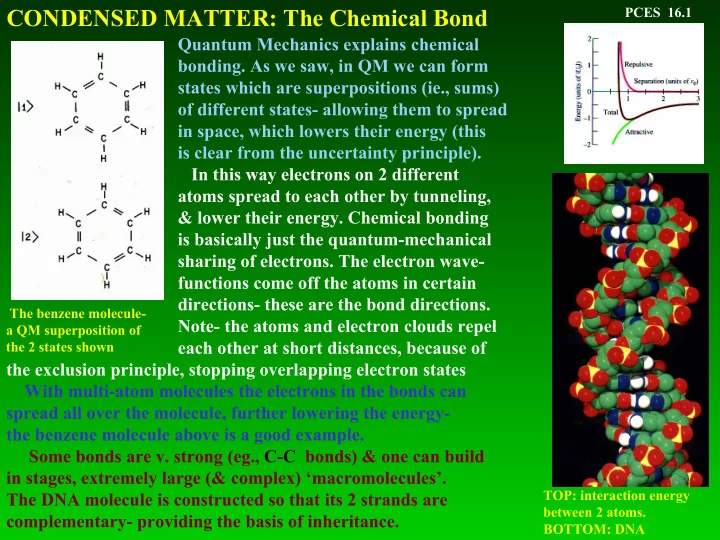
in space, which lowers their energy (this is clear from the uncertainty principle). In this way electrons on 2 different atoms spread to each other by tunneling, & lower their energy. Chemical bonding is basically just the quantum-mechanical sharing of electrons. The electron wave- functions come off the atoms in certain directions- these are the bond directions. Note- the atoms and electron clouds repel each other at short distances, because of the exclusion principle, stopping overlapping electron states With multi-atom molecules the electrons in the bonds can spread all over the molecule, further lowering the energy- the benzene molecule above is a good example. Some bonds are v. strong (eg., C-C bonds) & one can build in stages, extremely large (& complex) ‘macromolecules’. The DNA molecule is constructed so that its 2 strands are complementary- providing the basis of inheritance.

The benzene molecule- a QM superposition of the 2 states shown TOP: interaction energy between 2 atoms. BOTTOM: DNA PCES 16.1

slide-2
SLIDE 2

CONDENSED MATTER: Crystals

Obviously one can make repetitive patterns by assembling many atoms of the same kind. Hundreds of different basic patterns are possible, giving a large variety of natural crystals made from different atomic sub-units. Their strength and hardness depends entirely on that of the bonds between the atoms. Thus diamond is very hard (depending on strong inter-Carbon bonds), but graphite is made from Carbon planes which are

  • nly weakly coupled to each other- so they

easily slide. One can convert graphite to diamond by applying pressure & heat, and make many

  • ther Carbon-

based structures (eg. the ‘buckyball’, C-60, on page 15.8).

TOP: The basic ‘unit cell’ structure, of Si & O atoms, repeated in quartz. BOTTOM: structure

  • f water ice, made

from H2O units. Iron pyrite ( FeS ) ; ‘fool’s gold’. PCES 16.2 Epsomite crystals Haematite crystals ( Fe2O3 )

slide-3
SLIDE 3

PCES 16.3

CONDENSED MATTER: Structure of Solids

Obviously most objects are not macroscopic crystals. At the microscopic level one can have 2 kinds of structure: (i) We can have microcrystals. These fit together, with atom-sized dislocations & defects between

  • them. Heating such a ‘polycrystal’

will ‘anneal’ it- the defects move

  • ut, & the system plastically

deforms, leaving a singlecrystal behind. (ii) One can have a system where atomic bonds are

  • riented in random directions- defects everywhere.

This disorder is so extensive that the system has to melt to get rid of it. Such systems are called ‘glasses’ (window glass is an example). Glasses form if the system solidifies too fast to get rid of its defects. Slower solidification produces polycrystals- like

  • rocks. One can freeze defects by adding impurities,

preventing plastic deformation, & making the material strong- steel is an example.

The atomic structure

  • f a glass

Bending a crystal creates ‘fault lines’ (defects, dislocations), & then polycrystals. Heating then anneals out the dislocations.

slide-4
SLIDE 4

ELECTRONS in SOLIDS: Metals & Insulators

Suppose move a set of atoms towards each other. When far apart, the electron energy levels on all the different atoms will have the same energy. But as the electron clouds start to overlap, the electrons are forced into different

  • states. Some of these are spread over the different atoms and so have lower

energy, but others are even more confined and have higher energy. The end result is ‘bands’ of energy levels- all electron states are in these

  • bands. Each level can only contain 2 electrons (one for each spin state). The

higher energy states are completely delocalised, over the whole system. One can then simply understand the difference between metals (in which electrons move freely around in delocalised states- so metals conduct electricity), and insulators (where the electrons can’t move). In insulators all bands are full of states- an electron can only move by jumping to a higher Band, which takes a big whack of energy. In metals a band is only partly full- it is easy to excite electrons and move them around.

PCES 16.4 LEFT: The energy levels of 2 atoms as they approach. CENTRE: The levels of 5 atoms forced to approach each other. RIGHT: The levels of very many atoms approaching each other. The filling of states in 2 bands of a conductor, insulator, & semiconductor. Filled states are in red, empty in green.

slide-5
SLIDE 5

PCES 16.5

In modern times a technology of ‘quantum devices’ has developed, depending on our understanding of electron states in solids. The first major development was the transistor, & now we have thousands of devices ranging from solid-state lasers to electronic computers. Computers work by transferring electrons around- to make them faster one needs smaller components. Computing history is a story of component size reduction- which still has far to go.

1st transistor (1949) Oppenheimer, von Neumann, & the Los Alamos computer

SOLID-STATE ELECTRONICS

RIGHT: a Pentium 2 chip, containing 5 million processing elements BELOW: rise in computing speed, 1972-2007

slide-6
SLIDE 6

PCES 16.6

In the last 20 yrs a new technique has allowed physicists to look at & manipulate matter at the atomic scale on solid

  • surfaces. The STM

(Scanning Tunneling Microscope) is a very sharp needle which moves across a surface, only a few Angstroms above it. Electrons quantum tunnel between the two, & by measuring the electric current we look directly at the electronic clouds on the surface. One sees not only the structure of the electrons localised around atoms, but also the wavelike patterns of itinerant electrons moving across the

  • surface. The STM’s can also be

used to drag or pick up atoms, to make surface structures, such as the famous ‘quantum corral’. The STM is one of the important tools used in the modern technology of ‘nanoscience’, ie, making nm-sized structures.

STM tip (human hair ~ 100 µm thick) Surface of Cu using STM A ‘quantum corral’, with Ni atoms on a Cu surface. Surface of Be, near an atomic ‘edge’.

CONDENSED MATTER: Solid Surfaces

slide-7
SLIDE 7

CONDENSED MATTER: Spins & Magnetism

Magnetism is just the ordering of all the atomic spins in the same direction- the magnetic fields from all the spins then line up. One also gets magnetic fields from the electronic ‘current loops’, caused by electrons circulating around the atomic nuclei. In the same way we have polycrystalline domains inside a solid, we also have magnetic domains, inside which all spins point in the same direction. Between these domains there are ‘domain walls’ in which the spins turn over from one domain to another. If a magnetic field is applied to the magnet, it can make these walls move- or even turn the spins over. The origin of magnetism is entirely quantum-

  • mechanical. This isn’t just because QM gives us

spins, but because the interaction between the spins, which causes them to line up together, is a result of the Pauli exclusion principle. When electrons on nearby atomic sites overlap in space, this forces them to have opposite spins- or else to readjust to avoid each other. The result is effective forces between the spins, thousands of times larger than the interaction coming from the magnetic fields they generate.

PCES 16.7 ABOVE: Moving magnetic Domain walls with applied field BELOW: the field rotates the spins in a domain If we move between 2 magnetic domains, the spins turn over- this region is the domain wall.