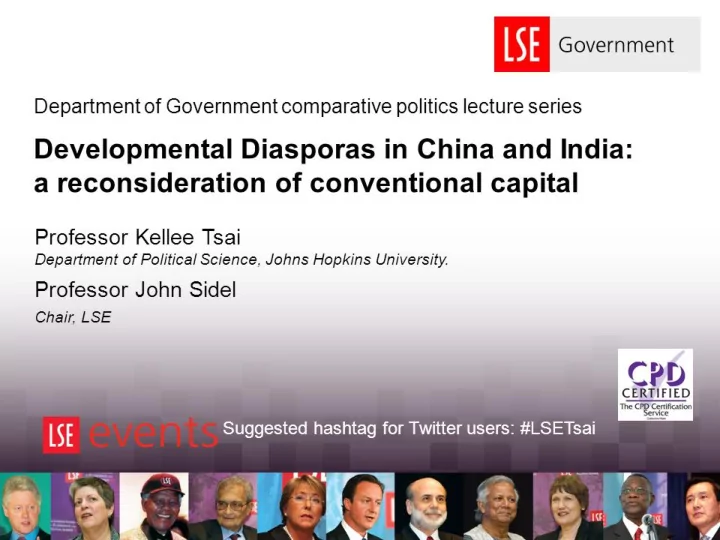
1 DEVELOPMENTAL DIASPORAS IN CHINA AND INDIA: A Reconsideration of - - PowerPoint PPT Presentation

1 developmental diasporas in china and india
SMART_READER_LITE
LIVE PREVIEW

1 DEVELOPMENTAL DIASPORAS IN CHINA AND INDIA: A Reconsideration of - - PowerPoint PPT Presentation

1 DEVELOPMENTAL DIASPORAS IN CHINA AND INDIA: A Reconsideration of Conventional Capital Kellee S. Tsai Johns Hopkins University 2 140.0 120.0 100.0 80.0 US$ billion China 60.0 India 40.0 20.0 0.0 3 US$ billion 40.0 60.0 20.0


slide-1
SLIDE 1

1

slide-2
SLIDE 2

2

DEVELOPMENTAL DIASPORAS IN CHINA AND INDIA: A Reconsideration of Conventional Capital Kellee S. Tsai

Johns Hopkins University

slide-3
SLIDE 3

3

0.0 20.0 40.0 60.0 80.0 100.0 120.0 140.0

US$ billion China India

slide-4
SLIDE 4

4

US$ billion

0.0 10.0 20.0 30.0 40.0 50.0 60.0 70.0 1991 1992 1993 1994 1995 1996 1997 1998 1999 2000 2001 2002 2003 2004 2005 2006 2007 2008 2009 2010 2011

Remittances Realized FDI

slide-5
SLIDE 5

5

  • Public investment

(developmental state) Including the diasporic dimensions

  • f informal finance
  • FDI from MNCs

(globalization, neo-liberalism)

  • External aid

(ODA & IFIs)

slide-6
SLIDE 6

6

  • Developmental performance should not be

reduced to FDI statistics

  • FDI may not be as foreign as it appears
  • Remittances influence development – in a

diversity of ways

slide-7
SLIDE 7

7

  • What motivates ethnic FDI vs. remittances?
  • What are the developmental implications of

these diasporic capital flows?

  • How to do national governments treat FDI vs.

remittances?

slide-8
SLIDE 8

8

1. Explaining the FDI gap

  • 2. Comparing remittance trends
  • 3. Developmental implications
  • 4. Analytic implications
slide-9
SLIDE 9

9

  • Policy & business environment explanations
  • Compositional differences in FDI

0.0 20.0 40.0 60.0 80.0 100.0 120.0 140.0

US$ billion China India

slide-10
SLIDE 10

10 Ease of… China India China-India Doing Business 91 132

  • 41

Starting a business 151 166

  • 15

Dealing with construction permits 176 181

  • 5

Registering property 40 97

  • 57

Getting credit 67 40 27 Protecting investors 97 38 50 Paying taxes 122 147

  • 25

Trading across borders 60 109

  • 49

Enforcing contracts 16 182

  • 166

Closing a business 62 140

  • 78
slide-11
SLIDE 11

11

Ranking out of 134 countries China India China-India Global Competitiveness Index 30 50

  • 20

A. Basic Requirements 42 80

  • 38

Institutions 56 53 3 Infrastructure 47 72

  • 25

Macroeconomic policy 11 109

  • 98

Health and primary education 50 100

  • 50
  • B. Efficiency enhancers

40 33 7 Higher education and training 64 63 1 Goods market efficiency 51 47 4 Labor market efficiency 51 89

  • 38

Financial market sophistication 109 34 75 Technological readiness 77 69 8 Market size 2 5

  • 3
  • C. Innovation and sophistication factors

32 27 5 Business sophistication 43 27 16 Innovation 28 32

  • 4
slide-12
SLIDE 12

12

  • Differing definitions of FDI
  • China’s FDI statistics are overestimated

(includes roundtrip capital)

  • India’s official FDI figures have been

underestimated (excludes reinvested earnings by foreign affiliates, inter-company foreign loans to domestic subsidiaries,

  • verseas commercial borrowing, etc.)
slide-13
SLIDE 13

13

  • Off-shore special purpose companies
  • Transfer pricing
  • Red-chip IPOs
slide-14
SLIDE 14

14

Onshore Offshore

25% equity

Chinese capital Offshore bank Offshore company

FAKE FIE

slide-15
SLIDE 15

15

CHINESE PARENT FOREIGN ENTITY Under-invoice imports Over-invoice exports (-) Receives less (+++) Pays more

OUTCOME: Net financial transfer to Chinese company

slide-16
SLIDE 16

16

Onshore Offshore

Chinese company Offshore bank Offshore company Red chip company IPO

slide-17
SLIDE 17

17

FDI Source Country Cumulative FDI (US$ billion) % of India’s Total FDI Mauritius $173.7 44% Singapore 35.1 9 United States 28.8 7 United Kingdom 23.2 6 Netherlands 16.4 4 Japan 12.7 3

slide-18
SLIDE 18

18

0.0 20.0 40.0 60.0 80.0 100.0 120.0 140.0

US$ billion

China India China w/o RTK

slide-19
SLIDE 19

19

Cumulative Net Portfolio Investment (2011) China: $211 billion India: $174 billion

slide-20
SLIDE 20

20

  • Non-Resident Indians (NRIs) account for < 14% of

India’s FDI

  • China’s FDI is dominated by Chinese investors
  • Through the 1990s, 2/3rds of China’s FDI

came from Hong Kong, Taiwan, Macau, and Singapore

  • As of 2011, 54% of FDI from 4 Chinese

economies

  • As of 2011, FDI mainly from Hong Kong

(47%) and Virgin Islands (14%).

slide-21
SLIDE 21

21

  • Government policies
  • Cultural affinity
  • Regional economic networks & production chains

There may not be an “India Circle” within South Asia, but there are commercial co-ethnic networks of Indians in various sectors.

  • Geographic distribution/concentration of diaspora
slide-22
SLIDE 22

22

0.0 20.0 40.0 60.0 80.0 100.0 120.0 140.0

US$ billion China

India China w/o RTK

slide-23
SLIDE 23

23

Imperial-era settlements in Southeast Asia Chinese dominance

  • f commerce
slide-24
SLIDE 24

24

  • 19th & early 20th century labor trade in

Americas, Australia, & Southeast Asia = migration of 2 million workers Hong Kong became hub for labor recruiters & remittance agencies

  • Patriotic remittances
  • reversed China’s negative BOP position
  • helped finance Revolution of 1911, May 30th

movement, Anti-Japanese war

slide-25
SLIDE 25

25

  • Despite outmigration of capitalists, remittances

from Overseas Chinese encouraged during 1950s & early 60s - channeled mainly through Hong Kong

  • Reform era – migration to US, Britain, Australia,

Canada, Latin America, and more recently, Europe & Africa

  • illegal migration from Changle, Fujian

reflected in remittances

  • Overseas Chinese viewed suspiciously during

Cultural Revolution (1966-76)

slide-26
SLIDE 26

26

  • 6th-11th century voyages => Buddhist & Hindu influence

in Southeast Asia

  • Itinerant commercial networks spanned Indian Ocean
  • 19th & early 20th century forced labor migration

to colonies following abolition of slavery = migration

  • f 1.5 million workers
  • Maistry and kangany system of labor recruitment
  • remittances recorded from Mauritius, British

Guiana, Trinidad, and other colonial territories

slide-27
SLIDE 27

27

1900-01 1920-21 1940-44 1957-60 Indians in Mauritius 70% 71% 63% 67% Indians in Trinidad 32 33 n.a. 36 Indians in British Guiana 38* 42 n.a. 48 Indians in Fiji 15 40 n.a. 49 Japanese in Hawaii 40 43 37 32 Chinese in Hawaii 17 9 7 6

slide-28
SLIDE 28

28

  • 1950s & 1960s: Skilled professionals to UK, US, Canada, &

Australia

  • 1980s – 2000s: Shift in remittance composition to

industrialized countries (over half of remittances from US since 2003)

  • decline of informal/hawala channels
  • shift from RBI deposits to remittances
  • RBI deposit withdrawals used for investment in

domestic real estate & equity markets

  • 1970s: Gulf migration – by 1977, 77% of remittances from

the Middle East

slide-29
SLIDE 29

29

  • Major increase since 1990: from 0.7% to 3.1% of GDP
  • Outstrips government expenditures on education &

health

  • Bolsters BOP position: NRI deposits exceed revenues from

software exports

Year Remittances (US$bil) Remittances/ Education Expenditures Remittances/ Health Expenditures 1990-91 $2.07 55.5% 127.8 1995-96 8.51 118.4 271.0 2000-01 12.85 86.2 206.9 2001-02 15.4 101.7 242.5 2002-03 16.39 104.9 234.5 2003-04 21.61 120.4 263.9 2004-05 20.25 196.8 225.8

slide-30
SLIDE 30

30

  • Cherur, Hindu village in southern Kerala
  • spent on education, weddings, gifts, & festivals
  • remittances not invested in local businesses
  • strengthens position of women due to matrilineal

inheritance

  • Veni, Muslim district in northern Kerala
  • illegal migrants employed in informal economy
  • consumption, gifts, charitable causes
  • investment in local businesses
  • Kembu, Christian village in central Kerala
  • mainly white-collar migrants
  • investment in education, property, & bank deposits
slide-31
SLIDE 31

31

  • Dongguan, Guangdong
  • early investment in manufacturing
  • from labor-intensive to technology-intensive
  • Chang Le, Fujian
  • depopulation of mountain villages
  • construction boom
  • center of illegal migration arranged by

snakeheads

  • Wenzhou, Zhejiang
  • transnational network of private entrepreneurs

& informal finance

  • investment in local industry & churches
slide-32
SLIDE 32

32

  • Conspicuous consumption – vacant show-case houses
  • f NRIs
  • Worst case scenario: “Downward spiral of local de-

development” (Ballard)

  • Lack of investment in agriculture and manufacturing
  • Rural outmigration & urban crowding
slide-33
SLIDE 33

33

  • Ethnic FDI should be distinguished from non-ethnic FDI
  • Migration and diasporic capital flows should be

incorporated into (political science) explanations of development.

  • Remittances also influence development
  • Existing explanations for development either neglect or

essentialize transnational ethnic capital

slide-34
SLIDE 34

34

DEVELOPMENTAL DIASPORAS IN CHINA AND INDIA: A Reconsideration of Conventional Capital Kellee S. Tsai

Johns Hopkins University

slide-35
SLIDE 35

35