Con onstructing a a na natio ional ide identity in in Tim - - PowerPoint PPT Presentation

con onstructing a a na natio ional ide identity in in tim
SMART_READER_LITE
LIVE PREVIEW

Con onstructing a a na natio ional ide identity in in Tim - - PowerPoint PPT Presentation

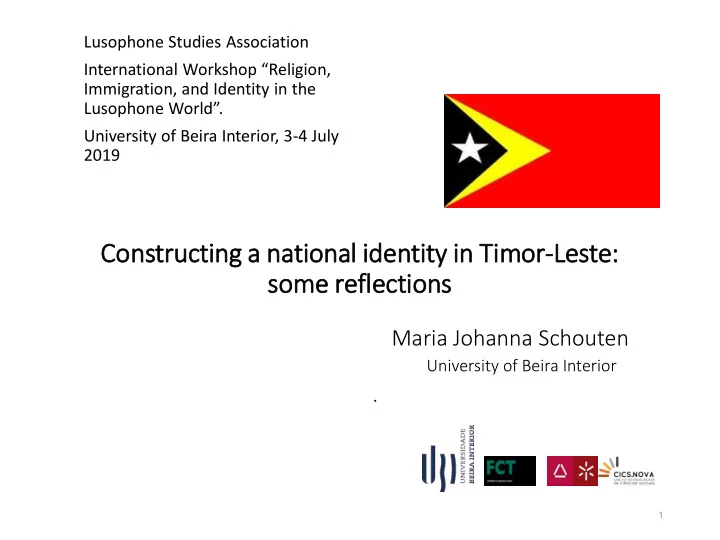
Lusophone Studies Association International Workshop Religion, Immigration, and Identity in the Lusophone World. University of Beira Interior, 3-4 July 2019 Con onstructing a a na natio ional ide identity in in Tim imor-Leste:


slide-1
SLIDE 1

Con

  • nstructing a

a na natio ional ide identity in in Tim imor-Leste: som some refle lectio ions

Maria Johanna Schouten

University of Beira Interior .

1

Lusophone Studies Association International Workshop “Religion, Immigration, and Identity in the Lusophone World”. University of Beira Interior, 3-4 July 2019

slide-2
SLIDE 2

Timor-Leste

An officially independent state since 2002

2

slide-3
SLIDE 3

Timor in the Southeast Asian Archipelago

3

Timor Leste: Area 14,874 km2; 2019 1,350,000 inhabitants; HDI 132/189.

slide-4
SLIDE 4

.

“Se somos um país pequeno, ainda por cima sem recursos, porquê não investimos em ser diferentes?” (Mari Alkatiri)

  • Cit. in: Monteiro 2017: 25.

4

slide-5
SLIDE 5

Eastern Timor and foreign supremacy

Portugal until 1975; Indonesia 1975-1999; [UN (transition period) 1999- 2002].

5

20 de maio 2002 :

Republik Demokratik Timor Leste

slide-6
SLIDE 6

“East-Timorese identity”

Motives for developing a national identity in the case of Timor Leste:

  • Creating a sense of a common project;
  • Recognition of the role of the central government;
  • Overcoming conflicts and avoiding future conflicts;
  • Affirmation of the new state on the world stage;
  • Differentiating from other states.

“Identity-building consolidates and legitimises a new nation-state and mitigates the risk of further state failure or collapse” (Shiosaki 2018: 54).

Identitarian politics: The state and institutions have a main role in instilling values, feelings, attitudes (education and language policies; official narratives). Identity has various dimensions, which may be manipulated, according to context and situation. (Some authors on identity: Barth 1969; Eriksen 1993/2010; Maalouf 1998).

6

slide-7
SLIDE 7

Dimension 1: perceived origins

7

Luís Peres. https://luisperes.wordpress.com/2009/07/24/timor-ilha-

crocodilo-timor-crocodile-island/

slide-8
SLIDE 8

Dimension 2: history and memory (1)

Portuguese colonial era

Fonte: Observatório da Língua Portuguesa (2015) Via Daniel de Lucca

slide-9
SLIDE 9

Dimension 2: history and memory (2)

Anna Voss, Watch Indonesia

slide-10
SLIDE 10

Dimension 3: ethnicity

  • a. Phenotype and b. Culture

.

10

slide-11
SLIDE 11

Culture: ethnolinguistic groups

Source: Fischer 2010

11

slide-12
SLIDE 12

Dimension 4: language

In Timor-Leste:

  • A. Indigenous languages

(N = 15+)

  • B. Official languages:
  • Tetum-Prasa
  • Portuguese.
  • C. Working languages:
  • Indonesian
  • English

Language (written word) and generation: Generation of 1975: Portuguese; Generation foun: Indonesian; Generation of Independence : …. + ….. + …..

12

slide-13
SLIDE 13

Dimension 5: religion

  • .

13

Percentage of Catholics:

1974 27.8 1989 81.4 1999 90

slide-14
SLIDE 14

Reconfigured tradition

14

slide-15
SLIDE 15

Th The Na National Id Identi tity ty Surv rvey

amon

  • ng students

ts of f Hi Higher Edu ducatio ion 20 2002 02, 20 2007 07, 20 2010 10

Question of survey (adapted from IPSS): Some people say the following things are important for being truly East

  • Timorese. Others say they are not important. How important do you

think each of the following is?

  • a. To have been born in Timor-Leste?
  • b. To have East Timorese citizenship?
  • c. To have lived in Timor-Leste for most of one’s life?
  • d. To be able to speak Tetum?
  • e. To be able to speak Portuguese?
  • f. To be a Catholic?
  • g. To respect tradition and adat?
  • h. To respect Timor-Leste’s political institutions and laws?
  • i. To feel East Timorese?

as in Leach 2012: 235-237

15

slide-16
SLIDE 16

The National Identity Survey 2002 % of respondents; N = 320

16

(as in Leach 2012: 235-236)

very important fairly important not very important not at all importamt

Speak Tetum 83 9 7 1 Speak Portuguese 24 31 26.5 17 Be Catholic 81 5.5 9.5 2

slide-17
SLIDE 17

The National Identity Survey

among students of Higher Education, 2007 % of respondents; N = 250

Indicator Very important Fairly important Not very important Not at all important

Speak Tetum 88.5 7.5 3.5 0.5 Speak Portuguese 52 28 14 6 Be Catholic 84 7 8 1

17

Leach 2012: 237

slide-18
SLIDE 18

The National Identity Survey

among students of Higher Education, 2010, Percentages of respondents; N = 365.

Indicator Very important Fairly important Not very important Not at all important

Speak Tetum 88.5 8.5 2.5 Speak Portuguese 52 31 12.5 2 Be Catholic 78 11 8 1

18

Leach 2012: 237

slide-19
SLIDE 19

.

19

slide-20
SLIDE 20

.

Construction and reconstruction processes go on.

The end. For now.

20

.

slide-21
SLIDE 21

Bibliography (1)

  • Anderson, Benedict (1991) Imagined communities. Reflections on the origin and spread of nationalism.

London/New York: Verso [First published in 1983.]

  • Anderson, Warwick and Ricardo Roque (2018) Imagined laboratories: Colonial and national

racialisations in Island Southeast Asia, Journal of Southeast Asian Studies 49, 3, pp 358–371.

  • Arthur, Catherine (2018) From Fretilin to freedom: The evolution of the symbolism of Timor-Leste's

national flag, Journal of Southeast Asian Studies, 49, 2, pp 227–249.

  • Barth, Fredrik (1969) Ethnic groups and boundaries. The social organization of culture difference. Oslo:

Universitetsforlaget.

  • Eriksen, Thomas Hylland (2010) Ethnicity and Nationalism: Anthropological Perspectives. 3rd ed.

London: Pluto Press.

  • Feijó, Rui Graça (ed.) (2016) Timor-Leste. Colonialismo, descolonização, lusotopia. Porto: Ed.

Afrontamento.

  • Fischer, J. Patrick 2010 Die Sprachen Timors. Wikimedia.

https://commons.wikimedia.org/wiki/File:Timor_Sprache.jpg Leach, Michael (2012) Longitudinal change in East Timorese tertiary student attitudes to national identity and nation building, 2002-2010, Bijdragen tot de Taal-, Land- en Volkenkunde 168, no. 2-3,

  • pp. 219-252
  • De Lucca, Daniel (2016) A timorizacão do passado: nação, imaginação e produção da história em

Timor-Leste. PhD thesis, Unicamp, Campinas, SP .

  • Maalouf, Amin (1999) As identidades assassinas. Algés: Difel. [Les identités meurtrières, 1998]

21

slide-22
SLIDE 22

Bibliography (2)

  • McClean, Nick (2014) Myth, resistance, and identity in Timor-Leste's Nino Conis Santana National Park,

Journal of Southeast Asian Studies, 45, 2: 153–173.

  • McMahon, Richard (2016) The Races of Europe: Construction of National Identities in the Social Sciences,

1839-1939. Ed. Springer.

  • Monteiro, José (2017) O português em Timor-Leste: presença da língua nas salas de aula de escolas do 1.º

e 2.º ciclos de Díli, Lautém, Manatuto e Bobonaro. M.A. Thesis, Universidade Aberta.

  • Schouten, Maria Johanna (2001a), Antropologia e colonialismo em Timor português Lusotopie, numéro

spécial, pp. 157-171.

  • Schouten, Maria Johanna (2001b) Apart and together: the Portuguese and the Dutch as neighbours in and

around Timor in the nineteenth century, in: Ivo Carneiro de Sousa and Richard Z. Leirissa (eds.), Indonesia- Portugal: Five hundred years of historical relationship, pp. 201-212. Lisbon: CEPESA.

  • Shiosaki, Elfie (2017) ‘‘We have resisted, now we must build’’: Regionalism and nation-building in Timor-

Leste, Journal of Southeast Asian Studies, 48(1), pp 53–70.

  • Strating, Rebecca (2014) Contested Self-determination: Indonesia and East Timor's Battle over Borders,

International Law and Ethnic Identity. The Journal of Pacific History 49, 4: 469-494.

  • Wallace, Alfred Russel (1962) The Malay archipelago. The land of the orang-utan and the bird of paradise.

A narrative of travel, with studies of man and nature. New York: Dover [First published in 1869.]

  • Washbrook, David (1982) Ethnicity and Racialism in Colonial Indian Society, in: Robert Ross (ed.) Racism

and colonialism, Essays on ideology and social structure. The Hague: Martinus Nijhoff, Pp. 159-162.

22