Complex Chronic Pain: Cases from the Field Soraya Azari, MD - - PowerPoint PPT Presentation

complex chronic pain cases from the field
SMART_READER_LITE
LIVE PREVIEW

Complex Chronic Pain: Cases from the Field Soraya Azari, MD - - PowerPoint PPT Presentation

3/12/2016 I have no disclosures to report. Complex Chronic Pain: Cases from the Field Soraya Azari, MD Assistant Clinical Professor of Medicine Objectives Case 1 To develop empathic and sensitive ways of 46yo M with a history of


slide-1
SLIDE 1

3/12/2016 1

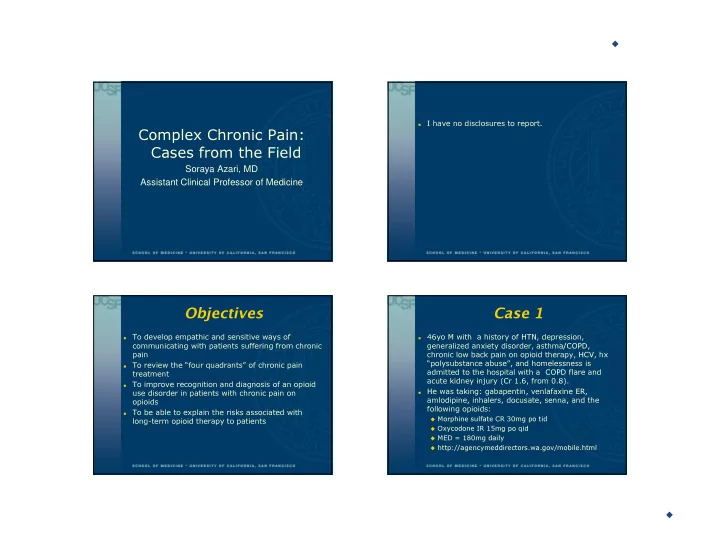
Complex Chronic Pain: Cases from the Field

Soraya Azari, MD Assistant Clinical Professor of Medicine

  • I have no disclosures to report.

Objectives

  • To develop empathic and sensitive ways of

communicating with patients suffering from chronic pain

  • To review the “four quadrants” of chronic pain

treatment

  • To improve recognition and diagnosis of an opioid

use disorder in patients with chronic pain on

  • pioids
  • To be able to explain the risks associated with

long-term opioid therapy to patients

Case 1

  • 46yo M with a history of HTN, depression,

generalized anxiety disorder, asthma/COPD, chronic low back pain on opioid therapy, HCV, hx “polysubstance abuse”, and homelessness is admitted to the hospital with a COPD flare and acute kidney injury (Cr 1.6, from 0.8).

  • He was taking: gabapentin, venlafaxine ER,

amlodipine, inhalers, docusate, senna, and the following opioids:

Morphine sulfate CR 30mg po tid Oxycodone IR 15mg po qid MED = 180mg daily http://agencymeddirectors.wa.gov/mobile.html

slide-2
SLIDE 2

3/12/2016 2

Case 1 continued

  • He received treatment for his asthma/COPD

exacerbation and intravenous fluids with improvement in his creatinine to 1.3.

  • He reported doing well – taking his pain pills and

abstaining from cocaine. He was buying diazepam

  • ff the street (10/d). He is homeless & estranged

from family. Has few trustworthy friends.

  • His main complaint is severe, uncontrolled pain in

his back (sharp and tight, paraspinal), and closely watched the clock for his next PRN.

  • He was seen by Pain Consult and described poor

pain control. He’d been buying methadone off the street and that was helping much more than the

  • morphine. He had been out of his gabapentin.

Case continued

  • The patient was transitioned from morphine sulfate

ER to methadone 20mg po TID + hydromorphine 8mg po q4hrs PRN in discussion with the PCP, pain consult, and hospitalist.

  • The patient missed his initial follow-up appointment

but then got repeat labs showing an increase of his creatinine back to 1.6. He could not be contacted by phone despite several attempts.

  • 5 days after discharge he was found dead.
  • Cause of death: acute mixed drug intoxication

Serum methadone = 1600ng/mL

Which of the following represents the best management plan with regard to his pain?

A.

Stop morphine sulfate ER and switch to methadone + short acting PRN

B.

Continue morphine sulfate ER and

  • xycodone and add

non-opioid pain relievers

C.

Stop all opioids and refer to methadone

maintenance treatment

D.

Increase dose of morphine sulfate ER + short acting PRN agent

Stop morphine sulfate E... Continue morphine sulfa.. Stop all opioids and refer .. Increase dose of morphin...

0% 0% 0% 0%

Case continued

  • Which of the following represents the best

management plan with regard to his pain?

A) Stop morphine sulfate ER and switch to

methadone + short acting PRN

B) Continue morphine sulfate ER and oxycodone and

add non-opioid pain relievers

C) Stop all opioids and refer to methadone

maintenance treatment

D) Increase dose of morphine sulfate ER + short

acting PRN agent

slide-3
SLIDE 3

3/12/2016 3

Lessons: the New Epidemic

  • Drug overdose

Leading cause of injury death in 2014 (>47,000

deaths), surpassing motor veh. accidents in 25-64 year olds

51% of deaths related to prescription drugs

~19,000 deaths from prescription opioid pain relievers 10,000 deaths from heroin

Rx-opioid overdose: quadrupled (2000-2014) Increased risk: high dose, hx of substance use or

mental health disorder

CDC Rx Opioids.

Is this New? 259 million

KFF Health Tracking Poll Nov 2015

Lessons

  • Distinguishing between pain and an opioid use

disorder?

Opioid use disorder

4 Rs

  • Risk of bodily harm
  • Relationship trouble
  • Role failure
  • Repeated attempts to cut back

4 Cs

  • Loss of Control
  • Continued use despite harm
  • Compulsion (time & activities)
  • Craving

Withdrawal and tolerance

Benzos + opioids

Time/hustle to buy street pills

I need more; pain pills are not holding me Homeless, disconnected from family

Lessons

  • Methadone

serum half life: 15-60 hours; variable bioavailability;

metabolized by CYP3A4

1999-2008: methadone poisoning increased 600% American Pain Society recs: 2.5mg q 8, inc q week www.compassionandsupport.org; Chou R, et al. J Pain. 2014;15(4):33865

slide-4
SLIDE 4

3/12/2016 4

  • Example:

Morphine sulfate 60mg po bid total 15mg

methadone daily

Morphine sulfate 200mg po tid total 40mg daily

If you can…prevention

$75/2 for Medicaid

$15 30 45 $500 $0

But this pain…do you want me to start shooting dope??

  • No, I don’t want you to start injecting heroin. I

don’t think you want that either. You should feel proud that you don’t use needles anymore.

  • My job is to take care of you and make sure you’re

safe.

  • I don’t think you can safely continue on opioid pain
  • pills. I want to give you a better, safer treatment

because I think you have severe, uncontrolled pain, and an opioid use disorder.

  • I’m not going to leave you. I know you are

suffering right now.

  • The treatments I can offer you are methadone

maintenance programs, or buprenorphine-

  • naloxone. Do you want to hear more about those?

Treatment Program Locator

  • Buprenorphine-certified providers:

http://www.samhsa.gov/medication-assisted-

treatment/physician-program-data/treatment- physician-locator

To get trained: www.buppractice.com

  • Opioid treatment program directory:

http://dpt2.samhsa.gov/treatment/directory.aspx

  • Substance use treatment warm line: 1-855-300-
  • 3595. 10a-6pm EST
slide-5
SLIDE 5

3/12/2016 5

Takehome points

  • Be the most sensitive and empathetic you can be

when communicating discontinuation of opioids.

  • Run towards the patient, not away.
  • Avoid opioids in individuals with active substance

use disorders given safety risks. Show caution with methadone, benzodiazepine, and alcohol use.

Case 2

  • A 34yo F with a history of depression, obesity,

PCOS, and low back pain presenting for primary care follow-up. She describes sharp pain in L back, 8/10, with occasional radiation down her leg x2

  • weeks. She denies weakness and numbness and

has a normal neurologic exam.

  • She says the pain is excruciating and she’s had

difficulty at work. She’s been using her husband’s pain pills (hydrocodone-acetaminophen) and is wondering if you can prescribe some.

  • You try NSAIDs, ice/heat, massage and basic wall

exercises and ask her to return in 2 weeks.

Case 2 continued

  • She returns in 2 weeks and says the pain is still

very severe (8/10), “tight and throbbing”, almost

  • constant. She tried the ibuprofen which had some

effect, as does ice/heat, but it’s only temporary. She is still using her husband’s hydrocodone- acetaminophen and says that’s her preferred

  • agent. She’s having difficulty sleeping, which is

making her more tired throughout the day.

  • She denies depressed mood or lack of interest in

daily activities. She continues to feel stress and anxiety about life at home. She does not smoke or use drugs or alcohol.

Evaluation

  • Empower

What are you doing to control your pain? Acknowledge suffering while focusing on strength and

recovery

  • Educate

Back pain is common (mean point prevalence 18%;

lifetime prevalence 39%)

At 1 mo. ~1/3 with mod. pain (20% activity); 1 year,

~1/3 with mod. pain

Opioid efficacy

  • Evaluate

Function (work, apt), substance use, and psychiatric

Von Korff M, Saunders K. Spine (Phila Pa 1976). 1996 Dec 15;21(24):2833.

slide-6
SLIDE 6

3/12/2016 6

Treatment: The Broader Context of Pain

Lumbosacral strain

  • Tired. Stressed. Depressed.

Worried something is wrong with her body.

Husband disabled. Sole wage

  • earner. IHSS hours decreased.

Pharmacologic Physical Complementary and Alternative Medicine Cognitive and Behavioral

What Are My Alternatives?

Pharmacologic

  • NSAIDs
  • Neuroleptics
  • Antidepressants
  • Muscle relaxants
  • Topicals
  • Opioid medications/Tramadol
  • Pumps (baclofen, lidocaine)
  • Buprenorphine

Physical

  • Physical Therapy
  • Joint injections
  • Directed Exercise Program
  • Pacing daily activity
  • Heat or ice
  • Trigger point injections

Complementary and Alternative Medicine

  • Acupuncture (community and schools)
  • Mindfulness Based Stress Reduction and

meditation

  • Yoga
  • Massage
  • Supplements (glucosamine chondroitin,

SAM-e)

  • Guided imagery
  • Breathing exercises

Cognitive and Behavioral

  • Pain Groups
  • Cognitive and behavioral therapy
  • Visualization, deep breathing, meditation
  • Sleep hygiene
  • Gardening, being outdoors, going to

church, spending time with friends and family, etc.

  • Pain ToolKit

Check out: https://healthinsight.org/Internal/assets/SMART/Pain%20Guidelines%20alternative%20to%20opioidsfinal.pdf

Can it work?

  • Biopsychosocial Treatment

Patients with chronic neck or back pain >3mos (taken

sick leave)(~50% depressed)

3 week inpatient multidisciplinary treatment (5d/w;

8h/d)

Physical exercises Ergonomic training Psychotherapy Patient education Behavioral therapy Workplace-based interventions

At 6 months: 67% returned to work; SF-36 score

improved

Buchner et al. Scandinavian Journal of Rheumatology. 2006: 363

slide-7
SLIDE 7

3/12/2016 7

Case cont’d

  • She was offered low-dose baclofen given her

complaints of tightness in her muscles. She was referred to the Healthy Spine clinic.

  • You check in with her by phone 1 week later and

she says the baclofen is making her sleepy and she still has pain. She’s been trying to do her exercises, think positively, and use the ice/heat and massage. She also got some muscle rub.

Which of the following is the best course of action?

A.

Continue with plan explaining it takes time to see improvement

B.

Add diazepam for muscle pain

C.

Check a urine drug screen

D.

Start extended- release opioid medication

E.

Something else

Continue with plan expla... Add diazepam for muscle... Check a urine drug screen Start extended-release o... Something else

74% 0% 23% 2% 2%

Question

  • Which of the following is the best course of action?
  • A) Continue with plan explaining it takes time to

see improvement

  • B) Add diazepam for muscle pain
  • C) Check a urine drug screen
  • D) Start extended-release opioid medication
  • E) Something else

Case continued

  • Discussion about risks/benefits of opioids. Urine

drug screen normal. Prescription activity report with no prescriptions. Decision to prescribe opioids (hydrocodone-acetaminophen) as treatment trial.

  • Patient returned for follow-up 2 weeks later. In

that time she did not have to take additional sick

  • days. She was taking ~1-3 pills per day. Her

sleep had improved. She attended her healthy spine appointment & was taught additional exercises.

  • Epilogue: Patient continued on opioid for ~3

months, taking less over time and with no concerning behaviors. Patient had also been doing basic fertility treatments and became pregnant, and stopped opioids completely.

slide-8
SLIDE 8

3/12/2016 8

Take Home Point

  • Think of the four quadrants when developing

treatment options with your patients. Cultivate their resilience & strength.

  • Opioids may still be required for patients that have

failed multi-modal therapy and who do not have active substance use or mental health disorders.

  • Also…Providers with DEA license must register for

CURES 2.0 before July 1, 2016: https://cures.doj.ca.gov

Case 3

  • 56yo M with a history of depression, alcohol use, retinal

detachment from prior trauma, DM, and obesity with low back pain. He described excruciating, severe pain, 10/10, in the center of his back, causing difficulty getting out of bed or walking normally. He was started

  • n opioids for acute pain management (oxy-APAP 1-2

tabs q6hr PRN pain).

  • He returned for follow-up appointments describing huge

relief from the medication. He was very grateful for the

  • care. 3 months later he was still requiring/requesting
  • pioid prescriptions.
  • Over the next 3 mos. he started to exhibit the

following concerning behaviors:

Poor adherence to other parts of treatment plan Poor PCP follow-up Frustration about any discussion of non-opioid agents

Case 3, continued

  • His provider monitored him closely:

Urine drug screens were appropriate Prescription activity report showed no outside

providers

He had no new ED visits or hospitalizations

  • The patient’s functional status: disabled, lives alone

(no partner), goes out for basic errands, periodically sees family

  • He continues to describe excruciating pain.

How would you manage this patient?

A.

Discontinue chronic

  • pioid therapy

B.

Re-discuss the contents

  • f the patient-provider

agreement and your treatment expectations

  • f him

C.

Start morphine sulfate ER 15mg po BID + short-acting PRN agents

D.

Switch him to buprenorphine-naloxone

Discontinue chronic opioi... Re-discuss the contents o... Start morphine sulfate E... Switch him to buprenor...

11% 30% 5% 54%

slide-9
SLIDE 9

3/12/2016 9

Question

  • How would you manage this patient?

A) Discontinue chronic opioid therapy B) Re-discuss the contents of the patient-

provider agreement and your treatment expectations of him

C) Start morphine sulfate ER 15mg po BID + short-

acting PRN agents

D) Switch him to buprenorphine-naloxone

Monitoring

  • Patient-provider agreements

no evidence they decrease misuse. Useful to

facilitate communication and set expectations.

  • Recommended by:

CDC Guidelines (2016) Chronic Opioid Treatment Guidelines (APS, AAPM;

2009)

Informed Consent (strong rec, low-quality evidence) Treatment agreements (weak rec, low-quality evidence)

  • Goals, expectations for follow-up and monitoring,

indications for stopping treatment, etc. State Medical Board of California: Guidelines for Rx

Controlled Substances for Pain (Nov 2014)

  • Examples:

http://www.agencymeddirectors.wa.gov/Files/txagreement.pdf

Assessment

Risks

Alcohol use Depression ?Not attending

appointments

?Not participating

in other forms of treatment

Not spending time

with family

Benefits

Patient report

Case Continued

  • The provider had actually been very clear with the

patient in signing the treatment agreement. She was worried about his depression and so wanted him to connect with the behavioral health and to attend physical therapy. Despite repeated attempts at outreach/reminders, he did not attend.

  • The provider explained that opioids would be
  • discontinued. The patient became angry and

verbally abusive toward the provider.

  • Epilogue: He was transferred to me ~4 weeks
  • later. Pain & previous history not discussed.

Getting treatment for his DM, alcohol use disorder and severe depression.

slide-10
SLIDE 10

3/12/2016 10

Depression & Pain

  • Depression and pain often linked

Study of outpatients at university-based outpatient pain

clinic (n=2104):

  • 55% with current opioid use 43% depressed (v.

26%)

  • If depressed, prob of opioids didn’t depend on pain

severity.

Outcomes in depressed patients

  • Mod-high negative affect groups in a RCT trial of opioid

therapy: decreased benefit from opioid therapy

Goesling J, et al. J Pain. 2015 Jun 12. Jamison RN et al. Pain Pract. 2013;13(3):17381.

“Adverse Selection”

% of patients receiving chronic

  • pioid

therapy

Edlund MJ, et al. Clin JPain.2010;26(1):18.

Inc.risk: ADRB Overdose SUD

Takehome point

  • Severely depressed or anxious patients often do

poorly on chronic opioid therapy. They may be inadvertently using opioids to treat their anxiety/depression symptoms, and hence feel very upset when medication is discontinued.

Case 4

  • JF is a 66yo M with hx of chronic low back pain

(sciatica s/p epidural injections), BPH, depression, remote alcohol and dextromethorphan abuse referred to CSI committee by new PCP.

  • Meds:

Fentanyl 75mcg TD q 48hrs Oxy-APAP 5-325 #180/month temazepam 15mg q hs Testosterone gel Dextroamphetamine 10mg q day

  • MED = 225mg daily
slide-11
SLIDE 11

3/12/2016 11

All of the following are risks of longterm, highdose chronic

  • pioid therapy except:
  • A. sleep disordered

breathing

  • B. Hypogonadism
  • C. unintentional
  • verdose
  • D. Pneumonia
  • E. BPH
  • F. osteoporotic

fracture

sleep disordered breathing Hypogonadism unintentional overdose Pneumonia BPH

  • steoporotic fracture

0% 0% 0% 0% 0% 0%

Question

  • All of the following are risks of long-term, high-

dose chronic opioid therapy except:

  • A) sleep disordered breathing
  • B) hypogonadism
  • C) unintentional overdose
  • D) pneumoinia
  • E) BPH
  • F) osteoporotic fracture

Risks of High Dose

  • Unintentional overdose (~0.7%/year 20-100MED)

and re-exposure (91% w/rx at 10mos. post OD)

  • Secondary Hypogonadism (~50% of men)

Dec bone mineral density & inc. fracture risk

  • Sleep-disordered breathing (60-70% of patients)
  • Pneumonia in older adults (case-control)
  • Others

Opioid-induced hyperalgesia? Cardiac toxicity with methadone Miller M, et al. JAMA Intern Med. 2015;175(4):60815. Rose AR, et al. J Clin Sleep Med. 2014;10(8):84752. Guilleminault C, et al. Lung 2010;188(6):45968. Rubinstein AL, et al. Clin J Pain. 2013;29(10):8405. Dublin Setal. JAGS, 2011;59(10): 1899. Smith HS, Elliott JA. Pain Physician. 2012;15(3 Suppl): ES14556. Teng Z et al. Plos One. 2015;10(6)

Case 4

  • JF is a 66yo M with hx of chronic low back pain

(sciatica s/p epidural injections), BPH, depression, remote alcohol and dextromethorphan abuse referred to CSI committee by new PCP.

  • Meds:

Fentanyl 75mcg TD q 48hrs Oxy-APAP 5-325 #180/month temazepam 15mg q hs Testosterone gel Dextroamphetamine 10mg q day

slide-12
SLIDE 12

3/12/2016 12

Approaches to High Dose

  • Open conversations with patients about risks and

benefits

BEST work-up?

  • Offer naloxone, if possible
  • Get feedback:

Pain specialist Peer review (controlled substance review

committees)

  • If tapering, go slow & see person often (10% per

week-month). Remember, we started the meds.

Case Continued

  • Patient referred to CSI committee
  • Open to tapering
  • Recs provided to PCP

Summary

  • Chronic pain is extremely common and severely

debilitating for our patients.

  • Applying the biopsychosocial model to chronic pain

helps inform management.

  • Treatment for pain should be multi-modal and

include pharmacologic, physical, complementary and alternative, and cognitive and behavioral techniques.

  • Chronic opioid therapy is commonly prescribed.

Emphasis should always be on safety and weighing the risks and benefits of treatment.

Summary cont’d

  • In patients with an active substance use or mental

health disorder, these should be treated/stabilized prior to prescribing chronic opioid therapy.

  • Be aware of the long-term risks associated with

chronic opioid therapy.

  • Keep in mind your patients are suffering every day.

Empower then to do the best they can via their

  • wn strengths and resources.
slide-13
SLIDE 13

3/12/2016 13

Questions? Resources

  • Patients:

Pain Toolkit:

http://www.paintoolkit.org/downloads/Pain_Toolkit_patient_b

  • oklet_copy_Short_Versions.pdf

Chronic Pain Facebook Groups You tube videos to educate patients about pain:

Chronic pain in 5 minutes:

https://www.youtube.com/watch?v=C_3phB93rvI

Treatment options: https://vimeo.com/74825810

  • Providers:

Washington Agency Medical Directors Guidelines:

http://www.agencymeddirectors.wa.gov/Files/2015AMDGOpio idGuideline.pdf

SFHP patient/provider resources:

http://www.sfhp.org/providers/pain-management/resource- tools/

With permission from Peter Moore.