Comparisson of Serum Zing Level in Recurrent Patients and Normal - - PDF document

comparisson of serum zing level in recurrent patients and
SMART_READER_LITE
LIVE PREVIEW

Comparisson of Serum Zing Level in Recurrent Patients and Normal - - PDF document

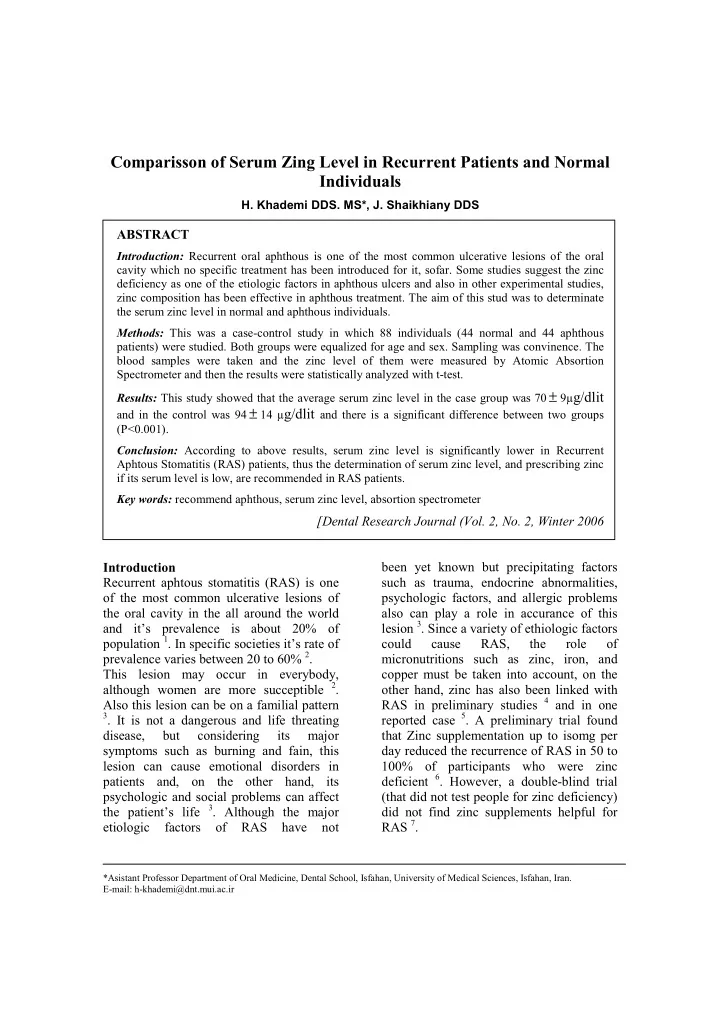
Comparisson of Serum Zing Level in Recurrent Patients and Normal Individuals H. Khademi DDS. MS*, J. Shaikhiany DDS ABSTRACT Introduction: Recurrent oral aphthous is one of the most common ulcerative lesions of the oral cavity which no specific


slide-1
SLIDE 1

Comparisson of Serum Zing Level in Recurrent Patients and Normal Individuals

  • H. Khademi DDS. MS*, J. Shaikhiany DDS

ABSTRACT

Introduction: Recurrent oral aphthous is one of the most common ulcerative lesions of the oral cavity which no specific treatment has been introduced for it, sofar. Some studies suggest the zinc deficiency as one of the etiologic factors in aphthous ulcers and also in other experimental studies, zinc composition has been effective in aphthous treatment. The aim of this stud was to determinate the serum zinc level in normal and aphthous individuals. Methods: This was a case-control study in which 88 individuals (44 normal and 44 aphthous patients) were studied. Both groups were equalized for age and sex. Sampling was convinence. The blood samples were taken and the zinc level of them were measured by Atomic Absortion Spectrometer and then the results were statistically analyzed with t-test. Results: This study showed that the average serum zinc level in the case group was 70 ± 9µg/dlit and in the control was 94 ± 14 µg/dlit and there is a significant difference between two groups (P<0.001). Conclusion: According to above results, serum zinc level is significantly lower in Recurrent Aphtous Stomatitis (RAS) patients, thus the determination of serum zinc level, and prescribing zinc if its serum level is low, are recommended in RAS patients. Key words: recommend aphthous, serum zinc level, absortion spectrometer

[Dental Research Journal (Vol. 2, No. 2, Winter 2006 Introduction Recurrent aphtous stomatitis (RAS) is one

  • f the most common ulcerative lesions of

the oral cavity in the all around the world and it’s prevalence is about 20% of population 1. In specific societies it’s rate of prevalence varies between 20 to 60% 2. This lesion may occur in everybody, although women are more succeptible 2. Also this lesion can be on a familial pattern

  • 3. It is not a dangerous and life threating

disease, but considering its major symptoms such as burning and fain, this lesion can cause emotional disorders in patients and, on the other hand, its psychologic and social problems can affect the patient’s life 3. Although the major etiologic factors

  • f

RAS have not been yet known but precipitating factors such as trauma, endocrine abnormalities, psychologic factors, and allergic problems also can play a role in accurance of this lesion 3. Since a variety of ethiologic factors could cause RAS, the role

  • f

micronutritions such as zinc, iron, and copper must be taken into account, on the

  • ther hand, zinc has also been linked with

RAS in preliminary studies 4 and in one reported case 5. A preliminary trial found that Zinc supplementation up to isomg per day reduced the recurrence of RAS in 50 to 100% of participants who were zinc deficient 6. However, a double-blind trial (that did not test people for zinc deficiency) did not find zinc supplements helpful for RAS 7.

*Asistant Professor Department of Oral Medicine, Dental School, Isfahan, University of Medical Sciences, Isfahan, Iran. E-mail: h-khademi@dnt.mui.ac.ir

slide-2
SLIDE 2

2 Comparisson of Serum Zing …

Since, according to the investigations, the zinc deficiency of soil, and as a result, of the agricultural products are endemic in Iran, so the aim of this research was to study the relationship between zinc level and the occurrence of RAS 8. Subjects and Methods This study was a case-control study. Case group was consisted of those affected with RAS and control group was selected from healthy people. In this study, sample group included all of the patients which had the inclusion criteria for the study and were referred to the dental clinics and oral medicine department of school of dentistry of Isfahan and the sampling method was convenience. According to recent investigations and the results in this field, the sample size was 44 in each group. After clinical examination of individuals and determining the presence of RAS in their oral cavity, and taking consent form, 5 cc of their venous blood were taken and transferred to the laboratory tubes, containing of nitrate free EDTA. Control group were selected from the patients who were referred to clinincs and did not have a history of RAS. Serum zinc level of control group blood samples were taken at the same day as of the case group. All of the blood samples were measured by the same person and by means of Atomic Absorption spectrometer. It should be mentioned that the most of the cases had referred in the 3rd or 5th days of their RAS disease period (Mean 4th). Necessary information including age, sex, place, back ground, and duration of ulcers were collected in questionnaires and then the results were statistically analyzed by student t-test. Atomic Absorption Spectrometer Blood samples were collected into 1% EDTA tubes and plasma zinc level was measured established atomic absorption method as, previously described. Briefly, plasma samples were mixed with nitric acid and hydrogen peroxide and Zinc concentration was determined using a varian AA220 spectrometer equaled with GTA-110 graphite oven. 20 micro liters of each sample was injected and absorbance signal was measured. The concentration of zinc in each samples was determined by comparison of its absorbance signal with of the standard solutions with known zinc concentrations. Results The results showed that about 79.55% of cases had minor and 13.64% had major aphtous ulcers, and 6.81% of them had herpetiform ulcers (table 1). The average number of ulcers in total patients was 10±2 (mean ± sd) and the most number of ulcers were herpetiform and minor ones (table 2). The average duration of involvement was 6.4± 2.3 years, totally, that this average was 5.7±1.4 in men and 6.9± 0.9 in

  • women. Also, the long duration of

involvements of RAS were 14 years in women and 17 years in men The average recurrency duration of lesions was 1.5± 0.2 months (male: 2.1±0.1; female: 1.3±0.3). Serum zinc level measured by Atomic Absorption Spectromotor showed that the average of serum zinc level in the case group was 70 ± 9µg/dilt and in the control group was 94± 14 µg/dlit. Based on gender frequency, 71.42% of men 73.33% of women had low zinc levels and there was not any significant difference between these two groups (table 3). Comparing with normal serum zinc level (70± 15µg/dlit), 32 cases had lower serum zinc levels than normal and there was a statistically significant difference between RAS patients and healthy individuals, based

  • n X2 test (p<0.05).
slide-3
SLIDE 3

3 Comparisson of Serum Zing … Table 1: Frequency of classification of RAS, based on gender Ulcer Sex Minor Major N(percent) Herptiform N(Percent( Total N(percent) Male 10 (71.4) 1 (7.1) 3(21.4) 14 (31.8) Female 25 (83.3) 5 (16.7) 0(0) 30(68.2) Total 35 (79.6) 6(13.7) 3(6.8) 44(100) Table 2: Frequency of number of ulcers, based on sex Ulcer age Sex <5 N(percent) 5-10 N(percent) 10-15 N(percent) 15-20 N(percent) 20-25 N(percent) 25< N(percent) Total N(percent) Male 4(28.6) 10(71.4) 0(0) 0(0) 0(0) 0(0) 14.31.8) Female 3(10) 18(60) 6(20) 1(3.3) 2(6.7) 0(0) 30(68.2) Total 7(15.9) 28(63.6) 6(13.6) 1(2.7) 2(4.55) 0(0) 44(100) Table 3: Zinc deficiency, based on sex in case group Zinc level Sex Deficent N(percent) Normal N(percent) Total N(percent) Male 10(71.4) 4(28.6) 14(31.9) Female 22(73.3) 8(26.6) 30(68.1) Total 32(72.7) 12(27.3) 44(100)

Discussion and Conclusion Using t-test, there is a significant difference between the averages of serum zinc levels

  • f two groups. Despite the fact there have

been studies concerning serum zinc level in RAS patients 10, 11. Based on X2 test, this study showed that there is a significant difference between the number

  • f

RAS patients with zinc deficiency compared with normal group (p> 0.05). About 72.7% of RAS patients and 15.9% of healthy individuals had low zinc levels based on the definition of zinc deficiency which means there serum zinc level lower than 70 µ g/dlit. Also this study showed that there is not a gender predilection in zinc deficiency. Considering the studies indicating that zinc deficiency and soil poverty of zinc is endemic in Iran, 8,9 zinc deficiency should be taken in to account in patients affected with RAS and even zinc therapy have been proved and recommended in some studies

10, 11.

Other results showed that 2/3 of patients were women and the lesions were mostly seen in the 3rd decades of life in both sexes. Finally, although the role of zinc deficiency has been proved in RAS patients but other micronutritional deficiencies such as iron, vitamine B12, folic acid, and selenium should be considered. Acknowledgment We would like to appreciate the financial support of vice chancellor for research of Isfahan University of Medical Sciences and Health Services.

slide-4
SLIDE 4

4 Comparisson of Serum Zing …

References

  • 1. Bricker ST, Robert P langlis. Intraoral

finding by surface change. In: Steven L

  • Bricker. Craig S Miller. Oral Diagnosis:

Philadelphia, 1998: 719-721.

  • 2. Martin S Greenberg. Ulcerative vascular

and Bullous lesion. In: Malcol MA, lynch Martin S Greenberg. Burkets

  • ral

medicine: JB Lipponcott: WB saunders, 1998: 410-430.

  • 3. Shafer WG. A text book of oral pathol.

Philadelphia: WB saunders, 1998: 410- 430.

  • 4. Pang JF. Relation between treatment with

traditional Chinese medicine for recurrent aphtous ulcer and human zinc and copper. Zhongguo Zhong Xi Yi Jie He Za Zhi 1992; 12: 280-2, 260-1 [in Chinese].

  • 5. Endre L. Recurrent aphthous ulceration with

zinc deficiency and cellular immune

  • deficiency. Oral surg Oral Med Oral Pathol

1991; 72:559-61.

  • 6. Merchant HW, Gangarosa LP, Glassman

AB, Sobel RE. Zinc sulfate supplementian for treatme of recurring oral ulcers. South Med J 1977; 70: 559-61.

  • 7. Wray D.A double-blind trial of systemic zinc

sulfate in recurrent aphthous stomatitis. Oral Surg Oral Med Oral Pathol 1982; 53: 469-72.

  • 8. Malakuti. MJ Persistant agriculture and

Increased function with the best fertilizer usage in Iran, Karaj, agricultural publication 1997, 300-304.

  • 9. Haghnia P.Soil ackrowlegent, Mashhad

university publications 2002: 150-154.

  • 10. Orbak R cicek Y, Tezel A, effects of zinc

treatment in patients with recurrent appthous stomatitis Dent Mater J 2003: 22(1): 21-9.

  • 11. Mcbride DR. management of aphthous
  • ulcers. Am fam physician, 2003: 62: 149-

154.

slide-5
SLIDE 5

5 Comparisson of Serum Zing …