Community Co-operative: Ecosystem-based community forestry in - - PowerPoint PPT Presentation

community co operative
SMART_READER_LITE
LIVE PREVIEW

Community Co-operative: Ecosystem-based community forestry in - - PowerPoint PPT Presentation

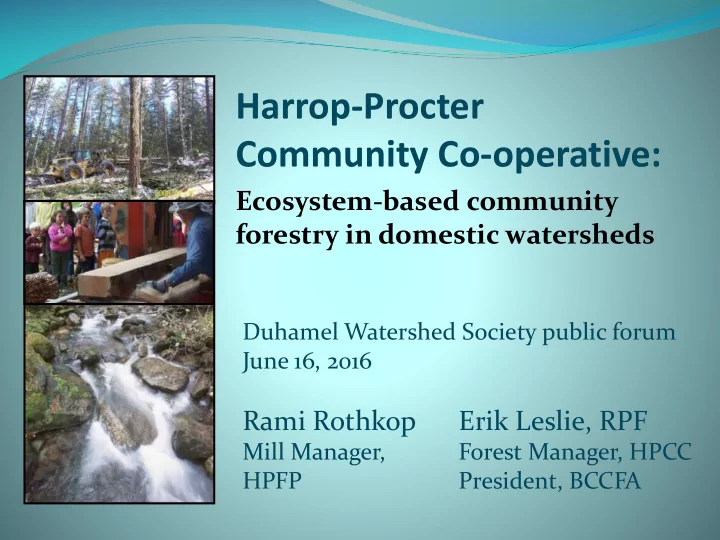
Harrop-Procter Community Co-operative: Ecosystem-based community forestry in domestic watersheds Duhamel Watershed Society public forum June 16, 2016 Rami Rothkop Erik Leslie, RPF Mill Manager, Forest Manager, HPCC HPFP President, BCCFA


slide-1
SLIDE 1

Harrop-Procter Community Co-operative:

Ecosystem-based community forestry in domestic watersheds

Duhamel Watershed Society public forum June 16, 2016

Rami Rothkop Erik Leslie, RPF

Mill Manager, Forest Manager, HPCC HPFP President, BCCFA

slide-2
SLIDE 2
slide-3
SLIDE 3

1980’s and 90’s: The ‘War in the Woods’

slide-4
SLIDE 4
slide-5
SLIDE 5
slide-6
SLIDE 6
slide-7
SLIDE 7

7

slide-8
SLIDE 8

Harrop-Procter Forest Products

slide-9
SLIDE 9
slide-10
SLIDE 10
slide-11
SLIDE 11
slide-12
SLIDE 12

Erik: Outline

  • 1. Management objectives
  • 2. Ecosystem-based forest planning
  • 3. Forestry operations
  • 4. Climate change adaptation

12

slide-13
SLIDE 13
slide-14
SLIDE 14

How the movement started

 Rami

slide-15
SLIDE 15

Ecosystem-based community forestry

 Explicitly manage for

community values

 Internalize the ‘externalities’

 Precautionary approach  Work with natural cycles

slide-16
SLIDE 16

HPCC Management Plan objectives

#1: minimize the impacts of roads and timber

harvesting on hydrology and water quality;

 maintain and enhance forest structural diversity;  improve community wildfire protection;  maintain sustainable timber harvest rates, while

considering ecosystem resilience and climate change projections;

 etc.

slide-17
SLIDE 17
slide-18
SLIDE 18
slide-19
SLIDE 19
slide-20
SLIDE 20

Narrows and Duhamel

Similarities Differences

 Community watersheds  Wildland-urban interface  Similar terrain  Old growth/ biodiversity

values

 Roads/ logging history  North vs. south aspects  Focal wildlife species  Community uses

20

slide-21
SLIDE 21
slide-22
SLIDE 22
slide-23
SLIDE 23
slide-24
SLIDE 24
slide-25
SLIDE 25
slide-26
SLIDE 26
slide-27
SLIDE 27
slide-28
SLIDE 28
slide-29
SLIDE 29

29

slide-30
SLIDE 30

Site-level practices

 Low risk approach to

water—reserves, access

 Wide range of retention  Experimentation

slide-31
SLIDE 31

31

slide-32
SLIDE 32

32

slide-33
SLIDE 33
slide-34
SLIDE 34
slide-35
SLIDE 35
slide-36
SLIDE 36
slide-37
SLIDE 37

37

slide-38
SLIDE 38

38

slide-39
SLIDE 39

Climate change adaptation project

 Analyze risks

 Drought, wildfire,

hydrology

 Specific strategies

 Fuel breaks  Harvest methods  Regeneration methods

 Community discussion  Regional outreach

 CBT funding

Key values: water, biodiversity, infrastructure, timber/ jobs

slide-40
SLIDE 40

40

Significant changes over past 30 years

slide-41
SLIDE 41

Climate models: simplified summary

Over the next 30 to 50 years:

 Fall/ winter/ spring 2 - 5 warmer and 10 - 25%

wetter

 Summers 3 - 7 warmer and up to 30% drier  ~5 to 50 times more average annual area burned  Increased frequency and magnitude of extreme

precipitation events Good enough to get started…

41

slide-42
SLIDE 42
slide-43
SLIDE 43
slide-44
SLIDE 44

Thank you!

www.hpcommunityforest.org

44