Communication Communication links: Machine Learning for Trading - - PowerPoint PPT Presentation

communication
SMART_READER_LITE
LIVE PREVIEW

Communication Communication links: Machine Learning for Trading - - PowerPoint PPT Presentation

Communication Communication links: Machine Learning for Trading http://cobweb.cs.uga.edu/~maria/classes/0-4646- Summer-2018/schedule.html CS 4646 maria.hybinette AT mac.com Course Introduction Piazza Setting up Access to


slide-1
SLIDE 1

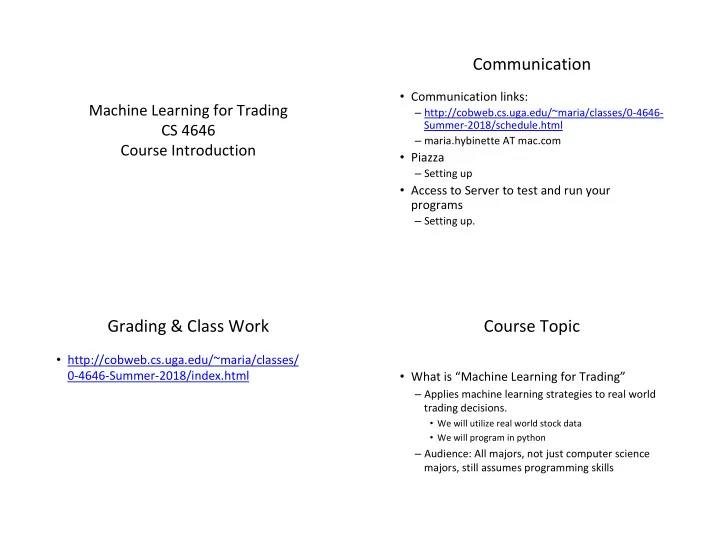
Machine Learning for Trading CS 4646 Course Introduction

Communication

  • Communication links:

– http://cobweb.cs.uga.edu/~maria/classes/0-4646- Summer-2018/schedule.html – maria.hybinette AT mac.com

  • Piazza

– Setting up

  • Access to Server to test and run your

programs

– Setting up.

Grading & Class Work

  • http://cobweb.cs.uga.edu/~maria/classes/

0-4646-Summer-2018/index.html

Course Topic

  • What is “Machine Learning for Trading”

– Applies machine learning strategies to real world trading decisions.

  • We will utilize real world stock data
  • We will program in python

– Audience: All majors, not just computer science majors, still assumes programming skills

slide-2
SLIDE 2

Course Topic

  • How Does it Differ from:

– CS 4641 : Machine Learning?

  • Our (4645) course is an applied course, we will learn

machine learning by programming in python and its modules.

  • Learn by example.

– CS 7646 : On-line version of the class?

  • Graduate version, self-directed course.
  • No class interaction.
  • Similar content.

3 Parts of Course

  • 1. Real World Data: Manipulating Financial Data in Python

– Read historical financial data into python and manipulate it using powerful statistical algorithms

  • 2. Real World Strategies: Computational Investing

– Algorithms, methods and models used by hedge funds and investment banks to manipulate and work with financial data

  • 3. Add Learning to (1) +(2): Learning Algorithms for Trading

– We pull (1) and (2) together:

  • Take what we learned in the first two segments:

– Data manipulation and – Classic investment strategies in the real world and

  • Show how to take that data and use it with learning, machine

learning, like Q learning and random forests to build new trading algorithms Part 2: will have a pre-amble of a machine learning project (decision tree – regression) up front, will will go over it in class how to implement it, and you will translate it into a python program.

Text Books

  • "Python for Finance: Analyze

Big Financial Data", Yves Hilpisch

– Chapters 4,5,6,11

  • "Machine Learning", Tom
  • M. Mitchell

– Chapters 1,3,8,13

  • "What Hedge Funds Really

Do", Philip Romero and Tucker Balch

– Chapters 2, 4, 5, 7, 8, 9, 12

Prerequisites

  • Strong programming skills!

– Main requirement.

  • Some python experience
  • Install python (+ numpy, scipy, pandas,

matplot) framework on laptop that is brought into class every lecture

– Will use for ‘activities’

slide-3
SLIDE 3

Why Python?

  • Quick Prototyping
  • Easy

– to Learn – to Use – to Read – reads like English

  • Document rich
  • Intuitive guess what should work,

and it works.

  • Powerful Libraries or Modules

– 3rd party : Example numPY

Monty Pythons Flying Circus

Who uses Python?

  • United Space Agency - NASA
  • Google: Maps, Gmail, Groups, News
  • YouTube, Reddit, BitTorrent
  • Computational Finance
  • Research: Universities worldwide for a variety
  • f disciplines

Python Primers

  • We will cover the highlights of python related to

computational finance.

– We will provide ‘templates’ on what you need related to topics covered in class.

  • We do assume strong programming skills and motivation.

– If you want dwell deeper:

  • Good resources:

– “Dive into Python”, Mark Pilgrim

  • http://diveintopython.net

– The Official Python Tutorial

  • https://docs.python.org/3/tutorial/

– The Python Quick Reference:

  • http://rgruet.free.fr/#QuickRef

Overview of Libraries Module

(we will learn how to use these by example)

  • NumPy –

– Numerical python, array oriented programming – Provides powerful data structures for efficient (memory) computation (operations) of arrays and multi-dimensional arrays and matrices.

  • SciPy

– Extends NumPy: Adds scientific algorithms:

  • integration, interpolation, minimization, regression, linear algebra, and statistics.
  • Pandas

– Spreadsheets for python – Good for analyzing tabular data (likes spread sheet data) – Structured data operations and manipulations – Data Frame.

  • Matplot lib

– Plotting mostly 2D, some limited 3D plotting is available.