SLIDE 1
1
Communication
Chapter 2
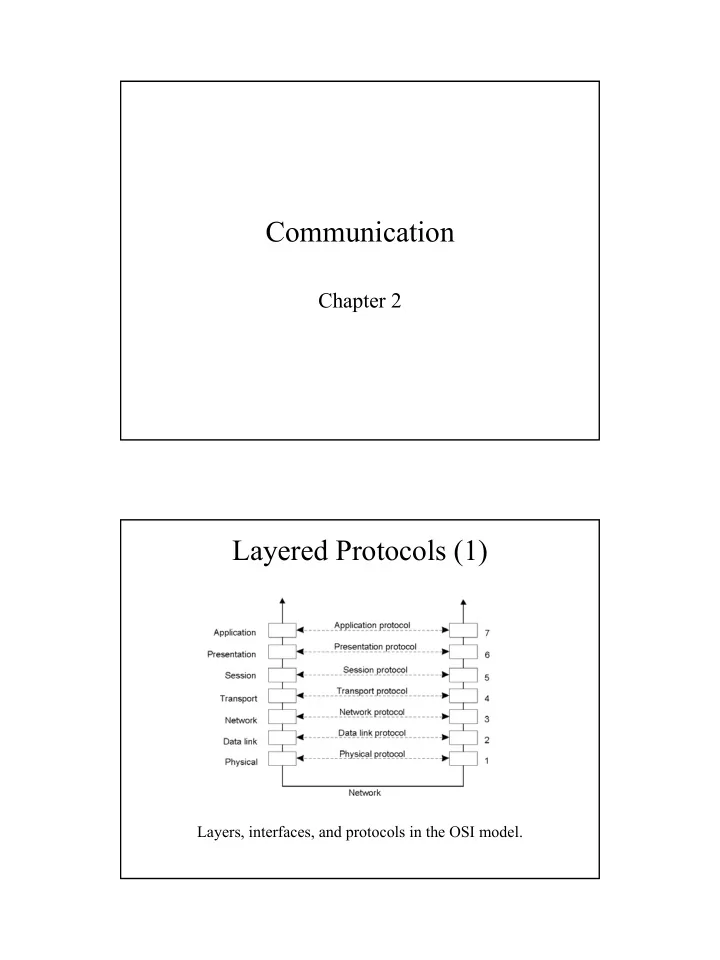
Layered Protocols (1)
Layers, interfaces, and protocols in the OSI model. 2-1
SLIDE 2
2
Layered Protocols (2)
A typical message as it appears on the network. 2-2
Data Link Layer
Discussion between a receiver and a sender in the data link layer. 2-3
SLIDE 3
3
Client-Server TCP
a) Normal operation of TCP. b) Transactional TCP. 2-4
Middleware Protocols
An adapted reference model for networked communication. 2-5
SLIDE 4
4
Conventional Procedure Call
a) Parameter passing in a local procedure call: the stack before the call to read b) The stack while the called procedure is active
Client and Server Stubs
Principle of RPC between a client and server program.
SLIDE 5 5
Steps of a Remote Procedure Call
- 1. Client procedure calls client stub in normal way
- 2. Client stub builds message, calls local OS
- 3. Client's OS sends message to remote OS
- 4. Remote OS gives message to server stub
- 5. Server stub unpacks parameters, calls server
- 6. Server does work, returns result to the stub
- 7. Server stub packs it in message, calls local OS
- 8. Server's OS sends message to client's OS
- 9. Client's OS gives message to client stub
- 10. Stub unpacks result, returns to client
Passing Value Parameters (1)
Steps involved in doing remote computation through RPC 2-8
SLIDE 6
6
Passing Value Parameters (2)
a) Original message on the Pentium b) The message after receipt on the SPARC c) The message after being inverted. The little numbers in boxes indicate the address of each byte
Parameter Specification and Stub Generation
a) A procedure b) The corresponding message.
SLIDE 7
7
Doors
The principle of using doors as IPC mechanism.
Asynchronous RPC (1)
a) The interconnection between client and server in a traditional RPC b) The interaction using asynchronous RPC 2-12
SLIDE 8
8
Asynchronous RPC (2)
A client and server interacting through two asynchronous RPCs 2-13
Writing a Client and a Server
The steps in writing a client and a server in DCE RPC. 2-14
SLIDE 9
9
Binding a Client to a Server
Client-to-server binding in DCE. 2-15
Distributed Objects
Common organization of a remote object with client-side proxy. 2-16
SLIDE 10 10
Binding a Client to an Object
a) An example with implicit binding using only global references b) An example with explicit binding using global and local references
Distr_object* obj_ref; //Declare a systemwide object reference
// Initialize the reference to a distributed object
// Implicitly bind and invoke a method (a) Distr_object obj_ref; //Declare a systemwide object reference Local_object* obj_ptr; //Declare a pointer to local objects
//Initialize the reference to a distributed object
//Explicitly bind and obtain a pointer to the local proxy
- bj_ptr -> do_something();
//Invoke a method on the local proxy (b)
Parameter Passing
The situation when passing an object by reference or by value. 2-18 O1 is serialized (call-by-value) R1 is passed by reference
SLIDE 11
11
The DCE Distributed-Object Model
a) Distributed dynamic objects in DCE. b) Distributed named objects 2-19
Persistence and Synchronicity in Communication (1)
General organization of a communication system in which hosts are connected through a network 2-20
SLIDE 12
12
Persistence and Synchronicity in Communication (2)
Persistent communication of letters back in the days of the Pony Express.
Persistence and Synchronicity in Communication (3)
a) Persistent asynchronous communication b) Persistent synchronous communication 2-22.1
SLIDE 13
13
Persistence and Synchronicity in Communication (4)
c) Transient asynchronous communication d) Receipt-based transient synchronous communication 2-22.2
Persistence and Synchronicity in Communication (5)
e) Delivery-based transient synchronous communication at message delivery f) Response-based transient synchronous communication
SLIDE 14 14
Berkeley Sockets (1)
Socket primitives for TCP/IP.
Release the connection Close Receive some data over the connection Receive Send some data over the connection Send Actively attempt to establish a connection Connect Block caller until a connection request arrives Accept Announce willingness to accept connections Listen Attach a local address to a socket Bind Create a new communication endpoint Socket Meaning Primitive
Berkeley Sockets (2)
Connection-oriented communication pattern using sockets.
SLIDE 15 15
The Message-Passing Interface (MPI)
Some of the most intuitive message-passing primitives of MPI.
Check if there is an incoming message, but do not block MPI_irecv Receive a message; block if there are none MPI_recv Pass reference to outgoing message, and wait until receipt starts MPI_issend Pass reference to outgoing message, and continue MPI_isend Send a message and wait for reply MPI_sendrecv Send a message and wait until receipt starts MPI_ssend Send a message and wait until copied to local or remote buffer MPI_send Append outgoing message to a local send buffer MPI_bsend Meaning Primitive
Message-Queuing Model (1)
Four combinations for loosely-coupled communications using queues. 2-26
SLIDE 16 16
Message-Queuing Model (2)
Basic interface to a queue in a message-queuing system.
Install a handler to be called when a message is put into the specified queue. Notify Check a specified queue for messages, and remove the first. Never block. Poll Block until the specified queue is nonempty, and remove the first message Get Append a message to a specified queue Put Meaning Primitive
General Architecture of a Message-Queuing System (1)
The relationship between queue-level addressing and network-level addressing.
SLIDE 17
17
General Architecture of a Message-Queuing System (2)
The general organization of a message-queuing system with routers. 2-29
Message Brokers
The general organization of a message broker in a message- queuing system. 2-30
SLIDE 18 18
Example: IBM MQSeries
General organization of IBM's MQSeries message-queuing system. 2-31
Channels
Some attributes associated with message channel agents.
Maximum times MCA will try to put received message into queue Delivery retries Specifies maximum number of retries to start up the remote MCA Setup retry count Maximum length of a single message Message length Indicates that messages are to be delivered in the order they are sent FIFO delivery Determines the transport protocol to be used Transport type Description Attribute
SLIDE 19 19
Message Transfer (1)
The general organization of an MQSeries queuing network using routing tables and aliases.
Message Transfer (2)
Primitives available in an IBM MQSeries MQI
Get a message from a (local) queue MQget Put a message into an opened queue MQput Close a queue MQclose Open a (possibly remote) queue MQopen Description Primitive
SLIDE 20
20
Data Stream (1)
Setting up a stream between two processes across a network.
Data Stream (2)
Setting up a stream directly between two devices. 2-35.2
SLIDE 21 21
Data Stream (3)
An example of multicasting a stream to several receivers.
Specifying QoS (1)
A flow specification.
- Loss sensitivity (bytes)
- Loss interval (µsec)
- Burst loss sensitivity (data units)
- Minimum delay noticed (µsec)
- Maximum delay variation (µsec)
- Quality of guarantee
- maximum data unit size (bytes)
- Token bucket rate (bytes/sec)
- Token bucket size (bytes)
- Maximum transmission rate
(bytes/sec) Service Required Characteristics of the Input
SLIDE 22
22
Specifying QoS (2)
The principle of a token bucket algorithm.
Setting Up a Stream
The basic organization of RSVP for resource reservation in a distributed system.
SLIDE 23
23
Synchronization Mechanisms (1)
The principle of explicit synchronization on the level data units.
Synchronization Mechanisms (2)
The principle of synchronization as supported by high-level interfaces. 2-41