Combining semantic and lexical methods for mapping MedDRA to VCM - - PowerPoint PPT Presentation

combining semantic and lexical methods for mapping meddra
SMART_READER_LITE
LIVE PREVIEW

Combining semantic and lexical methods for mapping MedDRA to VCM - - PowerPoint PPT Presentation

MIE 2018 Goteborg Combining semantic and lexical methods for mapping MedDRA to VCM icons Jean-Baptiste Lamy Rosy Tsopra PT 10058039 Cardiac perforation LIMICS Universit Paris 13, Sorbonne Paris Cit, 93017 Bobigny Sorbonne


slide-1
SLIDE 1

1

MIE 2018 – Goteborg

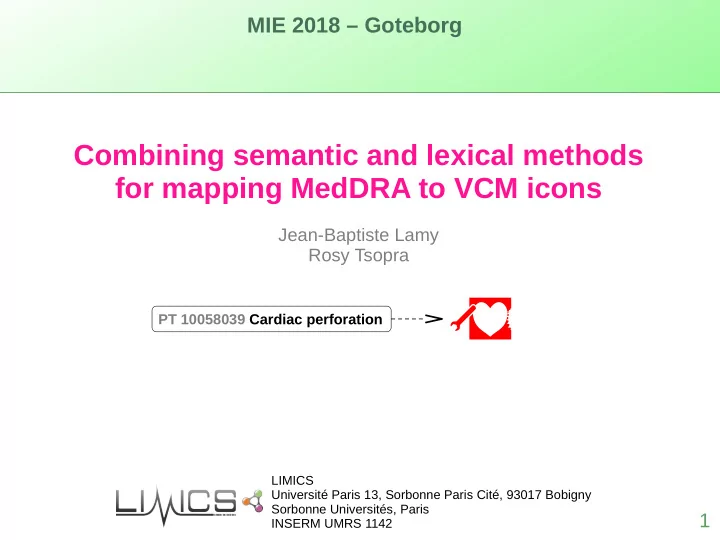
Combining semantic and lexical methods for mapping MedDRA to VCM icons

Jean-Baptiste Lamy Rosy Tsopra

LIMICS Université Paris 13, Sorbonne Paris Cité, 93017 Bobigny Sorbonne Universités, Paris INSERM UMRS 1142

PT 10058039 Cardiac perforation

slide-2
SLIDE 2

2

Introduction

Medical terminologies Essential for semantic interoperability But difficult for Humans! => we developed since 10 years VCM, an iconic language for representing medical concepts Not as precise as terminologies, but can be used for enriching text or illustrating terms Requires mapping between icons and terminologies Semantic methods for terminologies with a formal semantics (e.g. SNOMED CT [MEDINFO]) Other terminologies requires more complex methods Here, we will focus on MedDRA : Used for coding adverse effects Multiaxial classification without formal semantics => lexico-semantic method

slide-3
SLIDE 3

3

VCM

(Visualization of Concept in Medicine)

An iconic langage for medical concepts [BMC] Symptoms Disorders Treatments Exams Adverse effects Combinatorial grammars 150 pictograms 5 colors 30 shapes => thousands of icons A formal semantics (based on an OWL 2.0 ontology) [KBS]

150 28

slide-4
SLIDE 4

4

Lexical methods

Design of an OWL ontology MedDRA terms with codes, labels, parent-child relations Labels are decomposed in words and lemmas

MedDRA concept Word Word expression Lemma Lemma expression VCM concept VCM pictogram

lemmatized form * 1 * * mapped to * * * * * * child of / parent of has for word expression

HLT 10007543 Cardiac disorders NEC Cardiac Cardiac disorders Cardiac disorders NEC disorders disorders NEC NEC Cardiac disorders NEC cardiac cardiac disorder disorder cardiac disorder

MedDRA concept Word exp. Words Lemma Lemma exp.

has for lemma expression Stop words

slide-5
SLIDE 5

5

Lexical methods

OWL ontology Association between lemma expressions and VCM concepts

auricular

Lemma exp.

Ear pictogram

auricular auricular fibril fibril

Lemma exp.

Heart rhythm pictogram

consume coronary

Lemma exp.

Heart pictogram + blood vessel shape

slide-6
SLIDE 6

6

Semantic methods

Based on multiple inheritance through the MedDRA multiaxial classification

PT_10071710 Lenègre disease HLT_10000032 Cardiac conduction disorders

child of

HLGT_10007521 Cardiac arrhythmias

child of

PT_10049633 Shoshin beriberi HLT_10047842 Water soluble vitamin deficiencies HLT_10039164 Right ventricular failures

Child

  • f
slide-7
SLIDE 7

7

Combining both methods

PT 10058039 Cardiac perforation HLT 10007543 Cardiac disorders NEC HLT 10007602 Cardiac and vascular procedural complications

child of child of

VCM concept: Heart VCM concept: Lesion and perforation Lemma: cardiac Lemma: perfor

mapped to mapped to

VCM concepts: Disorder, Heart VCM concepts: Disorder, Heart, Procedural complication, Vascular

slide-8
SLIDE 8

8

Combining both methods

VCM concepts: Disorder, Heart, Procedural complication, Lesion and perforation PT 10058039 Cardiac perforation

slide-9
SLIDE 9

9

Results

User interface For mapping lemma expressions to VCM concepts Python 3 Use OwlReady2 for accessing the OWL ontology [AIM]

slide-10
SLIDE 10

10

OwlReady2

Ontology-oriented programming in Python [AIM]

slide-11
SLIDE 11

11

Results

Application of the methods on the cardiac SOC of MedDRA 634 MedDRA terms (excluding LLT)

212 lemma expressions 123 with 1 lemma 76 with 2 lemmas 13 with more => 212 lemma expressions mapped in lieu of 634 (longer) terms

mapped to 114 different VCM icons

541 to a single icon 85 to 2 icons 8 to 3 icons

Evaluation on 50 randomly-chosen terms A medical expert mapped the terms to VCM, blindly (gold standard)

For 40 terms, the expert chose exactely the same icons For 6 terms, the generated icons were incomplete or more general For 4 terms, the generated icons were discordant E.g. mycoplasma infections classified as fungal infections
slide-12
SLIDE 12

12

Discussion

Four main approaches for mapping medical terminologies : Manual mapping

Long, tedious, and often not reproducible

Chaining existent mapping:

MedDRA → SNOMED CT + SNOMED CT → VCM => MedDRA → VCM But cumules the errors and imprecisions of each mapping

Lexical approach

Difficult with icons Bag of words vs expressions

Semantic approach

Ontology alignment methods Requires terminologies having a formal semantics

slide-13
SLIDE 13

13

Discussion

The proposed method is easier than a manual mapping Lemma expressions are shorter than terms, and less numerous Perspectives Extending the methods with other approaches :

Learning method: try to learn new lexical mapping from the already asserted ones Chaining method (using SNOMED CT as an intermediate terminology) : OntoADR

Application of the methods to the entire MedDRA terminology Integration of VCM icons in pharmacovigilance software Reuse of the lemma expressions - VCM concepts mapping

For mapping with other terminologies, e.g. ICD10 For producing icons from free text

slide-14
SLIDE 14

14

References

[BMC] : Duclos C, Bar-Hen A, Ouvrard P, Venot A. An iconic language for the graphical representation of medical concepts. BMC Medical Informatics and Decision Making 2008;8:16 [MEDINFO] : Lamy JB, Tsopra R, Venot A, Duclos C. A Semi-automatic Semantic Method for Mapping SNOMED CT Concepts to VCM Icons. Stud Health Technol Inform 2013;192:42-6 [KBS] : Lamy JB, Soualmia LF. Formalization of the semantics of iconic languages: An

  • ntology-based method and four semantic-powered applications. Knowledge-Based

System 2017;135:159-179 [AIM] : Lamy JB. Owlready: Ontology-oriented programming in Python with automatic classification and high level constructs for biomedical ontologies. Artif Intell Med 2017;80:11-28

?

?

? ? ? ?