Collective Impact: Lessons Learned for HEAL Funders July 25, 2017 - - PowerPoint PPT Presentation

collective impact lessons learned for heal funders
SMART_READER_LITE
LIVE PREVIEW

Collective Impact: Lessons Learned for HEAL Funders July 25, 2017 - - PowerPoint PPT Presentation

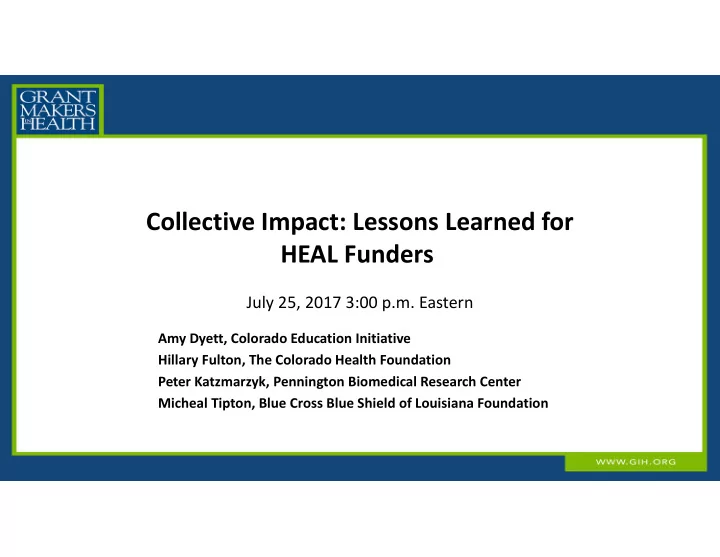
Collective Impact: Lessons Learned for HEAL Funders July 25, 2017 3:00 p.m. Eastern Amy Dyett, Colorado Education Initiative Hillary Fulton, The Colorado Health Foundation Peter Katzmarzyk, Pennington Biomedical Research Center Micheal Tipton, Blue


slide-1
SLIDE 1

Collective Impact: Lessons Learned for HEAL Funders

July 25, 2017 3:00 p.m. Eastern

Amy Dyett, Colorado Education Initiative Hillary Fulton, The Colorado Health Foundation Peter Katzmarzyk, Pennington Biomedical Research Center Micheal Tipton, Blue Cross Blue Shield of Louisiana Foundation

slide-2
SLIDE 2

Challenge for a Healthier Louisiana:

Tackling Obesity through Collective Impact Grant Making and What We Learned Along the Way

LESSONS LEARNED—

slide-3
SLIDE 3

Speakers:

Michael Tipton President, Blue Cross and Blue Shield of Louisiana Foundation michael.tipton@bcbsla.com Peter T. Katzmarzyk, PhD, FACSM, FAHA Associate Executive Director for Population and Public Health Sciences Pennington Biomedical Research Center, Louisiana State University Peter.katzmarzyk@pbrc.edu

slide-4
SLIDE 4

4th

Childhood Obesity

8th

Fastest Growing Obesity Rates

5th

Adult Obesity

Louisiana is tied with West Virginia for 8th fastest growing obesity rate since 1995.

Ranked 8th in Rising Obesity Rates

In Louisiana, 31.2% of adults are obese, compared to 22% nationwide.

Ranked 5th in Adult Obesity

In Louisiana, 20.7% of children are obese, compared to 16.4% nationwide.

Ranked 4th in Childhood Obesity

Louisiana’s Declining Health

slide-5
SLIDE 5

DIABETES

Current adult diabetes rate, with a total of 398,422 cases

13%

HYPERTENSION

Current adult hypertension rate, with a total of 822,898 cases

40% +

______________________

Annual spend on obesity-related healthcare costs

$1.4 BILLION

The Cost of Obesity

slide-6
SLIDE 6

Recognized leader statewide for childhood obesity prevention Internationally-recognized research center at the forefront of understanding the causes of obesity and associated chronic diseases Proven expertise in developing comprehensive, evidence-based prevention programs

slide-7
SLIDE 7

What is collective impact?

The commitment of a group of actors from different sectors to a common agenda for solving a specific social problem using a structured form of collaboration.

We needed innovative projects that addressed the root causes of obesity through integrated changes in policies, norms, practices, social supports and the physical environment.

Collective Impact

slide-8
SLIDE 8

Target Specific Needs

Successful projects would need to address specific needs and settings in local communities.

Multiple Collaborators

Successful projects would need partnerships across public health, business and nonprofit sectors.

Comprehensive Evaluation

Overall, we should build thoughtful evaluation into our efforts to provide scientific validation and lessons to build from in future granting.

Focused, Multi-Channel Efforts

Successful projects would need to incorporate a variety of obesity prevention efforts across multiple levels.

Elements of Success

Collective Impact

slide-9
SLIDE 9

Promoting/marketing healthy lifestyles, fitness and nutrition Parental involvement in childhood obesity prevention Direct support of adequate and healthy nutrition Providing safe access to facilities and play spaces

Potential Project Components

Physical activity, exercise classes, in-school activities

slide-10
SLIDE 10

Application Process

September 2011

  • RFP issued
  • Informational workshops

January 2012

  • Non-competitive letters of intent (112 received – all received feedback)

January – April 2012

  • Technical assistance workshops

April 2012

  • Final applications due (49 received)

May 2012

  • Expert evaluation, recommendations made to Foundation board, awards approved
slide-11
SLIDE 11

Statewide Investment

Overall:

  • 112 organizations submitted letters of intent
  • 49 submitted full organizations
  • 12 projects were awarded totally nearly $30 million in

collective impact, healthy living initiatives across Louisiana

Project Activities:

  • Develop policy councils
  • Renovate parks
  • Build gardens, farmers markets and incentive programs
  • Implement educational programming
  • Other initiatives
slide-12
SLIDE 12

v Highlights:

Park Infrastructure Revitalization

  • Improvements to 6 neighborhood parks

Physical Activity Programming

  • Classes included: dance, hula hooping, boot camp, Zumba, kickboxing,

yoga, & creative walking

  • Attracted approximately 7,050 community participants

Farmers Market Fruit/Vegetable Prescription Program (FMRx)

  • RX distribution by health care providers at community clinics, to 862

recipients

  • 76% were redeemed, primarily at local farmers markets, with some

transactions through Whole Foods

Community Engagement

  • 3 major community input events (~300 participants) to collect residents’

ideas for park programming, concessions, general improvements

  • 6 Family Fests (over 3,000 participants) to bring neighborhood
  • rganizations and families together to promote the Fit NOLA parks and

activities

FitNOLA

New Orleans

slide-13
SLIDE 13

v Highlights:

Increased Access to Fresh Food

  • Equipped 3 existing farmers markets to accept electronic payments and
  • ffer incentive programs for youth and EBT/SNAP clients
  • Helped start 2 new farmers markets that are now operated by non-

grantee leadership

  • Connected 10 restaurants with local farmers

Farmer Coaching & Training

  • Provided a total of 469 hours of business coaching to 15 existing farmers
  • Held 19 beginning farmer workshops

Region-wide Advocacy & Policy

  • Developed a local food brand called Fresh Central: Grown in the Heart of

Central Louisiana

  • Convened 73 Eat Local (local food coalition) meetings across 9 parishes
  • Convened a regional food policy council, which met 26 times
  • Hosted 3 annual – plus 1 special edition – Foodapalooza events

Central Louisiana Local Foods Initiative

slide-14
SLIDE 14

v Highlights:

Trail Construction

  • 2 miles of Ward Creek multi-use trail segment (including landscaping,

water fountains, QT Fit/smart phone fitness system, and parking access)

  • Initiation of the Perkins Road multi-use trail segment

Mobile Recreation Program

  • 2 “BREC on the Geaux” mobile recreation units (14-foot box trucks), fully

equipped and staffed

Parish-wide mobile recreation programming

  • School recess programs targeting pre-K to 5th grade; 10 schools/week;

up to 900 children/day;

  • After school & holiday programs – routes target low-income housing

complexes and neighborhood parks; the program has reached over 9,750 residents to date;

  • Integration of activities into community events;
  • Available for private functions (revenue generating)

Capital Area Pathways and Mobile Playground

Baton Rouge

slide-15
SLIDE 15

v Highlights:

Eat Healthy Southwest Louisiana Restaurant Initiative

  • 17 restaurants and cafeterias partnered with registered dieticians to

identify healthy menu items

Infrastructure Improvements

  • Over 13,000 linear feet of sidewalks to provide connectivity to parks,

schools, and shopping

Calcasieu Parish School System (CPSS) Wellness Programs

  • 70 “Wellness Warrior” teachers lead peers to participate in the CPSS

wellness initiative; 636 teachers participated (86% of those eligible)

  • 13,902 students participated in physical activity breaks, spending a total
  • f 14 minutes a day in in-class exercise

KISS (Keep it Simple Sister) Exercise & Healthy Eating Program

  • Total of six 12-week sessions held in six communities
  • 190 participants completed the program
  • Participants lost a total of 2,060 inches and 2,201 pounds

Dare to Be Healthy

Lake Charles

slide-16
SLIDE 16
  • Pre-Application Planning: refine program goals, criteria, timeline

and requirements to reflect the goals of BCBSLA

  • Application Process: conduct regional workshops to attract

potential applicants; identify key partners and broker collaborations; identify and recruit expert grant review panel to make recommendations to BCBSLA

  • Administration of Grants: serve as resource to grantees and

exchange relevant information through quarterly grantee meetings; ensure grantees are meeting goals, benchmarks and timelines; troubleshoot as needed

Pennington’s Role

slide-17
SLIDE 17
  • Evaluation of Each Grantee Program: develop evaluation plan for

each project, identifying and measuring key metrics; monitor attainment of milestones and pre-defined deliverables

  • Evaluation of Overall BCBSLA Challenge for a Healthier

Louisiana: develop a set of common outcomes measures and collect for each project to ensure comparative effectiveness across interventions can be assessed; track proximal and distal outcomes associated with each project; produce a final report on the overall impact of the program

Pennington’s Role

slide-18
SLIDE 18

Big Results!

  • f fresh produce

distributed

577,464

POUNDS

107

COMMUNITY GARDENS

built or improved

78

FARMERS MARKETS

new or improved

8

INCENTIVE PROGRAMS

to increase farmer’s markets purchases healthy food grown & purchased

slide-19
SLIDE 19

34

TRAILS

new/improved sidewalk, trail, crosswalk segments

25

MILES

new walking/biking paths

49

PARKS

parks, schools, recreation facilities improved

2.5x

LIKELY

participants are 2.5x more likely to keep up healthy behavior

Big Results!

slide-20
SLIDE 20

Five Lessons Learned

Project leadership = success.

Smart, adaptive leadership at a project/grantee level is more important than a perfectly structured project plan or a beautifully written grant application. Look for projects with strong leaders and lots of community buy-in.

Outsource evaluation, insource project management.

Keep evaluation partners focused on their tasks. Outsourcing so much of our program management to Pennington left them constantly moving, but limited our ability to be in direct contact with grantees.

Keep it manageable, stick to core programming.

Collective impact grantees will be ambitious, and some will want to take a kitchen sink approach. Too many moving parts can overwhelm and cannibalize a project quickly.

#1 #2 #3

slide-21
SLIDE 21

Five Lessons Learned

Be hands-on at every phase.

Collective impact projects will morph and change over the course of three years. As a funder, you will want to be on the ground with your grantees, understanding their challenges in real-time and helping them formulate strategies to adapt to challenges that arise.

Set ongoing, short-term benchmarks for grantees.

Grantees with less infrastructure/capacity will fall into a pattern of lapses and jumpstarts without structured benchmarks along the way. Be flexible with your grantees, but make sure there are performance standards and goals in the short-, medium- and long-terms.

#4 #5

slide-22
SLIDE 22

Most Importantly:

Small change is a big win.

Don’t expect huge change overnight. Even moving the needle slightly in the right direction is positive. Other collective impact projects around the nation have shown that this is hard work! You will see big outcomes – the analysis data may be small by comparison – but remember that you are inspiring a change in a long-entrenched trend. Moving in the other direction is victory!

slide-23
SLIDE 23

Michael Tipton Blue Cross and Blue Shield of Louisiana Foundation michael.tipton@bcbsla.com Peter Katzmarzyk Pennington Biomedical Research Center peter.katzmarzyk@pbrc.edu

slide-24
SLIDE 24

Healthy Schools Collective Impact

Subtitle here

Date or footer to go here 24

Grantmakers in Health Webinar July 25, 2017

Colorado Health Foundation

slide-25
SLIDE 25

25

25

The Colorado Health Foundation Mission: To Improve the Health of Coloradans

We are singularly focused on helping Coloradans live their healthiest lives by advancing opportunities to pursue good health and achieve health equity. Through grantmaking, policy and advocacy, strategic private investments and convening – we seek to drive lasting change.

slide-26
SLIDE 26

Colorado Education Initiative

Vision Every student in Colorado is prepared and unafraid to succeed in school, work, and life, and ready to take on the challenges of today, tomorrow, and beyond. Mission The Colorado Education Initiative unlocks the unique potential of every student in Colorado by incubating innovation, shining a spotlight on success and investing in sustainable change that improves outcomes for students.

slide-27
SLIDE 27
  • Significant investment over several

years

  • Growing interest among stakeholders to

leverage resources

  • Need among schools to streamline

resources and engagement requests

  • Will to work together differently
  • Foundation leadership interest in

Collective Impact

Date or footer to go here 27

Healthy Schools Collective Impact: History

slide-28
SLIDE 28

28 28 Colorado Health Foundation 28 9

  • Healthy Schools Collective Impact (HSCI) is:
  • Statewide
  • Cross-sector
  • Working towards systems transformation
  • HSCI Bold Goal:
  • By 2025, all Colorado K-12 public schools provide an environment and culture that integrates

health and wellness equitably for students and staff.

  • HSCI Vision:
  • All Colorado youth are healthy and reach their full potential.

Healthy Schools Collective Impact: The Work

slide-29
SLIDE 29

Increase access to locally appropriate, differentiated, youth friendly and equitable:

  • Student health services
  • Comprehensive PA programs
  • Health education
  • Supportive nutrition

environments and healthy food and beverages

  • Approaches that address

student behavioral health needs

  • Cultures and climates in

schools are supportive of student and staff health and wellness

Systemic Transformations

Healthy Schools Collective Impact: Roadmap

Strategies – See SAP Outcomes Goal & Vision

All outcomes should:

  • Address equity
  • Be informed by and accountable to local/on‐the‐ground perspectives
  • Consider student health services, comprehensive physical activity, nutrition, behavioral health and school cultures and climates
  • Consider the whole child
  • Prevent and prepare for shocks to the system
  • Balance bold/innovative long‐term strategies with actionable short‐term strategies
  • Be informed by data and best practices

By 2025, all Colorado K‐12 public schools provide an environment and culture that integrates health and wellness equitably for students and staff.

All Colorado youth are healthy and reach their full potential.

Public Will

So that…

Students, parents, families, educators, administrators, community members, and public officials have a voice, value and actively support health and wellness in schools

Policy

Federal, state & local policies and public official engagement are in place to prioritize, support, resource and implement health and wellness in schools

Staff

Schools & districts have qualified, motivated, and supported staff to ensure health and wellness is a priority and effectively implemented

Climate

Districts, state agencies & other funders effectively collaborate to ensure health and wellness is a priority in schools and is sufficiently resourced

Collaboration

School, community and state level partners consistently collaborate to ensure an efficient and effective system for healthy schools

Data

Data system is connected to people to be used to inform decisions and actions to ensure high impact results

slide-30
SLIDE 30

Steering Committee

To set the strategic direction and annual SAP of HSCI with

  • ngoing input &

collaboration from WG Reps & SGs; to intermittently reassess progress and challenges in achieving these goals

Steering Committee

To set the strategic direction and annual SAP of HSCI with

  • ngoing input &

collaboration from WG Reps & SGs; to intermittently reassess progress and challenges in achieving these goals

Equity Sprint Group

Engage and include the populations that are marginalized and those that will be most impacted by the changes HSCI is undertaking &

  • perationalize HSCI’s

definition of health equity

Equity Sprint Group

Engage and include the populations that are marginalized and those that will be most impacted by the changes HSCI is undertaking &

  • perationalize HSCI’s

definition of health equity

Backbone: Spark Policy Institute. Act as a neutral entity to coordinate and support the initiative. Backbone: Spark Policy Institute. Act as a neutral entity to coordinate and support the initiative. Evaluation: Harder & Company and Spark Policy Institute. The evaluation aims to provide useful and actionable information that can support TCHF and their grantees in transforming the school health system statewide and locally. Evaluation: Harder & Company and Spark Policy Institute. The evaluation aims to provide useful and actionable information that can support TCHF and their grantees in transforming the school health system statewide and locally.

Communications, Marketing & Engagement We believe that strategic communications are essential to the success of a sustainable, systems-wide strategy for those doing healthy schools work. We look for solutions that align tools, resources, and messages in order to support the shared vision of youth reaching their full potential. Professional Development

Strengthen the capacity of schools and communities to build an environment and culture that integrates health and wellness equitably for all students by developing, implementing, and evaluating (sustaining) a comprehensive professional development system, based on the WSCC model, that includes high-quality PD, best practices and ongoing technical assistance.

Policy

Organizations representing various content expertise and capacity to lobby/advocate to identify policy opportunities to inform and further school health best practices.

Data Systems, Research & Evaluation

Elevate evidence-based and promising practices promoting comprehensive health and wellness in schools by aligning data systems, as well as conducting and translating high quality research and evaluation.

Funders Table

Coordinating, aligning and providing funding and resources to support health and wellness in schools.

Healthy Schools Network

All stakeholders and partners interested in school health and wellness that want periodic updates on HSCI

Healthy Schools Network

All stakeholders and partners interested in school health and wellness that want periodic updates on HSCI

Work Group Rep Council

To collaborate and communicate between work groups and the steering committee to align efforts in support of strengthening the HSCI system.

WORK GROUPS

HEALTHY SCHOOLS COLLECTIVE IMPACT: STRUCTURE

Other Groups: While these groups are not currently in existence, they have been/are deemed important and may need to be established: Communications & Marketing sprint group, Local advisory group, Evaluation advisory group, Policy work group.
slide-31
SLIDE 31

31 31 Colorado Health Foundation 31 9

  • HSCI purpose
  • HSCI structure
  • HSCI membership
  • Team norms and partnership principles

Healthy Schools Collective Impact: The Successes

slide-32
SLIDE 32

32 32 Colorado Health Foundation 32 9

  • Theory of change
  • Co-created
  • Prioritizes strategies
  • Drives funding
  • Shared measurement systems

Healthy Schools Collective Impact: The Successes

slide-33
SLIDE 33

33 33 Colorado Health Foundation 33 9

  • Continue to establish a high-functioning team
  • Align roadmap strategies with milestones/missions
  • Create a baseline of resources
  • Build more transparent communication channels
  • Engage the voice from the field

Healthy Schools Collective Impact: Next Steps

slide-34
SLIDE 34
  • Old way:
  • Responsive grants, including re-granting to districts
  • Targeted funding opportunities designed by the Foundation

Date or footer to go here 34

Transitions in Funding Approach

slide-35
SLIDE 35
  • New way:
  • Funding priorities identified by steering committee and stakeholder work groups
  • Systems-level grants
  • Series of three facilitated meetings to prioritize
  • Community reviewers to share insights and questions
  • Local-level planning and implementation grants
  • Non-competitive
  • Funding level based on need and population size

Date or footer to go here 35

Transitions in Funding Approach

slide-36
SLIDE 36
  • Funder led / sense of urgency and identity
  • HEAL as starting point, though supportive of broader effort
  • Collective Impact is only one way to collaborate
  • Power dynamics
  • Neutral backbone
  • Evaluation is long term

Date or footer to go here 36

Lessons Learned: Colorado Health Foundation

slide-37
SLIDE 37
  • Open and clear communication
  • Team dynamics
  • Addressing elephant(s) in the room:
  • Difficult conversations
  • Competition for funding
  • Data drives decisions
  • Role clarity and decision making protocols

Date or footer to go here 37

Lessons Learned: Grantee Perspective

slide-38
SLIDE 38
  • Identify system-levers first and then allow organizations to apply
  • Balancing tangible activities with systems change mindset
  • Lay of the land, don’t recreate the wheel
  • Balancing funded and non-funded partners/work

Date or footer to go here 38

Lessons Learned: Grantee Perspective continued

slide-39
SLIDE 39

39 39 Colorado Health Foundation 39 9

  • Requires courage, discipline, persistence, and emotional energy
  • Gives people a sense of connection and belonging
  • Potential for significant impact

“When people come together and set aside their individual needs for the good of the whole, they can accomplish what might have looked impossible on paper.” ~Patrick Lencioni

Lessons Learned: Grantee Perspective

slide-40
SLIDE 40

40 40

Senior Program Officer The Colorado Health Foundation 303-953-3626 hfulton@coloradohealth.org

1780 Pennsylvania St, Denver, CO 80203 • p 303-953-3600 • p 877-225-0839 • f 303-322-4576 • coloradohealth.org

Hillary Fulton Amy Dyett

Director, Initiatives, Health and Wellness The Colorado Education Initiative 303-736-6477 ext. 216 adyett@coloradoedinitiative.org

slide-41
SLIDE 41
  • More webinars on this topic?
  • New topics you want to tackle or learn more about?
  • Innovative work that you want to share?
  • A question you want to pose to your colleagues?

Contact us at heal@gih.org