
SLIDE 1
Kristi Richard Melancon Mississippi College
Coding the Black Press: Integrating black newspapers as primary sources in the classroom
Coding the Black Press: Integrating black newspapers as primary - - PowerPoint PPT Presentation
Coding the Black Press: Integrating black newspapers as primary sources in the classroom Kristi Richard Melancon Mississippi College Theoretical Framework: Why study periodicals? P eriodical StudiesMargaret Beetham, A Magazine of Her Own?
Kristi Richard Melancon Mississippi College
Coding the Black Press: Integrating black newspapers as primary sources in the classroom
Periodical Studies…Margaret Beetham, A Magazine of Her Own? Domesticity and Desire in the Woman’s Magazine, 1800-1914
Accessibility & Affordability Portability Multi-vocal Multi-Genre Dynamic In her work on early women’s magazines, Beetham observes, “the periodical is above all an ephemeral form, produced for a particular day, week or month. Its claims to truth and importance are always contingent, as is clear from that date which is prominently displayed (sometimes on every page)” (9). She continues to argue that magazines were particularly useful to Victorian women because “those qualities of fluidity and
attractive to the powerless” (Beetham 13-14). “the magazine as ‘text’ interacts with the culture which produced it and which it
April 12, 1861 Beginning of Civil War (attack on Fort Sumter, SC by Confederacy) By this time over 40 black
papers had been established throughout the United States 1863 Douglass’ Monthly-begins appeal for Black men in the north to heed the call to join the Union Army (the best way to win equality-a "double battle" like the Double V campaign) January 1, 1863 Emancipation Proclamation 1864 New Orleans Tribune, first black daily newspaper in the United States, published in French and English 1864-1865 Thomas Morris Chester, first black correspondent for a major daily paper, The Philadelphia Press during Civil War 1865 End of Civil War (Confederate Gen. Robert
Union Gen. Ulysses S. Grant at Appomattox Court House in VA)on April 9 1865-1876 Reconstruction
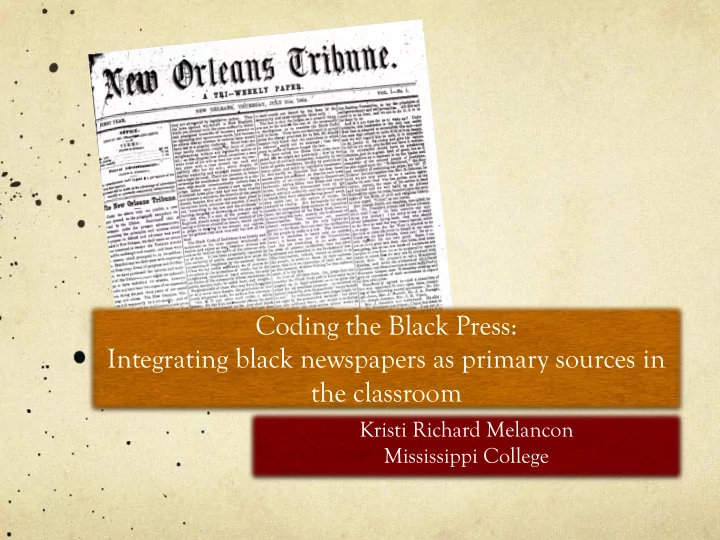
Founded by Paris-educated Creole Dr. Louis Charles Roudanez and his brother on July 21,1864 Edited by free black Paul Trevigne and Belgian-scientist Jean-Charles Houzeau The first black-owned daily newspaper in the US Published in French & English 1867- “Official Organ of the United States Government” Distributed to chief Northern newspapers, Congressmen, and European subscribers Lasted until 1870 “there is not a single colored man who does not feel that the Tribune is the rostrum from which the
be heard by the American nation” (qtd. in Rankin 4)
“Coding is the process
material into chunks or segments of text before bringing meaning to information” (171). (Rossman and Rallis)
Getting Started: choosing Pairs and gathering crayons Start Reading/Coding: creating a list of items and marking them in the issue as you read (20 minutes) Analyzing what you found: answering the 2 questions using the evidence (10 minutes) trends / categories, important how many times, important
did the staff of the Tribune find important to share with their readers and to shape in the larger public sphere?
this discourse community and its mission—their needs, concerns, who they are?
Orange=Education Purple=Gender Yellow=General Political Commentary/ Circulation Facts Green=Philanthropy Pink=Military Blue=Commercial/Advertisements & Market Quotes
Stratified Random Sampling
http://chroniclingamerica.loc.gov/newspapers/?state=ðnicity=African+American
Reconstruction New Orleans & the Black Press
1827- Freedom’s Journal edited by Russwurm and Cornish stated, “Too long have others spoken for us.” 1827-1862- All 31 black newspapers were published in the North. 1843- Free men of color in NO published poems, stories, fables, and articles in L’Album Litteraire. 1845- New Orleanian Armand Lanusse compiled Les Cenelles, the first and only collection
1860- Only 2,000 of the city’s approximately 19,000 free blacks were illiterate, half the percentage nationwide. 1862- Federal troops arrived in New Orleans. 1862- L’Union was published as the first black newspaper in the South. 1864-The New Orleans Tribune was first published. 1864- Louisiana’s state constitution provided for public education of blacks. 1865- The Black Republican was also published in New Orleans. 1868- Louisiana’ state constitution granted state citizenship to all persons who had resided in Louisiana for one year, required all licensed businesses and schools to be integrated, and granted suffrage to all males over the age of 21. 1870- The last edition of the Tribune appeared. 1877- Removal of federal troops from New Orleans. 1879- Schools were resegregated.