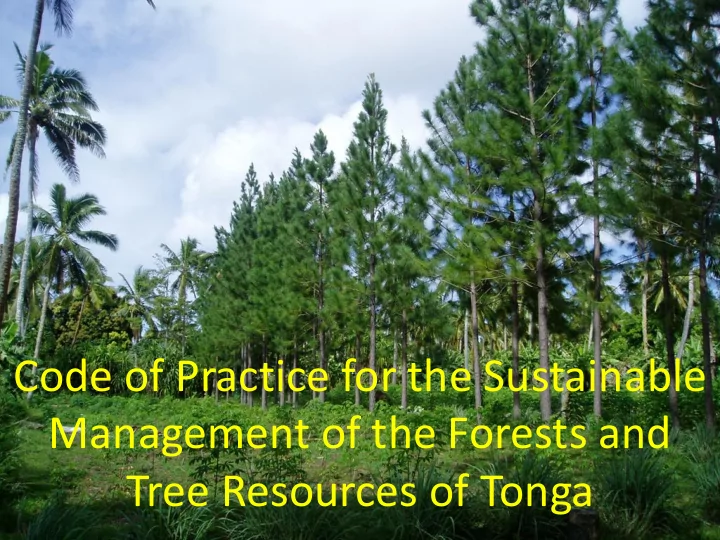
Code of Practice for the Sustainable Management of the Forests and - - PowerPoint PPT Presentation

code of practice for the sustainable
SMART_READER_LITE
LIVE PREVIEW

Code of Practice for the Sustainable Management of the Forests and - - PowerPoint PPT Presentation

Code of Practice for the Sustainable Management of the Forests and Tree Resources of Tonga Code for Eua National Code plantations Why do we need a code of practice? Forests and trees make a significant contribution to the economic,


slide-1
SLIDE 1

Code of Practice for the Sustainable Management of the Forests and Tree Resources of Tonga

slide-2
SLIDE 2

National Code Code for ‘Eua plantations

slide-3
SLIDE 3

Why do we need a code of practice?

  • Forests and trees make a significant contribution to the economic,

environmental and social well-being of all Tongans.

  • Forests and trees enhance the natural beauty of our islands and

provide many benefits, including- – providing shade and shelter for our crops, – protecting our coastline and sensitive areas from erosion, – providing habitat for many species of plants and animals – supplying us with timber, food, medicines and other traditional products for economic, social and cultural use

  • Forests and trees store carbon and have an important role to play in

mitigating the effects of global climate change

  • It is therefore important that they are managed in a sustainable

manner for both current and future generations.

slide-4
SLIDE 4

Contents of the National Code

  • 1. Clearing and harvesting trees
  • 2. Planting and managing trees
  • 3. Construction and maintenance of roads
  • 4. Mining and the removal of sand and other

materials

  • 5. Rubbish
  • 6. Fire protection
  • 7. Safety
slide-5
SLIDE 5
  • 1. Clearing and harvesting trees
slide-6
SLIDE 6

Vegetation in Reserves and Mangrove Forests

  • No trees or vegetation should

be cut or removed in reserves and mangrove forests

  • Trees or vegetation that are

damaged by natural events such as hurricanes may be cut and removed only if authorised by a permit issued by the Forestry Division

  • Any trees removed from

reserves should be replaced by replanting or promoting the natural regeneration of local species.

slide-7
SLIDE 7

Secondary growth of native species in allotments

  • Seek advice from the Forestry

Division on the potential commercial or conservation value

  • f the trees before clearing
  • High value timber species should

be utilised for timber production

  • Where possible, retain individual

trees to maximise their future commercial value

  • Only low value species and

residues should be used for firewood

  • Replant high value species along

boundary rows or under agroforestry systems.

slide-8
SLIDE 8

Coconut timber

  • Check with the

Forestry Division on the marketing

  • pportunities for

your coconut wood

  • Consider replanting

new coconut seedlings after any harvesting of old trees.

slide-9
SLIDE 9

Trees planted in allotments

  • Landholders who wish to cut

trees from allotments should first note the type and size

  • f the species present and

seek advice from the Forestry Division on the potential commercial or conservation value of the trees.

  • After harvesting consider

replanting to provide an

  • ngoing source of trees for

shelter, timber and firewood.

slide-10
SLIDE 10

Sandalwood

Sandalwood has been

  • vercut and it has

little future in Tonga without a process to regulate the cutting

  • f sandalwood and

promote new plantings. The Code proposes a system of regulation to encourage the development of a sustainable valuable resource.

slide-11
SLIDE 11
  • 2. Planting and managing trees
slide-12
SLIDE 12
  • Seek advice from the

Forestry Division on the selection of suitable species

  • Obtain good quality

nursery seedlings

  • Seedlings should be

well watered and planted as soon as possible after receipt from the nursery.

slide-13
SLIDE 13
  • Thin and prune to

produce straight, clear logs

  • Avoid damage to

trees.

slide-14
SLIDE 14
  • 3. Construction and maintenance of roads
  • Avoid roads in

sensitive locations

  • Maintain roads to

prevent erosion.

slide-15
SLIDE 15
  • 4. Mining and the removal of sand
  • Avoid mining in coastal dunes and

mangrove swamps

  • Rehabilitate all mined areas.
slide-16
SLIDE 16
  • 5. Rubbish
  • Rubbish should not be

dumped or burnt in the forest.

  • Spillage during refuelling or

machine maintenance must be avoided by locating maintenance areas on level ground well away from streams and drains.

slide-17
SLIDE 17
  • 6. Fire Protection

Avoid damage to trees and other assets

slide-18
SLIDE 18
  • 7. Safety
slide-19
SLIDE 19

Tree felling has a very high injury and fatality rate

Victoria Australia, 16 years to 2007- –62 deaths from tree felling –70% were occasional chainsaw users –30% professional

  • perators.
slide-20
SLIDE 20
slide-21
SLIDE 21
slide-22
SLIDE 22
  • Directional felling
  • Personal protective

equipment

  • Machines well

maintained.

slide-23
SLIDE 23

Principles of Code implementation

  • 1. Focus on training and education
  • 2. Monitor and report on standards
  • 3. Introduce regulation as required.
slide-24
SLIDE 24

Thank you