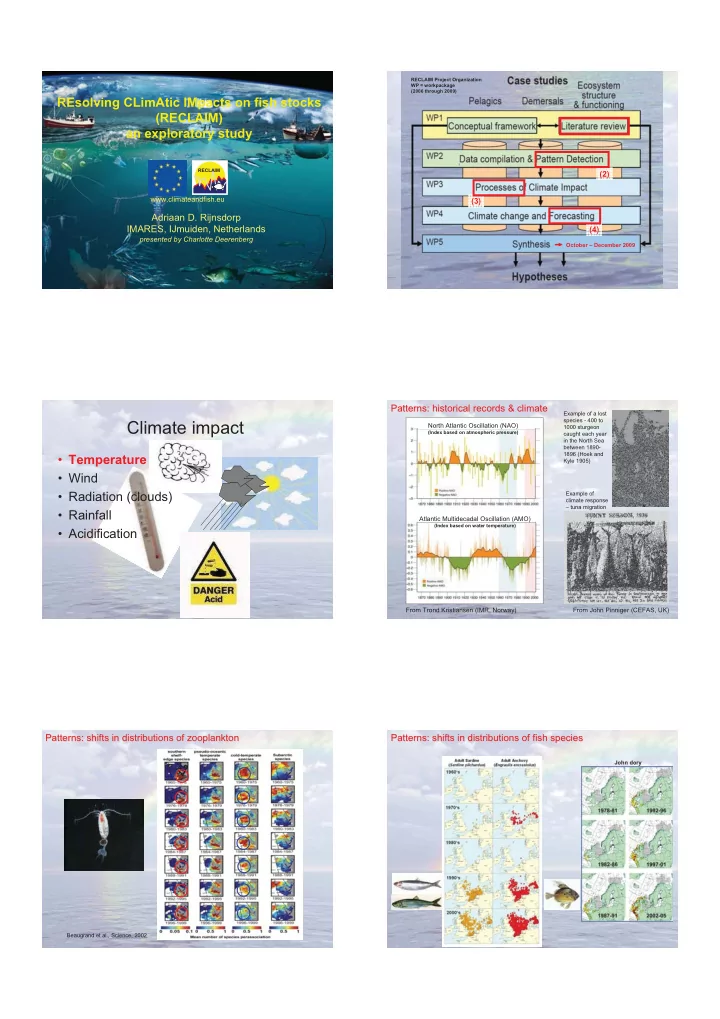
Climate impact North Atlantic Oscillation (NAO) 1000 sturgeon - - PDF document

climate impact
SMART_READER_LITE
LIVE PREVIEW

Climate impact North Atlantic Oscillation (NAO) 1000 sturgeon - - PDF document

RECLAIM Project Organization WP = workpackage (2006 through 2009) REsolving CLimAtic IMpacts on fish stocks (RECLAIM) an exploratory study RECLAIM (2) www.climateandfish.eu (3) Adriaan D. Rijnsdorp IMARES, IJmuiden, Netherlands (4)


slide-1
SLIDE 1

REsolving CLimAtic IMpacts on fish stocks (RECLAIM) an exploratory study

RECLAIM

Adriaan D. Rijnsdorp IMARES, IJmuiden, Netherlands

presented by Charlotte Deerenberg www.climateandfish.eu

(4) (2) (3)

October – December 2009

RECLAIM Project Organization WP = workpackage (2006 through 2009)

Climate impact

  • Temperature
  • Wind
  • Radiation (clouds)
  • Rainfall
  • Acidification

North Atlantic Oscillation (NAO)

(Index based on atmospheric pressure)

Atlantic Multidecadal Oscillation (AMO)

(Index based on water temperature)

Patterns: historical records & climate Patterns: historical records & climate

From Trond Kristiansen (IMR, Norway)

Example of a lost species - 400 to 1000 sturgeon caught each year in the North Sea between 1890- 1896 (Hoek and Kyle 1905) Example of climate response – tuna migration

From John Pinniger (CEFAS, UK)

Patterns: shifts in distributions of zooplankton Patterns: shifts in distributions of zooplankton

Beaugrand et al., Science, 2002

Patterns: shifts in distributions of fish species Patterns: shifts in distributions of fish species

John dory

slide-2
SLIDE 2

Climate effect depends on position in geographical range of species

MacKenzie & Koster (2004) Ecology

Patterns: recruitment Patterns: recruitment variation variation

sprat

1990 1995 2000 2005 2010 0.0 0.2 0.4 0.6 0.8 1.0 Year Cumulative Fraction

West of Scotland Orkney- Shetland Buchan Banks Downs Unknown Particle tracking models- origin of late larvae in the North Sea

Payne & Dickey-Collas, in prep.

MIK larvae Assumed come from North Sea spawning sites Models suggest differently

Patterns: recruitment area Patterns: recruitment area

grey line- environment dark line- herring habitat

Juveniles Juveniles: tend to remain at same temperature

Processes: temperature affects habitat Processes: temperature affects habitat

Late larvae: habitat changes with environment Juveniles: habitat changes but environment stay the same

Processes: salinity affects habitat Processes: salinity affects habitat

grey line- environment dark line- herring habitat

Late larvae: habitat changes but environment stays the same climate impact on growth & survival of fish early life stages

From Ute Daewel, Hamburg / Bergen

Processes: coupled 3 Processes: coupled 3-

  • d biophysical modelling

d biophysical modelling

Atlantic Cod

Model-based Survival Estimates January -April

1996 NAO -

  • 1992

average

50° N 52° N 54° N 56° N 58° N 60° N

potential survival %

  • drift of eggs and larvae
  • NAO

+ NAO

Time Fish Eggs Fish Larvae Larval Food match mismatch

Processes: pressures on fish stocks interact Processes: pressures on fish stocks interact

Baltic Sea Risk that cod will disappear

slide-3
SLIDE 3

From IPCC 2007, working group 1

Projections: temperature Projections: temperature

IPCC, 2007

.

changes from 1980-1999 to 2080-2099

  • Projections: temperature and precipitation

Projections: temperature and precipitation

North Sea: Results from 3-D ECOSMO model Largest changes for wind and increase in solar radiation Temperature Wind +20% Radiation -20%

Projections: Projections: „ „what if what if“ “ scenarios phytoplankton productivity scenarios phytoplankton productivity

Drinkwater 2005

1oC 2oC 3oC 4oC Projections: Projections: „ „what if what if“ “ scenarios fish stock productivity scenarios fish stock productivity

Anchovy in the Bay of Biscay Combined scenario: spawning occurs approximately 1 month earlier

Projections: Projections: „ „what if what if“ “ scenarios spawning time scenarios spawning time

Global climate models (GCM) show:

  • temperature increase
  • change in rainfall
  • uncertainty about wind (probably an increase)
  • decrease sea ice
  • but GCM unable to hindcast AMO and NAO

Conclusions: models Conclusions: models

GCMs should be improved to capture the decadal (NAO) and multidecadal (AMO) scale variations Regional downscaling needed

slide-4
SLIDE 4

Conclusions: interaction climate change and fisheries Conclusions: interaction climate change and fisheries

Fishing increases sensitivity to climate change

  • may result in regime shifts

Climate change may increase the sensitivity to other anthropogenic factors Distribution shifts (polewards, into deeper water)

  • but mechanism still obscure

Increase in biodiversity > likely increase in resilience

  • f ecosystems

Changes in productivity expected

  • Increase in stratification (temperature / salinity)
  • Probably positive for pelagics
  • Probably negative for demersals
  • But differences between areas

Conclusions: impact climate change on fish Conclusions: impact climate change on fish

Distributional shifts (across management areas)

  • fish more difficult to catch?
  • economic consequences
  • may influence allocation of fishing rights / TAC’s
  • may reduce effectiveness of Marine Protected Areas

Productivity changes

  • management reference points will change

New species management More uncertainty > precautionary approach Robust management > ecosystem approach

Conclusions: fisheries and management implications Conclusions: fisheries and management implications

Art: Glynn Gorick

What are your most important questions about impacts of climate change?

http://www.climateandfish.eu/ REsolving CLimAtic IMpacts on fish stocks

  • IMARES –IMARES, Institute for Marine Resources & Ecosystem Studies, The Netherlands ( www.imares.nl )

CEFAS– Centre for Environment, Fisheries & Aquaculture Science, UK ( www.cefas.co.uk) DTU-Aqua – National Institute of Aquatic Resources,Technical University of Denmark ( www.dfu.dtu.dk ) FRS – Fisheries Research Services, UK ( www.marlab.ac.uk ) IFREMER – Institut Français de Recherche pour l’Exploitation de la mer, France ( www.ifremer.fr ) IHF-UH – University of Hamburg, Germany ( www.biologie.uni-hamburg.de/ihf ) IMR – Institute of Marine Research, Norway ( www.imr.no ) NIOZ – Royal Netherlands Institute for Sea Research, The Netherlands ( www.nioz.nl ) UiB-GFI – University of Bergen, Geophysical Institute, Norway ( web.gfi.uib.no )

RECLAIM

RECLAIM Partners

  • Shifts to deeper waters: undersized plaice leave the

protected area “Plaice Box” (red lines) increased discards

Van Keeken et al. 2007 Journal of Sea Research

Patterns: management implicatins Patterns: management implicatins