Climate and Humans as Amplifiers of Hydro-Ecologic Change: Science - - PowerPoint PPT Presentation

climate and humans as amplifiers
SMART_READER_LITE
LIVE PREVIEW

Climate and Humans as Amplifiers of Hydro-Ecologic Change: Science - - PowerPoint PPT Presentation

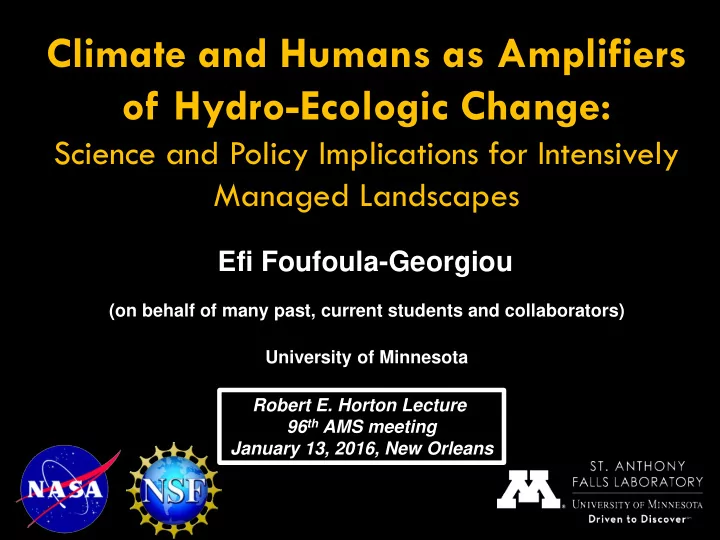
Climate and Humans as Amplifiers of Hydro-Ecologic Change: Science and Policy Implications for Intensively Managed Landscapes Efi Foufoula-Georgiou (on behalf of many past, current students and collaborators) University of Minnesota Robert E.


slide-1
SLIDE 1

Climate and Humans as Amplifiers

  • f Hydro-Ecologic Change:

Science and Policy Implications for Intensively Managed Landscapes

1

Efi Foufoula-Georgiou

(on behalf of many past, current students and collaborators) University of Minnesota Robert E. Horton Lecture 96th AMS meeting January 13, 2016, New Orleans

slide-2
SLIDE 2

2

A very generous citation – I am honored and humbled -- thank you!

… made me think broader than the title I gave for this talk …

Annual Meeting Theme: “Earth System Science in Service to Society “

slide-3
SLIDE 3

3

  • 1. Horton’s legacy …
  • 2. 30 years overview of my research in 2 mins
  • 3. Problems I am working on now …
  • 4. Challenges in Intensively Managed Landscapes
  • 5. A proposed framework to tackle complex problems
  • 6. AMS has a vital role to play
  • 7. Closing thoughts
slide-4
SLIDE 4

In the United States, proposals to establish a separate Hydrology Section of the AGU had been rejected by the leadership of the Union on the basis that … …“active scientific interest in the U.S. did not justify a separate section of scientific hydrology within the AGU” (NRC, 1991, 40). Finally, when the AGU was transformed from a committee of the National Research Council into an independent society in 1930, approval was given to establish a separate Section on Hydrology with R. E. Horton as vice-chairman

Robert E. Horton (1875-1945): “father” of Hydrology

slide-5
SLIDE 5

“… “Defining science as correlated knowledge, it is true that a statement of the field, scope, and status of hydrology at the present time may be little more than a birth-certificate…” … Hydrology may be regarded as charged with the duty of tracing and explaining the processes and phenomena of the hydrologic cycle, or the course of natural circulation of water in, on, and over the Earth’s surface. This definition has the advantage that it clearly outlines the field of hydrologic science.”

Robert E. Horton (1875-1945): “father” of Hydrology

From Horton, The field, scope and status of the science

  • f Hydrology, Trans. of AGU, 1931 (pages 190-192)
slide-6
SLIDE 6

6

Horton (1931, p.192)

Horton’s Illustration of the Hydrologic Cycle 1931

slide-7
SLIDE 7

7

National Resources Board (1934, p. 262) – strengthening federal government’s capacity to control nation’s water resources

  • - water as a distinct resource

Foundational visual illustration of Hydro-Cycle 1934

slide-8
SLIDE 8

8

“Blue Book” version of Hydrologic Cycle …

NRC, “Blue Book”, (1991) – Established HS as a distinct Geoscience & NSF HS Program

1991

Dam

slide-9
SLIDE 9

9

A water cycle for all tastes!

http://aquadoc.typepad.com/waterwired/2008/12/postmodern-hydrologic-cycle.html

slide-10
SLIDE 10

10

Horton’s most seminal contributions in hydro-geomorphology

Defined the quantitative basis of geomorphology

  • - Introduced Horton laws (scale invariance) in River networks
  • - Hydrophysical explanation of channel formation and evolution

… Cited 4329 times so far

slide-11
SLIDE 11

Horton’s eminence across disciplines …

AGU Horton Medal AGU Horton Research Grants AMS Horton Lecture GSA ? (A hint to GSA!)

slide-12
SLIDE 12

Looking back at my own career …

Arrow of Time

1985 2015 1995 2005

  • 1. Hydro-meteorology

decade

  • 2. Hydro-

geomorphology decade

  • 3. Earth-Water-Life

Integration decade

Involved in defining/performing interdisciplinary research …

slide-13
SLIDE 13

13

  • 1. What is the space-time structure of rainfall?
  • Min complexity (scaling) models across space-time scales?
  • Relation of “structure” to thermodynamic parameters?
  • How to use for downscaling/estimation/retrieval?
  • 2. Can geomorphic patterns reveal processes?
  • What is the climate signature on river network structures?
  • Can we constrain sediment transport laws from landscape form?
  • Do distributary patterns reveal their shaping processes?
  • 3. How to quantify Earth-Water-Life interactions?
  • Reduced complexity models for the cascade of changes?
  • Discovery of emergent process “hot spots”?
  • Climate vs. human amplifications?

Problems that captured me …

Arrow of Knowledge Arrow of Knowledge

Theory, Observations, Experiments

slide-14
SLIDE 14

14

Word Cloud: 30yrs-worth of my publications!

slide-15
SLIDE 15

National Center for Earth surface Dynamics NCED: 2002-2012+

15

To predict the coupled dynamics and co-evolution of landscapes and their ecosystems, in order to transform management and restoration of the Earth-surface environment.

slide-16
SLIDE 16

Year 0 Year 8

0.5px: initial development 2.0px: on-going defined project 4.0px: project produced synthesis paper 8.0px: well-established project with shared students or multiple papers

16

NCED: the Power of Integrative Research

slide-17
SLIDE 17

17

X1 = productivity of PI 1 X2 = productivity of PI 2 X = X1 + X2 X = productivity of center Mean(X) = Mean(X1) +Mean(X2); Var(X) = Var(X1) + Var(X2) + COV(X1,X2) Whole > sum of its parts Iff COV (+)  Whole > Sum (parts)?

Research Integration: watch your covariances!

slide-18
SLIDE 18

A few Highlights from my Current Research

slide-19
SLIDE 19

Precipitation estimation from space

Delta Sustainability River meandering Agricultural Landscapes

slide-20
SLIDE 20

Precipitation estimation from space

River meandering Agricultural Landscapes

Retrieval over land and complex terrain with emphasis on extremes Characterize delta topology and dynamics for classification, process inference, and vulnerability assessment Response to perturbations and meander train dynamics Human impacts on hydrology and river ecology

Delta Sustainability

slide-21
SLIDE 21

Precipitation Estimation from Space

GPM core satellite launched in 2014 following success of TRMM (beyond the tropics)

  • How to retrieve rainfall over radiometrically complex terrain?
  • How to estimate, fuse, and downscale simultaneously?

Ebtehaj et al., 2014, 2015a,b,c Foufoula-Georgiou et al., 2014

slide-22
SLIDE 22

Delta Sustainability

Deltas around the world are threatened by sea level rise and upstream human actions

  • Do network geometry and dynamics reveal processes? => delta classification
  • Can we build a network-based approach to vulnerability assessment?

Tejedor et al., WRR, 2015a,b

slide-23
SLIDE 23
  • 1. Graph theoretic Approach

Delta Sustainability

Deltaic Surface Graph Representation Algebraic Representation

                          1 1 1 1 1 1 1 1

Adjacency Matrix

  • 2. Metrics for topologic

and dynamic complexity

  • 3. Framework for

vulnerability maps

H M L

Tejedor et al., WRR, 2015a,b

slide-24
SLIDE 24

Experiment DB03, SAFL – see Sheets et al., 2007 Ganti et al., JGR-ES, 2011, 2013

  • St. Anthony Falls Laboratory

University of Minnesota

Controlled Laboratory experiments: Form Deltaic Surface Evolution & Stratigraphy

24

Delta Sustainability

slide-25
SLIDE 25

River Meandering

Does static planform geometry record meander dynamics? How sensitive are dynamics to local perturbations?

channel alignment evolution intrinsic geometric nonlinearity theta = centerline angle U = local migration rate cutoff-imposed nonlinearity

Schwenk, Lanzoni, EFG, The life of a meader bend, JGR-ES, 2014

slide-26
SLIDE 26

26

U = 20 mm/hr; P = 45 mm/hr Then, 5xP for 30 mins

Landscape response to climate change

  • What scales/processes are involved in landscape re-organization?
  • What new equilibrium states do landscapes reach after perturbations?

Singh et al., WRR, 2015

slide-27
SLIDE 27

Agricultural Landscapes: Economy, Water, Food, Environment

A global problem …

“If we fail on food, we fail on everything.”

  • Godfray, 2011 PNAS

How to ensure sustainability of agriculture in addition to all other environmental goods and services, which agriculture inevitably alters?

slide-28
SLIDE 28

28

The Story…

slide-29
SLIDE 29

29

Fluorescent glow (an indicator of amount of photosynthesis or gross productivity) in mid-western corn belt Peaks in July (40% greater than that

  • bserved in the Amazon)

Data from GOME-2, July 2007-2011 (COME=Global Ozone Monitoring Experiment)

PNAS, March 25, 2014

1

PNAS, 2014

slide-30
SLIDE 30

30

2

slide-31
SLIDE 31

31

3

slide-32
SLIDE 32

32

4

slide-33
SLIDE 33

33

1 2 3 4 1930 1940 1950 1960 1970 1980 1990 2000 2010 2020 Normalized Flow Mean Annual Flow Peak Daily Flow Spring Peak Daily Flow Summer & Fall 7 Day Low Flow Summer 7 Day Low Flow Winter High Flow Extreme Flow

Streamflow: Minnesota River Basin

1940 2010

(S. Kelly, after Novotny and Stefan 2007)

5

slide-34
SLIDE 34

34

6

slide-35
SLIDE 35

7

(S. Levine, B. Call, P. Belmont)

slide-36
SLIDE 36

36

8

MRB

(Photo: Star-Tribune)

slide-37
SLIDE 37

37

9

slide-38
SLIDE 38
  • - a water issue
  • - driven by economy
  • - driven by food demand
  • - driven by energy demand
  • - affecting the environment …

… NEED SOLUTIONS

38

slide-39
SLIDE 39

39

Challenging questions for integrated hydrologic sciences and sustainability/min)

  • 1. What is the interplay of climate and human-induced changes on hydrology

at multiple scales: from storm-event to annual/decadal trends?

  • 2. How do changes cascade from hydrology to sediment production and

transport, to stream geomorphologic change, to aquatic and riparian ecology?

  • 3. How to identify “hot spots” of vulnerability to inform mitigation

and/or management decisions?

slide-40
SLIDE 40

Δ Q Δ Sediment and Nutrients Δ Vegetation & Soils Δ Channel Width and/or Depth Δ Flood Propagation, Floodplain inundation Δ Climate and/or Land use Δ Nutrient Cycling Δ Aquatic Habitat

Complex cascade of changes

Terrestrial Environment Δ Rainfall-Runoff Processes Channel Network Δ Channel dynamics, Sediment transport & deposition Floodplain Economics Policy

slide-41
SLIDE 41

41

“Make everything as simple as possible but not simpler”

Albert Einstein

slide-42
SLIDE 42

42

“Sustainability through Vulnerability Science”

Proposed Framework

slide-43
SLIDE 43

43

  • 1. Space-time signatures of vulnerability
  • - critical space-time localization, leading indicators of abrupt system shifts,

vulnerability maps, coupled interactions

  • 2. Scale dependence of vulnerability
  • - heterogeneity is a fundamental governing variable
  • - natural processes, human management actions and policies are scale dependent
  • - at what scales to evaluate a system for sustainability?
  • 3. Process chains and vulnerability
  • - Nonlinear amplifications and thresholds govern evolution of human-natural system
  • 4. Hierarchical reduced-complexity modeling for emergent processes
  • - Only a subset of dynamics at one scale strongly affects those at other scales

FRAMEWORK: Sustainability through Vulnerability Science

min)

slide-44
SLIDE 44

Minnesota River Basin: our prototype

Minnesota River Basin (MRB) = 44,000 km2 basin draining to the Mississippi River Minnesota River Basin has 336 impairments for sediment, nutrients, aquatic life Minnesota plans to spend > $3.5 billion over next 20 years improving health of the state’s terrestrial and aquatic ecosystems. Where to concentrate efforts to be most effective?

slide-45
SLIDE 45

The cause of the problem is obvious, right?

slide-46
SLIDE 46

MRB: A system of excessive sedimentation…

MRB is primary source of sediment and nutrients for Lake Pepin (37% area, 90% sediment)

Lake Pepin Sediment Core

Belmont et al. 2011 ES&T

Recent shift in sediment sources: From top soil to bank erosion

Minnesota River Basin: 336 impairments for sediment, nutrients, aquatic life MRB

slide-47
SLIDE 47

Uplands: flat land, passive rivers Knick zone: steep, highly dynamic, incising rivers Minnesota River Valley: rapidly aggrading channel and floodplain

Landscape structure established 13.4 kyr ago

System structure implications for routing of water, sediment and nutrients Each region responds differently to external changes

47 Belmont et al. 2011 GSA

slide-48
SLIDE 48

Agriculture transitioned from hay and small grains to soybeans beginning in the southeast MRB

MRB: Land use/Land Cover Change

48

Foufoula-Georgiou et al., 2015, WRR

slide-49
SLIDE 49

Streamflow change during growing season

Redwood Whetstone

Redwood Whetstone

49

Foufoula-Georgiou et al., 2015, WRR

slide-50
SLIDE 50

MRB: Streamflow change

Redwood

50

Foufoula-Georgiou et al., 2015, WRR

P Q

slide-51
SLIDE 51

51

A strengthened dependence of a daily streamflow increase (dQ+/dt) in response to previous day precipitation This is especially so in mid-quantiles

Strengthened dependence of daily dQ+/dt on P

Copula analysis

Foufoula-Georgiou et al., 2015, WRR

slide-52
SLIDE 52

52

Reduction of inherent NL in daily Q dynamics!

(signature of a more “regulated” system due to tile drainage)

Phase space reconstruction Reduced NL after LUC Original Q Series Linearized versions

Foufoula-Georgiou et al., 2015, WRR

slide-53
SLIDE 53
  • S. Cho and P. Wilcock

Streamflow to Sediment Cascade?

  • Amplified Q increases sediment generation
  • Hydrology determines effectiveness of sediment reduction

management options

53

Can we shift more flows below the threshold? And thus reduce near-channel erosion in the incised zone

Water- Sediment FCs

Le Sueur

slide-54
SLIDE 54

Measured channel migration rate, m/yr 0.13 0.18 0.31 0.70 1.85

10 20 30 40 km

Measured channel migration rate, 1938-2005

Hotspots of geomorphic change?

Czuba and Foufoula-Georgiou, 2015, WRR

Above knickzone, a simple network- based model predicts persistence of sediment & identifies hotspots of channel migration suggesting bar push may be a driving mechanism.

Modeled Sediment persistence index

300 1000 1500 3000 6000 12000 Sediment persistence index, #×km×yr

0.4 0.8 1.2

Measured channel migration rate, m/yr

40 80 120 160

Distance from mouth of the Blue Earth River, km

4000 8000 12000

Sediment persistence index, # km yr

  • meas. mig.

s.p.i.

54

Knickzone Bank pull

slide-55
SLIDE 55

Hydro-geo-ecologic cascade of change?

55

Hansen et al., 2015, Freshwater Science

slide-56
SLIDE 56

56

Hansen et al., 2015, Freshwater Science

Mussel population density (mussels/m2), Mt

Hydro-geo-ecologic cascade of change?

slide-57
SLIDE 57

57

Hansen et al., 2015, Freshwater Science

Hydro-geo-ecologic cascade of change?

slide-58
SLIDE 58

Effective carrying capacity Extirpation

Sensitive to change

Transitional

58

Hansen et al., 2015, Freshwater Science

Hydro-geo-ecologic cascade of change?

Sediment- biota FCs

slide-59
SLIDE 59

Distributed Water Management Strategy

  • Design and strategically locate WRS (Water

Retention Sites) within a basin to achieve desirable goals

  • WRS: functional wetlands &

Temporary H2O Impoundment sites Hydraulic conductivity Extent Depth Location

59

Wetlands from Kloiber, MN DNR

Le Sueur

slide-60
SLIDE 60

60

Water Retention Structure (WRS) to sediment reduction?

WRS-Q reduction FCs

Karen Gran, Patrick Belmont

slide-61
SLIDE 61

Wetlands also decrease nitrogen concentrations in ditches during most critical season

L

61

  • Typically highest flows (large impact on loads)
  • Apr-June flux sets size of Gulf Hypoxic Zone

(Turner et al. 2012)

Wetland coverage is a 1st order control of TDN reduction in June w/ important thresholds of diminishing returns

  • 94 sites in 3 HUC-8 basins, sampled same week in June 2014
  • Drainage areas: 3 to 5800 km2
  • All sites with controlled % cropland (85% cropland +/- 2.5%)
  • J. Finlay, A. Hansen

Water- Nutrient FCs

A small wetland can go a long way…

June 2014

slide-62
SLIDE 62

62

  • 1. Space-time signatures of vulnerability
  • - critical space-time localization, leading indicators of abrupt system shifts,

vulnerability maps, coupled interactions

  • 2. Scale dependence of vulnerability
  • - heterogeneity is a fundamental governing variable
  • - natural processes, human management actions and policies are scale dependent
  • - at what scales to evaluate a system for sustainability?
  • 3. Process chains and vulnerability
  • - Nonlinear amplifications and thresholds govern evolution of human-natural system
  • 4. Hierarchical reduced-complexity modeling for emergent processes
  • - Only a subset of dynamics at one scale strongly affects those at other scales

FRAMEWORK: Sustainability through Vulnerability Science

min)

slide-63
SLIDE 63

63

We are at an important junction …

slide-64
SLIDE 64

“Humans have simultaneously increased the sediment transport by global rivers through soil erosion (by 2.3 billion Mg/yr), yet reduced the flux of sediment reaching the world’s coasts (by 1.4 billion Mg/yr) because of retention within reservoirs.” ~Syvitski et al., 2007

Humans have made profound changes to water, sediment and nutrient regimes

… We chocked rivers and starved deltas ….

Unintended Consequences realized yrs later

Google n-gram: Measures relative

  • ccurrence of

words in books

  • ver the past 200

years Courtesy of

  • S. Gibson and
  • P. Boyd,

USACE

slide-65
SLIDE 65

65

We treated the Hydrologic Cycle alone …

slide-66
SLIDE 66

66

And climate change comes on top of everything else …

slide-67
SLIDE 67

67

The “Earth-Water-Life Cycle”

Vorosmarty et al., EOS, 2014

slide-68
SLIDE 68

68

The Needs/The Vision

1. We need to understand the Earth-Water-Life cycle better (including the effects of human “replumbing”): quantitatively, process-based, from weather to climate scales and from the basin to continental scale 1. We need integrated wide-ranged observations (hydro-meteorological, geophysical, geochemical, geochronological, HR topography, biological, …) to discover critical interactions and constrain models 1. We need to pursue model development (from reduced complexity to fully coupled) with an eye towards making testable predictions 1. We need to engage decision makers, policy makers and the public 2. We need to educate the next generation of T scientists

slide-69
SLIDE 69

69

Sustained Interdisciplinary Collaboration

A Water Sustainability and Climate Project

slide-70
SLIDE 70

“The Sip of Science series features discussions that bridge the gap between science and culture in a setting that bridges the gap between brain and belly. “ The series takes place the second Wednesday of every month.

Engaging the public: “SIP of Science”

Engaging the public to science-based solutions on pressing problems

SMM: Future Earth Exhibit

70

slide-71
SLIDE 71

2009: Complexity and predictability in earth systems 2010: Rivers and Vegetation 2011: Coastal processes and dynamics of deltaic systems 2012: Future Earth: Prediction under environmental change 2013: From sub-surface to surface 2014: Complexity and predictability in earth’s surface 2015: Earth-casting under human and climate pressures 2016: Intensively Managed Landscapes

Summer Institute on Earth-surface Dynamics

Mentoring the Next Generation of Earth-surface Scientists

71

slide-72
SLIDE 72

72

The AMS community has a vital role to play…

slide-73
SLIDE 73

73

A career’s worth of people to thank!

Past PhD students

  • - Praveen Kumar (1993)
  • - Sanja Perica (1995)
  • - Alin Carsteanu (1997)
  • - Venu Venugopal (1998)
  • - Deborah Nykanen (2000)
  • - Boyko Dodov (2003)
  • - Sukanta Basu (2004)
  • - Chandana Gangodagamage (2009)
  • - Paola Passalacqua (2009)
  • - Arvind Singh (2011)
  • - Vamsi Ganti (2012)
  • - Ardeshir Mo Ebtehaj (2013)

Past post-doctoral fellows

  • - Victor Sapozhnikov
  • - Daniel Harris
  • - Bruno Lashermes

Collaborators (a few of many)

  • - Kevin Droegemeier
  • - Chris Paola
  • - Vaughan Voller
  • - Bill Dietrich
  • - Patrick Belmont
  • - Peter Wilcock
  • - Ilya Zaliapin
  • - Stefano Lanzoni
  • - Michele Guala
  • - Chris Keylock
  • - Tryphon Georgiou
  • - …
slide-74
SLIDE 74

Special thanks to my research group … and my kids

Jon Schwenk Jon Czuba

  • M. Danesh
  • Z. Takbiri
  • A. Hansen
  • A. Longjas
  • A. Tejedor

Mahesh Zi Wu Mulu Katerina Thomas

slide-75
SLIDE 75

Thank you!

slide-76
SLIDE 76

76 1:30 PM-2:30 PM: Wednesday, 13 January 2016 Lecture 3 Horton Lecture Location: Room 240/241 ( New Orleans Ernest N. Morial Convention Center) Hosts: (Joint between the 32nd Conference on Environmental Information Processing Technologies; the 23rd Conference on Probability and Statistics in the Atmospheric Sciences; the Fourth Symposium on the Weather, Water, and Climate Enterprise; the Fifth Aviation, Range, and Aerospace Meteorology Special Symposium; the Seventh Conference on Environment and Health; the 22nd Conference on Applied Climatology; the 13th Conference on Space Weather; the 19th Joint Conference on the Applications of Air Pollution Meteorology with the A&WMA; the 30th Conference on Hydrology; the Special Sessions on US-International Partnerships; the 25th Symposium on Education; the 14th Symposium on the Coastal Environment; the 12th Annual Symposium on New Generation Operational Environmental Satellite Systems; the Fourth Symposium on Building a Weather-Ready Nation: Enhancing Our Nation’s Readiness, Responsiveness, and Resilience to High Impact Weather Events; the Fourth AMS Symposium on the Joint Center for Satellite Data Assimilation (JCSDA); the Peter Lamb Symposium; the 20th Conference on Integrated Observing and Assimilation Systems for the Atmosphere, Oceans, and Land Surface (IOAS-AOLS); the 18th Symposium on Meteorological Observation and Instrumentation; the 14th Conference on Artificial and Computational Intelligence and its Applications to the Environmental Sciences; the 11th Symposium on Societal Applications: Policy, Research and Practice; the Seventh Conference on Weather, Climate, Water and the New Energy Economy; the Sixth Conference on Transition of Research to Operations; the Fourth Symposium on Prediction of the Madden-Julian Oscillation: Processes, Prediction and Impact; the 28th Conference on Climate Variability and Change; the Events; the 18th Conference on Atmospheric Chemistry; the 14th History Symposium; the Eighth Symposium on Aerosol–Cloud–Climate Interactions; and the Special Symposium on Seamless Weather and Climate Prediction— Expectations and Limits of Multi-scale Predictability ) 1:30 PM L3.1 Climate and Humans as Amplifiers of Hydro-ecologic Change: Science and Policy Implications for Intensively Managed Landscapes (Invited Presentation) Efi Foufoula-Georgiou Sr., Univ. of Minnesota/National Center for Earth Surface Dynamics, Minneapolis, MN