Classifying Objects as New or Learned with Convolutional By Kevin - - PowerPoint PPT Presentation

classifying objects as new or learned with convolutional
SMART_READER_LITE
LIVE PREVIEW

Classifying Objects as New or Learned with Convolutional By Kevin - - PowerPoint PPT Presentation

Classifying Objects as New or Learned with Convolutional By Kevin Xiong and Evan Phibbs Mentored by Yufei Wang Networks and SGD Introduction The turtlebot runs on Robotic Operating System (ROS). ROS allows us to interface with the


slide-1
SLIDE 1

Classifying Objects as New or Learned with Convolutional Networks and SGD

By Kevin Xiong and Evan Phibbs Mentored by Yufei Wang
slide-2
SLIDE 2

Introduction

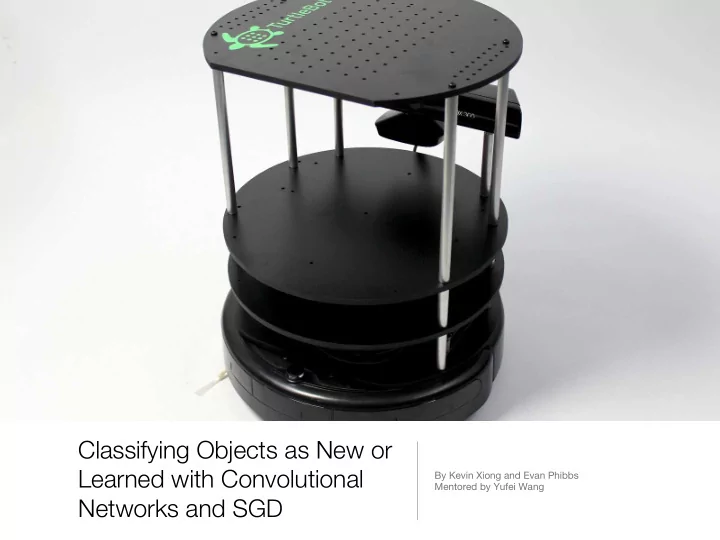
  • The turtlebot runs on Robotic Operating System

(ROS).

  • ROS allows us to interface with the turtlebot’s motors

and Xbox kinect’s camera and depth data.

slide-3
SLIDE 3

Goal

  • Our goal was for the turtlebot to be placed anywhere

in the room, move around the room to find objects around it, recognize each object as known or new and learn the object if it was new, as an attempt in open- ended learning.

slide-4
SLIDE 4

Libraries

  • We wrote our program entirely in python using two

libraries:

  • Caffe: A convolutional neural network library
  • Sklearn: a general-purpose machine learning library,

which includes a linear svm

slide-5
SLIDE 5

Methods

  • The robot captures depth data and rgb data from the

turtlebot’s kinect.

  • a binary mask is created from the depth data such

that each 1 corresponds to an object pixel and each 0 to a background pixel in order to reduce the effect of the background on classification

  • rgb data is multiplied by the mask and set as input into

the CNN

slide-6
SLIDE 6

Methods (continued)

  • The convolutional network’s last hidden layer

activations are used as input into an svm classifier

  • The distances to the separating hyperplanes of each

input into the svm are used as inputs into another svm classifier to determine whether an object is new or known.

slide-7
SLIDE 7

Methods (continued)

rgb

depth mask

rgb mask

linear svm classifier

class

decision_function method (distance to each hyperplane)

new

  • r old

linear svm classifier

e i g h t h l a y e r a c t i v a t i

  • n

s ( 4 9 6 d v e c t

  • r

)

Caffe convolutional network

slide-8
SLIDE 8

Hurdles

  • We encountered many limitations while using the

turtlebot

  • The turtlebot’s movements are not accurate
  • The turtlebot can only rotate, move forward, or

move backward.

  • Kinect has very noisy depth data and is not aligned

with camera rgb data

slide-9
SLIDE 9

Results

  • We tested on 4 types of tea, 2 types of cubes, a

bottle, magic eight ball, and a stuffed animal cat.

slide-10
SLIDE 10

Video Demonstration

slide-11
SLIDE 11

Improvements

  • Our program could be improved with the following:
  • a more robust way of circling the objects
  • an algorithm for moving about a room to ensure no
  • bjects are left undiscovered
  • Combining depth data and object partitioning

algorithms in order to create a finer, more accurate mask

slide-12
SLIDE 12

Improvements (continued)

  • relying solely on object partitioning in order to

recognize known objects and remove them from the scene, leaving only new objects to be focused on and trained

  • using an object mask such that background pixels

are set to random color noise