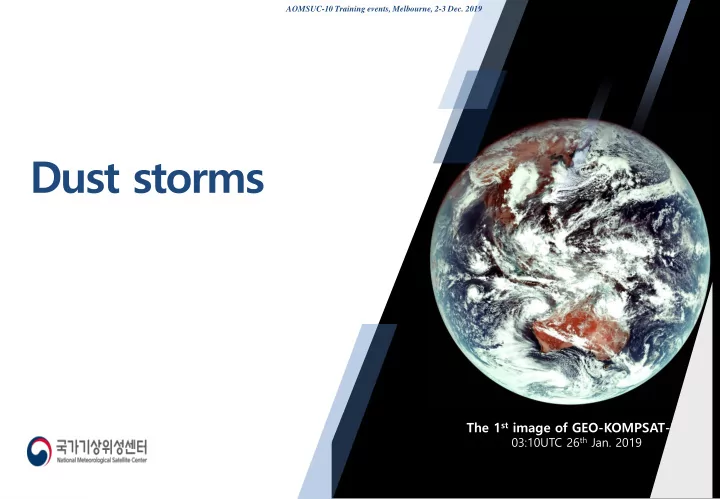
The 1 st image of GEO-KOMPSAT-2A 03:10UTC 26 th Jan. 2019 C) COMS - - PowerPoint PPT Presentation

the 1 st image of geo kompsat 2a
SMART_READER_LITE
LIVE PREVIEW

The 1 st image of GEO-KOMPSAT-2A 03:10UTC 26 th Jan. 2019 C) COMS - - PowerPoint PPT Presentation

AOMSUC-10 Training events, Melbourne, 2-3 Dec. 2019 The 1 st image of GEO-KOMPSAT-2A 03:10UTC 26 th Jan. 2019 C) COMS Aerosol Optical Depth(AOD) A) COMS Aerosol index(AI) B) Himawari-8 Aerosol Detection(D*) D) Dust RGB(GK2A) E) T rue Color


slide-1
SLIDE 1

The 1st image of GEO-KOMPSAT-2A

03:10UTC 26th Jan. 2019

AOMSUC-10 Training events, Melbourne, 2-3 Dec. 2019
slide-2
SLIDE 2

A) COMS Aerosol index(AI) C) COMS Aerosol Optical Depth(AOD) B) Himawari-8 Aerosol Detection(D*) D) Dust RGB(GK2A) C) T rue Color RGB(GOCI/COMS) E) T rue Color RGB(GK2A) 21

slide-3
SLIDE 3

22 500hPa pressure field(18UTC, 26th Oct. 2019) Upper trough GK2A DUST RGB with wind at 1000hPa(07UTC, 27th Oct. 2019) Strong wind > 25kts

Gobi desert Inner Mongolia Mongolia Gobi desert Inner Mongolia Loess plateau Taklamakan desert

Aerosol density(PM10) Dust observation network between CMA and KMA PM10 : 500~800ug/m3

slide-4
SLIDE 4

15:00UTC 27th Oct. 2019

  • (15:00UTC) After the outbreak of dust storm at the Gobi deserts, PM10 densities
  • ver the north China increased rapidly by 800ug/m3 and moving ESE direction

with 110km/hr.

  • (21:00UTC) PM10 density over the inner Mongolia are also steadily increasing and

moving speed slowed down as 50km/hr, moving direction changed to SE from ESE

  • 21:00 UTC 27th Oct. 2019

09UTC 12UTC 15UTC 15UTC 18UTC 21UTC

23

slide-5
SLIDE 5

A) DUST RGB (KMA recipe) B) Dust RGB (JMA recipe) D) Dust Detection(D*) C) COMS Aerosol Index

Socrative Question 4. Which product do you prefer for monitoring dust areas ?

24

Socrative Question 5 : What’ s the advantage of dust RGB compared to dust products ? (choose all )

slide-6
SLIDE 6

Socrative Question 5 : What’s the advantage of dust RGB compared to dust products ? (choose all ) A) They distinguish dust areas very clearly from the clouds area B) They provide quantitative density information better than dust products C) They track the dust area and movement continuously even over the ocean D) The colors of surface shows diurnal variation E) They provide the information of different clouds F) They detect weak dust area better than dust products(AI, D*)

slide-7
SLIDE 7
  • 2019. 10. 28. 17:40UTC

Seoul

Baengyeongdo Seoul Gunsan

Gusan Baengyeongdo

Particle size : 2~4 µm Dust height < 4km

slide-8
SLIDE 8

27

Socrative Question 6 : Looking at the animation, Where is most likely to be affected by dust

  • n the ground at 06:00UTC 15 April 2018(right image) ?
  • A. Gwangwon-do B. Capital area C. Chungcheong-do D. Gyeongsang-do

A B C D

slide-9
SLIDE 9
  • Dust RGB and products by satellite detect the floating dusts around 3~4km well
  • Surface instrument observe the dusts or aerosols density near the surface.

28

  • A. Gwangwon-do B. Capital area C. Chungcheong-do D. Gyeongsang-do

Time series of 1hr average PM10 density over the Korean Peninsula(15th April 2018)

270µg/m3 200µg/m3 120µg/m3 150µg/m3

A B D C PM10 density on the ground A B C D

slide-10
SLIDE 10

29

What make different distribution of dust areas between satellite and surface observation  Mainly depend on the vertical motion and density of floating dusts  Satellite detect floating dusts at the rising motion area, while surface instrument

  • bserves dusts concentrated on the ground

 Therefore, forecasters should consider vertical motion by referring to the satellite detection when forecasting dust affected areas on the grounds.

sinking sinking sinking

PV analysis at isentropic field(290K)

760 800 700 840

A B D C PM10 density Sinking area

slide-11
SLIDE 11

30

 Discussed useful GK2A spectral band and products for monitoring, detection, analysis of convection clouds

  • Introduced various RGB and spectral images to monitor convective clouds
  • How to analyse the microphysical properties of convective clouds using RGB

and products of GK2A

 Examined the Dust RGBs to forecast dust affected areas

  • Detection of dust areas using dust RGBs and products from GK2A
  • Comparing different observation data : satellite & surface instrument
  • Introduce how to forecast dust affected areas on the ground
slide-12
SLIDE 12

31 / 85

국가기상위성센터