Class Feedback Letter Interim Assessment for Achievement Standard - - PDF document

class feedback letter interim assessment for achievement
SMART_READER_LITE
LIVE PREVIEW

Class Feedback Letter Interim Assessment for Achievement Standard - - PDF document

Class Feedback Letter Interim Assessment for Achievement Standard 91480 and 91476 91480 (3.9) Respond critically to significant aspect(s) of visual and/or oral text(s) through close reading, supported by evidence 91476 (3.5) Create and deliver a


slide-1
SLIDE 1

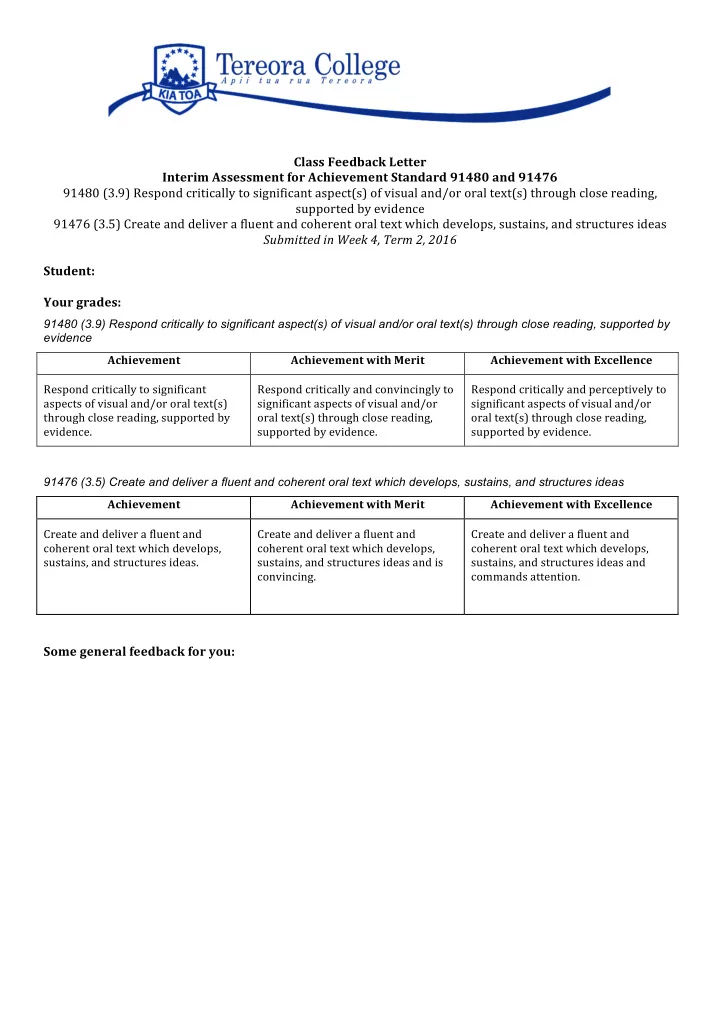
Class Feedback Letter Interim Assessment for Achievement Standard 91480 and 91476 91480 (3.9) Respond critically to significant aspect(s) of visual and/or oral text(s) through close reading, supported by evidence 91476 (3.5) Create and deliver a fluent and coherent oral text which develops, sustains, and structures ideas Submitted in Week 4, Term 2, 2016 Student: Your grades:

91480 (3.9) Respond critically to significant aspect(s) of visual and/or oral text(s) through close reading, supported by evidence Achievement Achievement with Merit Achievement with Excellence Respond critically to significant aspects of visual and/or oral text(s) through close reading, supported by evidence. Respond critically and convincingly to significant aspects of visual and/or

  • ral text(s) through close reading,

supported by evidence. Respond critically and perceptively to significant aspects of visual and/or

  • ral text(s) through close reading,

supported by evidence. 91476 (3.5) Create and deliver a fluent and coherent oral text which develops, sustains, and structures ideas Achievement Achievement with Merit Achievement with Excellence Create and deliver a fluent and coherent oral text which develops, sustains, and structures ideas. Create and deliver a fluent and coherent oral text which develops, sustains, and structures ideas and is convincing. Create and deliver a fluent and coherent oral text which develops, sustains, and structures ideas and commands attention.

Some general feedback for you:

slide-2
SLIDE 2

Dear 3ELIT, Excellent work! You guys picked up the challenge that I laid down and really made it work for you. To most of us this was a new way of doing assessment, and I’m really pleased with how it went. Below I’ll go through: the expectations of the assessment; your strengths with the close viewing part of the assessment; your weaknesses with the close viewing part of the assessment; your strengths with the oral text part of the assessment; and finally your weaknesses with the oral text part of the assessment. Expectations You conducted a close critical response to an unstudied scene from The Tempest, choosing aspects and critically responding to their use, meaning/s, and effect/s in the scene, providing specific evidence. You then presented your ideas in the form of an oral presentation, which might have been live or in a recorded format. This task allowed you to present evidence towards two different standards, the achievement criteria for which are above. In order to do well here your close viewing needed to be detailed and focused clearly on the aspects you were discussing – if you were talking about lighting, for example, then the more you focused in on and kept coming back to the lighting with various different examples, the more convincing and perceptive you tended to become. I was expecting to hear about the aspects’ effect/s on or meaning/s for the audience, and what Julie Taymor was trying to get us to realise/understand/etc by using them in that way (not necessarily using exactly those words). To achieve with Merit or Excellence you also needed to show how two or more aspects worked together to create a combined meaning or effect. In order to do well in the oral text side of things, your presentation needed to be coherent, which means that you had put time and effort into making sure it was clear, easy to understand, and engaged interest. It also needed to be fluent, which meant that you knew what you were saying, and could speak clearly and confidently, using oral and body language features to hold attention and help the audience understand your ideas as you developed and structured them. I loved watching and listening to your presentations. I was, in the first place, really impressed with the quality

  • f the critical response you developed. I was then delighted by the effort that you put into presenting this

analysis orally, whether it was a video or a live presentation. You all generally worked hard on your presentations and it really showed. It took me a handful of hours altogether to work through them, but it was a very enjoyable handful of hours. Close Viewing: Strengths The standard defines ‘close reading’ as a ‘detailed exploration and consideration’ of the aspects you’ve chosen to analyse. ‘Exploration’ really suggests the idea of digging around in all the details of the aspects. Those of you who achieved all did this to some extent. Those students who stuck close to the aspects and the scene tended to develop more convincing or perceptive analyses. To achieve, the standard says your critical response needed to be making ‘evaluative interpretations and judgements’ of the aspects you’ve chosen. There were many different examples of such interpretations and judgements of of meaning (basically, what it makes the audience think about/realise/understand) and effects (basically, how it makes the audience feel/react). Here are some paraphrased examples:

  • The setting of the scene in which Antonio and Sebastian try to murder Alonso and Gonzalo looks like

the bars of a prison and shows how they are all trapped.

  • High and low angles of the characters in this scene also demonstrate who has power and who is

powerless.

  • The tightening of Prospera’s corset in the confrontation scene underscores how she has become again

who she once was.

  • Close ups in the confrontation scene help us connect with and understand Prospera more deeply.
  • The confrontation scene is brightly lit which represents Prospera’s forgiving change of heart.

Most of these could have been developed into Merit-level critical responses by digging more deeply and discerningly into the meanings and effects created (audience reaction, director’s purpose, etc).

slide-3
SLIDE 3

To analyse ‘convincingly’, and thus achieve a Merit, your ideas needed to be ‘discerning and informed’, or a little more detailed and thoughtful. Here are some Merit-standard ideas:

  • Close ups help the audience understand the emotions of the characters, which is particularly useful

when the student can’t understand the meaning of the dialogue. (This analysis was developed in detail, looking at a sequence of Caliban's facial expressions and how they developed meaning about his character and his reactions.)

  • Caliban is the strongest character because he’ll fight back, be rebellious, be so stubborn, he just wants

his island back.

  • Caliban is an ambiguous figure who is represented in different ways throughout the film: as a monster,

as a victim, as a manipulator, as a hero. Caliban is shown to have both good and evil, human and monster, inside him. (Some students developed this idea to Excellence level by digging into it more deeply and making insightful observations.)

  • Caliban’s dialogue and costume show that he is the victim, which makes us reflect on how we all have

the capacity for evil within us.

  • Contrast of lighting and dialogue in the bramblewood scene: soft lighting doesn’t match with Caliban’s

harsh words.

  • Dialogue shows the smarter and more civilised side of Caliban.
  • Nature versus nurture: dialogue and character actions show that it’s not necessarily Caliban’s fault that

he doesn’t have the capacity to show mercy to others. Could this be the way he is? Was he born to be this evil? Or is this the way he was raised? Is this the result of him being abused as he was growing up? Is this the result of a circle of mercilessness?

  • Taymor uses the bramblewood scene to show the comparisons between characters, such as the parallel

between Caliban, Stephano and Trinculo conspiring against Prospera and Antonio and Sebastian conspiring against Alonso and Gonzalo. The difference is though that Caliban is trying to take back his kingdom, whereas Antonio and Sebastian stole kingdoms from others. This highlights that Caliban is

  • nly doing this out of revenge and justice, and isn’t actually as evil as the more ‘civilized’ characters.
  • Caliban gets Stephano and Trinculo to do his dirty work, which shows he is a genius in disguise. Caliban

has colonised the mind of Stephano! Caliban has now become a coloniser himself, and so is mirroring Prospera.

  • Caliban links to today’s society: all we want to do is bring peope down and stand on them, and the only

thing they have left is to dream of what they wish they had.

  • Camerawork in the last scene builds intensity and highlights how Prospera has changed and given up

her power, perhaps now being less powerful than Caliban.

  • Costume changes show us changes in characters, e.g. Prospera, or lack of change, e.g. Caliban.
  • Men become monsters by making the wrong choices and doing the wrong things. Prospera giving up

her magic in the final scene represents her giving up her inner monster, becoming more forgiving.

  • The circle of flame in the confrontation scene is a symbol of Prospera’s rebirth: the circle is a symbol of

the cycle of destruction and rebirth/creation, and the flame reminds us of the phoenix rising from the ashes. Again, most of these could have been (and were by some students) developed into Excellence level critical responses by digging more perceptively or with more sophistication into the meanings and effects created (audience reaction, author’s purpose, etc). To achieve with Excellence, your needed to respond critically and ‘perceptively’ to your aspects, which the standard says means that you make ‘sophisticated, insightful, and/or original interpretations and judgements’

  • f the aspects. This is the kind of analysis that makes people go, ‘Oh whoa! Yeah I’d never thought of it like

that!’, or is otherwise really seeing into the heart of what’s going on. Some examples of Excellence analysis are:

  • Caliban’s character actions and dialogue in the bramblewood scene depict the idea of the colonisation of

the mind.

  • The contrast between costumes and dialogue in the bramblewood scene highlight the idea of status and

the hierarchy of races: the costumes make us think Stephano and Trinculo are more developed and superior to Caliban, but the style of speech (e.g. poetry versus prose) suggests Caliban is more developed and superior to Stephano and Trinculo.

  • Ideas about love and loss in the bramblewood scene, in particular in relation to Caliban’s love for and

loss of his island.

slide-4
SLIDE 4
  • Whereas at first we thought of Caliban as monstrous, Prospera’s behaviour and attitudes in contrast to

Caliban’s love for his island mean we come to ‘see Prospera as the monster … We are convinced that Prospera’s cruelty outweighs Caliban’s monstrosity.’

  • Humans can’t help being cruel and enslaving others, because this is how we’ve lived for years and we

can’t change now. Importantly, as part of all these critical responses you offered your evaluations and judgements: what you liked, what you found effective, what you thought could have been improved, etc. Close Viewing: Weaknesses The major weakness I came across was simply people not developing their critical response as deeply as they

  • could. What is the audience being made to think and feel? Why is Taymor trying to make us think and feel that

way? What is she trying to get us to realise or understand or believe about a character, about a setting, about an idea, about what’s going on in the plot? How are we being manipulated? For example:

  • Students commented that particular aspects contributed to the mood or atmosphere of the scene, or

that they gave us a feel for a character – but didn’t specify what this mood, atmosphere, or feel was. Frightening? Suspicious? Heroic? Thoughtful? Threatening? Confusing? Etc.

  • Not commenting on why Taymor might be doing what she’s doing. For example, in a discussion of music

a student commented that it created a feeling of suspense and intensity, and that a character had changed during the scene because the music had changed. This could be developed further by commenting on why Taymor would want to create a feeling of suspense and intensity at this point in the film, and why he would be signaling to us that the character had changed.

  • Introducing a theme, such as the idea that storytelling gives you power, but then not tying the use of a

technique, for example lighting, to that theme. How does the lighting help us understand that storytelling gives you power? Oral Text: Strengths There are sort of two criteria for this standard. The first is roughly to do with what you’re saying: ‘the development of ideas and the making of links between them’, says the standard. The second is roughly to do with how you say it: ‘the selection and use of structures and oral language features … to create consistency in meaning and effect, and to sustain interest’. You needed to do all of these to be fluent and coherent, and be developing (going into depth), structuring (organising your ideas well), and sustaining (keeping up the links and the quality all the way through) ideas. You needed to meet both criteria at the same level to get that mark for the standard. If you had a ‘discriminating’ selection of ideas, but your oral language features were not yet at that level, you wouldn’t have met the overall criteria for Merit (‘demonstrating a discerning understanding of purpose and audience’). What you’re saying How well you did here was in large part about how well you developed your critical response to the aspects. If you came up with good analysis, then your ideas were developed and sustained. How you’re saying it As an academic presentation to your peers, there were a number of basic, expected oral language features: eye contact, knowing your material well so you could speak confidently and fluently, clear speaking tone, the use of analytical language, use of gesture and body language, varying your tone (pitch, volume, pace, pauses) to emphasise points, etc. This was generally done well. Most of you structured your ideas well. Generally people had a short introduction, discussed their aspects one at a time, making links where needed, and then finished with a short conclusion. Some students captured attention early on with statements or questions that intrigued the audience, such as ‘Is Caliban truly a monster? Or has he become a monster because he has been colonised?’ and ‘The Tempest is a deceiving film’. You generally structured your ideas by moving from simpler points towards more complex ones, which made logical sense and made it easier to follow and understand your ideas. Some students organised their ideas more

slide-5
SLIDE 5

chronologically, discussing the aspects as they came up in the scene from beginning to end. This was sometimes a little more confusing than discussing one aspect at a time, but generally worked and allowed a more ‘organic’ analysis of how the scene unfolds. Students used the visual aids of PowerPoints and videos effectively. Simple PowerPoints without too much information on each slide were useful and interesting. Videos which incorporated the action (for example allowing characters to speak their ‘quote’ rather than quoting the dialogue yourself over the top of a silenced video) was very engaging. Students used some oral language features beyond the basics to start being convincing and/or to command attention, such as:

  • Engaging the audience by using questions and getting them involved in the presentation.
  • Expanding on what was written on the PowerPoint slides.
  • The use of a clear professional tone.
  • The use of a more conversational tone.
  • The use of humour.
  • The use of striking language.

Oral Text: Weaknesses I’ve already commented on the weaknesses in people’s critical response, which flows through to the weaknesses in how they developed, sustained, and structured ideas for this standard. In terms of oral language features, some common weaknesses were:

  • Students not knowing their material well enough, so that they weren’t always in control of their

presentation.

  • If you had to read large chunks to us from your notes or from the PowerPoint slides, then you’re

not really creating audience interest or engagement.

  • If you were obviously making up what you were saying on the spot, or searching for words, then

you needed to be more prepared. This doesn’t mean reading or memorizing something word- for-word – you just needed to know what it was you wanted to say.

  • Humour and informal, conversational tones sometimes worked, and sometimes didn’t. If they didn’t, it

was generally because the student wasn’t well prepared enough. If the student was clearly prepared and in control of their material, a conversational approach was very successful. Conversational doesn’t mean uncrafted.

  • Some structures were not very clear, seeming to bounce between different ideas and then back again,

making it a bit confusing for the audience.

  • We didn’t have any monotonous presentations, where the speaker is talking like a robot, which was

great! But sometimes students fell into patterns (such as always going up at the end of their sentences so it sounded like everything was a question) that could make it harder to keep up audience interest.

  • Students who made recordings sometimes slipped into quite slow paces or quiet tones, which could

have been sped up a little to command more attention.

  • Some students had very short or sudden conclusions that could have left the audience with a more

satisfying feeling at the end.

  • The use of visual aids was less effective when there was too much information on the PowerPoint

slides, or if, in a video, the scene was ‘left playing’ while your commentary moved on to other ideas or

  • points. I would keep watching the video and lose track of what you were saying, or would be wondering

if what you were saying was connected to where the scene had reached at that given time. Conclusion Well done guys! I’m really, really pleased with how this went. Lots of learning here for us all, and many impressive skills on display! Mr Moffat-Wood.